Strategies for Reducing Non-Specific Binding in Optical Biosensors: From Antifouling Coatings to Advanced Detection
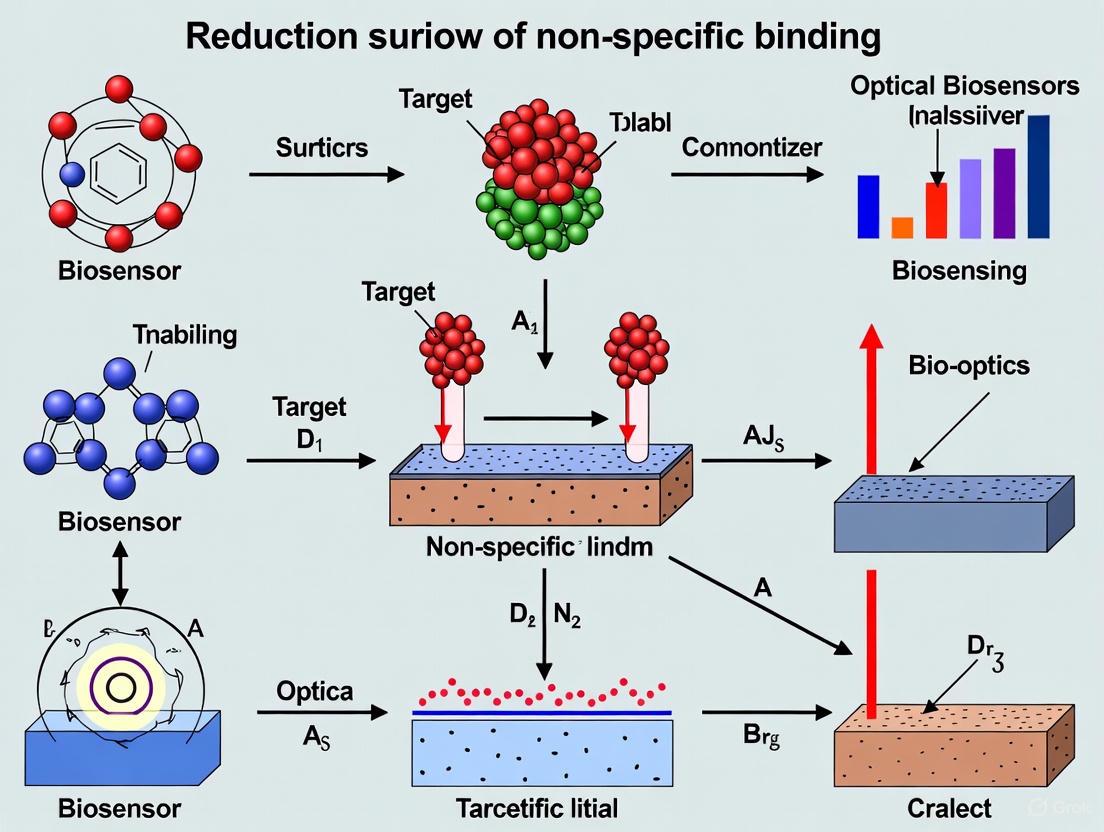
Non-specific binding (NSB) remains a critical barrier to the widespread adoption and reliability of optical biosensors in clinical diagnostics and drug development.
Strategies for Reducing Non-Specific Binding in Optical Biosensors: From Antifouling Coatings to Advanced Detection
Abstract
Non-specific binding (NSB) remains a critical barrier to the widespread adoption and reliability of optical biosensors in clinical diagnostics and drug development. This article provides a comprehensive overview of strategies to mitigate NSB, addressing the needs of researchers and scientists working on sensor development. It covers the foundational mechanisms of NSB and its impact on analytical signals, explores a wide range of methodological solutions from surface chemistry to novel materials, discusses troubleshooting and optimization protocols for real-world complex samples, and validates these approaches through comparative analysis of detection principles and performance metrics. The synthesis of these intents provides a actionable framework for developing robust, high-fidelity optical biosensors capable of operating in demanding biological environments.
Understanding Non-Specific Binding: The Fundamental Challenge in Optical Biosensing
Defining Non-Specific Adsorption (NSA) and Its Impact on Sensor Performance
A guide to understanding and troubleshooting a key challenge in optical biosensing.
Non-specific adsorption (NSA), often referred to as non-specific binding or biofouling, is the adhesion of unwanted atoms, ions, or molecules (such as proteins) to a biosensor's surface through physisorption. This occurs via intermolecular forces like hydrophobic interactions, ionic bonds, van der Waals forces, and hydrogen bonding, rather than through specific, targeted recognition. [1]
For optical biosensors, this phenomenon is a primary source of interference, negatively impacting performance by reducing sensitivity, specificity, and reproducibility, and increasing false-positive signals. [1] This guide will help you identify, understand, and mitigate NSA in your experiments.
Understanding Non-Specific Adsorption
What is Non-Specific Adsorption and Why Does It Occur?
NSA is a persistent challenge where molecules in a sample indiscriminately adsorb to a sensor's surface. This is distinct from the desired specific binding between a bioreceptor (e.g., an antibody) and its target analyte. [1]
The occurrence and extent of NSA depend on several factors related to both the surface and the sample:
- Surface Properties: Hydrophobicity, charge, topography, and chemical composition. [2]
- Protein Properties: The size, structural stability, and charge of the proteins in the sample, which can vary with environmental pH. [2]
- Sample Complexity: Complex biological fluids like serum, plasma, cell lysate, and nasopharyngeal fluid contain high concentrations (30-80 mg/mL) of various proteins, leading to a high probability of NSA. [2] [3]
How Does NSA Impact Optical Biosensor Performance?
When NSA occurs on or near the sensing area of an optical biosensor, it leads to a localized increase in mass, which changes the local refractive index. This generates a background signal that is indistinguishable from the specific binding signal of your target, leading to several critical issues: [1] [3]
- Elevated Background Signal: Masks the specific signal from your target analyte. [1]
- Reduced Sensitivity and Selectivity: Makes it difficult to detect low-abundance targets in a complex mixture. [1] [2]
- Decreased Reproducibility: Introduces variability between experiments and sensors. [1]
- False-Positive Results: Can be misinterpreted as a true positive signal. [2]
The following diagram illustrates the fundamental difference between a specific binding event and the two primary types of interference caused by NSA.
Troubleshooting Guide: Mitigating NSA
Here are answers to frequently asked questions from researchers dealing with NSA.
FAQ 1: What are the main strategies to reduce NSA?
Strategies for NSA reduction can be broadly classified into two categories: passive methods (blocking) and active methods (removal). [1]
| Strategy | Description | Key Examples |
|---|---|---|
| Passive Methods (Blocking) | Prevent NSA by coating the surface with a physical or chemical layer that creates a hydrophilic, non-charged boundary. [1] | Physical blockers (e.g., BSA, casein), Chemical coatings (e.g., PEG, zwitterionic polymers, dextran). [1] [4] [3] |
| Active Methods (Removal) | Dynamically remove adsorbed molecules after they have attached to the surface, typically by generating surface shear forces. [1] | Electromechanical transducers, Acoustic devices (e.g., hypersonic resonator), Hydrodynamic fluid flow. [1] |
FAQ 2: Which surface coatings are most effective?
The optimal coating depends on your specific sensor platform and sample type. The table below summarizes quantitative data on the performance of different materials from controlled experiments.
Comparison of Protein Adsorption on Various Materials [2]
| Material | Key Characteristics | Relative Fluorescence Intensity (of adsorbed BSA) |
|---|---|---|
| SU-8 | Polymeric epoxy resin; often used in microfluidic channels. | ~6 (Lowest Adsorption) |
| CYTOP (S-grade) | Fluoropolymer with -CF₃ terminal group; low refractive index similar to water. | ~11 |
| CYTOP (A-grade) | Fluoropolymer with -COOH terminal group. | ~30 |
| Silica | Thermally grown film; common substrate and insulating layer. | ~50 |
| CYTOP (M-grade) | Fluoropolymer with amide-silane terminal group. | ~90 (Highest Adsorption) |
Note: Fluorescence intensity of FITC-labeled BSA (100 µg/mL in PBS) was measured after exposure to the surfaces. Lower values indicate superior resistance to NSA. [2]
Advanced surface chemistries are also being developed. For instance, one study found that a proprietary zwitterionic peptide monolayer (Afficoat) outperformed traditional coatings like PEG and CM-Dextran when exposed to crude bovine serum. [3]
FAQ 3: How can I optimize my sensor's surface functionalization?
For biosensors using self-assembled monolayers (SAMs) as linkers, optimization of the functionalization protocol itself can significantly reduce NSA. A study on alkanethiol SAMs on gold surfaces identified three key parameters: [5]
| Parameter | Optimization Strategy | Impact on NSA |
|---|---|---|
| SAM Incubation Time | Increase incubation time. | Reduced NSA, with short-chain SAMs responding more favorably. [5] |
| Surface Roughness | Use surfaces with lower root mean square (RMS) roughness. | Both short- and long-chain SAMs are sensitive to roughness; smoother surfaces (0.8 nm RMS) reduce NSA. [5] |
| Gold Crystal Orientation | Re-grow gold crystals along the (1 1 1) orientation. | Profoundly reduced NSA, especially on short-chain SAMs. [5] |
Optimizing these parameters allowed researchers to achieve very low NSA levels of 0.05 ng/mm² for fibrinogen and 0.075 ng/mm² for lysozyme. [5]
FAQ 4: What if I'm working with complex samples like serum or cell lysate?
Complex samples present a high risk of NSA due to their high total protein content (40-80 mg/mL). [3] In these cases, a multi-pronged approach is essential:
- Use Ultra-Low Fouling Coatings: Rely on the most effective available coatings, such as zwitterionic polymers (e.g., Afficoat) or optimized PEG layers. [3]
- Employ a Blocking Step: After immobilizing your bioreceptor, block any remaining reactive sites on the surface with a non-interfering protein like BSA or casein. [1] [2]
- Consider Active Removal: If your sensor platform allows, integrate an active removal method (e.g., acoustic or hydrodynamic) to periodically clean the surface. [1]
- Systematically Screen Buffers: Use a Design of Experiments (DOE) approach to efficiently test different buffer additives (e.g., salts, detergents) to find the optimal composition that minimizes NSA for your specific analyte. [6]
Experimental Protocol: Evaluating Material Resistance to NSA
This protocol, adapted from published research, allows you to quantitatively compare the NSA of different sensor surface materials or coatings using fluorescence microscopy. [2]
Workflow for Testing Material Resistance to NSA
Step-by-Step Methodology
- Sample Preparation: Fabricate or coat your material of interest (e.g., CYTOP, SU-8, silica) on a suitable substrate (e.g., silicon wafer). Ensure multiple samples (n≥3) for statistical significance. [2]
- Surface Cleaning and Activation: Clean all surfaces with isopropanol (IPA) and deionized (DI) water. Immediately before the experiment, subject the surfaces to a UV-Ozone treatment to ensure a consistent starting state. [2]
- Protein Exposure: Prepare a solution of Bovine Serum Albumin labeled with Fluorescein Isothiocyanate (FITC-BSA) at a concentration of 100 µg/mL in phosphate-buffered saline (PBS). Expose each test surface to this solution for 20 minutes. [2]
- Rinsing: Gently rinse the samples with PBS for 5 minutes to remove any loosely adsorbed proteins. [2]
- Measurement: Use fluorescence microscopy to measure the fluorescence intensity of each sample. Take multiple measurements (e.g., 9) across each sample to account for heterogeneity. [2]
- Data Analysis:
- Prepare negative-control samples (not exposed to FITC-BSA) to measure the auto-fluorescence of each material.
- For each test sample, calculate the average fluorescence intensity and subtract the average auto-fluorescence intensity of its corresponding control.
- The resulting relative fluorescence intensity is proportional to the amount of NSA. Lower values indicate better resistance to fouling. [2]
The Scientist's Toolkit: Key Reagents for NSA Reduction
| Research Reagent | Function in NSA Reduction |
|---|---|
| Bovine Serum Albumin (BSA) | A common blocking protein that adsorbs to vacant sites on a surface, preventing subsequent NSA of other proteins from the sample. [1] [2] |
| Polyethylene Glycol (PEG) | A polymer chain that creates a hydrated, steric barrier, reducing the ability of proteins to reach and interact with the underlying surface. [1] [3] |
| Zwitterionic Peptides (e.g., Afficoat) | Form self-assembled monolayers (SAMs) that are highly hydrophilic and electrically neutral, creating a strong hydration layer that resists protein adsorption. [3] |
| Casein | A milk protein used similarly to BSA as a physical blocking agent in assays like ELISA. [1] |
| Sodium Dodecyl Sulfate (SDS) | An ionic detergent used to elute or strip adsorbed proteins from surfaces to study binding strength or clean sensors. It can also be used to modify the charge of molecularly imprinted polymers (MIPs) to suppress NSA. [2] [7] |
| Cetyltrimethylammonium bromide (CTAB) | A cationic surfactant used to modify the surface charge of materials like MIPs, helping to neutralize functional groups that cause non-specific interactions. [7] |
Non-specific adsorption (NSA) is a pervasive challenge in optical biosensing, negatively impacting sensitivity, specificity, and reproducibility by generating false-positive signals and increasing background noise [1] [8]. At its core, NSA is driven by physisorption, a process governed by non-covalent, intermolecular forces [1]. Understanding the precise mechanisms of these forces—electrostatic, hydrophobic, and van der Waals—is fundamental to developing effective strategies to suppress them. For researchers and drug development professionals, mastering this interplay is not merely a technical exercise but a critical step in creating robust, reliable biosensors for clinical diagnostics and therapeutic characterization [9] [6]. This guide provides targeted troubleshooting advice and foundational knowledge to identify and mitigate the specific NSA mechanisms plaguing your experiments.
Fundamental Forces Behind Non-Specific Adsorption
Non-specific binding occurs when molecules adsorb to a surface through physisorption, which is weaker and more reversible than chemisorption (which involves covalent bonds) [1] [10]. The primary physical forces responsible for this phenomenon are electrostatic, hydrophobic, and van der Waals interactions. These forces are generic and can act concurrently, making their collective contribution to NSA complex and highly dependent on the specific experimental conditions [11].
The following diagram illustrates how these fundamental forces work together to drive the process of non-specific adsorption on a biosensor surface.
FAQ: What is the difference between specific and non-specific binding?
Answer: Specific binding is the high-affinity, selective interaction between a bioreceptor (like an antibody or aptamer) and its target analyte (like an antigen). This is the desired signal in a biosensing experiment [9]. In contrast, non-specific binding (NSB) is the undesired adhesion of molecules to the sensor surface or non-target sites through generic physical forces [12]. NSB leads to elevated background signals, false positives, and can compromise the accuracy of kinetic data, ultimately reducing the biosensor's performance [1] [6].
Troubleshooting Guide: Identifying and Mitigating NSA Mechanisms
This section provides a structured approach to diagnose the root cause of NSA in your optical biosensor experiments and offers proven strategies to resolve it.
Diagnostic Workflow
Follow this logical workflow to systematically identify the dominant mechanism of NSA in your experiment and select the appropriate countermeasure.
Mechanism-Specific Mitigation Strategies
Once you have identified the likely dominant mechanism using the workflow above, employ the specific strategies detailed in the table below to mitigate the issue.
| Mechanism | Underlying Principle | Mitigation Strategies | Key Experimental Parameters to Optimize |
|---|---|---|---|
| Electrostatic Interactions | Attraction between oppositely charged molecules and surfaces [11] [12]. | - Increase salt concentration (e.g., NaCl) to shield charges [12] [13].- Adjust buffer pH to match the protein's isoelectric point (pI) [12] [13].- Use zwitterionic polymers or coatings to create a neutral surface [11]. | - Salt concentration: Test 0-500 mM NaCl [12].- Buffer pH: Test a range around the pI of your analyte (±1 pH unit). |
| Hydrophobic Interactions | Driven by the entropy gain when non-polar surfaces associate, minimizing contact with water [10]. | - Add non-ionic surfactants (e.g., Tween 20) to disrupt interactions [12] [13].- Use blocking proteins like BSA (0.1-1%) to cover hydrophobic patches [12] [13].- Coat surface with hydrophilic polymers (e.g., PEG) [10]. | - Surfactant concentration: Typically 0.01-0.1% (v/v) [12].- Blocking time: 30-60 minutes incubation. |
| van der Waals Forces | Universal, weak attractive forces from fluctuating dipoles in all molecules [11] [10]. | - Increase distance between the sensor surface and bioreceptor using molecular linkers [10].- Employ passive coatings that create a hydrated physical barrier (e.g., OEG, polymer brushes) [1] [11]. | - Linker length: Optimize SAM or PEG chain length.- Coating density: Maximize surface coverage. |
Comprehensive Buffer Optimization Table
The following table provides a quick reference for the most common buffer additives used to combat NSA, summarizing their function and typical working concentrations.
| Research Reagent | Primary Function & Mechanism | Typical Working Concentration | Ideal For Countering |
|---|---|---|---|
| Bovine Serum Albumin (BSA) | Blocking protein that adsorbs to hydrophobic patches and vacant spaces on the surface, shielding the analyte from non-specific interactions [12] [13]. | 0.1% - 1% (w/v) | Hydrophobic Interactions, van der Waals Forces |
| Tween 20 | Non-ionic surfactant that disrupts hydrophobic interactions by associating with non-polar regions [12]. | 0.01% - 0.1% (v/v) | Hydrophobic Interactions |
| Sodium Chloride (NaCl) | Salt that shields electrostatic attractions by increasing the ionic strength of the solution, effectively screening opposite charges [12] [13]. | 50 - 500 mM | Electrostatic Interactions |
| Zwitterionic Polymers | Creates a highly hydrated, neutrally charged surface layer that provides strong resistance to protein adsorption via hydration and steric repulsion [11]. | Varies by polymer (e.g., 0.1-1 mg/mL) | All mechanisms, particularly effective in complex biofluids |
FAQ: My sensorgram still shows a high response after injection in a negative control channel. What should I do?
Answer: A persistent response in a control channel is a classic sign of NSA. First, ensure you are using an appropriate reference surface. Then, systematically test the mitigators listed in the tables above.
- Start with a blocking step: Incubate the sensor surface with a 1% BSA solution for 30 minutes [12] [13].
- Add surfactants: Include 0.05% Tween 20 in your running buffer and sample dilution buffer [12].
- Optimize pH and salt: If the problem is charge-based, adjust your buffer pH or add 150-250 mM NaCl [12] [13]. A Design of Experiments (DOE) approach can be highly effective for efficiently screening multiple buffer conditions simultaneously [6].
Advanced Methodologies: Surface Coating & Experimental Design
Beyond buffer additives, advanced surface engineering provides a more permanent solution to NSA.
Detailed Protocol: Preparing a Zwitterionic Polymer-Coated Sensor Surface
This protocol is adapted from studies demonstrating that zwitterionic bottlebrush polymers can achieve ultralow fouling properties (<0.2 ng cm⁻² protein adsorption) [11].
Principle: Zwitterionic polymers create a dense, hydrophilic brush that resists protein adsorption through strong hydration and steric repulsion. The bottlebrush structure with loop conformations provides exceptional stability and lubrication [11].
Materials:
- Sensor chip (e.g., gold, silica)
- Zwitterionic bottlebrush polymer (e.g., with catechol or silane anchoring groups)
- Anhydrous ethanol
- Phosphate Buffered Saline (PBS), pH 7.4
- Nitrogen gas stream
Procedure:
- Surface Cleaning: Clean the sensor chip in ethanol for 2 minutes and dry under a gentle stream of nitrogen.
- Polymer Immobilization: Incubate the clean sensor surface with a 1 mg/mL solution of the zwitterionic bottlebrush polymer in PBS for 2 hours at room temperature.
- Washing: Rinse the coated sensor chip thoroughly with copious amounts of PBS and then deionized water to remove any physically adsorbed polymer.
- Curing: Dry the coated chip under a nitrogen stream and allow it to cure overnight at room temperature before use.
- Validation: Validate coating performance by exposing it to a concentrated protein solution (e.g., 10% serum) and measuring the adsorbed mass. A successful coating will show >99% reduction in adsorption compared to an uncoated surface [11].
FAQ: Are aptamers better than antibodies for reducing NSA?
Answer: Aptamers offer certain advantages that can help reduce methodological NSA. They are synthesized chemically, which leads to higher batch-to-batch consistency and less inherent stickiness compared to antibodies, which are produced in biological systems and can exhibit variability [9]. Furthermore, aptamers can be easily engineered and modified with specific functional groups that allow for more controlled, oriented immobilization on sensor surfaces. A well-oriented bioreceptor leaves fewer vacant spaces for non-specific molecules to adhere, thereby reducing one of the primary causes of NSA [9] [10]. However, the choice depends on the specific application, as antibodies still possess exceptional specificity and a proven track record in clinical diagnostics [9].
How NSA Compromises Sensitivity, Specificity, and Reproducibility
FAQs: Understanding NSA and Its Impacts
What is Non-Specific Adsorption (NSA) and why is it a problem in biosensing? Non-specific adsorption (NSA) occurs when molecules irreversibly adsorb to a biosensor's surface through physisorption rather than specific, targeted binding. This phenomenon creates high background signals that are often indistinguishable from the specific binding signal, compromising the assay's performance. NSA negatively affects key biosensor metrics by decreasing sensitivity, specificity, and reproducibility, leading to false-positive responses and reduced reliability in diagnostic applications [1].
How does NSA directly reduce assay sensitivity? NSA reduces assay sensitivity by increasing the background noise level, which obscures the true signal from the target analyte. This elevation in background effectively raises the minimum detectable signal, thereby increasing the limit of detection (LOD). For example, in conventional immunoassays, non-specific binding of detection antibodies can generate sufficient background to mask genuine low-concentration targets, making it difficult to distinguish true signals from noise [1] [14].
What are the specific mechanisms through which NSA affects reproducibility? NSA impacts reproducibility through methodological non-specificity, which includes surface protein denaturation, mis-orientation of capture molecules, substrate "stickiness," and non-specific electrostatic binding to charged surfaces. These factors introduce random variability between experimental replicates because the exact pattern and extent of non-specific binding can differ each time an assay is performed, even under identical conditions [1].
Can NSA cause false positives in multiplexed detection systems? Yes, NSA is a significant source of false positives in multiplexed systems. When non-specific molecules adsorb to immunological sites or vacant spaces on the sensor surface, they generate signals that are indiscernible from true positive signals. This is particularly problematic in clinical diagnostics, where false positives can lead to incorrect medical conclusions [1].
Troubleshooting Guides: Mitigating NSA
Problem: High Background Signal Leading to Poor Sensitivity
Potential Causes and Solutions:
- Cause: Inadequate surface blocking or passivation.
- Solution: Implement advanced antifouling coatings. Use polymer brushes like poly(oligo(ethylene glycol) methacrylate) (POEGMA), which possess excellent antifouling properties that physically prevent non-specific binding, potentially eliminating the need for traditional blocking steps [15].
- Cause: Excessive concentration of detection antibodies.
- Solution: Optimize detection antibody concentration. Research shows that high concentrations of detection antibodies (e.g., 500 nM) can dramatically increase non-specific background. Titrate to find the lowest concentration that maintains specific signal (e.g., 50 nM) while minimizing background [14].
- Cause: Non-specific binding in complex biological samples like serum or blood.
- Solution: Utilize single-molecule colocalization assays (SiMCA). This method uses orthogonally labeled capture and detection antibodies with TIRF microscopy to specifically count only colocalized signals, effectively discriminating against and eliminating background from non-specifically bound detection antibodies [14].
Problem: Inconsistent Results Between Experimental Replicates (Poor Reproducibility)
Potential Causes and Solutions:
- Cause: Heterogeneous surface functionalization leading to variable capture molecule density.
- Solution: Normalize signals to account for surface heterogeneity. In SiMCA, colocalized detection antibody counts are normalized to the count of capture antibodies in each field of view. This correction dramatically reduces the coefficient of variance (CV) between replicates, by as much as 4.8-fold according to documented experiments [14].
- Cause: Reliance on statistical significance (P-value) alone for identifying positive signals.
- Solution: Incorporate fold-change (FC) ranking. Studies demonstrate that selecting differentially expressed genes (or positive signals) based solely on P-value ranking leads to highly irreproducible lists. Combining FC-ranking with a non-stringent P-value cutoff significantly enhances the reproducibility of identified signals across sites and platforms [16].
Problem: Loss of Specificity in Complex Samples
Potential Causes and Solutions:
- Cause: Physisorption of interferent proteins in samples like serum.
- Solution: Employ microfluidic hydrodynamic removal methods. These active methods generate surface shear forces via controlled fluid flow to overpower the adhesive forces of weakly adhered, non-specifically adsorbed molecules, shearing them away from the sensing area [1].
- Cause: Inability to distinguish specific binding from non-specific background.
- Solution: Integrate active removal methods like electromechanical or acoustic transducers. These techniques dynamically remove adsorbed molecules after functionalization, offering an alternative to passive coating methods [1].
Quantitative Data: Impact and Improvement
The tables below summarize core quantitative data on NSA's impact and the performance improvements achieved with various mitigation strategies.
Table 1: Impact of NSA on Assay Performance
| Performance Metric | Effect of NSA | Quantitative Impact |
|---|---|---|
| Limit of Detection (LOD) | Increased (worsened) | Conventional assay: 26 ± 5.8 pM (for TNF-α) [14]. |
| Signal Reproducibility | Decreased | High CV for low-concentration targets in single-color assays [14]. |
| Background Signal | Increased | Up to 92 ± 23 non-specifically bound dAb molecules per FOV at high dAb concentration [14]. |
| Inter-site Reproducibility | Decreased | P-value only gene lists: 20-40% overlap for 100 genes. FC-based lists: ~90% overlap [16]. |
Table 2: Performance Improvements with NSA Reduction Methods
| Mitigation Method | Key Performance Improvement | Experimental Conditions |
|---|---|---|
| Single-Molecule Colocalization (SiMCA) | 3-fold lower LOD (7.6 ± 1.9 pM for TNF-α) [14]. | Assay in 70% serum or whole blood [14]. |
| SiMCA with Signal Normalization | 4.8-fold reduction in Coefficient of Variance (CV) [14]. | At 100 pM TNF-α concentration [14]. |
| FC-ranking + P-value cutoff | Inter-site POG increased from 20-40% to ~90% [16]. | Gene expression analysis across platforms [16]. |
| Antifouling POEGMA Brushes | Achieved LOD in femtogram-per-mL range for proteins (e.g., IL-8) [15]. | Magnetic beads-based proximity extension assay [15]. |
Experimental Protocols for NSA Reduction
Detailed Protocol: Single-Molecule Colocalization Assay (SiMCA)
This protocol outlines the steps to implement SiMCA for significantly reducing non-specific background in immunoassays [14].
1. Surface Passivation and Capture Antibody Immobilization:
- Use a coverslip passivated with a mixture of polyethylene glycol (PEG) and PEG-biotin to minimize non-specific binding.
- Immobilize site-specifically biotinylated capture antibodies (cAbs) onto a neutravidin-coated surface. This ensures proper orientation of the antigen-binding domain.
- Label the cAb with a green fluorophore (e.g., Alexa-546).
2. Detection Antibody Preparation:
- Label the detection antibody (dAb) with a spectrally distinct red fluorophore (e.g., Alexa-647).
3. Assay Incubation and Washing:
- Incubate the functionalized coverslip with a mixture containing the target analyte (e.g., TNF-α) and the fluorescently labeled dAb.
- Use an optimized, low concentration of dAb (e.g., 50 nM) to minimize non-specific binding.
- Perform washing steps to remove unbound dAb.
4. TIRF Microscopy and Image Acquisition:
- Acquire images using a custom two-color Total Internal Reflection Fluorescence (TIRF) microscope.
- Use sequential excitation with 532-nm and 635-nm lasers for the green and red channels, respectively.
- Collect multiple fields of view (FOVs) per coverslip (e.g., 128 FOVs) for statistical robustness.
5. Image Analysis and Colocalization Counting:
- Use automated image segmentation and registration software to count fluorescent signals.
- Identify and count only the dAb signals (red) that are spatially colocalized with a cAb signal (green). Discard all non-colocalized red signals as non-specific background.
- To correct for cAb surface density heterogeneity, normalize the colocalized dAb count to the cAb count in each individual FOV.
Protocol: Enhancing Reproducibility with FC-Ranking
This statistical method improves the reproducibility of positive hit identification in screening data [16].
1. Data Collection and Preprocessing:
- Perform replicates of your experiment (e.g., technical or biological replicates).
2. Statistical Calculation:
- For each entity (e.g., gene, protein), calculate both the Fold-Change (FC) and a P-value (e.g., from a t-test) between comparison groups.
3. Gene/Entity Selection:
- Rank primarily by the absolute value of Fold-Change (FC). This prioritizes effects based on the magnitude of change, which tends to be more reproducible.
- Apply a non-stringent P-value cutoff (e.g., P < 0.05) as a secondary filter. This helps balance sensitivity and specificity without making the list unstable.
- Avoid using a highly stringent P-value threshold as the sole or primary ranking criterion, as this leads to less reproducible results, especially when selecting small lists of top hits.
Visualization of Workflows and Relationships
Signal Discrimination in SiMCA vs Conventional Assays
NSA Reduction Method Decision Guide
The Scientist's Toolkit: Research Reagent Solutions
Table 3: Essential Reagents and Materials for NSA Reduction
| Item | Function in NSA Reduction | Example & Notes |
|---|---|---|
| PEG/Biotin-PEG Mix | Surface passivation to create a non-fouling, hydrophilic barrier that minimizes physisorption [14]. | Used for coverslip coating in SiMCA; creates a neutral, hydrated layer [14]. |
| Site-Specific Biotinylated Antibodies | Ensures oriented immobilization of capture probes, reducing denaturation and mis-orientation that can expose sticky surfaces [14]. | Critical for maximizing active binding sites and minimizing free space for NSA [1] [14]. |
| Polymer Brushes (e.g., POEGMA) | Creates a dense, antifouling physical barrier that prevents proteins from reaching the surface [15]. | Coating on magnetic beads; can eliminate need for traditional blocking and washing steps [15]. |
| Orthogonal Fluorophores (e.g., Alexa-546, Alexa-647) | Enables multiplexed detection and colocalization analysis for discriminating specific vs. non-specific binding [14]. | Must have well-separated emission spectra for clear channel discrimination in SiMCA [14]. |
| Blocking Proteins (e.g., BSA, Casein) | Traditional passive method; adsorbs to vacant surface sites to prevent subsequent NSA of target molecules [1]. | Serum albumins and milk proteins; common in ELISA but can be ineffective for some sensing surfaces [1]. |
The Critical Difference Between Specific Binding and Biofouling
In optical biosensing, the accurate detection of a target analyte hinges on one critical principle: distinguishing the true signal from the noise. Specific binding is the desired, high-affinity interaction between your bioreceptor (e.g., an antibody) and its target analyte. Biofouling (or non-specific adsorption), is the unwanted adhesion of proteins, cells, or other molecules to your sensor's surface. This fouling leads to increased background noise, false positives, and unreliable data, ultimately compromising your assay's sensitivity, specificity, and reproducibility [1] [17].
This guide provides troubleshooting protocols and FAQs to help you identify, isolate, and mitigate biofouling in your optical biosensor experiments.
FAQ & Troubleshooting Guide
How can I experimentally distinguish a specific binding signal from a biofouling signal?
This is a fundamental challenge. The table below summarizes key differentiators you can measure.
| Characteristic | Specific Binding | Biofouling (Non-Specific Adsorption) |
|---|---|---|
| Binding Affinity | High, saturable [18] | Low, often non-saturable [1] |
| Kinetics | Follows a defined binding model (e.g., Langmuir) | Often non-specific, continuous drift [19] |
| Reversibility | Often reversible upon washing or introduction of a competing ligand | Frequently irreversible or only partially reversible [1] |
| Response to Analyte Concentration | Concentration-dependent, saturable response | Weak or non-systematic concentration dependence [18] |
| Signal Direction (in a model chemiresistive system) | Negative ΔR (Resistance Change) [18] | Positive ΔR (Resistance Change) [18] |
Experimental Protocol to Isolate Specific Response:
A powerful method is to use a negative control surface that lacks the specific bioreceptor.
- Step 1: Functionalize a Test Sensor. Prepare your optical sensor with the immobilized bioreceptor (e.g., antibody, aptamer).
- Step 2: Prepare a Control Sensor. Prepare an identical sensor but immobilized with a non-functional, inert protein (e.g., BSA) or blocked with an antifouling coating.
- Step 3: Simultaneous Measurement. Expose both sensors to the same complex sample (e.g., serum, milk).
- Step 4: Data Analysis. The signal from the control sensor represents the non-specific adsorption. Subtract this control signal from the test sensor's signal to isolate the specific binding component [1] [19].
The following diagram illustrates the logical workflow for this experiment:
What are the most effective surface coatings to prevent biofouling?
Antifouling coatings create a physical and chemical barrier that minimizes non-specific interactions. They can be broadly categorized as passive or active.
Passive Methods: Surface Coatings and Blockers These methods aim to prevent adhesion by creating a hydrophilic, neutral, and highly hydrated surface layer [1].
| Coating Type | Examples | Mechanism of Action | Key Considerations |
|---|---|---|---|
| Polymer Brushes | Zwitterionic polymers (e.g., sulfobetaine (SB), carboxybetaine (CB)) [20] | Forms a dense, hydrated layer that acts as a physical and energetic barrier to protein adsorption. | Excellent performance in complex fluids like blood serum; requires controlled polymerization (e.g., ATRP). |
| Poly(Ethylene Glycol) (PEG) | PEG-based self-assembled monolayers (SAMs) [1] | Creates a hydrated, steric repulsion layer that reduces protein adsorption. | Can be prone to autoxidation, limiting long-term stability [20]. |
| Protein Blockers | Bovine Serum Albumin (BSA), Casein, milk proteins [1] | Adsorbs to vacant sites on the sensor surface, "blocking" other proteins from sticking. | Easy to implement (common in ELISA); may desorb or interact with some analytes. |
Experimental Protocol: Applying a Zwitterionic Polymer Coating via ATRP
This is a high-performance method for creating durable antifouling surfaces [20].
- Step 1: Surface Initiation. Start with amine-functionalized magnetic beads or a sensor chip. React the surface with α-bromoisobutyryl bromide to attach bromo-initiator groups for Atom Transfer Radical Polymerization (ATRP).
- Step 2: Surface-Initiated Polymerization. Place the initiator-functionalized substrate in a degassed solution containing the zwitterionic monomer (e.g., sulfobetaine methacrylate), copper(I) chloride catalyst, and a ligand (e.g., 2,2'-Bipyridine). Allow polymerization to proceed for a controlled time to achieve the desired brush thickness.
- Step 3: Purification. Thoroughly wash the coated beads/sensor with Milli-Q water and appropriate solvents to remove all catalyst and unreacted monomer.
- Step 4: Functionalization. The terminal end of the polymer brush can be modified with your specific bioreceptor (e.g., biotin, mannose) for specific capture while the polymer backbone resists non-specific adsorption [20].
My sensor shows signal drift in complex media. Is this biofouling?
Yes, a drifting signal (a steadily increasing or decreasing baseline) is a classic symptom of progressive biofouling [19]. In complex samples like blood serum or milk, a slow but continuous accumulation of proteins and other biomolecules on the sensor surface changes its optical properties, leading to this drift. This effect is distinct from the stable signal plateau typically seen after a specific binding event reaches equilibrium.
Troubleshooting Steps:
- Verify with Buffer: Run a control experiment using only the sample buffer (without complex components). If the drift disappears, biofouling from the sample matrix is the likely culprit.
- Enhance Surface Blocking: Re-evaluate your surface blocking protocol. Consider moving from a simple BSA block to a more robust zwitterionic polymer coating [20].
- Introduce Wash Steps: Incorporate stringent wash steps (e.g., with a mild surfactant like Tween-20) after sample incubation. A signal that withstands washing is more likely to be specific.
- Use In-Situ Cleaning: For some sensor platforms, active removal methods like applying surface shear forces through fluid flow or electromechanical transducers can help remove weakly adsorbed foulants [1].
The Scientist's Toolkit: Key Research Reagent Solutions
| Reagent / Material | Function in Experiment | Example Use Case |
|---|---|---|
| Biotin/Avidin | High-affinity binding pair for model studies and sensor functionalization. | Used as a model system to study specific binding kinetics and signal response [18]. |
| Zwitterionic Monomer (e.g., SB) | Building block for creating ultra-low fouling polymer brush coatings. | Grafted from sensor surfaces via ATRP to prevent non-specific protein adsorption from serum [20]. |
| Bovine Serum Albumin (BSA) | A common blocking agent to passivate unoccupied surface sites. | Added to buffer or used to pre-treat sensor surfaces to reduce background noise in immunoassays [1]. |
| GOPS ((3-Glycidyloxypropyl)trimethoxysilane) | A linker molecule for covalent attachment of bioreceptors. | Used to tether avidin to a polymer-coated fabric in a chemiresistive biosensor [18]. |
| Fe(PTS)₃ (Iron (III) p-toluenesulfonate) | An oxidant used in the vapor-phase polymerization of conducting polymers. | Used to polymerize EDOT for creating a PEDOT-based sensor platform [18]. |
Success in optical biosensing is not just about maximizing the specific signal; it's about ruthlessly minimizing the non-specific background. By understanding the fundamental differences between specific binding and biofouling, and by implementing the rigorous experimental controls and advanced antifouling materials outlined in this guide, you can significantly enhance the reliability and credibility of your data. The future of the field lies in the continued development of smart surfaces and integrated detection schemes that can actively discriminate between these two phenomena in real-time [18] [19].
Non-specific adsorption (NSA) is the unwanted accumulation of non-target molecules (e.g., proteins, lipids) on a biosensor's surface. In complex matrices like serum and blood, NSA can cause false positives, reduced sensitivity, and unreliable data by obscuring the specific signal from your target analyte [19] [1]. For optical biosensors, this biofouling can directly interfere with the signal transduction mechanism, compromising the entire experiment [2].
Troubleshooting FAQs
Q1: My optical biosensor shows high background signal in undiluted serum. What is the cause?
A high background signal is a classic symptom of NSA. Serum contains a high concentration of diverse proteins, such as albumin and immunoglobulins, which can physisorb to sensing surfaces through hydrophobic interactions and electrostatic forces [19] [1]. This creates a fouling layer that non-specifically scatters light or alters the refractive index in optical systems, leading to an elevated baseline [19].
Q2: My calibration is accurate in buffer but fails in blood plasma. Why?
This discrepancy occurs because the calibration buffer lacks the complex matrix components found in plasma. NSA from plasma proteins can passivate the sensing interface, reducing its ability to interact with the target analyte. Furthermore, adsorbed molecules can sterically hinder the conformational changes of structure-switching bioreceptors (like aptamers) or block access to immobilized antibodies [19].
Q3: What are the most effective surface coatings to prevent NSA in serum?
The most effective antifouling coatings create a hydrophilic, neutral barrier. Research indicates the following materials are promising:
- SU-8 Epoxy Resist: Exhibits very low protein adsorption, making it an excellent material for microfluidic channels [2].
- Fluoropolymers (e.g., CYTOP): Especially the S-grade (with -CF₃ terminal groups), shows low NSA and has a refractive index close to water, which is beneficial for optical biosensors [2].
- Self-Assembled Monolayers (SAMs): Of polyethylene glycol (PEG) or zwitterionic molecules form dense, hydrated layers that resist protein adsorption [1].
- Blocking Proteins: Bovine Serum Albumin (BSA) or casein can be used to pre-emptively occupy non-specific binding sites on the sensor surface [1].
Q4: My sensor performance degrades over time with complex samples. How can I clean it?
For regenerable sensors, chemical cleaning with solutions like sodium dodecyl sulfate (SDS) can disrupt hydrophobic interactions and remove fouling layers [2]. Active removal methods are emerging, which use electromechanical or acoustic transducers to generate surface shear forces that physically desorb weakly bound molecules [1]. A simple and effective initial protocol is rinsing with a mixture of isopropanol (IPA) and deionized (DI) water [2].
Experimental Protocols for NSA Evaluation
Protocol 1: Quantifying NSA using Fluorescence Microscopy
This protocol uses fluorescently-labeled proteins to directly visualize and quantify fouling.
Workflow:
- Surface Preparation: Clean your substrate (e.g., sensor chip, glass slide) with IPA and DI water. A UV-Ozone treatment can be applied immediately before the experiment to ensure a clean, consistent surface [2].
- Protein Exposure: Incubate the surface with a solution of a model protein (e.g., FITC-labeled BSA) at a relevant concentration (e.g., 100 µg/mL in phosphate-buffered saline) for a set time [2].
- Washing: Rinse the surface thoroughly with PBS or DI water to remove any unbound protein.
- Imaging & Analysis: Image the surface using a fluorescence microscope. The relative fluorescence intensity, calculated by averaging intensities across the surface and subtracting the auto-fluorescence of a negative control (a surface not exposed to the protein), is proportional to the amount of NSA [2].
Protocol 2: Evaluating Antifouling Coatings in a Microfluidic Biosensor
This protocol tests the efficacy of a candidate coating under flow conditions mimicking real-world use.
Workflow:
- Chip Fabrication & Coating: Fabricate your microfluidic biosensor and apply the antifouling coating (e.g., spin-coat CYTOP or form a SAM) to the channel walls [2].
- Baseline Acquisition: Flow a clean buffer through the channel and record the stable baseline optical signal (e.g., reflectance, resonance wavelength).
- Challenge with Complex Matrix: Introduce the complex matrix (e.g., 100% serum or blood plasma) into the channel and monitor the signal shift.
- Data Interpretation: A small, stable signal shift indicates good antifouling performance. A large, continuous drift signifies significant NSA and coating failure [19].
- Regeneration Test: Flush the channel with a cleaning agent (e.g., SDS solution) followed by buffer. Measure the signal recovery to assess the coating's reusability [2].
Quantitative Data for Material Selection
The table below summarizes key findings from NSA studies on various materials to guide your experimental design.
Table 1: Comparison of Material Performance Against NSA of BSA
| Material | Surface Characteristics | Relative Fluorescence Intensity* | Recommendation for Optical Biosensors |
|---|---|---|---|
| SU-8 | Polymeric epoxy resin | Lowest | Excellent. Low NSA and widely used in microfluidics. |
| CYTOP S-grade | Fluoropolymer (-CF₃ terminal) | Low | Very Good. Low NSA and refractive index matched to water. |
| CYTOP M-grade | Fluoropolymer (amide-silane terminal) | Medium | Moderate. Higher NSA than S-grade. |
| Silica | Hydrophilic, high energy surface | Highest | Poor. Prone to significant NSA unless well-modified. |
*Data adapted from fluorescence microscopy studies using FITC-BSA [2].
The Scientist's Toolkit: Essential Reagents & Materials
Table 2: Key Research Reagent Solutions for NSA Reduction
| Item | Function/Application |
|---|---|
| Bovine Serum Albumin (BSA) | A common blocking agent used to passivate non-specific binding sites on sensor surfaces [1]. |
| Casein | A milk protein used as an effective blocking agent in assays like ELISA and Western blotting [1]. |
| PEG-based Reagents | Used to create hydrophilic, antifouling self-assembled monolayers (SAMs) or polymer brushes on gold and other surfaces [1]. |
| Zwitterionic Molecules | Form highly hydrated surfaces that strongly resist protein adsorption, providing excellent antifouling properties [1]. |
| CYTOP Fluoropolymer | A low-refractive-index material used to fabricate microfluidic channels or as a cladding in optical biosensors to minimize NSA [2]. |
| Sodium Dodecyl Sulfate (SDS) | A strong ionic detergent used for rigorous cleaning and regeneration of surfaces by solubilizing and removing adsorbed proteins [2]. |
Antifouling Strategies and Surface Engineering Solutions
Troubleshooting Guide: FAQs on Passive Reduction Methods
FAQ 1: Why does my optical biosensor still show a high background signal after using a blocking agent? High background signal often results from an insufficient or ineffective blocking layer. The chosen blocking agent may not be compatible with your specific sensor surface or the sample matrix. For instance, Bovine Serum Albumin (BSA), a common blocking protein, can sometimes exhibit cross-reactivity with certain hapten-conjugates, leading to false-positive signals. Furthermore, an incorrectly optimized concentration can leave vacant sites unblocked. To resolve this, systematically test different types and concentrations of blocking agents (e.g., switching to casein or polyethylene glycol) and ensure thorough washing steps are incorporated to remove any unbound molecules [1] [21].
FAQ 2: How can I prevent the denaturation of my immobilized bioreceptor during surface passivation? Denaturation can occur if the passivation chemistry is harsh or if the bioreceptor is not stabilized. When using chemical coatings like self-assembled monolayers (SAMs), ensure the functionalization process uses mild pH and temperature conditions. For protein-based bioreceptors like antibodies, physical methods using blocker proteins like casein can sometimes provide a gentler alternative. The key is to create a hydrated, neutral boundary layer that minimizes hydrophobic interactions, which are a primary driver of denaturation. Always validate bioreceptor activity after the complete surface preparation process [1].
FAQ 3: My surface coating is causing a loss of specific signal. What could be the issue? This is typically a problem of steric hindrance, where the blocking layer is physically preventing the target analyte from accessing the binding site of the immobilized bioreceptor. This can happen if the blocking agent is too large or is used at an excessively high density. To troubleshoot, consider switching to a smaller molecule blocking agent, such as a short-chain polyethylene glycol (PEG), which can create a dense, non-fouling layer without occupying significant volume above the receptor. Optimizing the surface density of both the bioreceptor and the blocking agent is crucial [1] [21].
FAQ 4: How do I choose between protein-based and polymer-based blocking agents? The choice depends on your sensor platform and the nature of your sample.
- Protein-based blockers (e.g., BSA, casein) are highly effective at covering hydrophobic surfaces and are widely used in assays like ELISA. However, they can be susceptible to cross-reactivity and may not be stable in long-term applications.
- Polymer-based blockers (e.g., PEG, zwitterionic polymers) form highly hydrated, chemically stable layers that are excellent at repelling a broad spectrum of biomolecules through steric exclusion and electrostatics. They are often preferred for sensors requiring long-term stability or those used in complex biofluids. Empirical testing is recommended for your specific system [1] [21].
FAQ 5: What are the critical parameters to validate for a newly applied surface coating? After applying a passive coating, you should validate:
- Reduction in Non-Specific Adsorption (NSA): Test the sensor's response to a solution containing high concentrations of non-target proteins or molecules from the sample matrix (e.g., serum). A successful coating will show a significantly reduced signal compared to an uncoated sensor.
- Retention of Specific Signal: Confirm that the sensor still produces a strong, concentration-dependent signal when exposed to its target analyte.
- Stability: Monitor the baseline signal over time in running buffer to ensure the coating is stable and does not degrade or desorb [1] [22].
The table below summarizes key findings from an optimization study for blocking agents in a DNA-based biosensor, highlighting the performance of different agents.
Table 1: Optimization of Blocking Agents for an Electrochemical DNA Biosensor [21]
| Blocking Agent | Optimal Concentration | Key Advantages | Key Limitations | Reported Performance Enhancement |
|---|---|---|---|---|
| Bovine Serum Albumin (BSA) | 1% in Tween 20 | Widely used, effective for many surfaces | Potential for cross-reactivity with certain conjugates | Good blocking characteristics; common standard |
| Gelatin | 1% in Triton X-100 | Low cross-reactivity | Can sometimes block specific binding sites | Effective when used with surfactant |
| Polyethylene Glycol (PEG) | 1% in Tween 20 (MW: 3500-7000 Da) | Forms dense, hydrated layers; non-ionic | Shorter chains form more densely packed monolayers | Identified as the most effective in the study |
Detailed Experimental Protocols
Protocol 1: Optimizing a Blocking Step for a Biosensor Surface
This protocol outlines a systematic approach to selecting and applying a blocking agent to a functionalized biosensor surface [1] [21].
Materials Needed:
- Functionalized biosensor substrate (e.g., with immobilized antibodies or DNA probes).
- Blocking buffer (e.g., 0.01 M Phosphate Buffered Saline, PBS, pH 7.4).
- Blocking agents: BSA, casein, gelatin, PEG of varying molecular weights.
- Surfactants: Tween 20, Triton X-100.
- Washing buffers (e.g., PBS with surfactant).
- Solutions for interference analysis: non-target biomolecules, serum.
Methodology:
- Preparation of Blocking Solutions: Prepare a matrix of blocking solutions. For example, create solutions of BSA, gelatin, and PEG at 1% (w/v) concentration, each dissolved in PBS containing 0.1% Tween 20. Other surfactants like Triton X-100 can be tested in parallel.
- Application of Blocking Agent: Apply the blocking solution to the functionalized biosensor surface. Ensure the surface is fully covered. Incubate for 1 hour at room temperature or as optimized for your system.
- Washing: Gently rinse the surface three times with a washing buffer (e.g., PBS with 0.05% Tween 20) to remove any unbound blocking agent.
- Validation and Optimization:
- Chronoamperometric Analysis: Perform electrochemical measurements to establish a stable baseline.
- Interference Test: Challenge the blocked sensor with a cocktail of potential interferrants (e.g., other miRNAs, proteins, DNA) spiked in a complex matrix like Fetal Bovine Serum (FBS). Compare the signal to that generated by the specific target.
- Compare and Iterate: Repeat steps 2-4 with all blocking agents in your test matrix. The optimal agent is the one that yields the lowest interference signal while maintaining a high specific signal.
Protocol 2: Applying a PEG-Based Antifouling Coating
This protocol describes a method for creating a non-fouling surface using Polyethylene Glycol (PEG), a polymer known for its strong resistance to non-specific adsorption [1] [21].
Materials Needed:
- Sensor substrate (e.g., gold chip for SPR, carbon electrode).
- Appropriate chemical linkers for your substrate (e.g., thiol derivatives for gold, carboxyl groups for carbon).
- Methoxy-terminated PEG (e.g., mPEG-Thiol for gold surfaces).
- Anhydrous, oxygen-free solvents if required for the coupling chemistry.
- Purified nitrogen gas.
Methodology:
- Surface Activation: Clean and activate the sensor surface according to standard protocols for your material. For gold surfaces, this typically involves plasma cleaning and UV-ozone treatment.
- PEGylation: Immerse the activated sensor substrate into a solution of mPEG-Thiol (1-10 mM) in a suitable solvent. Allow the self-assembled monolayer to form over 12-24 hours under an inert atmosphere (e.g., nitrogen blanket) to prevent oxidation.
- Rinsing and Drying: Thoroughly rinse the substrate with pure solvent followed by ethanol and deionized water to remove any physisorbed PEG molecules. Dry the surface under a stream of nitrogen gas.
- Validation: Characterize the coated surface using techniques like Ellipsometry or X-ray Photoelectron Spectroscopy (XPS) to confirm monolayer formation. Validate its non-fouling performance by exposing it to 100% serum or a high concentration of BSA (1 mg/mL) and measuring the non-specific adsorption, which should be minimal.
Diagrams of Methods and Workflows
Diagram 1: Passive NSA reduction methods workflow
The Scientist's Toolkit: Research Reagent Solutions
Table 2: Essential Reagents for Passive Reduction of Non-Specific Adsorption
| Reagent / Material | Function / Purpose | Key Considerations |
|---|---|---|
| Bovine Serum Albumin (BSA) | Protein-based blocking agent that adsorbs to hydrophobic surfaces, covering vacant sites. | Check for cross-reactivity; optimal concentration is often 1-2% in a surfactant like Tween 20 [21]. |
| Casein | Milk-derived protein blocker; effective at preventing NSA in immunoassays. | Less cross-reactive than BSA; often used in combination with surfactants for enhanced performance [1] [21]. |
| Polyethylene Glycol (PEG) | Polymer that forms a dense, hydrated, and neutrally charged brush layer to repel proteins sterically. | Molecular weight matters; shorter chains (3.5-7 kDa) form denser monolayers [1] [21]. |
| Zwitterionic Polymers | Create a super-hydrophilic surface via electrostatically induced hydration, providing excellent antifouling. | Highly stable and effective in complex media; may require more complex surface chemistry for grafting [1] [23]. |
| Tween 20 (Polysorbate 20) | Non-ionic surfactant that reduces hydrophobic and electrostatic interactions, lowering NSA. | Commonly used at 0.05-0.1% in blocking and washing buffers to minimize background [21]. |
FAQs and Troubleshooting Guides
❯ PEG Performance and Stability
Q: My PEG-coated biosensor shows increased non-specific binding over time. What could be the cause?
A: Polyethylene glycol (PEG) is susceptible to oxidative degradation in biological media, which can lead to a loss of its anti-fouling properties over time [24] [25] [26]. This is a known limitation of PEG, especially for long-term implantable devices or sensors. Consider these solutions:
- Use branched or Y-shape PEG: These architectures can provide better surface coverage and stability. Studies show Y-shape PEG with two inert terminates can noticeably decrease nonspecific binding compared to linear PEG [27].
- Switch to zwitterionic coatings: Zwitterionic polymers form a denser hydration layer via electrostatic interactions and offer superior thermal and oxidative stability compared to PEG [24] [25].
- Ensure proper surface coverage: Incomplete surface coverage with PEG leaves exposed sites for non-specific protein adsorption.
Q: How can I improve the low binding capacity of my highly PEGylated surface?
A: A dense PEG brush can sometimes sterically hinder the access of target biomolecules to the capture probes. To address this:
- Optimize PEG chain length and density: A longer polymer chain covers more surface area, but if too long or dense, it can cause entanglement and hinder binding [27]. Systematically test different molecular weights and grafting densities.
- Use heterobifunctional PEGs: Employ PEGs with different terminal functional groups (e.g., NHS-ester, maleimide) to better control the orientation and density of your capture probes [28].
- Employ co-passivation strategies: Mix functionalized PEG with non-functionalized "backfill" molecules (like linear mPEG or zwitterionic compounds) to create a surface that has both specific binding sites and excellent non-specific binding resistance [27] [24].
❯ Zwitterionic Polymers and Peptides
Q: Are zwitterionic polymers really better than PEG for preventing cellular biofouling?
A: Yes, in many cases, zwitterionic polymers demonstrate superior broad-spectrum anti-fouling performance, extending beyond proteins to include bacteria and mammalian cells [24] [25]. Their ultra-low fouling property comes from a tightly bound hydration layer formed via electrostatic interactions, which is more robust than the hydrogen-bonded hydration layer of PEG [25]. A specific zwitterionic peptide sequence (EKEKEKEKEKGGC) was shown to be more effective than PEG in preventing adsorption from complex biofluids and in enhancing the signal-to-noise ratio of a biosensor [24].
Q: What is the best method for grafting zwitterionic polymers onto my biosensor surface?
A: The grafting method depends on your substrate material and desired film stability. Common and effective techniques include:
- Atom Transfer Radical Polymerization (ATRP): Allows for precise control over polymer chain length and high grafting density, resulting in a very stable "polymer brush" layer [25].
- Reversible Addition-Fragmentation Chain Transfer (RAFT) Polymerization: Another controlled living polymerization technique ideal for creating well-defined zwitterionic polymer coatings [25].
- Covalent Immobilization of Zwitterionic Peptides: Short, synthetically designed peptides with a terminal cysteine anchor can be directly conjugated to gold surfaces or to other suitably functionalized surfaces via maleimide-thiol or other click chemistry reactions [24].
❯ General Troubleshooting for High Background
Q: Despite using a blocking agent, my optical biosensor still has a high background signal. What are the next steps?
A: High background often results from incomplete surface passivation.
- Verify your blocking agent and protocol: Traditional blockers like BSA or casein can sometimes contain impurities that bind nonspecifically [27]. Consider using synthetic blockers like polymer-based systems.
- Check for over-carbonization: If using thermal carbonization of porous silicon (TCPSi), excessive treatment can lead to pore blockages that trap impurities and create a high, variable background [24].
- Characterize your surface: Use techniques like contact angle measurement or fluorescence staining to confirm the uniformity and hydrophilicity of your coating. A uniform distribution of fluorescent spots with low background is a sign of good passivation [27].
- Re-evaluate your assay buffer: The presence of detergents or the wrong pH/ionic strength can influence non-specific interactions. Incorporating non-ionic surfactants or adjusting salt concentration can help minimize nonspecific binding [27].
Experimental Protocols
Protocol 1: Passivating a Silicon-Based Surface with Y-Shape Polyethylene Glycol (Y-mPEG)
This protocol details the use of Y-shape PEG to block nonspecific interactions on silicon/silicon dioxide substrates, as adapted from single-molecule force spectroscopy experiments [27].
1. Materials Needed
- Amino-functionalized substrate (e.g., SiO₂ wafer).
- NHS-PEG-maleimide (Linear, functionalized PEG).
- Y-shape PEG-SC (Y-mPEG, with succinimidyl carbonate termini).
- Appropriate anhydrous solvent (e.g., DMSO or toluene).
- Phosphate Buffered Saline (PBS), pH 7.4.
- (Optional) Fluorescent dye (e.g., SH-PEG-FITC) for validation.
2. Procedure 1. Surface Preparation: Ensure the substrate is clean and has a uniform layer of amine groups. 2. Preparation of PEG Solution: Prepare a co-dissolution of NHS-PEG-maleimide and Y-mPEG in an anhydrous solvent. The molar ratio can be optimized (e.g., 1:1), but the goal is to mix functionalized PEG with non-functionalized Y-mPEG for passivation. 3. Incubation: Apply the PEG solution to the aminated substrate and incubate in a dry environment for 2-4 hours. This allows the NHS-ester groups to covalently bind to the surface amines. 4. Washing: Rinse the substrate thoroughly with PBS and then pure solvent to remove any unreacted PEG molecules. 5. Validation: Characterize the modified surface. Successful modification can be confirmed via: * Raman Spectroscopy: Look for a peak at approximately 2883 cm⁻¹ [27]. * Contact Angle Measurement: A lower contact angle indicates enhanced hydrophilicity. * Fluorescence Staining: If using a fluorescent marker, a uniform distribution of spots with low background fluorescence confirms effective passivation [27].
Protocol 2: Functionalizing a Gold Surface with Zwitterionic Peptides
This protocol describes the covalent immobilization of zwitterionic EK peptides onto a gold surface for biosensor applications, based on work with porous silicon biosensors [24].
1. Materials Needed
- Gold-coated sensor substrate.
- Zwitterionic peptide (e.g., C-terminal cysteine-containing sequence: EKEKEKEKEKGGC).
- Ethanol (absolute).
- Phosphate Buffered Saline (PBS), pH 7.4.
- Toluene or other anhydrous solvent.
- (3-Mercaptopropyl)trimethoxysilane (MPTMS).
2. Procedure 1. Surface Cleaning: Clean the gold substrate thoroughly with oxygen plasma or piranha solution (Caution: Piranha is extremely dangerous), followed by rinsing with ethanol and drying. 2. Thiol Formation: Incubate the clean gold substrate in a 1-2 mM solution of MPTMS in toluene for 12 hours under an inert atmosphere. This forms a self-assembled monolayer (SAM) with exposed thiol groups. 3. Peptide Conjugation: Prepare a solution of the zwitterionic peptide (e.g., 0.1-0.5 mg/mL) in degassed PBS. Incubate the thiol-functionalized substrate in this peptide solution for 4-6 hours. The terminal cysteine thiol on the peptide will form a disulfide bond with the MPTMS thiols, covalently tethering the peptide. 4. Washing and Storage: Rinse the substrate extensively with PBS and ultrapure water to remove physically adsorbed peptides. Store the functionalized sensor in PBS at 4°C until use.
The following diagram illustrates the logical workflow for selecting a surface modification strategy based on the experimental requirements and constraints.
Table 1: Comparison of Anti-Fouling Coating Performance
| Coating Material | Key Feature | Tested System / Analyte | Performance Results | Key Advantage |
|---|---|---|---|---|
| Y-shape PEG [27] | Branched architecture with two inert termini | Single-Molecule Force Spectroscopy (SMFS) / (GB1)4-Cys protein | Weaker nonspecific interaction peaks; higher single-molecule event rate than linear PEG. | Better surface coverage and hydrophilicity without extra steps. |
| Zwitterionic Peptide (EKEKEKEKEKGGC) [24] | Alternating glutamic acid (E) and lysine (K) motifs | Porous Silicon Aptasensor / Lactoferrin in GI fluid | >1 order of magnitude improvement in LOD and SNR over PEG. | Superior resistance to biofouling from proteins, bacteria, and cells. |
| PEG-Diacrylate in Hydrogel [29] | PEG modified with diacrylate for incorporation into hydrogel | Sandwich Immunoassay / Staphylococcal Enterotoxin B (SEB) | 6-fold increase in specific signal; 10-fold decrease in non-specific signal. | Effective integration into 3D hydrogel matrices for immunoassays. |
| Polyacrylamide-Based Copolymer Hydrogels [26] | Combinatorial library of acrylamide monomers | Electrochemical Biosensor / Small-molecule drug in vivo | Preserved device function and enabled continuous measurement in vivo better than PEG. | Discovered non-intuitive compositions outperforming gold standards. |
Table 2: Troubleshooting Common Problems
| Problem | Possible Cause | Recommended Solution |
|---|---|---|
| High background signal | Incomplete surface passivation; exposed reactive sites. | Increase passivation agent concentration or time; use a co-passivation strategy (e.g., mixed PEGs) [27] [28]. |
| Rapid signal degradation in vivo | Oxidative degradation of PEG coating [24] [26]. | Switch to a more stable coating like zwitterionic polymers or peptides [24] [25]. |
| Low binding capacity of target analyte | Dense polymer brush sterically hinders capture probe. | Optimize the ratio of functionalized to non-functionalized passivation agent; reduce polymer chain density [27]. |
| Non-specific cell adhesion | Coating is only effective against proteins, not cells. | Implement a zwitterionic coating, which has demonstrated broad-spectrum resistance to cellular fouling [24]. |
The Scientist's Toolkit: Key Research Reagent Solutions
Table 3: Essential Materials for Surface Functionalization
| Reagent | Function / Purpose | Example from Literature |
|---|---|---|
| Heterobifunctional PEG (e.g., NHS-PEG-Maleimide) | Covalently links surface amines to thiol-containing biomolecules; allows for controlled bioconjugation [27] [28]. | Used to tether (GB1)4-Cys protein to AFM cantilevers for SMFS [27]. |
| Y-shape PEG (Y-mPEG-SC) | Provides superior blocking of non-specific interactions due to its branched structure and increased surface coverage [27]. | Used to passivate SiO₂ substrates, resulting in lower fluorescence background vs. linear PEG [27]. |
| Zwitterionic EK Peptides | Forms a strong, charge-neutral hydration layer that resists non-specific adsorption of proteins and cells [24]. | Sequence EKEKEKEKEKGGC covalently immobilized on PSi for lactoferrin detection in GI fluid [24]. |
| Bovine Serum Albumin (BSA) | Traditional protein-based blocking agent used to shield unoccupied hydrophobic/hydrophilic sites on a surface [18] [29]. | Used as a wash to minimize protein adsorption on conducting polymer fabric sensors [18]. |
| Polyacrylamide-Based Monomers | Building blocks for creating combinatorial hydrogel coatings with tunable mechanical and anti-fouling properties [26]. | Used in a high-throughput screen to discover novel copolymers that reduce platelet adhesion [26]. |
Research Reagent Solutions
Table 1: Essential Materials for Biomimetic Biosensor Development
| Reagent/Material | Function/Description | Key Characteristics & Applications |
|---|---|---|
| Phospholipids (e.g., Phosphatidylcholine) | Primary structural components of lipid bilayers [30]. | Zwitterionic; forms lamellar phases; provides biocompatible foundation for membranes [30]. |
| Functional Peptides (e.g., RGD, IKVAV) | Bioactive recognition elements that bind to material surfaces and confer specific biological activity [31] [32]. | High specificity, stability, and tunability; used to promote cell adhesion or bind specific analytes like cholesterol [33] [34]. |
| Block Copolymers (e.g., PMOXA-PDMS-PMOXA) | Synthetic amphiphiles for creating highly robust biomimetic membranes [35]. | Exceptional mechanical stability; can form vesicles and freestanding membranes; integrates transmembrane proteins [35]. |
| Polyethylene Glycol (PEG) | Polymer used for surface passivation and to create cushion layers [36] [35]. | Reduces non-specific binding; improves stability of lipid membranes via hydrogel conjugation [36] [35]. |
| Gold Nanoparticles (GNPs) | Transduction scaffolds in plasmonic biosensors [34]. | Unique optoelectronic properties and easily tunable surface chemistry; enable highly sensitive detection [34]. |
| Membrane Proteins (e.g., Ion Channels, Receptors) | Facilitate selective transport and recognition within lipid membranes [30] [37]. | Provides gated or selective analyte transport (e.g., OmpF, gramicidin) and specific ligand binding [30] [37]. |
Experimental Protocols & Workflows
Fabrication of Supported Lipid Bilayers (SLBs) via Vesicle Fusion
Detailed Methodology:
- Lipid Vesicle Preparation: Dissolve selected lipids (e.g., phosphatidylcholine) in an organic solvent like chloroform. Evaporate the solvent under a stream of nitrogen gas to form a thin lipid film on the walls of a glass vial. Place the vial under vacuum for at least 1 hour to ensure complete solvent removal. Hydrate the dried lipid film with an aqueous buffer (e.g., 10 mM HEPES, 150 mM NaCl, pH 7.4) to a final lipid concentration of 0.5-1 mg/mL. Agitate the mixture gently, and then extrude it through a polycarbonate membrane with a defined pore size (typically 50-100 nm) using a mini-extruder to create a solution of unilamellar vesicles of uniform size [30] [37].
- Substrate Preparation: Clean solid supports (e.g., silicon dioxide, glass) rigorously. A standard protocol involves immersion in a base solution (e.g., 1M NaOH) or piranha solution (a 3:1 mixture of concentrated sulfuric acid and 30% hydrogen peroxide - use extreme caution), followed by extensive rinsing with pure water and drying under a stream of nitrogen [30].
- Bilayer Formation: Incubate the cleaned substrate with the vesicle solution for 30-60 minutes at a temperature above the lipid phase transition temperature. The vesicles will adsorb, rupture, and spontaneously fuse to form a continuous, fluid lipid bilayer on the surface [30] [37]. Rinse the substrate thoroughly with buffer to remove any non-fused vesicles.
- Quality Control: Verify bilayer formation and fluidity using techniques such as:
- Fluorescence Recovery After Photobleaching (FRAP): To confirm lateral mobility of fluorescently tagged lipids [30].
- Atomic Force Microscopy (AFM): To characterize surface topography and bilayer integrity [31] [32].
- Quartz Crystal Microbalance with Dissipation (QCM-D): To monitor the mass and viscoelastic changes during the fusion process in real-time [31].
Diagram 1: Experimental workflow for fabricating Supported Lipid Bilayers (SLBs) via vesicle fusion, covering vesicle preparation, substrate cleaning, bilayer formation, and quality control.
Surface Functionalization with Peptide-Based Coatings
Detailed Methodology:
- Surface Activation: For a silica (SiO₂) surface, begin with a vapor-phase or solution-based silanization process. Expose the cleaned substrate to (3-Aminopropyl)triethoxysilane (APTES) to introduce primary amine (-NH₂) groups, creating an Si-APTES surface [34]. For polymer surfaces like polyimide, functionalization can be achieved by overnight treatment with reagents like N-(3-Aminopropyl)methacrylamide hydrochloride to introduce vinyl groups [32].
- Linker Attachment: Incubate the amine-functionalized surface with a bifunctional crosslinker. A common choice is a 2.5% glutaraldehyde solution in phosphate-buffered saline (PBS) for 1 hour. Glutaraldehyde reacts with the surface amines to form Schiff base linkages, presenting aldehyde groups on the surface. Rinse thoroughly to remove unbound crosslinker [34].
- Peptide Conjugation: Synthesize the desired peptide sequence (e.g., a polystyrene-binding sequence fused to RGD) via solid-phase peptide synthesis to at least 95% purity [31]. Prepare a solution of the peptide (e.g., 0.1 mg/mL in PBS) and incubate it with the activated surface for 2-4 hours. The primary amine at the N-terminus or on a lysine side chain within the peptide will react with the surface aldehyde groups. To stabilize the bond, reduce the resulting Schiff base to a secondary amine by adding sodium cyanoborohydride [31] [32].
- Surface Blocking and Validation: Block any remaining reactive sites by incubating with a 1% bovine serum albumin (BSA) solution for 1 hour. Rinse with buffer. Validate successful functionalization using:
Diagram 2: Step-by-step workflow for surface functionalization with peptide-based coatings, showing parallel activation paths and key conjugation and validation stages.
Troubleshooting Guides & FAQs
Frequently Asked Questions (FAQs)
Q1: What are the primary advantages of using peptide-based coatings over whole proteins or antibodies for reducing non-specific binding? Peptides offer superior stability, chemical versatility, and tunability compared to proteins [38] [34]. Their smaller size and ability to be engineered with specific material-binding domains allow for the creation of dense, oriented surfaces that minimize non-specific interactions by presenting a more uniform and controlled biointerface [31]. This reduces the random adsorption of contaminants that is more common with larger, more complex proteins.
Q2: How does the choice between free-standing and supported lipid membranes impact non-specific binding and sensor performance? Free-standing Black Lipid Membranes (BLMs) offer a natural environment for transmembrane proteins but are mechanically fragile and prone to non-specific rupture [36] [37] [35]. Supported Lipid Bilayers (SLBs) are more robust but can suffer from unwanted interactions with the solid support, which may impede protein functionality and attract contaminants [30] [37]. Tethered or polymer-cushioned lipid membranes provide an optimal compromise, offering enhanced stability while maintaining a hydrated space that reduces denaturing interactions with the substrate and minimizes non-specific binding [37] [35].
Q3: What are the most effective surface passivation strategies to employ alongside these biomimetic coatings? The incorporation of non-fouling polymers like polyethylene glycol (PEG) is a highly effective strategy [36] [35]. PEG can be conjugated to lipid headgroups in membranes or used as a spacer in peptide coatings, creating a hydration barrier that repels proteins and other biomolecules [36] [35]. Additionally, the use of inert proteins like bovine serum albumin (BSA) to block remaining reactive sites after functionalization is a standard practice to further minimize non-specific adsorption [31].
Q4: What techniques are critical for validating the success of my coating and its resistance to non-specific binding? A combination of techniques is recommended:
- Quartz Crystal Microbalance with Dissipation (QCM-D): Monitors mass and viscoelastic changes in real-time, ideal for tracking non-specific adsorption [31].
- Surface Plasmon Resonance (SPR): Provides highly sensitive, label-free detection of binding events on the sensor surface [33].
- Atomic Force Microscopy (AFM): Characterizes surface topography and integrity at the nanoscale [31] [32].
- Fluorescence Microscopy: Using labeled proteins (e.g., fibrinogen) or particles to visually quantify non-specific adsorption onto the coated surface.
Troubleshooting Common Experimental Issues
Table 2: Troubleshooting Guide for Biomimetic Coating Experiments
| Problem | Potential Cause | Solution |
|---|---|---|
| Unstable or rupturing lipid membranes | Mechanical or electrical shock; inappropriate lipid composition; solvent residue [36]. | Use polymer-cushioned or tethered membranes [37] [35]; ensure complete solvent removal during lipid film preparation; incorporate stabilizing lipids like polymerizable lipids [36]. |
| High non-specific binding on coating | Incomplete surface coverage; insufficient passivation; contaminated reagents. | Include a BSA blocking step post-functionalization [31]; incorporate PEG or other non-fouling polymers into the coating design [36] [35]; ensure rigorous cleaning of substrates and use of high-purity reagents. |
| Low or no biological activity of immobilized peptide | Peptide denaturation during synthesis or conjugation; incorrect orientation on surface. | Source peptides with high purity (>95%) and confirm sequence integrity [31]; employ a conjugation chemistry that ensures correct orientation (e.g., via C-terminal cysteine); verify activity with a positive control assay. |
| Poor incorporation/function of membrane proteins | Harsh isolation procedure; mismatch between protein and lipid membrane properties [30]. | Use gentle detergents for protein extraction; optimize lipid composition to match protein's native environment (e.g., include cholesterol) [30]; employ proteoliposome fusion for incorporation into SLBs [30]. |
Diagram 3: Logical troubleshooting flowchart for diagnosing and resolving the common problem of high non-specific binding on biomimetic coatings.
Core Concepts and Quantitative Comparison
The following table summarizes the key characteristics of electromechanical and acoustic biosensing techniques, which can be leveraged to develop active removal methods for reducing non-specific binding.
Table 1: Comparison of Electromechanical and Acoustic Biosensing Techniques
| Feature | Microcantilever (MC) Sensors [39] | Surface Acoustic Wave (SAW) Sensors [40] |
|---|---|---|
| Primary Detection Mechanism | Static mode: Measures surface stress-induced deflection. Dynamic mode: Measures change in resonant frequency from mass loading. | Measures changes in amplitude, velocity, or frequency of an acoustic wave due to mass loading, viscosity, or electroacoustic effects. |
| Key Measurable Parameters | Deflection (static), Resonant Frequency (dynamic), Surface Stress. | Wave Intensity, Frequency Shift, Phase Change, Wave Velocity. |
| Typical Materials | Silicon, Piezoresistive materials (e.g., for integrated FET). | Piezoelectric substrates (e.g., LiNbO₃ - Lithium Niobate), Metal IDT electrodes. |
| Reported Advantages | Unprecedented sensitivity (e.g., detection below 50 fg mL⁻¹) [39]. Real-time, label-free data. | Label-free, cheap, repeatable measurements, easy measurement procedure, sensitive to electrical properties of cells [40]. |
| Inherent Challenges for Specificity | Challenging to functionalize only one surface (static mode). Signal varies with binding location and surface energy. Sensitive to environmental noise [39]. | Sensitive to non-specific mass loading, viscosity changes, and environmental conductivity. Response is a composite of mass and electroacoustic effects [40]. |
Troubleshooting Guide & FAQs
This section addresses common experimental challenges related to non-specific binding when working with electromechanical and acoustic biosensors.
FAQ 1: Our microcantilever experiments show significant signal drift and false positives. How can we confirm if this is due to non-specific adsorption and not a specific binding event?
Answer: You can implement several validation protocols to isolate the signal source.
- Control Experiment with Passivated Surface: Run a parallel experiment using an identical microcantilever functionalized with a non-specific protein (e.g., Bovine Serum Albumin - BSA) or a blocked surface. A significant signal change in this control indicates non-specific binding is occurring [39].
- Analyze Binding Kinetics: Non-specific binding often exhibits different kinetics compared to specific antigen-antibody interactions. Specific binding typically follows a saturable binding curve, whereas non-specific binding may show a more linear, non-saturating signal increase over time.
- Reference Cantilever in Wheatstone Bridge: Use a differential measurement setup with a functionalized sensing cantilever and a non-functionalized reference cantilever in a Wheatstone bridge configuration. This helps cancel out common-mode noise and environmental drift, making the signal from specific binding more discernible [39].
FAQ 2: In our SAW biosensor, the frequency shift from target cancer cells is inconsistent. We suspect interference from proteins in the complex biofluid. What active or passive methods can reduce this?
Answer: A multi-pronged approach is most effective.
- Optimize Surface Blocking: Prior to introducing your target sample, incubate the sensor's active area with a robust blocking agent (e.g., casein, BSA, or commercial blocking buffers) to occupy any remaining non-specific binding sites on the substrate.
- Introduce Specific Wash Steps: Develop a stringent washing protocol using buffers with specific pH, ionic strength, or mild detergents (e.g., Tween 20) to disrupt weak, non-specific interactions after sample incubation without denaturing the specific receptors.
- Leverage the Electroacoustic Effect: For cell detection, exploit the fact that different cell types have unique membrane electric charges. As demonstrated with colon cancer cells, the electroacoustic interaction with the SAW can provide a diagnostic sign beyond mere mass loading. This intrinsic property can help distinguish specific cell binding from non-specific protein fouling [40].
FAQ 3: The resonant frequency of our dynamic microcantilever is highly damped in fluid, reducing sensitivity. What are the best practices for operating in liquid environments?
Answer: Operating in fluid is challenging due to viscous damping.
- Design Considerations: Use short, stiff cantilevers for dynamic mode operation in liquid, as they have higher resonant frequencies that are less susceptible to low-frequency damping [39].
- Integrated Actuation and Sensing: Employ cantilevers with integrated piezoresistive elements or field-effect transistors (FETs) for sensing deflection or frequency changes. This avoids the complications of optical methods (like laser reflection) in liquid and integrated microfluidic setups [39].
- Utilize Higher Vibration Modes: Operating the cantilever at a higher harmonic mode can sometimes improve the quality factor (Q-factor) and signal-to-noise ratio in viscous environments.
Detailed Experimental Protocols
Protocol 1: Differentiating Cancer Cells Using a Surface Acoustic Wave (SAW) Biosensor via Electroacoustic Effects
This protocol is adapted from research on diagnosing progressive (SW-48) from primary (HT-29) colon cancer cells [40].
1. Sensor Fabrication & Setup: * Substrate: Use a piezoelectric LiNbO₃ (Lithium Niobate) substrate. * IDT Fabrication: Fabricate two Interdigitated Transducers (IDTs) on the substrate using photolithography and metal deposition (e.g., Cr/Au). One IDT acts as the transmitter, the other as the receiver, forming a delay-line configuration. * Microfluidics: Integrate a microfluidic channel or chamber over the delay line (active area) between the IDTs to contain the cell suspension. * Instrumentation: Connect the transmitting IDT to a radio frequency (RF) signal generator and the receiving IDT to a network/spectrum analyzer to measure the transmitted wave's S21 parameter (intensity vs. frequency).
2. Functionalization (if applicable): * If detecting specific cell surface markers, functionalize the active area with appropriate capture antibodies using standard EDC-NHS chemistry.
3. Baseline Measurement: * Flow a clean, cell-free buffer (e.g., PBS) through the microfluidic chamber. * Scan the frequency response (e.g., 80-110 MHz) using the network analyzer to record the baseline resonance peak intensity and frequency.
4. Sample Measurement: * Introduce a suspension of the target cells (e.g., SW-48) in buffer at a predetermined concentration. * Allow cells to settle and attach to the active area for a fixed period (e.g., 30-60 minutes). * Gently flush with buffer to remove non-adherent cells. * Rescan the frequency response with the attached cells on the surface.
5. Data Analysis: * Frequency Shift: Observe and quantify the shift of the resonance peak to a lower frequency, primarily due to mass loading. * Intensity Change: Observe and quantify the change in the transmitted wave's intensity. Research indicates that metastatic cells like SW-48, which carry more negative membrane charges, can induce a more significant attenuation of the wave due to stronger electroacoustic coupling, even at lower cell densities compared to primary cells [40]. * Specificity Control: Repeat the experiment with a different cell line (e.g., HT-29) and compare the magnitude of the frequency and intensity changes to build a diagnostic signature.
Protocol 2: Investigating Non-Specific Binding with Static Microcantilevers
1. Cantilever Preparation: * Obtain a microcantilever array with integrated piezoresistive readout. * Sensing Cantilever: Functionalize one cantilever with your specific receptor (e.g., antibody). * Reference Cantilever: Functionalize a second, identical cantilever with a non-specific protein (BSA) or leave it unfunctionalized but blocked.
2. Data Acquisition: * Place the array in a fluid cell with the reference and sensing cantilevers connected in a Wheatstone bridge circuit to compensate for thermal drift and buffer effects [39]. * Flow a stable buffer to establish a baseline deflection signal. * Introduce the sample solution containing the target analyte and potential interferents. * Monitor the differential deflection signal between the sensing and reference cantilevers in real-time.
3. Data Interpretation: * A deflection signal only in the sensing cantilever indicates specific binding. * A correlated deflection in both cantilevers indicates non-specific binding or a bulk effect (e.g., change in pH or ionic strength). The differential signal will help isolate the specific component.
Experimental Workflow Visualization
Active Removal Techniques Diagram
The Scientist's Toolkit: Research Reagent Solutions
Table 2: Essential Materials for Electromechanical and Acoustic Biosensor Experiments
| Item Name | Function / Application |
|---|---|
| Piezoelectric Substrate (e.g., LiNbO₃) | The foundational material for SAW biosensors. It generates acoustic waves in response to an applied electric field from the IDTs [40]. |
| Interdigitated Transducers (IDTs) | Metal electrodes fabricated on the piezoelectric substrate to launch and receive acoustic waves, defining the sensor's operating frequency [40]. |
| Microcantilever Array | The core sensing element for electromechanical detection. Often made of silicon with integrated piezoresistive elements for readout [39]. |
| Polydimethylsiloxane (PDMS) | A silicone-based organic polymer used to fabricate microfluidic channels for sample delivery and to create waterproof, stable laminations for textile-based sensors [41]. |
| Functionalization Reagents (EDC, NHS) | Crosslinking agents (1-Ethyl-3-(3-dimethylaminopropyl) carbodiimide and N-Hydroxysuccinimide) used to covalently immobilize antibodies or other receptors onto sensor surfaces [42]. |
| Blocking Agents (e.g., BSA, Casein) | Proteins used to passivate unused binding sites on the sensor surface after functionalization, thereby minimizing non-specific adsorption [39]. |
| Silver-Coated Stretchable Fabric | A conductive textile used as the active material in resistive strain sensors for measuring mechanical movements like chest expansion during breathing [41]. |
Conductive Polymers, Hybrid Composites, and Nanostructures
FAQs: Material Properties and Selection
Q1: What are the most common conductive polymers used in biosensing and what are their key advantages?
The most frequently used conductive polymers (CPs) in the design of sensors and biosensors are Polyaniline (PANI), Polypyrrole (PPY), Polythiophene (PTh), and Poly(3,4-ethylenedioxythiophene) (PEDOT) [43] [44]. Their popularity stems from a combination of excellent electrical conductivity, environmental stability, mechanical elasticity, and biocompatibility [44]. These polymers can be synthesized and deposited using various methods, including electrochemical and chemical polymerization, allowing for tailored properties for specific applications [44].
Q2: How can nanostructuring improve the performance of conductive polymers for sensing applications?
Compared to their bulk counterparts, nanostructured CPs offer several critical advantages for sensing [45]:
- Larger Specific Surface Area: Provides more sites for the immobilization of biomolecules (e.g., enzymes, antibodies), which can significantly enhance sensitivity.
- Shortened Charge/Mass Transport Pathways: Enables faster electron transfer and quicker diffusion of reactants, leading to improved response times.
- Enhanced Mechanical Properties: Nanostructures like nanofibers can offer greater flexibility and better integration with flexible substrates or biological tissues. These unique physicochemical properties make nanostructured CPs promising candidates for advanced biomedical applications, including biosensing and nerve regeneration [45].
Q3: What is the significance of creating composites with conductive polymers?
Creating composites allows researchers to combine the beneficial properties of CPs with those of other materials, leading to synergistic effects [46]. For instance:
- Blending with other polymers (e.g., polyethylene oxide-PEO, silk fibroin-SF) can improve the solubility and processability of inherently rigid CPs, making them suitable for techniques like electrospinning. It can also enhance their mechanical properties and biocompatibility [45].
- Incorporating nanomaterials as dopants can leverage their excellent electrocatalytic properties, multiple active sites, and good stability. This can boost the overall electrical and sensing performance of the composite [46].
Troubleshooting Guides
Issue 1: Poor Adhesion or Irregular Morphology of Polymer Films
Problem: The synthesized conductive polymer film is non-uniform, powdery, or peels off from the electrode substrate easily.
Possible Causes and Solutions:
- Cause 1: Inappropriate polymerization technique or parameters.
- Solution: Optimize the synthesis method. Electrochemical polymerization allows for better control over film thickness and adhesion by fine-tuning parameters like applied potential, charge passed, and monomer/electrolyte concentration [44]. If using chemical polymerization, consider interfacial polymerization, which can produce CPs with high porosity and excellent conductivity [46].
- Cause 2: Rigid backbone and low solubility of the CP.
- Solution: For techniques like electrospinning, use a co-electrospinning or blending approach with a carrier polymer (e.g., PEO) to improve processability and achieve uniform nanofibers. This also enhances the mechanical properties of the resulting mat [45].
Issue 2: Low Electrical Conductivity and Poor Electron Transfer
Problem: The fabricated sensor shows weak electrochemical signals, high background noise, or insufficient sensitivity.
Possible Causes and Solutions:
- Cause 1: Inefficient doping of the conductive polymer.
- Solution: Ensure proper doping/de-doping procedures are followed. The conductivity of CPs can be varied by doping, which increases the number of charge carriers. Using nanomaterials as dopants is particularly effective for enhancing electrocatalytic properties and conductivity [46].
- Cause 2: Poor electrical contact between the CP and the electrode or between the CP and biomolecules.
- Solution: Incorporate highly conductive nanomaterials like carbon nanotubes (CNTs) or graphene into the CP matrix to form a composite [47]. These materials provide a large surface area and facilitate electron transfer. For example, a multilayer film of PPY and SWCNT has been used to create a high-performance glucose biosensor [47].
Issue 3: Non-Specific Binding in Complex Samples
Problem: The biosensor exhibits significant signal interference when analyzing real biological samples (e.g., serum, blood), reducing its selectivity and accuracy.
Possible Causes and Solutions:
- Cause 1: The surface chemistry of the CP promotes adsorption of non-target molecules.
- Solution: Functionalize the CP surface with antifouling agents. While not explicitly covered in the search results, general best practices include creating a hydrophilic and neutral charge surface. This can be achieved by grafting polyethylene glycol (PEG) or its derivatives, or by using zwitterionic polymers.
- Solution: Employ Molecularly Imprinted Polymers (MIPs). CP-based MIPs can be designed to possess selectivity and sensitivity almost on par with natural biological materials, while offering superior stability and lower costs. MIPs create specific cavities for the target analyte, physically blocking non-specific binding [44].
- Cause 2: Non-specific protein adsorption on nanomaterials like CNTs.
- Solution: When using CNT-composites, ensure proper functionalization and passivation of the nanotube surface. Non-specific binding is a known challenge for CNT-based biosensors used with complex biological fluids [47].
Issue 4: Inconsistent Biosensor Performance or Signal Drift
Problem: Sensor readings are not reproducible between different batches or drift over time during a single measurement.
Possible Causes and Solutions:
- Cause 1: Unstable immobilization of biomolecules (enzymes, antibodies).
- Solution: Move beyond simple physical adsorption. Use covalent immobilization strategies. For example, leverage the -COOH groups on oxidized CNTs or graphene to form amide bonds with the -NH2 groups on biomolecules using crosslinkers like EDC/NHS [47]. This creates a stable and oriented binding layer.
- Cause 2: Degradation or loss of bio-recognition element activity.
- Solution: Choose a biocompatible CP and a gentle immobilization method. Enzymatic synthesis of CPs (e.g., using glucose oxidase and H₂O₂) is performed under mild, environmentally friendly conditions and often results in structures with good compatibility and retained enzyme activity [44].
Experimental Protocol: Enzymatic Synthesis of Polypyrrole for a Biocompatible Interface
This protocol details a "green" synthesis method for polypyrrole (PPY) using an enzymatic initiation system, which is known to produce biocompatible structures suitable for biosensor fabrication [44].
1. Reagent Preparation:
- Monomer Solution: Prepare a 0.1 M solution of pyrrole in a suitable buffer (e.g., 0.1 M phosphate buffer, pH 6.5-7.0). Note: Pyrrole should be purified prior to use.
- Enzyme Solution: Dissolve Glucose Oxidase (GOx) from Penicillium vitale in the same buffer to achieve a concentration of 1-2 mg/mL.
- Glucose Solution: Prepare a 0.1 M D-Glucose solution in buffer.
- Dopant Solution: Prepare a solution of an appropriate dopant anion (e.g., 0.1 M sodium p-toluenesulfonate).
2. Synthesis Procedure:
- In a reaction vessel, combine the monomer solution, the enzyme solution, and the dopant solution. Gently stir the mixture.
- Initiate the polymerization by adding the glucose solution to the mixture. Glucose oxidase will catalyze the oxidation of glucose, generating hydrogen peroxide (H₂O₂) in situ. This H₂O₂ acts as a strong oxidant to initiate the polymerization of pyrrole [44].
- Allow the reaction to proceed for 1-4 hours at room temperature with gentle stirring. The formation of a black precipitate of PPY indicates successful polymerization.
- Recover the synthesized PPY particles by centrifugation, and wash thoroughly with buffer and deionized water to remove any unreacted monomers, enzyme, and byproducts.
3. Integration into a Sensor:
- The resulting PPY particles can be dispersed in a solvent (e.g., water with a surfactant) and drop-casted onto an electrode surface.
- Alternatively, biomolecules can be entrapped directly during polymerization by adding them to the reaction mixture before initiation, ensuring their encapsulation within the growing polymer matrix [44].
Research Reagent Solutions
The table below lists key materials used in the fabrication of conductive polymer-based biosensors, along with their primary functions.
| Research Reagent | Function in Biosensor Development |
|---|---|
| Polyaniline (PANI) | A frequently used CP known for its tunable conductivity and stability; applied in electrochemical sensors and biofuel cells [44] [46]. |
| Polypyrrole (PPY) | A biocompatible CP often synthesized enzymatically; used as a functional layer in biosensors and for cell modification due to its compatibility with biological systems [43] [44]. |
| PEDOT:PSS | A commercially widely available and highly successful conductive polymer (e.g., PEDOT doped with polystyrenesulfonate), known for its high conductivity and stability; used in various electronic and sensing applications [46]. |
| Single-Walled Carbon Nanotubes (SWCNTs) | Used as a supporting scaffold on electrodes to increase surface area for biomolecule immobilization and to enhance electron transfer rates, thereby improving sensitivity [47]. |
| Molecularly Imprinted Polymers (MIPs) | Synthetic polymers that create specific recognition sites for a target molecule; used as stable and cost-effective alternatives to biological receptors in sensors to minimize non-specific binding [44]. |
| Glucose Oxidase (GOx) | An enzyme used not only as a recognition element for glucose sensing but also as a catalyst for the "green" enzymatic synthesis of various conducting polymers like PPY and PANI [44]. |
Experimental Optimization Workflow
The diagram below outlines a logical workflow for troubleshooting and optimizing a conductive polymer-based biosensor, focusing on mitigating non-specific binding.
Troubleshooting Guides and FAQs
Frequently Asked Questions
Q1: What are the most effective strategies to minimize non-specific binding in optical biosensors? Non-specific binding is a primary cause of elevated background noise and false positives. The most effective modern strategies involve creating a physical and energetic barrier to adsorption. Beyond conventional blockers like Bovine Serum Albumin (BSA) or ethanolamine, advanced materials such as zwitterionic peptides offer superior performance. These peptides, for example with EK repeating motifs, form a stable, charge-neutral hydration layer that resists the adhesion of biomolecules, proteins, and even cells more effectively than the traditional "gold standard," polyethylene glycol (PEG) [24]. For optical biosensors like Surface Plasmon Resonance (SPR), ensuring a well-passivated surface with these materials is crucial for maintaining a low limit of detection and high signal-to-noise ratio [48].
Q2: How does bioreceptor orientation affect my biosensor's performance, and how can I control it? Orientation is critical because an improperly oriented bioreceptor may have its active binding site blocked or facing away from the solution, drastically reducing the assay's sensitivity and specificity. Poor orientation is a common source of low signal amplitude. Control is achieved through specific surface chemistry during immobilization. Instead of random adsorption, use covalent coupling methods that target specific functional groups on your bioreceptor. For antibodies, this can involve oxidizing carbohydrate groups in the Fc region to allow site-specific attachment, ensuring the antigen-binding Fab regions are exposed and available for binding [48].
Q3: Why is the stability of my immobilized bioreceptor layer decreasing over time, and how can I improve it? Loss of stability can result from the degradation of the surface chemistry, the bioreceptor itself, or the underlying sensor substrate. A key innovation to enhance stability is the use of three-dimensional (3D) immobilization matrices. Materials such as hydrogels, porous silicon (PSi), and covalent organic frameworks (COFs) provide a high surface area for binding, which often leads to more stable multi-point attachment [49] [50] [51]. This multi-point covalent bonding prevents leaching and denaturation, significantly improving the operational lifetime and reusability of the biosensor.
Q4: My sensor response is inconsistent between batches. What could be the cause? Batch-to-batch inconsistency often stems from variations in the immobilization protocol or a lack of standardized reporting. To ensure reproducibility, meticulously control all factors during surface functionalization, including reagent concentrations, pH, temperature, and incubation times. Furthermore, adhere to community-driven standards like STROBE (Standards for Reporting Optical Biosensor Experiments) when documenting your methods. This ensures all critical information—such as sensor type, sample preparation, method settings, and data evaluation—is captured, allowing for precise replication of experiments [52].
Troubleshooting Common Problems
| Problem | Possible Cause | Solution |
|---|---|---|
| High Background Signal | Inadequate surface passivation; biofouling in complex fluids. | Implement a zwitterionic antifouling layer (e.g., EK peptides) before immobilizing the bioreceptor [24]. |
| Low Binding Signal | Poor bioreceptor orientation; low immobilization density; loss of activity. | Switch to site-specific covalent immobilization strategies. Use 3D scaffolds (e.g., porous gold, hydrogels) to increase probe density [50]. |
| Signal Instability & Drift | Bioreceptor leaching or denaturation; non-specific binding over time. | Employ multi-point covalent attachment in a stable 3D matrix like a COF or a cross-linked enzyme aggregate (CLEA) [51]. |
| Poor Reproducibility | Uncontrolled immobilization conditions; variable surface chemistry. | Standardize the immobilization protocol rigorously. Document all steps according to STROBE guidelines to ensure replicability [52]. |
Experimental Protocols & Data
Detailed Protocol: Immobilization with Zwitterionic Peptide Passivation
This protocol outlines the process of passivating a porous silicon (PSi) optical biosensor surface with zwitterionic peptides to minimize non-specific binding, followed by aptamer immobilization for specific target capture [24].
Surface Activation:
- Clean the PSi sensor surface using standard protocols (e.g., oxygen plasma treatment).
- Functionalize the surface with reactive groups, such as thiols or aldehydes, suitable for coupling with the terminal cysteine residue on the peptide.
Peptide Conjugation:
- Prepare a solution of the zwitterionic peptide (e.g., sequence: EKEKEKEKEKGGC) in a suitable buffer.
- Incubate the activated sensor surface with the peptide solution for several hours at room temperature to allow covalent bonding via the cysteine anchor.
- Rinse thoroughly with buffer to remove any physically adsorbed peptides.
Bioreceptor Immobilization:
- The passivated surface is now ready for the immobilization of your specific bioreceptor (e.g., a DNA aptamer).
- If the aptamer is modified with a complementary reactive group (e.g., NH₂), use a cross-linker to covalently attach it to the peptide-passivated layer.
- Block any remaining reactive sites with a small molecule like ethanolamine.
Validation:
- Test the antifouling performance by exposing the sensor to a complex biofluid (e.g., GI fluid, serum) and measure the non-specific adsorption signal. Compare it to a control surface (e.g., PEG-passivated) [24].
Quantitative Performance Data
The table below summarizes experimental data comparing the performance of different antifouling strategies, highlighting the superiority of zwitterionic peptides.
Table 1: Comparison of Antifouling Coating Performance on Biosensors
| Antifouling Coating | Key Characteristics | Non-Specific Adsorption Reduction | Demonstrated Performance |
|---|---|---|---|
| Zwitterionic Peptide (EKEKEKEKEKGGC) | Net-neutral charge; strong hydration layer; covalent attachment [24]. | Superior to PEG; prevents protein adsorption and cellular adhesion [24]. | >10x improvement in LOD and signal-to-noise for a lactoferrin aptasensor in GI fluid [24]. |
| Polyethylene Glycol (PEG) | Conventional "gold standard"; hydrophilic; binds water via H-bonding [24]. | Good, but prone to oxidative degradation in biological media [24]. | Baseline for comparison; performance can degrade over time [24]. |
| Hyperbranched Polyglycerol (HPG) | 3D, multi-terminal OH groups; enhanced hydrophilicity and stability vs. PEG [24]. | Superior to PEG due to better surface coverage and stability [24]. | Improved stability and antifouling, but polymerization is difficult to control [24]. |
| Poly(oligo(ethylene glycol) methacrylate) (POEGMA) Brushes | Polymer brush structure; high graft density provides physical barrier [15]. | Excellent antifouling; eliminates need for blocking steps in immunoassays [15]. | Enabled femtogram/mL level detection of IL-8 in a robust immunoassay [15]. |
The Scientist's Toolkit: Research Reagent Solutions
Table 2: Essential Materials for Optimized Bioreceptor Immobilization
| Material | Function & Rationale |
|---|---|
| Zwitterionic Peptides (e.g., EK repeats) | Form a dense, charge-neutral hydration layer that acts as a physical barrier to non-specifically binding proteins and cells, drastically reducing background noise [24]. |
| Covalent Organic Frameworks (COFs) | Porous crystalline polymers that provide an exceptionally high surface area for enzyme/receptor immobilization, enhancing loading capacity, stability, and mass transfer [51]. |
| Cross-linked Enzyme Aggregates (CLEAs) | A carrier-free immobilization method that precipitates and cross-links enzymes, boosting stability against denaturation from heat, pH, and organic solvents, and improving reusability [51]. |
| Porous Silicon (PSi) / 3D Nanomaterials | Sensor substrates or matrices with high surface-to-volume ratio that increase the density of immobilized bioreceptors, thereby amplifying the signal and improving sensitivity [49] [24] [50]. |
| Gold Nanoparticles & Nanostars | Used in electrochemical and optical (e.g., SERS, LSPR) biosensors to enhance signal transduction and provide a versatile surface for functionalization with thiolated biomolecules [42] [50]. |
Workflow Visualization
Optimization Workflow
Troubleshooting Logic
Optimizing Biosensor Performance in Complex Sample Matrices
Standardized Protocols for NSA Evaluation and Quantification
Troubleshooting Guide: Frequently Asked Questions
FAQ 1: What are the primary strategies to minimize non-specific binding (NSA) in optical biosensor surface preparation?
Non-specific binding (NSA) remains a significant challenge, but several surface modification strategies can effectively minimize it.
- Use Blocking Agents: Traditional blocking agents like Bovine Serum Albumin (BSA), skim milk, or casein occupy uncovered surface areas on the sensor substrate after antibody immobilization. This prevents non-target analytes from adsorbing to these sites, thereby reducing false-positive signals and stabilizing specific antigen-antibody interactions [53].
- Implement Nonfouling Surface Coatings: Synthetic polymers and polysaccharides can create surfaces that resist protein adsorption. Polyethylene glycol (PEG) is widely used for this purpose. Recent advancements include PEG-grafted copolymers that enable multivalent antibody conjugation, which simultaneously minimizes nonspecific adsorption and enhances immunoassay sensitivity by improving antibody accessibility and avidity [53]. Other effective materials include dextran, chitosan, and hyaluronic acid [53].
- Apply Polymer Brushes: Engineered polymer brushes provide highly effective nonfouling surfaces, significantly improving the signal-to-noise ratio in assays like ELISA, a principle that translates directly to optical biosensor surfaces [53].
FAQ 2: How can improper antibody orientation contribute to NSA, and how can it be corrected?
Passive adsorption of capture antibodies can lead to random orientation and partial denaturation. When the antigen-binding sites are not optimally exposed, it reduces the efficiency of specific target capture. Unoccupied areas on the sensor surface can then contribute to NSA [53].
- Correction via Fc-Specific Immobilization: Using bacterial proteins such as Protein A or Protein G, which bind to the Fc region of antibodies, ensures a uniform orientation with the antigen-binding sites facing outward. This enhances binding efficiency and reduces the surface area available for NSA [53].
- Correction via Biotin-Streptavidin System: Biotinylating the capture antibody allows for a strong and controlled interaction with a streptavidin-coated sensor surface. This provides a stable and uniformly oriented antibody layer [53].
- Correction via Covalent Crosslinking: Covalent attachment of antibodies to functionalized surfaces, often combined with antifouling polymer coatings, provides a permanent and stable attachment that minimizes antibody loss and NSA [53].
FAQ 3: Why does fluid flow management impact NSA, and what techniques can optimize it?
In assays reliant on capillary flow or passive diffusion, inefficient mixing can prolong the exposure of the sensor surface to non-target analytes, increasing the probability of NSA. Furthermore, inconsistent manual washing is a major source of variability and high background noise [53] [54].
- Optimization via Microfluidics: Integrating microfluidic systems automates fluid manipulation, replacing manual washing and mixing steps. This miniaturization conserves reagents, reduces human error, and enables more controlled and reproducible washing, which is crucial for minimizing background signals and ensuring specificity [53].
- Optimization via Flow Constriction: In lateral flow systems, physically constraining the flow can enhance specific binding. Techniques like using a femtosecond laser to create microchannels in the nitrocellulose membrane delay the flow, increasing the interaction time between the target analyte and the capture antibody. This enhanced specific binding effectively improves the signal-to-noise ratio by allowing more target molecules to be captured specifically [54].
FAQ 4: How can I distinguish between specific binding signals and NSA signals in my sensor data?
Differentiating these signals is critical for accurate data interpretation. A study on conducting polymer biosensors demonstrated that the physical response to specific and non-specific binding events can be fundamentally different.
- Specific Binding between complementary pairs (e.g., Biotin/Avidin) resulted in a consistent negative change in resistance (ΔR) [55].
- Non-Specific Binding (e.g., with non-complementary proteins like Gliadin or Casein) resulted in a positive ΔR [55]. This inherent difference in signal response can be leveraged and further clarified using machine learning classifiers, such as a random forest model, which was able to predict the presence of a specific target in a dual-protein solution with 75% accuracy by learning the distinct electronic fingerprints of each binding type [55].
Experimental Protocols for Key Experiments
Protocol 1: Evaluating Blocking Agent Efficacy
Objective: To systematically compare the performance of different blocking agents in reducing NSA on an optical biosensor surface.
Materials:
- Optical biosensor (e.g., SPR, waveguide)
- Capture antibody specific to your target
- Blocking agents: BSA, casein, skim milk, synthetic polymer (e.g., PEG-based solution)
- Non-target protein (e.g., serum albumin, lysozyme)
- Running buffer (e.g., PBS)
Methodology:
- Surface Preparation: Immobilize the capture antibody on the sensor surface using your standard method (e.g., amine coupling).
- Blocking: Divide the sensor surface into multiple channels. Treat each channel with a different blocking agent solution (e.g., 1% BSA, 1% casein, 1% skim milk, PEG solution) for a fixed period (e.g., 30-60 minutes).
- Baseline: Flush all channels with running buffer to establish a stable baseline signal.
- NSA Challenge: Introduce a solution containing a high concentration of a non-target protein.
- Data Collection: Monitor the sensor response (e.g., Resonance Units (RU) for SPR, wavelength shift for photonic sensors) in real-time.
- Regeneration: Wash the surface with a regeneration buffer (e.g., Glycine-HCl, pH 2.0) to remove all bound material.
Data Analysis: The response signal during the "NSA Challenge" step is a direct measure of non-specific adsorption. A lower signal indicates a more effective blocking agent. Compare the steady-state or maximum response values across all channels.
Table 1: Quantitative Comparison of Blocking Agent Efficacy
| Blocking Agent | Concentration | Signal Response (RU) | % Reduction vs. No Block |
|---|---|---|---|
| No Block | - | 100 (Reference) | 0% |
| BSA | 1% | 15 | 85% |
| Casein | 1% | 12 | 88% |
| Skim Milk | 1% | 10 | 90% |
| PEG-based Polymer | 0.1% | 5 | 95% |
Protocol 2: Distinguishing Specific vs. Non-Specific Binding via Signal Analysis
Objective: To characterize and isolate the signal signatures of specific and non-specific binding events.
Materials:
- Biosensor platform (e.g., SPR, or chemiresistive sensor as in [55])
- Ligand: Avidin
- Specific Analyte: Biotin
- Non-Specific Analytes: Gliadin, Casein
- Crosslinker: (3-Glycidyloxypropyl)trimethoxysilane (GOPS)
- Buffer: Phosphate Buffered Saline (PBS)
Methodology:
- Sensor Functionalization: Covalently attach the ligand (Avidin) to the sensor surface using an appropriate crosslinker (e.g., GOPS).
- Blocking: Wash the surface with a blocking solution (e.g., BSA in PBS) to minimize protein adsorption on unoccupied sites.
- Specific Binding Test:
- Establish a baseline in pure PBS.
- Inject a series of Biotin solutions at increasing concentrations.
- Record the sensor's response over time.
- Non-Specific Binding Test:
- Re-establish a baseline in pure PBS.
- Inject solutions of non-specific proteins (Gliadin or Casein) at similar concentrations.
- Record the sensor's response over time.
- Dual-Analyte Test: Introduce a solution containing both Biotin and a non-specific protein to simulate a complex sample.
Data Analysis:
- Plot the sensor response (e.g., resistance change ΔR% or optical signal shift) over time for each experiment.
- As demonstrated in [55], specific binding (Biotin/Avidin) should produce a negative ΔR, while non-specific binding (Gliadin/Avidin) should produce a positive ΔR.
- For complex data, employ machine learning. Extract features (e.g., max signal change, slope, curve shape) from the response curves. Train a classifier (e.g., Random Forest) on the single-analyte data to predict the presence of the specific target in the dual-analyte solution.
Experimental Workflow and Signaling Visualization
Biosensor NSA Evaluation Workflow
Specific vs. Non-Specific Binding Response
Research Reagent Solutions Toolkit
Table 2: Essential Materials for NSA Evaluation and Mitigation
| Item Name | Function/Application | Key Consideration |
|---|---|---|
| Bovine Serum Albumin (BSA) | A standard protein-based blocking agent that occupies uncovered hydrophobic surfaces on the sensor substrate to prevent NSA [53]. | Effectiveness can vary between lots; potential for cross-reactivity in some assays. |
| Casein / Skim Milk | Effective and inexpensive blocking agents derived from milk, useful for reducing NSA in a variety of immunoassays [53]. | Can contain impurities and may not be suitable for all sensor surface chemistries. |
| Polyethylene Glycol (PEG) | A synthetic polymer used to create nonfouling surfaces that resist protein adsorption through steric repulsion and hydration [53]. | Molecular weight and grafting density are critical parameters for optimal performance. |
| Protein A / Protein G | Bacterial proteins used to immobilize antibodies via their Fc region, ensuring proper orientation and maximizing antigen-binding site availability [53]. | Binding affinity varies between antibody species and subclasses; can be costly. |
| Biotin-Streptavidin | A high-affinity pair used for oriented immobilization of biotinylated antibodies on streptavidin-coated surfaces, enhancing capture efficiency [53]. | Requires an extra biotinylation step, which could potentially affect antibody activity. |
| (3-Glycidyloxypropyl)trimethoxysilane (GOPS) | A common crosslinker for covalently attaching biomolecules (like proteins) to hydroxylated surfaces (e.g., glass, metal oxides) [55]. | Provides stable covalent linkage but requires careful control of reaction conditions. |
| Iron (III) p-toluenesulfonate | An oxidant used in the vapor-phase polymerization of conducting polymers like PEDOT, which can serve as a transducer material [55]. | Handling and storage are important as it is sensitive to moisture and light. |
Surface Regeneration and Reusability Without Performance Loss
This technical support center provides targeted guidance for researchers aiming to achieve reliable sensor surface regeneration, a critical capability for reducing non-specific binding (NSB) and ensuring the accuracy and cost-effectiveness of optical biosensor experiments.
Frequently Asked Questions (FAQs)
1. What is non-specific binding (NSB) and how does it affect my biosensor data? Non-specific adsorption (NSA) or binding (NSB) occurs when molecules attach to the sensor surface through non-covalent, physio-chemical interactions rather than specific biological recognition. This phenomenon elevates background signals, leads to false positives, and compromises data accuracy by making specific binding events indiscernible [1]. In quantitative assays, NSB can interfere with the accurate calculation of kinetic parameters and active analyte concentration [6] [56].
2. Why is surface regeneration important for optical biosensors? Surface regeneration allows the same sensor to be reused for multiple analyses. This is crucial for reducing experimental costs, enabling high-throughput screening, and is particularly valuable in settings with limited accessibility where frequent sensor replacement is impractical [57]. Effective regeneration removes the bound analyte and associated molecular layers, refreshing the sensing surface for a new assay cycle.
3. What are the common challenges associated with sensor regeneration? The primary challenge is removing the biological recognition layer without damaging the underlying optical transducer or its initial performance characteristics. Harsh chemical treatments can degrade sensitive transducer surfaces, leading to increased noise and reduced sensitivity upon reuse [58]. A successful regeneration strategy must completely remove the biochemical layer while preserving the sensor's physical and optical properties.
4. How can I verify that my regeneration protocol is successful? Success is confirmed by demonstrating that the sensor's performance is maintained after multiple regeneration cycles. Key indicators include stable baseline signals, consistent response amplitude to a standard analyte concentration, and low non-specific binding in subsequent assays. Fluorescence-intensity measurements or signal stability in buffer solutions can provide supporting evidence for a thoroughly cleaned surface [59].
Troubleshooting Guides
Issue 1: Incomplete Regeneration or Signal Drift
Problem: After regeneration, the sensor baseline does not return to its original level, or the response to a known analyte diminishes over multiple cycles.
Solutions:
- Optimize Regeneration Chemistry: For sensors using a histidine-tagged peptide layer, a combination of imidazole (e.g., 300-500 mM) and acetic acid has been shown to remove the peptide and associated biomolecules, regenerating the underlying nickel surface with >95% efficiency [57].
- Consider Physical Methods: For robust optical transducers, dry oxygen plasma treatment can be an alternative to wet chemistry. This method completely removes the organic recognition moiety, allowing the surface to be refunctionalized, and is compatible with standard microfabrication processes [58].
- Re-apply Passivation: If the baseline consistently drifts, the surface may require a new passivation layer after regeneration. For capacitive DNA biosensors, simply re-adsorbing a fresh layer of a cationic polyelectrolyte like poly(allylamine hydrochloride) (PAH) can effectively reset the sensor for reuse [59].
Issue 2: High Non-Specific Binding After Regeneration
Problem: Following a regeneration cycle, the sensor exhibits high background binding, making new data unreliable.
Solutions:
- Re-block the Surface: The regeneration process may have stripped away blocking agents. After regeneration and before the next assay, re-introduce a blocking protein like Bovine Serum Albumin (BSA) at 1% concentration or casein to passivate unused surface sites [1] [12].
- Adjust Buffer Conditions: Modify the running buffer to mitigate NSB. This can include:
- Use a "Non-cognate Target" Control: For complex samples like serum, capture a non-reactive, structurally similar protein on the regenerated surface before testing your specific target. This measures the NSB component, which can be digitally subtracted from your specific binding signal [56].
Issue 3: Physical Damage to the Sensor During Regeneration
Problem: Aggressive regeneration protocols damage the transducer, causing irreversible performance loss.
Solutions:
- Gentler Chemical Elution: Prioritize mild eluents first. For example, use competitive elution with agents like imidazole before resorting to strong acids or bases [57].
- Systematic Condition Screening: Utilize a Design of Experiments (DOE) approach to efficiently screen multiple regeneration conditions (e.g., pH, ionic strength, contact time) rather than testing one variable at a time. This identifies the mildest yet most effective protocol, preserving sensor integrity [6].
Experimental Protocols for Surface Regeneration
Protocol 1: Chemical Regeneration of a Fiber Optic SPR Sensor
This protocol is for regenerating a surface plasmon resonance (SPR) sensor with a histidine-tagged peptide layer immobilized on nickel [57].
Workflow:
Materials:
- Regeneration Solution 1: 300-500 mM Imidazole in appropriate buffer (e.g., PBST).
- Regeneration Solution 2: Dilute Acetic Acid (ACT).
- Rinse Buffer: Phosphate-Buffered Saline with Tween 20 (PBST), pH 7.4.
Step-by-Step Method:
- Remove Biomolecular Layers: Flow imidazole solution (300-500 mM) over the sensor surface for a set contact time (e.g., 10-15 minutes). Imidazole competes with the histidine tag for coordination sites on the nickel, disrupting the immobilization.
- Rinse: Thoroughly rinse the flow system with PBST buffer to remove imidazole and eluted biomolecules.
- Acid Wash: Flow a diluted acetic acid solution to remove any residual material and ensure a clean nickel surface.
- Final Rinse: Rinse again with PBST buffer until a stable baseline is achieved.
- Quality Control: Confirm regeneration by verifying that the sensor's output signal returns to its initial baseline. The surface is now ready for a new cycle of peptide immobilization and assay.
Protocol 2: Polyelectrolyte-Based Regeneration for Capacitive DNA Biosensors
This protocol is for regenerating capacitive field-effect sensors (EIS) functionalized with weak polyelectrolytes like PAH for DNA detection [59].
Workflow:
Materials:
- Stripping Buffer: Low pH buffer to disrupt electrostatic interactions.
- PAH Solution: Poly(allylamine hydrochloride) at 0.5-2 mg/mL in a suitable buffer.
- Measurement Buffer: Typically a low ionic strength buffer to minimize charge screening.
Step-by-Step Method:
- Strip Old Layers: Expose the sensor gate surface to a low-pH buffer or a solution of high ionic strength. This disrupts the electrostatic interactions, stripping away the immobilized DNA and the underlying PAH layer.
- Rinse: Rinse with measurement buffer to prepare the surface.
- Re-apply PAH: Immerse or flow a fresh PAH solution (0.5-2 mg/mL) over the gate surface to form a new cationic polyelectrolyte layer.
- Final Rinse: Rinse with measurement buffer to remove loosely adsorbed PAH.
- The sensor surface, now bearing a fresh PAH layer, is ready for a new round of DNA probe immobilization and hybridization. This method has demonstrated reliable reuse for at least five detection cycles [59].
The following table summarizes performance data for various regeneration methods as reported in the literature.
Table 1: Quantitative Performance of Biosensor Regeneration Methods
| Sensor Platform | Regeneration Method | Key Performance Metric | Result | Reference |
|---|---|---|---|---|
| Fiber Optic SPR (Ni/HP surface) | Imidazole + Acetic Acid | Regeneration Efficiency | >95% surface regeneration | [57] |
| Capacitive EIS (PAH/DNA surface) | Electrostatic Desorption & PAH Re-adsorption | Number of Reuse Cycles | At least 5 cycles demonstrated | [59] |
| Microcavity Optical Biosensor | Oxygen Plasma Treatment | Outcome | Complete removal of recognition moiety | [58] |
The Scientist's Toolkit: Key Research Reagent Solutions
Table 2: Essential Reagents for Surface Regeneration and NSB Reduction
| Reagent / Material | Function in Regeneration/NSB Reduction |
|---|---|
| Imidazole | Competes with histidine tags for coordination sites on transition metal (e.g., Ni) surfaces, enabling gentle elution of tagged biomolecules [57]. |
| Poly(allylamine hydrochloride) (PAH) | A cationic weak polyelectrolyte used to create a regenerable surface layer on capacitive sensors; can be re-adsorbed after stripping to reset the sensor [59]. |
| Bovine Serum Albumin (BSA) | A blocker protein used to passivate surfaces both initially and after regeneration; adsorbs to remaining sticky sites to minimize NSB [1] [12]. |
| Tween 20 | A non-ionic surfactant added to buffers (typically at 0.05%) to disrupt hydrophobic interactions that cause NSB [12]. |
| Sodium Chloride (NaCl) | High salt concentration (e.g., 150-200 mM) shields charge-based interactions, reducing electrostatic NSB to the sensor surface [12]. |
| Oxygen Plasma | A dry-chemistry method that aggressively removes organic layers from sensor surfaces, effectively regenerating the bare transducer for subsequent refunctionalization [58]. |
Balancing Sensitivity with Antifouling Properties
Non-specific binding (NSB) and biofouling present significant challenges in optical biosensing, often compromising sensitivity, specificity, and reproducibility. Achieving the delicate balance between maintaining high analytical sensitivity while implementing effective antifouling strategies is crucial for reliable biosensor performance, particularly in complex biological matrices. This technical support center provides practical guidance for researchers addressing these fundamental challenges in their experimental workflows.
Fundamental Concepts: Understanding the Balance
Non-specific binding (NSB) occurs when biomolecules interact with sensor surfaces through non-targeted interactions, leading to elevated background signals, reduced dynamic range, and compromised detection limits. In optical biosensors, NSB can manifest through various mechanisms:
- Hydrophobic interactions between non-polar protein regions and sensor surfaces
- Electrostatic attractions between charged biomolecules and oppositely charged surfaces
- Van der Waals forces and hydrogen bonding that facilitate physisorption
The interplay between sensitivity and antifouling represents a critical optimization challenge. Antifouling strategies that completely eliminate NSB may inadvertently reduce sensitivity by:
- Creating physical barriers that impede target analyte access
- Introducing distance between recognition elements and transducers
- Reducing the efficiency of electron transfer in detection systems
Frequently Asked Questions (FAQs)
Q1: Why does my biosensor show high background signals even with specific binding confirmed?
This typically indicates insufficient antifouling protection. Non-specifically adsorbed molecules create background interference that masks specific binding events. Implement a systematic approach to identify the source: test your analyte on bare sensor surfaces, evaluate different buffer conditions, and consider your target's biophysical properties (isoelectric point, hydrophobicity). A Design of Experiments (DOE) approach can efficiently screen multiple conditions to reduce NSB [6].
Q2: How can I maintain high sensitivity while implementing antifouling strategies?
The key is selecting antifouling materials that provide protection without creating significant barriers to mass transport. Porous coatings can enhance both antifouling and sensitivity by providing increased surface area for biodetection while resisting non-specific adsorption. Recent research demonstrates that micrometer-thick porous nanocomposite coatings can maintain rapid electron transfer kinetics while resisting biofouling, with reported sensitivity enhancements of 3.75- to 17-fold for different target biomolecules [60].
Q3: What are the most effective surface chemistries for preventing NSB in complex biological fluids?
While polyethylene glycol (PEG) has been the "gold standard," recent advances show zwitterionic peptides outperform PEG in challenging environments. Systematic screening identified specific sequences (e.g., EKEKEKEKEKGGC) that exhibit superior antibiofouling properties, preventing non-specific adsorption from complex biofluids including gastrointestinal fluid and bacterial lysate [24]. These peptides form stable, charge-neutral hydration layers that effectively resist non-specific adsorption while preserving surface functionality.
Q4: How does surface charge affect NSB, and how can I optimize buffer conditions?
Surface charge significantly influences NSB through electrostatic interactions. The pH of your running buffer dictates the overall charge of your biomolecules. If your analyte is positively charged at a given pH, it may non-specifically interact with negatively charged sensor surfaces. Adjusting buffer pH to the isoelectric point of your protein or increasing salt concentration (e.g., 200 mM NaCl) can shield charge-based interactions and reduce NSB [12].
Troubleshooting Guides
Problem: Persistent NSB in Surface Plasmon Resonance (SPR) Experiments
Symptoms: Elevated baseline signals, inconsistent binding curves, poor regeneration
Solution Strategies:
Buffer Optimization
- Add non-ionic surfactants (e.g., 0.05% Tween 20) to disrupt hydrophobic interactions
- Incorporate protein blockers (e.g., 1% BSA) to shield non-specific interactions
- Adjust salt concentration (50-200 mM NaCl) to shield charge-based interactions
- Optimize pH to match the isoelectric point of your analyte [12]
Surface Chemistry Modification
- Consider alternative coupling strategies if binding pockets are near immobilization sites
- Implement capture experiments instead of direct covalent coupling
- Utilize different functional groups (e.g., thiol coupling) for oriented immobilization [61]
Reference Surface Optimization
- Couple a non-binding compound on the reference flow cell
- Test analyte binding to native, deactivated, and BSA-coated surfaces [61]
Table 1: Troubleshooting Persistent NSB in SPR Experiments
| Problem | Possible Causes | Solution Approaches | Expected Outcome |
|---|---|---|---|
| High baseline drift | Buffer mismatch, surface charging | Adjust pH/salt concentration, include surfactants | Stable baseline, reduced noise |
| Inconsistent binding | NSB to reference surface, improper regeneration | Optimize reference surface, test regeneration solutions | Reproducible binding curves |
| Poor regeneration | Incorrect solution strength, surface denaturation | Test acidic (10 mM glycine pH 2), basic (10 mM NaOH), or high salt (2 M NaCl) solutions | Complete surface regeneration without activity loss |
Problem: Sensitivity Loss After Antifouling Treatment
Symptoms: Reduced signal-to-noise ratio, higher limit of detection, diminished response to target analyte
Solution Strategies:
Evaluate Coating Thickness and Porosity
- Ultra-thin coatings (<10 nm) may lack durability and foul over time
- Excessive thickness can create diffusion barriers and reduce sensitivity
- Implement porous coatings (∼1 μm) that provide both antifouling and enhanced surface area [60]
Optimize Coating Architecture
- Utilize emulsion-templated porous nanocomposites for balanced performance
- Ensure interconnected pore structures for efficient mass transport
- Incorporate conductive materials (e.g., gold nanowires) to maintain electron transfer efficiency [60]
Characterize Electrode Performance
- Monitor electron transfer kinetics using electrochemical impedance spectroscopy
- Verify that antifouling coatings don't compromise reference/counter electrode function
- Use localized deposition to apply coatings only to working electrodes [60]
Problem: Biofouling in Complex Biological Samples
Symptoms: Signal degradation over time, poor reproducibility in serum/plasma, false positives
Solution Strategies:
Advanced Antifouling Materials
- Implement zwitterionic peptides with alternating glutamic acid and lysine residues
- Consider hyperbranched polyglycerol (HPG) for enhanced stability over PEG
- Explore thermal carbonization of porous silicon (TCPSi) with functional coatings [24]
Surface Characterization and Optimization
- Control pore size to function as molecular filters (small pores prevent large biomolecule infiltration)
- Achieve high surface coverage (>80%) for stable resistance against non-specific adsorption
- Balance surface area reduction with fouling propensity (large pores are more prone to fouling) [24]
Validation in Complex Matrices
- Test sensor performance in relevant biofluids (serum, GI fluid, bacterial lysate)
- Evaluate both molecular fouling (proteins) and cellular fouling (bacteria, mammalian cells)
- Compare signal-to-noise ratios with conventional coatings (e.g., PEG) [24]
Table 2: Advanced Antifouling Materials Comparison
| Material | Mechanism of Action | Advantages | Limitations | Reported Performance |
|---|---|---|---|---|
| Zwitterionic peptides (EKEKEKEKEKGGC) | Forms charge-neutral hydration layer via glutamic acid and lysine motifs | Superior to PEG, prevents protein/cellular adhesion, tunable sequences | Commercial synthesis required | >10x improvement in LOD and SNR over PEG [24] |
| Porous albumin nanocomposite (1 μm thick) | Cross-linked BSA matrix with interconnected pores and gold nanowires | Enhanced sensitivity, long-term stability (≥1 month), positioned deposition | Nozzle printing required for optimal results | 3.75- to 17-fold sensitivity enhancement [60] |
| Hyperbranched polyglycerol (HPG) | 3D multi-terminal hydroxyl structure, enhanced hydrophilicity | Superior thermal/oxidative stability vs. PEG, better surface coverage | Polymerization process difficult to control | Enhanced stability vs. PEG [24] |
Experimental Protocols
Protocol 1: Implementing Zwitterionic Peptide Coatings for Porous Silicon Biosensors
Principle: Zwitterionic peptides with alternating charged residues form strongly hydrated layers that resist non-specific adsorption while maintaining biosensor functionality.
Materials:
- Porous silicon (PSi) biosensors
- Zwitterionic peptides (e.g., EKEKEKEKEKGGC)
- Standard buffer solutions (PBS, etc.)
- Coupling reagents appropriate for your sensor surface
Procedure:
- Surface Preparation: Clean and activate PSi surfaces according to standard protocols
- Peptide Immobilization: Covalently immobilize zwitterionic peptides via terminal cysteine residues
- Orientation Control: Ensure peptides are conjugated with zwitterionic domains facing outward
- Validation: Characterize surface coverage and hydration capacity
- Performance Testing: Evaluate NSB resistance using complex biofluids (e.g., GI fluid, bacterial lysate)
- Functional Assessment: Compare detection limits and signal-to-noise ratios with PEG-modified surfaces
Expected Outcomes: Research demonstrates this approach can achieve more than one order of magnitude improvement in both limit of detection and signal-to-noise ratio compared to PEG-passivated sensors [24].
Protocol 2: DOE Approach for Systematic NSB Mitigation
Principle: A Design of Experiments methodology enables efficient screening of multiple conditions to identify optimal NSB reduction strategies while conserving resources.
Materials:
- MODDE software or equivalent DOE platform
- Biosensor system (SPR, BLI, or other optical platform)
- Range of buffer additives (BSA, Tween 20, salts, etc.)
Procedure:
- Factor Selection: Identify critical variables (pH, surfactant concentration, salt concentration, blocking agents)
- Experimental Design: Create structured test matrix using DOE software
- High-Throughput Screening: Systematically evaluate NSB across conditions
- Data Analysis: Identify significant factors and interaction effects
- Optimization: Determine optimal conditions for balancing sensitivity and antifouling
- Validation: Confirm performance in relevant biological matrices
Expected Outcomes: This approach systematically identifies optimal conditions by assessing various mitigators and buffer compositions, saving time and resources compared to one-factor-at-a-time optimization [6].
Protocol 3: Electrochemical Aptasensor Development with Antifouling Properties
Principle: Combining specific aptamer recognition with effective antifouling strategies enables sensitive detection in complex matrices.
Materials:
- Gold screen-printed electrodes
- α-lipoic acid–NHS linker
- Amine-terminated aptamers
- Target analyte (e.g., oxytetracycline for food safety applications)
Procedure:
- Surface Modification: Incubate gold electrodes with α-lipoic acid–NHS (2-4 mM, 3 days at 4°C)
- Aptamer Immobilization: Conjugate amine-terminated aptamers (100 μM, 5h at RT)
- Binding Characterization: Use electrochemical techniques (CV, DPV, EIS) to verify modification steps
- Performance Validation: Test detection in buffer and complex matrices (e.g., milk)
- Antifouling Assessment: Compare signals with and without interfering substances
Expected Outcomes: This approach achieves detection limits satisfying regulatory requirements (e.g., 14 ng/mL in buffer, 10 ng/mL in milk for oxytetracycline) while maintaining specificity in complex matrices [62].
Research Reagent Solutions
Table 3: Essential Reagents for Balancing Sensitivity and Antifouling
| Reagent/Category | Function | Application Examples | Key Considerations |
|---|---|---|---|
| Zwitterionic peptides (EK repeats) | Surface passivation via hydrated neutral layer | PSi biosensors, implantable devices | Superior to PEG in complex biofluids [24] |
| Bovine Serum Albumin (BSA) | Protein blocking agent | SPR, BLI, general biosensing | Use at 0.1-1% concentration; may not suffice for complex matrices [12] |
| Non-ionic surfactants (Tween 20) | Disrupts hydrophobic interactions | Buffer additive for SPR, electrochemical sensors | Use at low concentrations (0.01-0.1%); mild and non-denaturing [12] |
| α-lipoic acid–NHS linker | Facilitates oriented aptamer immobilization | Electrochemical aptasensors | Provides both coupling and mild antifouling properties [62] |
| Porous nanocomposite emulsions | Thick (μm) antifouling conductive coatings | Electrochemical sensors in complex media | Nozzle printing enables localized deposition [60] |
| Salt solutions (NaCl) | Shields charge-based interactions | Buffer optimization for charged analytes | Typically 50-200 mM; test effect on specific binding [12] |
Workflow Visualization
Successfully balancing sensitivity with antifouling properties requires a systematic approach that considers the specific biosensing application, target analyte characteristics, and operational environment. By implementing the troubleshooting strategies, experimental protocols, and reagent solutions outlined in this technical support guide, researchers can optimize their optical biosensors for reliable performance in challenging biological matrices. The continued development of advanced materials like zwitterionic peptides and porous nanocomposites promises further improvements in achieving this critical balance for next-generation biosensing applications.
FAQs: Understanding and Managing Matrix Effects
1. What are matrix effects and why are they a problem in biosensing? Matrix effects refer to the interference caused by the complex components of a biological sample (such as blood, serum, or sputum) on the accuracy of a biosensor. These effects occur when molecules other than your target analyte (e.g., proteins, lipids, salts) non-specifically interact with the biosensor's surface or recognition elements [63] [19]. This can lead to false positives or false negatives, reduced sensitivity, signal drift, and poor reproducibility, ultimately compromising the reliability of your diagnostic results [63] [19] [64].
2. What are the main mechanisms behind non-specific adsorption? Non-specific adsorption (NSA) is primarily driven by physicochemical interactions between the sample matrix and the biosensor interface. The main forces involved are [19]:
- Electrostatic interactions between charged surfaces and sample components.
- Hydrophobic interactions.
- Hydrogen bonding and other dipole-dipole interactions.
- van der Waals forces.
3. Which sample types are most likely to cause significant matrix effects? Complex biological fluids are the main culprits. Key examples mentioned in the literature include [19] [65] [64]:
- Blood, serum, and plasma: Contain a high concentration of proteins like albumin that readily adsorb to surfaces.
- Sputum: Comprises highly cross-linked mucins creating a viscous, heterogeneous matrix [65].
- Urine and saliva: While less complex, they can still inhibit reporter systems in cell-free assays and cause interference [64].
4. Can I simply dilute my sample to mitigate matrix effects? Dilution is a common and straightforward initial strategy to reduce the concentration of interfering substances. It can be effective for some samples [19]. However, it comes with a major trade-off: diluting the sample also dilutes your target analyte, which can lower the signal and push the concentration below the sensor's limit of detection. Therefore, its applicability depends on the initial concentration of your analyte and the sensitivity of your biosensor.
Troubleshooting Guides
Problem 1: High Background Signal or False Positives
Potential Cause: Non-specific adsorption of matrix proteins or other components onto the sensing surface.
Solutions:
- Implement Antifouling Coatings: Modify your sensor surface with materials that resist protein adsorption. Recent developments include [19]:
- New peptides and cross-linked protein films.
- Hybrid materials and polymer brushes.
- Optimize Sample Dilution Buffer: Add additives to your dilution buffer that minimize nonspecific interactions [19]:
- Surfactants (e.g., Tween 20).
- Inert proteins (e.g., Bovine Serum Albumin (BSA)) to block non-specific sites.
- Salts to adjust ionic strength.
- Employ a Pre-treatment Step: For highly viscous samples like sputum, a liquefaction step is crucial. One protocol uses hydrogen peroxide to mechanically disrupt the mucin matrix through bubble production in a rapid, one-step process without organic solvents [65].
Problem 2: Signal Drift or Loss of Sensitivity Over Time
Potential Cause: Progressive fouling of the sensor surface, leading to passivation and degradation of the biorecognition element's activity [19].
Solutions:
- Use a More Robust Bioreceptor: Consider switching from antibodies to more stable recognition elements like aptamers (single-stranded DNA or RNA molecules), which are less susceptible to denaturation [63] [66].
- Add Enzymatic Inhibitors: If using cell-free biosensor systems, the sample matrix may contain nucleases or proteases that degrade your sensor components. The addition of RNase inhibitors has been shown to partially restore cell-free protein synthesis in serum, plasma, and urine [64]. Note: Be aware that commercial inhibitor buffers often contain glycerol, which can itself be inhibitory [64].
Problem 3: Inconsistent Results Between Different Sample Batches
Potential Cause: High inter-patient variability in the composition of clinical samples [64].
Solutions:
- Standardize Sample Preparation: Ensure consistent collection and pre-processing steps (e.g., centrifugation speed and time to obtain serum or plasma) across all samples [19] [64].
- Incorporate an Internal Control: Develop a standard addition method or use an internal reference standard to correct for sample-to-sample variation.
- Use an Improved Cell-Free Extract: For cell-based systems, one study developed an E. coli strain that produces its own RNase inhibitor during extract preparation. This approach reduced inter-patient variability in analytical signals, particularly for plasma samples, by making the system more robust to matrix differences [64].
The table below summarizes specific protocols from recent research for handling complex samples.
Table 1: Experimentally Validated Protocols for Matrix Effect Mitigation
| Sample Type | Pre-treatment / Additive | Protocol Details | Key Outcome | Source |
|---|---|---|---|---|
| Sputum | Enzymatic liquefaction | Add H₂O₂ to sample for 1 min to disrupt mucin matrix via bubble production. | Rapid (1-min) pre-treatment enabled detection of Pyocyanin with a paper biosensor, reducing variability compared to ELISA [65]. | [65] |
| Serum, Plasma, Urine | RNase Inhibitor | Added to cell-free biosensor reactions. | Partially restored reporter protein (sfGFP, Luciferase) production that was inhibited by the clinical sample matrix [64]. | [64] |
| Various Clinical Samples | Glycerol-free RNase Inhibitor | Use of a novel E. coli strain producing endogenous RNase inhibitor during cell-free extract preparation. | Avoided inhibition caused by glycerol in commercial inhibitors, yielding higher reporter production and reduced inter-patient variability [64]. | [64] |
| Complex Matrices (General) | Antifouling Coatings | Application of novel peptides, cross-linked protein films, or hybrid materials to the sensor surface. | Reduced nonspecific adsorption, improving signal stability and sensor selectivity in complex samples like blood and milk [19]. | [19] |
Research Reagent Solutions
Table 2: Essential Reagents for Mitigating Matrix Effects
| Reagent / Material | Function / Explanation |
|---|---|
| Bovine Serum Albumin (BSA) | An inert protein used to block vacant sites on the sensor surface, reducing non-specific adsorption of proteins from the sample matrix. |
| Tween 20 | A non-ionic surfactant added to washing and dilution buffers to minimize hydrophobic interactions that cause non-specific binding. |
| RNase Inhibitor | Protects RNA-based components (e.g., in cell-free biosensors or aptamer-based sensors) from degradation by nucleases present in clinical samples. |
| Hydrogen Peroxide (H₂O₂) | Used in a rapid, enzymatic liquefaction protocol for viscous samples like sputum, disrupting the mucin matrix to release target analytes. |
| Aptamers | Synthetic DNA or RNA recognition elements that are often more stable and less prone to denaturation than antibodies, offering improved robustness in complex matrices. |
| Antifouling Peptides/Polymers | Specially designed molecules that form a hydration layer or create a steric barrier on the sensor surface, preventing the adhesion of foulants. |
Experimental Workflow Diagrams
The following diagram illustrates a general strategic workflow for addressing matrix effects, from sample preparation to surface engineering.
General Workflow for Matrix Effect Mitigation
The diagram below details the specific operational steps for using a paper biosensor to detect a target in a complex sample, as demonstrated for sputum pyocyanin detection.
Paper Biosensor Protocol for Sputum
This technical support center provides targeted guidance to help researchers address critical quality control challenges in optical biosensor development, with a specific focus on mitigating non-specific binding to enhance assay robustness.
Troubleshooting Guides
Guide 1: Addressing Poor Reproducibility in Assay Signals
Problem: Significant variation in signal output between replicates or different sensor batches, often exacerbated by non-specific binding in complex sample matrices.
Investigation and Resolution:
- Step 1: Verify Immobilization Procedure Check the consistency of your biorecognition element (e.g., antibody, aptamer) immobilization onto the sensor surface. Ensure fresh preparation of coupling reagents like EDC/NHS and严格控制 reaction time and temperature [48].
- Step 2: Introduce a Ratiometric Signal Implement a ratiometric sensing strategy. This uses a built-in reference signal that is insensitive to the analyte, which self-corrects for variations in probe concentration, environmental fluctuations, and instrumental factors [67]. Ratiometric fluorescence probes, for example, can significantly improve sensing contrast and accuracy.
- Step 3: Optimize Blocking and Washing Incorporate a robust blocking step after immobilization using agents like bovine serum albumin (BSA) or casein to passivate unused reactive sites on the sensor surface. Increase stringency of wash buffers (e.g., add mild detergents like Tween-20) to reduce weakly bound contaminants [68].
Guide 2: Managing Sensor Stability and Shelf-Life
Problem: Degradation of sensor performance over time or during storage, leading to loss of sensitivity and signal drift.
Investigation and Resolution:
- Step 1: Evaluate Storage Conditions Test different storage buffers. Often, adding stabilizers like sucrose or trehalose and storing sensors at 4°C in a dry, dark environment can prolong activity of biological recognition elements [68].
- Step 2: Utilize Advanced Nanomaterials Consider using metal-organic frameworks (MOFs) as protective carriers for your biorecognition elements or signal probes. MOFs can shield encapsulated molecules from harsh environments, prevent photobleaching, and enhance operational stability [69].
- Step 3: Conduct Accelerated Aging Studies Perform real-time and accelerated stability testing (e.g., by exposing sensors to elevated temperatures) to model shelf-life and identify failure modes, allowing for proactive formulation improvements.
Frequently Asked Questions (FAQs)
Q1: What are the most effective surface chemistry strategies to minimize non-specific binding (NSB) in complex samples like serum?
A: Effective strategies go beyond standard blocking. The integration of functionalized low-dimensional nanomaterials is a key advancement. Surfaces can be engineered with non-fouling polymers or hydrogels. Furthermore, MOFs with highly tunable porosity and surface chemistry can be functionalized with specific recognition elements, providing a more selective surface that inherently reduces interference from matrix components [70] [69].
Q2: How can I quickly determine if signal drift is due to sensor instability or non-specific binding?
A: Run a control experiment with a sample that does not contain the target analyte but matches the matrix of your test sample (e.g., analyte-free serum). A significant signal in this control indicates substantial NSB. If the baseline signal of the sensor itself drifts unpredictably even in a pure buffer, the instability likely originates from the sensor's biorecognition layer or the transducer itself [48].
Q3: Our colorimetric biosensors are easy to use but lack the sensitivity needed for detecting low-abundance analytes. How can we improve this without making the assay too complex?
A: You can enhance sensitivity while retaining simplicity by:
- Employing Nanomaterials: Use gold nanoparticles (AuNPs) whose aggregation causes a visible color shift from red to blue. The high extinction coefficient of AuNPs allows for sensitive naked-eye detection [71].
- Incorporating Nanozymes: Use nanoparticles with enzyme-like activity (nanozymes) to catalyze color-generating reactions, offering superior stability and lower cost than natural enzymes [71].
- Adopting a Digital Readout: Use a smartphone camera to quantitatively analyze the Red, Green, Blue (RGB) values of the colorimetric reaction, which improves objectivity and enables detection of subtle color changes invisible to the naked eye [71].
Table 1: Performance Metrics of Advanced Materials for Biosensor Quality Control
| Material/Strategy | Key Function | Reported Improvement/Performance | Reference |
|---|---|---|---|
| Ratiometric Probes | Built-in self-calibration; corrects for signal fluctuations | Significantly improves sensing accuracy and contrast; mitigates false positives from background interference [67] | |
| Metal-Organic Frameworks (MOFs) | Protective carrier; signal amplifier; high-surface-area scaffold | Prevents photobleaching; enhances stability; achieves detection limits in femtomolar range [69] | |
| Gold Nanoparticles (AuNPs) | Colorimetric reporter via LSPR; signal amplifier | Enables visual detection; sensitivity enhancement through aggregation-induced color shifts [71] | |
| Nanozymes | Stable, synthetic enzyme mimics for signal generation | Higher stability, lower cost, and longer shelf-life compared to conventional protein enzymes [71] |
Detailed Experimental Protocol: Developing a Ratiometric Sensor
This protocol outlines the methodology for creating a ratiometric fluorescence biosensor, a powerful strategy to improve reproducibility and compensate for non-specific effects [67].
1. Principle: The sensor operates on fluorescence resonance energy transfer (FRET). A single probe is designed with two fluorophores: a donor and an acceptor. The presence of the target analyte alters the efficiency of energy transfer between them, causing the emission intensity of the two fluorophores to change in opposite directions. The ratio of these two emission intensities provides an internally calibrated, quantitative measure of the analyte concentration.
2. Reagents and Equipment:
- FRET-based molecular probe or nanoprobe.
- Buffer solutions appropriate for the target analyte.
- Spectrofluorometer or fluorescence microplate reader.
- Source of the target analyte (e.g., purified protein, chemical standard).
3. Step-by-Step Procedure:
- Step 1: Probe Preparation Reconstitute the ratiometric probe according to the manufacturer's instructions or synthesize it as per established literature. Dilute it to a working concentration in the assay buffer.
- Step 2: Data Acquisition
- Add a fixed concentration of the ratiometric probe to a series of samples containing known concentrations of the target analyte (including a zero-analyte control).
- Incubate the mixture under optimal binding conditions (e.g., 37°C for 30 minutes).
- Using a fluorometer, excite the donor fluorophore and record the emission spectra, capturing the peak emission intensities for both the donor and the acceptor.
- Step 3: Data Analysis
- For each sample, calculate the ratiometric signal (R) = Intensity Acceptor / Intensity Donor.
- Plot the ratiometric signal (R) against the known analyte concentration to generate a calibration curve.
- The ratio (R) is inherently corrected for variations in probe concentration, excitation source fluctuations, and environmental influences, leading to more reproducible data.
Visualization of Signaling Pathways and Workflows
Ratiometric FRET Sensing Mechanism
Surface Modification to Reduce Non-Specific Binding
The Scientist's Toolkit: Research Reagent Solutions
Table 2: Essential Materials for Enhancing Biosensor Quality Control
| Reagent Solution | Primary Function in Quality Control | Key Consideration |
|---|---|---|
| EDC/NHS Chemistry | Standard method for covalent immobilization of biomolecules on sensor surfaces. | Ensure fresh preparation for consistent and reproducible coupling efficiency [48]. |
| BSA or Casein | Blocking agents used to passivate unreacted sites, reducing non-specific adsorption. | Screen different blocking agents and concentrations to find the optimal one for your specific sample matrix [68]. |
| Metal-Organic Frameworks (MOFs) | Nanostructured materials that protect biorecognition elements, enhance stability, and can be functionalized for specific targeting. | Select MOFs based on pore size, stability in operational conditions, and compatibility with immobilization chemistry [69]. |
| Gold Nanoparticles (AuNPs) | Provide a strong colorimetric signal via LSPR; used in visual and spectrophotometric detection. | Tune size and shape to adjust plasmonic peak and optimize sensitivity for your detection system [71]. |
| Ratiometric Fluorescence Probes | Provide an internal calibration signal to correct for environmental and instrumental variability. | Choose donor-acceptor pairs with strong spectral overlap for efficient FRET and minimal crosstalk [67]. |
Integrating Reference Sensors and Signal Correction Algorithms
Technical Support Center: Troubleshooting Guides and FAQs
Frequently Asked Questions (FAQs)
Q1: What is the primary function of a reference sensor in an optical biosensing system? A reference sensor serves as an internal control to monitor and correct for non-specific binding, environmental fluctuations, and instrumental drift. It is typically a non-functionalized or blocked sensor that shares the same platform as the active sensing element. By measuring the signal on this reference channel, researchers can subtract background interference from the total signal measured on the active sensor, thereby isolating the specific binding signal of the target analyte [42].
Q2: My signal correction algorithm is over-correcting and removing my specific signal. What could be the cause? Over-correction often occurs when the reference sensor is not an accurate representation of the background noise experienced by the active sensor. Common causes include:
- Mismatched Surface Properties: The chemical passivation of the reference sensor does not perfectly mimic the non-specific binding profile of the functionalized active sensor [42].
- Insufficient Replication: Using only a single reference sensor for multiple active sensors with different biorecognition elements (e.g., antibodies, aptamers) can lead to inaccurate background modeling.
- Algorithm Weighting: The correction algorithm applies a simple, direct subtraction. Implementing a weighted or adaptive correction factor based on control experiments can mitigate this [42].
Q3: What are the best practices for surface blocking to minimize non-specific binding (NSB) on reference sensors? Effective blocking is critical for reducing NSB. The optimal blocking agent depends on your sample matrix.
- For complex biofluids (e.g., serum, blood): Use a combination of protein-based blockers like Bovine Serum Albumin (BSA) or casein (1-2% w/v) with small molecule surfactants such as Tween-20 (0.01-0.1% v/v) [42].
- For buffer-based samples: Small molecule blockers or short, inert peptides may be sufficient. The blocking process should be validated by running a negative control (a sample without the target analyte) and confirming a minimal signal response on the blocked reference sensor.
Q4: How can I validate the performance of my signal correction algorithm? Validation should involve experiments with known outcomes:
- Negative Controls: Use samples confirmed to be devoid of the target analyte. The final, corrected signal should be at or near the baseline.
- Positive Controls: Use samples with a known, low concentration of the target analyte. The corrected signal should yield a concentration value within the expected error margin of your calibration curve.
- Standard Addition: Spike a known amount of analyte into a complex sample matrix and verify that the algorithm accurately recovers the expected concentration.
Troubleshooting Guides
Issue 1: High and Variable Background Signal on Reference Sensors
| Observed Problem | Potential Root Cause | Diagnostic Steps | Solution & Recommended Protocol |
|---|---|---|---|
| Excessive drift or noise on reference channels after exposure to sample matrix. | Incomplete or ineffective surface passivation/blocking, leading to non-specific adsorption of matrix components. | 1. Inspect the sensor surface for uniformity. 2. Run a calibration curve with standard solutions in buffer; if background is low, the issue is sample-specific. 3. Compare signal from a fully blocked sensor vs. a bare one in sample buffer. | Protocol for Enhanced Surface Blocking:1. After sensor fabrication and cleaning, incubate with 1% BSA and 0.05% Tween-20 in PBS for 1 hour at 37°C.2. Rinse thoroughly with running buffer to remove unbound blockers.3. Validate by testing with a negative control sample. The signal shift should be < 5% of the active sensor's signal for a low-concentration positive control [42]. |
Issue 2: Signal Correction Algorithm Fails to Improve Data Accuracy
| Observed Problem | Potential Root Cause | Diagnostic Steps | Solution & Recommended Protocol |
|---|---|---|---|
| Corrected data shows no correlation with expected analyte concentration or introduces more noise. | Reference and active sensor signals are not sufficiently correlated, or the algorithmic model is incorrect. | 1. Plot the raw signal from the active sensor against the raw signal from the reference sensor across multiple experiments. A low correlation coefficient (< 0.7) suggests mismatched sensors.2. Check the algorithm's mathematical operation (e.g., direct subtraction vs. ratio-based). | Protocol for Algorithm Calibration and Application:1. Sensor Correlation Check: Collect data from multiple buffer-only runs. The active and reference sensor signals should be highly correlated. If not, re-evaluate sensor fabrication for consistency.2. Algorithm Implementation: Apply a linear correction model: Corrected_Signal = Active_Signal - k * Reference_Signal, where the correction factor k is determined empirically from control experiments without specific analyte. For advanced correction, a multivariate model incorporating temperature and flow rate can be implemented [42]. |
Issue 3: Poor Reproducibility in Corrected Signal Output
| Observed Problem | Potential Root Cause | Diagnostic Steps | Solution & Recommended Protocol |
|---|---|---|---|
| Significant variation in final results between replicate experiments or different sensor chips. | Inconsistent sensor functionalization or reference sensor blocking. Variation in fluidics leading to differential fouling. | 1. Quantify the surface density of the biorecognition element (e.g., using a spectroscopic method) across different sensor batches.2. Examine the flow cells for bubbles or obstructions.3. Analyze the raw (uncorrected) signals from both active and reference sensors for variability. | Protocol for Standardized Sensor Preparation:1. Controlled Functionalization: Use a precise method like EDC/NHS chemistry for covalent attachment. Standardize the concentration (e.g., 50 µg/mL for antibodies), incubation time (1 hour), and temperature (25°C).2. Reference Sensor Uniformity: Implement a rigorous, standardized blocking protocol applied to all reference sensors for the same duration and under the same conditions.3. In-line Monitoring: Use a quality control step where each new sensor batch is validated with a standard analyte solution before use with real samples [42]. |
Summarized Quantitative Data from Key Experiments
Table 1: Performance Metrics of SERS-Based Immunoassay with Reference Correction Data adapted from a study on a SERS-based platform for α-fetoprotein (AFP) detection, demonstrating the critical role of sensitive detection and background management [42].
| Parameter | Value / Range | Description / Significance |
|---|---|---|
| Limit of Detection (LOD) | 16.73 ng/mL | The minimum detectable concentration of AFP antigen, highlighting the assay's sensitivity achievable with effective signal processing [42]. |
| Antibody Range | 167 – 38 ng/mL | The operational range of the immobilized capture antibody on the sensor surface [42]. |
| Antigen Detection Range | 500 – 0 ng/mL | The dynamic range over which the sensor can quantify the target analyte (AFP) before correction [42]. |
| Nanostar Concentration Tuning | 10, 30, 60 min | Centrifugation times used to optimize the SERS-active nanoparticle concentration, directly impacting signal intensity and background noise [42]. |
Table 2: Key Reagent Solutions for Sensor Functionalization and Blocking This table details essential materials and their functions based on methodologies from recent literature [42].
| Research Reagent | Function / Explanation |
|---|---|
| Mercaptopropionic Acid (MPA) | A self-assembled monolayer (SAM) molecule used on gold-silver nanostars. Its carboxyl (-COOH) groups are activated for covalent attachment of biorecognition elements [42]. |
| EDC & NHS | Cross-coupling agents used in carbodiimide chemistry. EDC activates carboxyl groups, and NHS stabilizes the intermediate, enabling efficient amide bond formation with antibodies or aptamers [42]. |
| Monoclonal Anti-α-fetoprotein Antibodies | The specific biorecognition element immobilized on the sensor surface. It binds selectively to the target AFP antigen [42]. |
| Bovine Serum Albumin (BSA) | A common protein-based blocking agent. It adsorbs to unreacted sites on the sensor surface, preventing non-specific binding of other proteins from the sample matrix [42]. |
| Tween-20 | A non-ionic surfactant used in blocking and running buffers. It reduces hydrophobic interactions, a major contributor to non-specific binding of molecules to the sensor surface [42]. |
Experimental Workflow and Algorithm Logic Visualization
Sensor Integration and Correction Workflow
Algorithm Decision Logic
Validation Frameworks and Comparative Performance Analysis
Quantitative Metrics for Assessing Antifouling Efficacy
Troubleshooting Guides
Guide 1: Addressing High Non-Specific Adsorption (NSA) in SPR Biosensing
Problem: High background signal or false positives during Surface Plasmon Resonance (SPR) analysis, making specific binding data unreliable. Question: How can I identify and reduce high non-specific adsorption in my SPR experiments?
Solution: Follow this systematic troubleshooting workflow to identify the cause and apply the correct solution.
Detailed Protocols:
Preliminary NSA Test
- Purpose: Determine if NSA is primarily charge-based or hydrophobic.
- Procedure: Inject your analyte over a bare, functionalized sensor surface without immobilized ligand. Monitor the response in Resonance Units (RU).
- Interpretation: A significant signal increase indicates substantial NSA requiring intervention [12].
Buffer pH Adjustment for Charge Reduction
- Principle: Operate at a pH where your analyte has neutral net charge.
- Protocol:
- Calculate the isoelectric point (pI) of your analyte.
- Prepare running buffer at pH ±0.5 units from the pI.
- Equilibrate the system with new buffer before analyte injection [12].
- Quantitative Metric: Successful reduction shows >70% decrease in NSA signal versus initial test.
Salt Shielding for Electrostatic Interactions
- Principle: High ionic strength shields charged groups.
- Protocol:
- Prepare running buffer with 50-200 mM NaCl.
- Dissolve analyte in the same buffer.
- Ensure salt compatibility with your biomolecules [12].
- Quantitative Metric: Target >80% reduction in charge-based NSA at optimal salt concentration.
Guide 2: Optimizing Antifouling Surface Coating Formation
Problem: Coated biosensor surfaces show inconsistent antifouling performance or poor biomolecule immobilization. Question: Why is my antifouling coating underperforming and how can I optimize it?
Solution: Inconsistent coating often stems from improper self-assembled monolayer (SAM) formation. Optimization requires controlling physical and chemical parameters.
Detailed Protocols:
SAM Formation Quality Control
- Principle: Dense, ordered monolayers prevent foulant penetration.
- Protocol:
- Use ultra-pure solvents for SAM preparation.
- Control immersion time (typically 24-48 hours for alkanethiols on gold).
- Maintain consistent temperature during formation.
- Rinse thoroughly with pure solvent to remove physisorbed molecules [72].
- Quantitative Metric: Use water contact angle measurement. Target <30° for hydrophilic EG4 surfaces.
Surface Characterization Validation
- Principle: Verify monolayer completeness and chemical composition.
- Protocol:
- Quantitative Metric: Surface roughness (Rq) should be <1 nm for optimal performance.
Frequently Asked Questions (FAQs)
FAQ 1: Fundamental Concepts
Q1: What is the fundamental difference between specific binding and non-specific adsorption (NSA)?
A1: Specific binding involves complementary molecular recognition between a bioreceptor and target analyte, such as antibody-antigen or DNA hybridization. Non-specific adsorption involves physisorption through hydrophobic forces, ionic interactions, van der Waals forces, and hydrogen bonding without molecular complementarity. NSA creates background signal that interferes with specific detection [1] [19].
Q2: Why is NSA particularly problematic for optical biosensors like SPR?
A2: SPR measures changes in refractive index at the sensor surface, which cannot distinguish between mass changes from specific binding versus NSA. This leads to:
- False positives and overestimated binding responses
- Reduced sensitivity and dynamic range
- Compromised accuracy of kinetic constants (ka, kd, KD)
- Poor reproducibility between experiments [72] [1] [73].
FAQ 2: Performance Assessment
Q3: What are the key quantitative metrics for evaluating antifouling efficacy?
A3: The table below summarizes core quantitative metrics used in antifouling assessment:
| Metric | Definition | Measurement Method | Target Value |
|---|---|---|---|
| Signal-to-Noise Ratio (SNR) | Specific signal divided by NSA background | SPR response comparison | >10:1 [72] |
| Non-Specific Adsorption Reduction | Percentage decrease in NSA | (RUcontrol - RUtest)/RUcontrol × 100 | >90% [72] [73] |
| Limit of Detection (LOD) | Lowest detectable analyte concentration | Serial dilution in complex media | Femtomolar (fM) range [73] |
| FoM (Figure of Merit) | Combined sensitivity and specificity metric | SNR × (1/LOD) | Application dependent |
| Coating Durability | Maintenance of performance over time | Repeated binding/regeneration cycles | >50 cycles [19] |
Q4: How do I validate antifouling performance in complex biological samples?
A4: Use this standardized protocol:
- Sample Preparation: Use undiluted human serum/plasma or relevant biofluid
- Control Surface: Include a non-fouling reference surface
- Measurement: Inject sample over both test and reference surfaces
- Quantification: Calculate percentage signal reduction compared to uncoated surface
- Benchmarking: Compare against known standards (e.g., BSA-blocked surfaces) [73] [19]
Success Criteria: <5% signal increase from complex matrix components indicates excellent antifouling performance.
FAQ 3: Material Selection
Q5: What are the most effective antifouling materials for optical biosensors?
A5: The most validated materials include:
| Material Class | Examples | Mechanism | Best For |
|---|---|---|---|
| Poly(ethylene glycol) | OEG-SH SAMs, PEG-based polymers | Steric hindrance, hydration layer | SPR, general biosensing [72] [73] |
| Zwitterionic polymers | Poly(carboxybetaine), poly(sulfobetaine) | Electrostatic hydration | Complex media, serum [73] |
| Hydrogels | Dextran, cellulose derivatives | Hydrated porous matrix | High capacity immobilization [73] |
| Proteins | BSA, casein | Surface blocking | Quick implementation [1] [12] |
Q6: How do I choose between passive coatings and active removal methods?
A6: Consider these factors:
| Factor | Passive Coatings | Active Removal |
|---|---|---|
| Implementation | Simple, one-time application | Requires external energy/flow |
| Longevity | Permanent until degradation | On-demand, reusable |
| Compatibility | May affect bioreceptor function | Minimal interface modification |
| Effectiveness | High when properly optimized | Good for weakly adhered molecules |
| Best Applications | Long-term sensing, point-of-care | Flow systems, reusable sensors [1] |
The Scientist's Toolkit: Research Reagent Solutions
| Reagent/Material | Function | Application Protocol |
|---|---|---|
| Oligo(ethylene glycol) alkanethiols | Forms antifouling self-assembled monolayers on gold | 1 mM solution in ethanol, 24-48h immersion, thorough rinsing [72] |
| Bovine Serum Albumin (BSA) | Protein blocker for surface passivation | 0.1-1% in running buffer, pre-incubation or continuous addition [1] [12] |
| Tween 20 | Non-ionic surfactant reduces hydrophobic interactions | 0.005-0.05% in buffers, compatible with most biomolecules [12] |
| Carboxymethyl dextran | Hydrogel matrix for 3D immobilization | Pre-activated surfaces, covalent ligand attachment [73] |
| Zwitterionic surfactants | Charge-neutral interface creation | SAM formation or polymer grafting, excellent serum resistance [73] |
| NaCl solutions | Ionic strength modifier for charge shielding | 50-200 mM in running buffers, pH consideration critical [12] |
Advanced Assessment Methodologies
Complex Media Testing Protocol
For rigorous antifouling validation, employ this standardized complex media testing workflow:
Quantitative Analysis:
- NSA Reduction (%) = [(RUuncoated - RUcoated) / RUuncoated] × 100
- Performance Rating: >90% = Excellent, 80-90% = Good, <70% = Needs optimization [73] [19]
Reference Surface Implementation
Always incorporate a reference surface in your biosensor design:
- Function: Isolates specific binding signal from NSA and bulk effects
- Implementation: Non-functionalized antifouling surface adjacent to active sensing area
- Data Processing: Specific response = RUsactive - RUsreference [72] [19]
This approach enables accurate quantification even in challenging complex media like undiluted serum or heterogeneous food samples.
Troubleshooting Guides
Baseline and Signal Issues
Q: My baseline is unstable or drifting. What could be the cause and how do I fix it?
A: Baseline drift is a common issue across optical biosensors. For SPR and BLI systems, this can often be traced to buffer or environmental factors.
- Solution for SPR: Ensure your buffer is properly degassed to eliminate bubbles, check for leaks in the fluidic system, use fresh buffer to avoid contamination, and optimize flow rate, temperature, and stabilization time settings. Allow sufficient time for the sensor surface to equilibrate, sometimes requiring overnight buffer flow [74] [75].
- Solution for BLI: While BLI doesn't have a continuous flow system, ensure the sensor tips are properly hydrated and the microplate containing buffers is free of contaminants and maintained at a stable temperature. Signal fluctuations can also be minimized by operating the instrument in a stable environment with minimal vibrations [76].
Q: I am observing high levels of non-specific binding (NSB) in my experiments. How can I reduce this?
A: NSB is a critical challenge that can compromise data accuracy across all optical platforms. The strategies below are applicable to SPR, LSPR, and BLI.
- Optimize the Sensor Surface: Use appropriate blocking agents such as BSA or casein to cover any unbound sites on the sensor surface [74] [77]. For LSPR, the formation of self-assembled monolayers (SAMs) on the nanoparticle surface can improve selectivity in complex media [78].
- Refine Sample Preparation: Purify your samples to remove impurities or contaminants. Techniques like centrifugation, dialysis, or size exclusion chromatography can be employed for sample clean-up [77].
- Adjust Experimental Conditions: Systematically optimize the buffer composition, pH, ionic strength, and temperature. The use of additives like detergents can help tame unwanted interactions. A Design of Experiments (DOE) approach is efficient for screening multiple buffer conditions and NSB mitigators simultaneously [6].
- Implement Rigorous Controls: Always include well-designed negative controls (e.g., no target analyte or an irrelevant molecule) to identify and subtract the NSB signal from your specific binding data [77].
Q: During analyte injection, my signal is weak or there is no significant change. What should I check?
A: A weak or absent binding signal can stem from several methodological issues.
- Verify Assay Biochemistry: Confirm that your ligand is active and properly immobilized. Check that the analyte concentration is appropriate and that an interaction is expected between the biomolecules [74].
- Increase Ligand Density or Analyte Concentration: A low ligand immobilization level is a common cause of weak signals. Optimize the immobilization chemistry to achieve a higher density. If feasible, increasing the analyte concentration can also help [74].
- Check for Solubility Issues: For all platforms, ensure your analyte or ligand is soluble and stable in the running buffer. Optimize sample preparation or change buffer conditions/additives to enhance solubility [74].
- Consider Effective Concentration (BLI-specific): For BLI, the effective concentration of the immobilized molecule on the sensor tip is a key factor. Ensure you are in the appropriate binding regime (equilibrium vs. stoichiometric) for accurate data interpretation [76].
Data Quality and Analysis
Q: The dissociation phase in my sensorgram is incomplete, leading to carryover between cycles. How can I improve regeneration?
A: Incomplete regeneration is a frequent challenge in kinetic assays.
- Optimize Regeneration Conditions: Test different regeneration buffers with varying pH, ionic strength, and composition to find the condition that efficiently removes bound analyte without damaging the immobilized ligand. Increasing the regeneration flow rate or contact time can also be effective [74].
- Alternative Kinetic Methods: If regeneration remains problematic, consider using Single-Cycle Kinetics (for SPR) or other multi-cycle methods that require less frequent regeneration [74].
- Analyze Kinetic Curves: Complex kinetic curves, such as those with non-single-exponential phases, can sometimes indicate multivalent binding or other artifacts. For BLI, if complex dissociation precludes standard analysis, the equilibrium response amplitude can be used for quantification instead [76].
Q: Data from my replicate experiments are inconsistent. How can I improve reproducibility?
A: Inconsistency often points to variations in experimental protocol or instrument state.
- Standardize Procedures: Use a consistent immobilization procedure and sample handling technique. Small variations in ligand density can significantly impact binding responses [74].
- Verify Sample and Ligand Stability: Ensure your ligand remains stable and functional on the sensor surface over the duration of your experiment. Check that your analyte samples are prepared consistently and are free of precipitates [74].
- Proper Instrument Maintenance: Regularly calibrate your instrument and follow manufacturer guidelines for sensor surface (or tip) regeneration and maintenance [74].
Frequently Asked Questions (FAQs)
Q: What are the fundamental differences between SPR, LSPR, and BLI that might influence my choice of platform?
A: The core difference lies in their physical principles and implementation. Traditional SPR propagates a surface plasmon wave along a continuous metal film, while LSPR utilizes the resonant oscillation of electrons confined to the surface of noble metal nanoparticles [78]. BLI, while physically related to SPR, is a dip-and-read system where the sensor tip is moved between different solutions, eliminating the need for a continuous flow system [76]. Your choice depends on factors like required sensitivity, sample consumption, throughput needs, and whether you need to characterize membrane proteins in lipid environments, a known challenge that LSPR platforms are advancing to address [78].
Q: How can I accurately distinguish specific binding from non-specific binding in my data?
A: Kinetic analysis is a powerful tool. Specific interactions typically display clear association and dissociation phases with defined rate constants. In contrast, non-specific binding often shows rapid, non-saturating association and a much slower, linear dissociation [77]. The most critical step, however, is the use of proper control experiments. By including a reference surface or a negative control (e.g., a non-binding mutant protein) and subtracting this signal, you can isolate the specific binding component [77].
Q: My target analyte is a small molecule. Which platform offers the best sensitivity?
A: Detecting small molecules remains challenging because the generated signal is proportional to the mass shift or change in refractive index, which is small for low molecular weight analytes [78]. LSPR can be advantageous here due to its high sensitivity to changes within the short electromagnetic field decay length (~5-10 nm), which is comparable to the size of a small molecule or protein [78]. Furthermore, LSPR signal amplification strategies using plasmonic coupling or nanoparticles with asymmetric shapes can improve the limit of detection for small molecules [78].
Q: Are there technical solutions to improve the accuracy of biosensing measurements?
A: Yes, the development of ratiometric probes is a major advancement. These probes utilize a self-calibrating mechanism by measuring the ratio of signals at two different wavelengths (e.g., one sensitive to the analyte and one as an internal reference). This built-in correction compensates for fluctuations from factors like probe concentration or environmental noise, significantly improving sensing accuracy and reliability in complex biological environments [67]. This strategy is applicable to fluorescence, photoacoustic, and bioluminescence imaging modalities.
Comparison of Technical Specifications
Table 1: Summary of Technical Specifications and Common Challenges
| Feature/Aspect | SPR | LSPR | BLI (Interferometry) |
|---|---|---|---|
| Core Principle | Plasmon wave propagation on metal film | Plasmon oscillation on nanoparticles | Interferometry of white light from sensor tip surface |
| Throughput | Medium (fluidic system) | High (array-based) | High (parallel tip operation) |
| Sample Consumption | Low (continuous flow) | Very Low | Medium (sample in microplate wells) |
| Primary NSB Challenges | Bulk refractive index shifts, matrix effects [74] [77] | Biofouling in complex media [78] | NSB to sensor tip or immobilized ligand [6] |
| Key NSB Mitigation Strategies | Reference surface subtraction, buffer optimization, surface blocking [74] [77] | Self-assembled monolayers (SAMs), shape complementarity [78] | DOE for buffer screening, use of Kinetics Buffer [6] |
| Strengths | Gold-standard for kinetics, rich information | Label-free, portable, high sensitivity to local changes | Throughput, ease of use, no fluidics |
| Limitations | Fluidic complexity, higher skill requirement | Sensitivity to environmental noise, fabrication | Higher sample consumption, more complex data for multivalent interactions [76] |
Experimental Protocols for NSB Reduction
Protocol: Systematic Optimization of Running Buffer Using DOE
Purpose: To efficiently identify the optimal buffer composition for minimizing NSB in biosensor experiments [6].
Reagents:
- Running buffer (e.g., HBS-EP, PBS)
- Additives: Detergents (e.g., Tween-20), charged polymers, proteins (BSA, casein)
- Your purified analyte and ligand
Procedure:
- Define Factors and Ranges: Select critical buffer factors to test (e.g., pH, ionic strength, detergent concentration, type of blocking agent).
- Design Experiment Matrix: Use specialized software (e.g., Sartorius MODDE) to generate an efficient experimental design that screens multiple factors with a minimal number of runs.
- Execute Assays: Perform your binding assays (on SPR, LSPR, or BLI) according to the generated matrix. Use a system with high NSB as a reporter.
- Analyze Responses: Measure the response signal (e.g., response units post-injection) for both specific binding and NSB.
- Build Model and Identify Optima: The software will build a model showing the influence of each factor on NSB. Use this model to pinpoint the buffer condition that minimizes NSB while preserving specific signal.
Protocol: Preparation of a Low-NSB Sensor Surface
Purpose: To functionalize a sensor surface to maximize specific binding and minimize NSB. This is a generalized protocol adaptable to SPR chips, LSPR nanoparticles, or BLI tips.
Reagents:
- Sensor surface (SPR chip, LSPR substrate, BLI tip)
- Appropriate coupling chemistry (e.g., EDC/NHS for carboxyl groups, Ni-NTA for His-tagged proteins)
- Ligand protein in immobilization buffer
- Blocking agent (e.g., 1% BSA or 1M ethanolamine)
- NSB testing solution (e.g., a non-interacting protein at high concentration)
Workflow:
Procedure:
- Surface Activation: Prepare the sensor surface according to the manufacturer's instructions. Activate the surface using the appropriate chemistry for your ligand (e.g., inject EDC/NHS for a carboxylated surface).
- Ligand Immobilization: Inject your purified ligand in a suitable immobilization buffer. Aim for an appropriate density; too high can cause steric hindrance or mass transport effects, while too low yields a weak signal [74].
- Blocking: Inject a blocking agent, such as BSA or ethanolamine, to cap any remaining reactive groups on the sensor surface. This is a critical step to prevent NSB of the analyte to the surface itself [74] [77].
- NSB Validation: Perform a control injection of a high concentration of a non-interacting protein or a complex matrix (like BSA in buffer). If the surface was properly blocked, the response should be minimal. A high signal indicates that further optimization of the blocking step is required.
The Scientist's Toolkit: Essential Reagents for NSB Reduction
Table 2: Key Research Reagent Solutions for Minimizing Non-Specific Binding
| Reagent / Material | Function | Application Notes |
|---|---|---|
| BSA (Bovine Serum Albumin) | A common blocking agent used to passivate unoccupied sites on the sensor surface. | Effective for many systems, but ensure it does not interact with your biomolecules. A concentration of 0.1-1% is typical [74] [77]. |
| Casein | A protein-based blocking agent derived from milk. Often effective in reducing NSB from charged interactions. | Can be used as an alternative to BSA. Useful in immunoassays and other applications [77]. |
| Detergents (e.g., Tween-20) | Surfactants that reduce hydrophobic interactions, a common cause of NSB. | Used as a small percentage additive (e.g., 0.005-0.05%) in running and sample buffers. Critical for handling membrane proteins [6] [78]. |
| CM-Dextran | A charged polymer used to create a hydrophilic matrix on sensor chips (SPR). | The carboxyl groups provide sites for ligand immobilization while the dextran backbone helps create a non-fouling environment [74]. |
| ForteBio Kinetics Buffer | A commercially optimized buffer designed to minimize NSB in BLI systems. | Provides a standardized starting point for assay development, reducing time spent on buffer optimization [6]. |
| Self-Assembled Monayers (SAMs) | Ordered molecular assemblies that form on metal surfaces (gold). | Used in LSPR to create a well-defined, low-fouling chemical interface and control ligand orientation [78]. |
Troubleshooting Guide: FAQs on Non-Specific Adsorption (NSA) in Optical Biosensors
FAQ 1: What is the fundamental difference between specific binding and non-specific adsorption (NSA) on my sensor surface?
Non-specific adsorption (NSA) involves the physisorption of molecules to a sensor surface via weaker interactions like hydrophobic forces, ionic interactions, and van der Waals forces. Unlike specific binding, it does not involve targeted biorecognition (e.g., antibody-antigen binding). NSA leads to elevated background signals that are often indiscernible from specific binding, causing false positives, reduced sensitivity, and poor reproducibility [1]. In some sensor types, the signals can be distinguished; for example, one study on a conducting polymer-based chemiresistive biosensor found that specific binding resulted in a negative change in resistance (ΔR), while NSA produced a positive ΔR [18].
FAQ 2: What are the primary mechanisms that cause NSA, and how can I counteract them?
NSA is primarily driven by physical adsorption facilitated by a combination of interactions. The main mechanisms and corresponding counter-strategies are summarized below [19]:
| Mechanism of NSA | Description | Counteracting Strategies |
|---|---|---|
| Electrostatic Interactions | Attraction between charged surfaces and molecules in the sample. | Use neutral or weakly negative antifouling coatings; adjust buffer ionic strength. |
| Hydrophobic Interactions | Interaction between non-polar surfaces and molecules. | Employ hydrophilic, well-hydrated surface coatings. |
| Hydrogen Bonding | Dipole-dipole interactions between surfaces and biomolecules. | Select coatings that minimize hydrogen bond donors/acceptors. |
A multifaceted approach is often required, addressing not just the sensor surface, but also sample preparation and the operational buffer conditions [19].
FAQ 3: My biosensor's signal drifts upwards over time in complex samples. Is this a sign of NSA?
Yes, a progressive signal drift, especially when analyzing complex matrices like serum or blood, is a classic symptom of ongoing NSA. Non-specifically adsorbed molecules accumulate on the sensing interface, which continuously changes the surface properties and adds a signal that is indistinguishable from your specific analyte binding [19]. This fouling can also lead to false negatives by passivating the surface and sterically blocking the bioreceptor from accessing its target analyte [19].
FAQ 4: I am using a standard BSA blocking procedure, but I am still getting a high background. What are more advanced surface coating options?
While protein blockers like BSA and casein are common and easy to use, they may not provide sufficient protection in all applications [1]. The field has shifted towards more robust chemical and polymer-based antifouling coatings. Promising solutions developed in recent years include:
- Self-assembled monolayers (SAMs) of ethylene glycol (EG) derivatives [1] [48].
- New peptide-based coatings [19].
- Cross-linked protein films and hybrid materials [19].
The ideal coating must be compatible with your detection method, providing the right balance of antifouling properties, conductivity (for electrochemical detection), and appropriate thickness (for optical methods like SPR) [19].
FAQ 5: Are there methods to actively remove adsorbed molecules instead of just blocking the surface?
Yes. Beyond passive blocking methods, active removal techniques have been developed to dynamically shear away weakly adhered biomolecules post-functionalization. These can be broadly categorized as:
- Transducer-based methods: Using electromechanical or acoustic energy to generate surface forces that dislodge adsorbed molecules [1].
- Fluid-based methods: Leveraging pressure-driven flow in microfluidic channels to create high shear forces that wash away non-specifically bound species [1]. These active methods are particularly valuable for micro/nano-scale sensors where passive coatings can be challenging to apply effectively [1].
Experimental Protocols for NSA Reduction
Case Study 1: Functionalizing a Conducting Polymer Sensor with an Antifouling Strategy
This protocol is adapted from a study that successfully distinguished specific from non-specific binding on a chemiresistive biosensor [18].
1. Sensor Fabrication via Vapor-Phase Polymerization (VPP)
- Materials: Polypropylene-cellulose fabric, Iron(III) p-toluenesulfonate hexahydrate (Fe(PTS)₃) oxidant, 3,4-ethylenedioxythiophene (EDOT) monomer, 3-thiopheneethanol (3TE) monomer, butanol, ethanol.
- Procedure:
- Soak the polypropylene-cellulose fabric in a 40 wt.% solution of Fe(PTS)₃ in butanol.
- Place the oxidant-coated fabric in a sealed jar with the EDOT monomer and heat at 70°C for 1 hour to polymerize it into PEDOT.
- Rinse the PEDOT-coated fabric in ethanol for 1 hour to remove unreacted monomers and oxidant.
- Place the fabric in a sealed jar with the 3TE monomer and heat again at 70°C for 1 hour to form an interpenetrating network (IPN) of PEDOT and P3TE [18].
2. Surface Functionalization and Blocking
- Materials: (3-Glycidyloxypropyl)trimethoxysilane (GOPS), Bovine Serum Albumin (BSA), Phosphate Buffered Saline (PBS), Avidin.
- Procedure:
- Covalent Linker Attachment: Place the polymer-coated fabric in a sealed container with 50 µL of GOPS and heat at 120°C for 2 hours. Rinse in ethanol to remove excess GOPS.
- Blocking: Perform two consecutive washes (1 hour each) in a solution with a 1:1 ratio of BSA to PBS. This critical step minimizes protein adsorption onto unoccupied binding sites.
- Bioreceptor Immobilization: Immerse the fabric in 10 mL of PBS containing 1 mg of avidin and incubate overnight to allow covalent attachment.
- Final Rinse: Soak the sensor in pure PBS for 10 minutes to remove any unattached avidin. The sensor is now ready for testing and should be stored in PBS [18].
Case Study 2: SPR Biosensor for Analysis in Complex Media
This protocol outlines a general strategy for preparing an SPR biosensor chip to minimize NSA when analyzing complex samples like serum [19] [48].
1. Chip Preparation and Ligand Immobilization
- Materials: SPR chip with a gold surface (e.g., carboxymethylated dextran chip), N-hydroxysuccinimide (NHS), ethylenediamine, ligand of interest (e.g., antibody, protein).
- Procedure:
- Activate the carboxymethylated dextran matrix on the SPR chip using standard NHS-chemistry.
- Immobilize your chosen ligand to the activated surface.
- Deactivate any remaining active esters. A common strategy involves further coupling of a small, neutral molecule like ethylenediamine to cap unreacted sites [19].
2. Application of an Antifouling Coating
- Materials: Selected antifouling polymer (e.g., PEG-based compounds, peptides, hybrid materials).
- Procedure:
- Following ligand immobilization and deactivation, expose the sensor chip to a solution of your chosen antifouling material.
- The coating should form a dense, hydrophilic layer on non-occupied areas. The composition, thickness, and conductivity (for EC-SPR) of the coating must be optimized for your specific sample matrix and analyte [19].
3. Sample Analysis with Reference Channel
- Procedure:
- Always use a reference flow channel on the SPR sensor that has been treated with the same blocking and antifouling procedure but lacks the specific ligand.
- The signal from the reference channel, which contains the contribution from NSA but not from specific binding, is subtracted from the active channel's signal. This helps isolate the specific binding response [19] [48].
Quantitative Data on NSA Reduction Performance
The following table summarizes experimental data from a study using a conducting polymer biosensor, demonstrating how specific and non-specific binding can be quantified and distinguished [18].
Table 1: Sensor Response to Specific vs. Non-Specific Analytes
| Analyte | Type of Interaction | Concentration Tested | Average ΔR% | Signal Direction |
|---|---|---|---|---|
| Biotin | Specific (to Avidin) | 50 nM - 50 µM | -1.5% to -4.5% | Negative |
| Gliadin | Non-Specific | 50 nM - 50 µM | +0.5% to +1.5% | Positive |
| Casein | Non-Specific | 50 nM - 50 µM | ~ +1.0% | Positive |
Research Reagent Solutions
This table lists key reagents and their functions in developing biosensors with reduced NSA [1] [18] [19].
Table 2: Essential Reagents for NSA Reduction
| Reagent | Function & Application |
|---|---|
| Bovine Serum Albumin (BSA) | A common protein blocker; adsorbs to unoccupied surface sites to prevent subsequent NSA. |
| Casein | A milk-derived protein mixture used similarly to BSA as a physical blocking agent. |
| Poly(ethylene glycol) (PEG) | A polymer used in antifouling coatings to create a hydrated, neutral barrier that resists protein adsorption. |
| (3-Glycidyloxypropyl)trimethoxysilane (GOPS) | A linker molecule used to covalently attach bioreceptors (e.g., avidin) to sensor surfaces. |
| Ethylenediamine | A small molecule used to "cap" reactive groups on sensor surfaces after ligand immobilization, reducing NSA. |
| Peptide-based Coatings | New-generation antifouling materials; sequences are designed to form highly hydrated, non-adsorptive layers. |
Visual Guide: NSA Reduction Strategy Workflow
The following diagram illustrates a logical workflow for diagnosing and addressing Non-Specific Adsorption in optical biosensors.
Visual Guide: Surface Functionalization with Blocking
This diagram outlines the key steps in the functionalization and blocking protocol for a biosensor surface, as described in the experimental case study.
Troubleshooting Guides
1. How do I resolve high background signals in my cross-platform biosensor? High background noise often stems from Non-Specific Adsorption (NSA) of non-target molecules to the sensor surface, which can obscure the specific signal from your target analyte [8].
- Problem: The sensor shows a significant signal even when the target analyte is absent, or the baseline signal is unstable and noisy.
- Solution: Implement a combination of passive and active NSA reduction strategies.
- Action 1 (Passive): Apply a surface passivation layer. Common chemical blockers include self-assembled monolayers (SAMs) of polyethylene glycol (PEG) derivatives, which create a hydrophilic, non-charged boundary that resists protein adsorption [8].
- Action 2 (Active): In microfluidic systems, introduce an active removal step. After the sample incubation period, flow a washing buffer at an optimized shear force to physically dislodge weakly adhered (physisorbed) background molecules without affecting specifically bound targets [8].
- Verification: After applying these methods, re-run a negative control (a sample without the target analyte). A significantly reduced signal confirms successful NSA mitigation.
2. Why is there a signal discrepancy between my optical and electrochemical readouts? Discrepancies can arise from differences in the fundamental detection principles, the location of the binding event, or the integrity of the biorecognition layer.
- Problem: The electrochemical signal indicates a successful binding event, but the optical signal is weak, or vice-versa.
- Solution: Systematically check the sensor setup and the nature of the signal.
- Action 1: Verify the immobilization of the biorecognition element (e.g., antibody, enzyme, DNA). Inconsistent coating can lead to localized signals that one detector picks up and the other misses. A framework connecting outputs like binding affinity (KD) from techniques like Bio-Layer Interferometry (BLI) to sensor design can help standardize this process [79].
- Action 2: Confirm that your signal is from a specific binding event. The table below summarizes key performance indicators to check for both platforms [79]:
Table 1: Key Performance Indicators for Cross-Platform Validation
| Key Performance Indicator (KPI) | Optical Biosensor (e.g., BLI, SPR) | Electrochemical Biosensor (e.g., Capacitive, EIS) |
|---|---|---|
| Sensitivity | High sensitivity to changes in refractive index or interference pattern near the sensor surface. | High sensitivity to changes in capacitance or charge transfer resistance at the electrode interface. |
| Selectivity | Ability to distinguish target binding from non-specific adsorption in complex media. | Specificity of the electrochemical signal to the target binding event, minimizing interference. |
| Response Time | Real-time monitoring of association (kon) and dissociation (koff) kinetics. | Time for the electrochemical signal to stabilize post-target binding. |
| Operating Range | Concentration range over which the optical signal is linear and quantifiable. | Concentration range for a linear electrochemical response (e.g., linear range of 10²–10⁸ CFU/mL for E. coli detection [80]). |
3. My biosensor's sensitivity is lower than expected. How can I improve it? Low sensitivity can be caused by inefficient binding, signal transduction, or high NSA.
- Problem: The limit of detection (LOD) is too high, meaning the sensor cannot detect low concentrations of the target analyte.
- Solution: Enhance the signal and reduce the noise.
- Action 1 (Signal Enhancement): Use nanomaterials to amplify the signal. For example, a study on E. coli detection used magnetic core-shell Fe₂O₃@CdSe/ZnS quantum dots (MQDs) to achieve a low LOD of 2.7 × 10² CFU/mL in an electrochemical impedance spectroscopy (EIS) biosensor [80]. For optical biosensors, nanoparticle-enhanced SPR can push detection limits to the fM range [81].
- Action 2 (Noise Reduction): Revisit and optimize your surface passivation protocol (as in Troubleshooting Guide #1). Even a small amount of NSA can mask the signal from a low-concentration target.
Frequently Asked Questions (FAQs)
Q1: What are the main advantages of using a cross-platform validation approach? Cross-platform validation significantly increases the reliability of your results. It combines the complementary strengths of different sensing modalities. For instance, optical methods like BLI or SPR provide real-time, label-free kinetic data (kon, koff, KD) on biomolecular interactions, which is invaluable for understanding binding mechanisms [79] [81]. Electrochemical methods, on the other hand, are often highly sensitive, cost-effective, and easier to implement in portable, point-of-care devices [80]. Using both confirms that the observed signal is robust and not an artifact of a single detection method.
Q2: What are the best practices for minimizing non-specific binding from the start of my experiment? A robust strategy involves both surface chemistry and experimental design.
- Surface Passivation: Always functionalize your sensor surface with an antifouling coating, such as PEG-based SAMs, before immobilizing your biorecognition element [8].
- Buffer Optimization: Use buffers containing mild detergents (e.g., Tween 20) or carrier proteins (e.g., BSA) to block nonspecific sites and reduce hydrophobic and ionic interactions.
- Controlled Flow: In flow-based systems, carefully optimize the flow rate during sample introduction and washing to maximize specific binding while minimizing NSA [8].
Q3: Can you provide a detailed protocol for a basic cross-platform validation experiment? The following workflow outlines a general protocol for validating a protein-protein interaction using BLI for initial screening and an electrochemical biosensor for functional application.
Table 2: Experimental Workflow for Cross-Platform Validation
| Step | Procedure | Purpose | Key Parameters |
|---|---|---|---|
| 1. Bioreceptor Immobilization | Immobilize the receptor (e.g., antibody, ACE2) onto both the BLI sensor tip and the electrochemical electrode surface using a consistent coupling chemistry (e.g., EDC/Sulfo-NHS). | To ensure a consistent and oriented binding surface for the target analyte across both platforms. | Coupling density, buffer pH, activation time. |
| 2. Kinetic Analysis (BLI) | Dip the functionalized BLI sensor into solutions with varying concentrations of the target analyte (e.g., SARS-CoV-2 spike protein). Monitor the association and dissociation phases in real-time. | To quantify the binding affinity (KD) and kinetics (kon, koff) of the molecular interaction [79]. | KD, kon, koff, sensorgram quality. |
| 3. Biosensor Development & Selectivity Check | Transfer the same receptor and binding conditions to an electrochemical platform (e.g., a capacitive biosensor). Test against the target and non-target analytes to establish selectivity [79]. | To map the kinetic data from BLI to biosensor performance indicators like sensitivity and selectivity. | Signal change for target vs. non-target, hysteresis. |
| 4. Hybrid Detection (Advanced) | For a more integrated approach, develop a hybrid biosensor. Example: A paper-based electrochemical biosensor using magnetic quantum dots (MQDs) that can be read electrochemically and optically [80]. | To achieve multi-modal detection in a single device, combining advantages of both methods for rapid, sensitive detection. | EIS LOD, fluorescence quenching, total analysis time (e.g., 30 min [80]). |
The logical relationship and data flow between these experimental stages can be visualized as follows:
Q4: What essential materials and reagents are needed for these experiments? The following table lists key reagents used in the featured hybrid biosensor study for E. coli detection, which combined electrochemical and optical sensing [80].
Table 3: Research Reagent Solutions for a Hybrid Biosensor
| Reagent / Material | Function in the Experiment | Example from Literature |
|---|---|---|
| Magnetic Quantum Dots (MQDs) | Core-shell nanoparticles (e.g., Fe₂O₃@CdSe/ZnS) that act as signal-amplifying tags. They enable both magnetic separation and optical (fluorescence) detection. | Fe₂O₃@CdSe/ZnS MQDs were synthesized and antibody-modified for target capture and signal generation [80]. |
| Bio-recognition Element | The molecule (e.g., antibody, enzyme, DNA) that specifically binds to the target analyte. | Escherichia coli antibody (ab25823) was used to functionalize the MQDs for specific E. coli capture [80]. |
| Electrochemical Substrate | The base material for constructing the sensor electrode. | A low-cost graphite electrode was created on paper using an 8B soft pencil [80]. |
| Coupling Agents | Chemicals used to covalently immobilize the bio-recognition element onto the sensor surface or nanoparticles. | N-(3-dimethylaminopropyl)-N′-ethylcarbodiimide hydrochloride (EDC) and N-hydroxysulfosuccinimide (Sulfo-NHS) [80]. |
| Magnet | Used to separate and concentrate the MQD-bound analyte complexes on the sensor surface, enhancing sensitivity. | A neodymium rectangle magnet was used in the hybrid biosensor setup [80]. |
Benchmarking Against Gold-Standard Methods like ELISA
Troubleshooting Guide: Resolving Non-Specific Binding in Optical Biosensors
This guide addresses common challenges researchers face with non-specific binding (NSB) when developing optical biosensors and benchmarking them against established methods like ELISA.
FAQ: Common Challenges and Solutions
1. How can I distinguish between specific binding and non-specific adsorption signals in my biosensor data?
Specific and non-specific binding events can produce distinct signal patterns. In conducting polymer-based chemiresistive biosensors, for example, specific binding often results in a negative ΔR (change in resistance), while non-specific binding produces a positive ΔR [18]. Beyond electrical signals, you should examine binding kinetics: specific interactions typically show saturable, concentration-dependent binding with characteristic association and dissociation phases, while NSB often appears as a linear, non-saturable signal increase. Always run control experiments with non-cognate analytes or blocked surfaces to establish baseline NSB levels.
2. What are the most effective surface passivation strategies for reducing NSB in complex samples like serum?
The optimal passivation strategy depends on your biosensor platform and sample matrix. Recent research shows zwitterionic peptides outperform traditional polyethylene glycol (PEG) in porous silicon biosensors, reducing fouling from complex biofluids like gastrointestinal fluid and bacterial lysate [24]. For SPR biosensors analyzing serum samples, effective approaches include:
- Adding protein blockers like 1% bovine serum albumin (BSA) to sample and running buffers [12]
- Incorporating non-ionic surfactants such as Tween 20 (0.005-0.01%) to disrupt hydrophobic interactions [12]
- Adjusting buffer pH to neutralize charges on your analyte and sensor surface [12]
- Increasing salt concentration (e.g., 200 mM NaCl) to shield charge-based interactions [12]
3. My biosensor shows excellent sensitivity in buffer but fails in complex matrices. How can I improve real-sample performance?
This common issue indicates significant NSB from matrix components. Implement a multi-pronged approach:
- Sample pre-treatment: Dilute samples, add blocking agents, or use centrifugation/filtration to reduce complexity [19]
- Surface engineering: Apply advanced antifouling coatings like zwitterionic polymers or peptides that form strong hydration barriers [24]
- Reference subtraction: Use a dual-channel system with a reference surface to subtract NSB contributions [56]
- Signal processing: Employ machine learning classifiers (e.g., random forest) that can distinguish specific from non-specific binding patterns [18]
4. How does NSB impact the limit of detection (LOD) when comparing my biosensor to ELISA?
NSB elevates background noise and reduces signal-to-noise ratio, directly worsening LOD. For example, in porous silicon biosensors, implementing zwitterionic peptide coatings instead of conventional PEG reduced LOD by more than an order of magnitude [24]. The variability introduced by NSB also affects measurement precision and reproducibility, making reliable comparison to ELISA challenging. To ensure fair benchmarking, optimize your surface chemistry to minimize NSB before comparative studies.
5. What experimental controls are essential for validating that NSB is minimized?
Implement a comprehensive control strategy:
- Blank surfaces: Run samples over bare sensor surfaces without immobilized receptors
- Non-cognate targets: Use structurally similar but non-binding proteins
- Ligand activity verification: Confirm immobilized ligands remain functional after surface attachment
- Matrix-matched standards: Prepare calibration curves in the same matrix as your samples
- Reference surfaces: Include surfaces with scrambled or inactive receptors [56]
Troubleshooting Table: NSB Symptoms and Solutions
| Observed Problem | Potential Causes | Recommended Solutions |
|---|---|---|
| High background signal in blank samples | Inadequate surface passivation, buffer composition issues | Implement zwitterionic coatings [24], add BSA (1%) or Tween 20 (0.01%) to buffers [12], optimize pH and ionic strength [12] |
| Non-saturable binding at high analyte concentrations | Predominant NSB overwhelming specific signal | Reduce ligand density, improve surface blocking, switch to more specific bioreceptors, use competitive inhibition assays |
| Signal drift during measurements | Progressive fouling, unstable surface chemistry | Apply more stable antifouling layers (e.g., zwitterionic peptides instead of PEG) [24], incorporate continuous NSB monitoring with reference channels [19] |
| Poor correlation between biosensor and ELISA results | Different susceptibility to NSB, matrix effects | Harmonize sample preparation, implement NSB correction protocols [56], validate with standard reference materials |
| Variable results between sample replicates | Inconsistent NSB across measurements | Standardize surface regeneration protocols, use more reproducible coating methods (e.g., optimized APTES functionalization) [82] |
Quantitative Comparison of Antifouling Materials
The table below summarizes performance data for various antifouling coatings used in optical biosensors:
| Coating Material | Sensor Platform | Tested Matrix | Performance Improvement | Reference |
|---|---|---|---|---|
| Zwitterionic peptide (EKEKEKEKEKGGC) | Porous Silicon | GI fluid, bacterial lysate | >10x improvement in LOD and SNR vs. PEG [24] | - |
| Methanol-based APTES (0.095%) | Optical Cavity Biosensor | Buffer with streptavidin | 3x LOD improvement (27 ng/mL) vs. other methods [82] | - |
| PEG (750 Da) | Porous Silicon | GI fluid, bacterial lysate | Baseline performance, susceptible to oxidation [24] | - |
| Bovine Serum Albumin (BSA) | SPR, various | Serum, plasma | Effective for many applications, may require optimization [12] | - |
Experimental Protocols
Protocol 1: Zwitterionic Peptide Surface Functionalization for Porous Silicon Biosensors
This protocol details the covalent immobilization of zwitterionic peptides onto porous silicon surfaces, significantly reducing NSB from complex biofluids [24].
Materials Needed:
- Porous silicon sensor chip
- Zwitterionic peptide (e.g., EKEKEKEKEKGGC) with terminal cysteine
- Anhydrous ethanol and methanol
- (3-aminopropyl)triethoxysilane (APTES)
- N,N-Diisopropylethylamine (DIPEA)
- N,N'-Dimethylformamide (DMF)
- Maleimide-PEG-NHS ester
- Phosphate buffered saline (PBS), pH 7.4
Procedure:
- Surface Activation: Clean PSi chip in oxygen plasma for 2 minutes at 100 W.
- Silane Functionalization: Immerse chip in 2% APTES in anhydrous ethanol for 1 hour at room temperature to create amine-terminated surface.
- Cross-linker Attachment: React with 2 mM Maleimide-PEG-NHS in PBS for 1 hour to introduce maleimide groups.
- Peptide Coupling: Incubate with 0.2 mg/mL zwitterionic peptide in PBS (pH 7.4) containing 1% DIPEA for 4 hours at room temperature.
- Quenching: Block remaining active groups with 50 mM ethanolamine for 30 minutes.
- Rinsing and Storage: Rinse thoroughly with PBS and deionized water, then store under nitrogen until use.
Validation:
- Measure contact angle to confirm hydrophilic surface (should be <30°)
- Test antifouling performance with 10% serum in PBS, targeting >90% reduction in NSB compared to unmodified surface
Protocol 2: SPR Assay with NSB Correction for Serum Analysis
This protocol enables accurate measurement of antibody active concentration in complex serum samples by correcting for NSB [56].
Materials Needed:
- SPR instrument with carboxymethylated dextran chip
- Anti-B2m mouse IgG (anchor antibody)
- Target antigen and non-cognate control antigen
- Running buffer: HBS-EP+ (10 mM HEPES, 150 mM NaCl, 3 mM EDTA, 0.05% surfactant P20, pH 7.4)
- Serum samples (centrifuged and filtered)
Procedure:
- Surface Preparation: Immobilize anti-B2m anchor antibody (~10,000 RU) using standard amine coupling.
- NSB Assessment:
- Inject diluted serum (1:10 in running buffer) over empty surface
- If NSB > 5% of specific signal, add blocking agents to buffer
- Dual-Target Binding Cycle:
- Capture non-cognate target on one flow cell, measure serum binding
- In new cycle, capture specific target on same flow cell, measure serum binding
- Ensure similar capture levels for both targets
- NSB Correction: Subtract response from non-cognate target from specific target response
- Active Concentration Determination: Use calibration-free concentration analysis if mass transport limited conditions are achieved
Critical Parameters:
- Maintain flow rate ≥ 30 μL/min to minimize mass transport effects
- Keep ligand density high enough to achieve mass transport limitation
- Use identical surface chemistry for specific and reference surfaces
Research Reagent Solutions
Essential materials for implementing effective NSB reduction strategies:
| Reagent | Function in NSB Reduction | Application Notes |
|---|---|---|
| Zwitterionic Peptides (e.g., EKEKEKEKEKGGC) | Forms hydration layer via alternating charged groups; superior to PEG in complex biofluids [24] | Covalently attach via cysteine terminus; effective against protein and cellular fouling |
| Bovine Serum Albumin (BSA) | Protein blocker that occupies non-specific binding sites [12] | Use at 0.5-1% in buffers; may interfere with some protein interactions |
| Tween 20 | Non-ionic surfactant disrupts hydrophobic interactions [12] | Effective at 0.005-0.01%; higher concentrations may disrupt specific binding |
| APTES (3-aminopropyltriethoxysilane) | Silane coupling agent for surface functionalization [82] | Methanol-based deposition (0.095%) provides most uniform layers for optical biosensors |
| Ethanolamine | Quenches unreacted NHS esters after immobilization [18] | Standard blocking agent for carboxylated surfaces |
| Carboxymethylated Dextran | Hydrophilic matrix for SPR biosensors [56] | Provides low-fouling environment while allowing ligand immobilization |
Workflow Visualization
NSB Troubleshooting Workflow Diagram
Biosensor and ELISA Comparison Diagram
For further assistance with specific experimental scenarios, consult the additional resources on SPR NSB reduction [12] and coupled EC-SPR biosensors [19].
Analyzing Cost-Benefit Trade-offs of Different Antifouling Strategies
Troubleshooting Guides
FAQ 1: My optical biosensor signal shows high background noise and false positives in complex samples like serum. What is the most likely cause and how can I address it?
The most likely cause is Non-Specific Adsorption (NSA) or biofouling, where non-target molecules like proteins from the sample adsorb onto your sensing interface [1] [19]. This fouling leads to high background signals that are indistinguishable from specific binding events, compromising sensitivity and selectivity [1].
Troubleshooting Steps:
- Diagnose the Issue: First, run a control experiment using a sample without the target analyte. A significant signal change confirms an NSA problem [19].
- Apply an Antifouling Coating: Implement a passive antifouling coating on your sensor surface. For optical biosensors, commonly used materials include hydrophilic polymers and engineered peptides that create a hydration barrier to repel proteins [19].
- Optimize Sample and Buffer: Dilute the complex sample if possible, and ensure your running buffer is optimized (e.g., contains surfactants or other blocking agents) to minimize non-specific interactions [19] [1].
FAQ 2: The antifouling coating on my sensor is affecting the signal transduction of my optical biosensor. What should I do?
This is a common challenge where the coating interferes with the evanescent field or adds background noise. The trade-off between fouling protection and sensor performance must be carefully managed [1] [19].
Troubleshooting Steps:
- Check Coating Thickness and Properties: For optical biosensors like those using Surface Plasmon Resonance (SPR), the antifouling layer must be thin and uniform to avoid excessive damping of the surface plasmon wave. Consult literature for coatings specifically validated for optical platforms [19].
- Switch Coating Type: If your current coating is too thick or disruptive, consider switching to an alternative. Ultra-thin cross-linked protein films or self-assembled monolayers (SAMs) can provide adequate antifouling while maintaining optical signal integrity [19].
- Re-functionalize the Sensor: The problem may lie in the bioreceptor immobilization step. Ensure your functionalization strategy is compatible with the antifouling layer. A common solution is to use a mixed SAM, where one component provides antifouling and the other offers sites for bioreceptor attachment [1] [19].
FAQ 3: My sensor performance degrades rapidly during long-term measurements in biologically relevant media. How can I extend its operational lifetime?
Rapid degradation indicates that your current antifouling strategy is insufficient for prolonged exposure to the sample matrix. This necessitates more robust solutions [1] [83].
Troubleshooting Steps:
- Re-evaluate Coating Durability: Standard blocker proteins like BSA may desorb over time. Consider implementing a covalently bound, cross-linked antifouling coating for enhanced stability [1] [19].
- Consider Active Removal Methods: For long-term deployments, passive coatings alone may not be sufficient. Investigate integrating active removal methods, such as periodic generation of surface shear forces through fluid flow (hydrodynamic removal) within a microfluidic channel to physically dislodge weakly adhered molecules [1].
- Validate with Real Samples: Systematically test your improved sensor in the actual medium (e.g., serum, milk) over the desired timeframe. Monitor the signal drift from a control channel to quantify the improvement in stability [19].
Comparative Analysis of Antifouling Strategies
The following tables summarize the cost-benefit trade-offs of common antifouling strategies to help you select the most appropriate one for your application.
Table 1: Comparison of Passive Antifouling Methods
| Strategy | Mechanism | Typical Materials | Relative Cost | Key Benefits | Key Limitations | Best Suited For |
|---|---|---|---|---|---|---|
| Physical Blocking | Adsorbs blocker proteins to occupy vacant surface sites [1]. | BSA, Casein, Milk proteins [1]. | $ | Low cost, simple protocol [1]. | Can be reversible, may desorb over time, can dilute specific signal [1]. | Short-term experiments, routine ELISA-style assays [1]. |
| Chemical Coatings (SAMs/Hydrogels) | Creates a hydrated, neutral, and hydrophilic physical barrier that repels proteins [1] [19]. | Poly(ethylene glycol) (PEG), Zwitterionic polymers, Hydrogels [1] [19]. | $$ | Highly effective, tunable chemistry, can be covalently bound for stability [1] [19]. | Can be difficult to apply, may require complex surface chemistry, some materials (e.g., PEG) can oxidize [1] [19]. | High-sensitivity sensors for complex media where long-term stability is needed [19]. |
| Biocide-Based Coatings | Releases toxic compounds that kill fouling organisms [83] [84]. | Copper-based paints, Organic biocides [83] [84]. | $$$ | Very effective against macrofouling, long-lasting protection [84]. | Environmental toxicity, regulated use, not suitable for most clinical biosensors [83] [84]. | Environmental and marine sensors (e.g., buoys, underwater platforms) [83]. |
Table 2: Comparison of Active and Emerging Antifouling Methods
| Strategy | Mechanism | Implementation Example | Relative Cost | Key Benefits | Key Limitations | Best Suited For |
|---|---|---|---|---|---|---|
| Hydrodynamic Removal | Uses fluid flow to generate surface shear forces that overpower adhesive forces of adsorbed molecules [1]. | Integrated microfluidic pumps to create pulsatile or high-flow regimens [1]. | $$ | Does not require surface modification, can be applied post-fouling [1]. | Requires complex fluidic systems, may not remove strongly adhered films, high flow can shear specific bonds [1]. | Microfluidic biosensors, flow-cell based systems like SPR [1]. |
| Electromechanical Removal | Uses transducer (e.g., piezoelectric) to generate surface vibrations/waves to shake off foulants [1]. | Piezoelectric element attached to sensor substrate [1]. | $$$ | Highly effective at removing adhered material, "self-cleaning" capability [1]. | High cost, complex integration, potential for sensor damage, power consumption [1]. | Harsh environments where passive coatings fail, long-term autonomous deployments [1] [83]. |
| Foul-Release Coatings (FRC) | Creates an ultra-smooth, low-surface-energy surface that makes adhesion difficult and removal easy [84] [85]. | Silicone-based, fluoropolymer-based coatings [84] [85]. | $$$ | Biocide-free, effective against a wide range of organisms, long service life [84]. | Can be mechanically soft and vulnerable to damage, high cost [84] [85]. | Marine sensors and vessels where environmental regulations are strict [84]. |
Experimental Protocols for Evaluating Antifouling Strategies
Protocol 1: Evaluating Antifouling Coating Efficacy in Serum
This protocol is designed to test and compare the performance of different antifouling coatings on an optical biosensor surface when exposed to a complex biological medium [19].
Workflow Diagram
Research Reagent Solutions
| Item | Function in Protocol |
|---|---|
| PEG-based Coating | A well-established hydrophilic polymer that forms a hydration layer to resist protein adsorption [1] [19]. |
| Zwitterionic Coating | Creates a super-hydrophilic surface through strong electrostatic hydration; often more stable than PEG [19]. |
| BSA | A common blocking protein used as a baseline control for antifouling performance [1]. |
| Fetal Bovine Serum (FBS) | A complex matrix containing hundreds of proteins, used to simulate a challenging biofouling environment [19]. |
| Optical Biosensor (e.g., SPR) | Instrument to measure real-time binding events and surface fouling as a change in refractive index or resonance angle [19]. |
Detailed Procedure:
- Sensor Functionalization: Clean and prepare your optical sensor chip (e.g., gold for SPR). Apply the antifouling coating(s) of choice according to established literature (e.g., incubate with PEG-thiol solution for 4 hours). On a separate channel, apply a standard like BSA (1-2% solution, 1 hour) for comparison [1] [19].
- Bioreceptor Immobilization: Immobilize your specific bioreceptor (e.g., antibody) onto the functionalized surface. This step verifies that the coating allows for specific bio-conjugation. A channel without a bioreceptor can be used as a negative control [19].
- Baseline Establishment: Prime the sensor system and flow a standard running buffer (e.g., PBS) until a stable baseline signal is achieved [19].
- Serum Challenge: Switch the flow to a solution of 10% FBS in running buffer (ensuring it contains no target analyte) for 30-60 minutes. Monitor the signal in real-time [19].
- Signal Monitoring: The signal increase during serum exposure is directly related to NSA. A better coating will show a smaller signal shift.
- Buffer Wash: Revert to running buffer and observe if the signal returns to the original baseline. Irreversible binding is indicated by a permanent signal offset.
- Data Analysis: Calculate the total signal change (in Resonance Units or nm) due to serum exposure for each coating. The coating with the smallest, most reversible signal change is the most effective.
Protocol 2: Testing the Durability of a Coating with Repeated Regeneration
This protocol assesses the robustness of an antifouling coating and its ability to withstand multiple analysis cycles, which is critical for re-usable biosensors [1] [19].
Workflow Diagram
Detailed Procedure:
- Initial State: Begin with a sensor that has been functionalized with the antifouling coating and bioreceptor, stabilized in running buffer.
- Cycle Start - Sample Injection: Inject your complex sample (e.g., diluted serum) for a fixed period and concentration.
- Fouling Monitor: Record the maximum signal level reached, which includes contributions from both specific binding and NSA.
- Surface Regeneration: Inject a regeneration solution (e.g., 10 mM Glycine-HCl, pH 2.0) for 1-2 minutes to dissociate both specifically and non-specifically bound molecules. The choice of regenerant must be compatible with the coating's stability [19].
- Recovery Check: Return to running buffer and monitor the signal. A robust coating will allow the signal to return to the original baseline.
- Repeat Cycles: Repeat steps 2-5 for at least 5-10 cycles.
- Durability Analysis: Plot the baseline signal and the maximum fouling signal for each cycle. A stable baseline and consistent fouling level indicate a durable coating. A drifting baseline or increasing fouling signal indicates coating degradation.
The Scientist's Toolkit: Key Research Reagent Solutions
Table 3: Essential Materials for Antifouling Biosensor Research
| Item | Category | Primary Function | Key Considerations for Optical Biosensors |
|---|---|---|---|
| PEG-based Thiols/Alkanethiols | Chemical Coating | Forms a dense, hydrophilic self-assembled monolayer (SAM) on gold surfaces to resist protein adsorption [1] [19]. | Layer thickness must be controlled to minimize optical interference. Can be susceptible to oxidative degradation. |
| Zwitterionic Polymers (e.g., PCB, PSB) | Chemical Coating | Creates a highly hydrated surface via electrostatic interactions, providing superior antifouling stability in serum [19]. | Requires more complex surface chemistry for immobilization. Offers high stability and low thickness. |
| Bovine Serum Albumin (BSA) | Protein Blocker | A cheap and effective blocking agent that adsorbs to vacant sites, reducing NSA [1]. | Can desorb over time and may block specific binding sites if not optimized. Considered a baseline control. |
| Casein | Protein Blocker | A mixture of phosphoproteins from milk that effectively blocks hydrophobic and charged surfaces [1]. | Like BSA, it is a passivating agent that can leach over time, not a covalent solution. |
| Surface Plasmon Resonance (SPR) Instrument | Analysis Instrument | Label-free, real-time technology to quantitatively measure adsorption kinetics and fouling on a sensor surface [19]. | The gold standard for evaluating antifouling efficacy in real-time. |
| Fluorescence Microscopy | Analysis Instrument | Provides spatial visualization of fouling, often using fluorescently labeled proteins like fibrinogen [19]. | Excellent for confirming uniform coating and identifying localized fouling. |
| Microfluidic Flow Cell | Fluidic System | Enables precise control of sample delivery and the application of hydrodynamic removal forces [1]. | Essential for testing under dynamic conditions and for integrating active cleaning methods. |
Conclusion
Reducing non-specific binding is not a singular challenge but requires a holistic approach integrating surface chemistry, material science, and detection technology. The progression from foundational understanding to validated applications demonstrates that effective NSA management is achievable through tailored antifouling coatings, optimized immobilization strategies, and robust validation protocols. Future directions will likely focus on smart, stimuli-responsive coatings, the integration of machine learning for real-time signal discrimination, and the development of universal functionalization strategies that maintain performance in undiluted clinical samples. As optical biosensors continue to evolve toward point-of-care applications, overcoming NSB will remain paramount to unlocking their full potential in personalized medicine, drug discovery, and clinical diagnostics, ultimately enabling more reliable and accessible healthcare solutions.
References
- 1. Non-Specific Adsorption Reduction Methods in Biosensing [https://pmc.ncbi.nlm.nih.gov/articles/PMC6603772/]
- 2. Non-specific adsorption of protein to microfluidic materials [https://www.sciencedirect.com/science/article/abs/pii/S0927776521005828]
- 3. Afficoat™ for Reducing Non-Specific Adsorption in SPR ... [https://www.affiniteinstruments.com/post/afficoat-for-reducing-non-specific-adsorption]
- 4. Non-specific adsorption of serum and cell lysate on 3D ... [https://www.sciencedirect.com/science/article/pii/S1878535215002099]
- 5. Methods of reducing non-specific adsorption in microfluidic ... [https://asu.elsevierpure.com/en/publications/methods-of-reducing-non-specific-adsorption-in-microfluidic-biose]
- 6. Overcoming Non-Specific Binding in Biolayer ... [https://www.sartorius.com/en/products/biolayer-interferometry/bli-resources/overcoming-non-specific-binding-in-bli-article]
- 7. Innovative approaches to suppress non-specific adsorption ... [https://www.sciencedirect.com/science/article/abs/pii/S0956566324000563]
- 8. Non-Specific Adsorption Reduction Methods in Biosensing [https://www.mdpi.com/1424-8220/19/11/2488]
- 9. Aptamers and antibodies in optical biosensing [https://link.springer.com/article/10.1007/s44371-025-00094-2]
- 10. Suppressing Non-Specific Binding of Proteins onto ... [https://www.mdpi.com/2079-6374/9/1/15]
- 11. Nonspecific interactions in biomedical applications [https://www.sciencedirect.com/science/article/abs/pii/S1359029419301001]
- 12. 4 Ways to Reduce Non-Specific Binding in SPR Experiments [https://nicoyalife.com/blog/4-ways-reduce-non-specific-binding-spr/]
- 13. How to eliminate non-specific binding? [https://www.aatbio.com/resources/faq-frequently-asked-questions/how-to-eliminate-non-specific-binding]
- 14. Improved immunoassay sensitivity and specificity using ... [https://www.nature.com/articles/s41467-022-32796-x]
- 15. Insights in biosensors and biomolecular electronics 2024: ... [https://pmc.ncbi.nlm.nih.gov/articles/PMC12423070/]
- 16. The balance of reproducibility, sensitivity, and specificity of ... [https://pmc.ncbi.nlm.nih.gov/articles/PMC2537561/]
- 17. Optical and Electrochemical Biosensors and Biofouling [https://www.jove.com/v/5794/optical-and-electrochemical-biosensors-and-biofouling]
- 18. Isolating Specific vs. Non-Specific Binding Responses in ... [https://pmc.ncbi.nlm.nih.gov/articles/PMC8512428/]
- 19. Promising Solutions to Address the Non-Specific ... [https://www.mdpi.com/2227-9040/13/3/92]
- 20. Highly Specific Binding on Antifouling Zwitterionic Polymer ... [https://pmc.ncbi.nlm.nih.gov/articles/PMC5682608/]
- 21. An optimization of blocking agents for designing reliable ... [https://www.sciencedirect.com/science/article/abs/pii/S2214785323023866]
- 22. Measuring Protein Interactions by Optical Biosensors - PMC [https://pmc.ncbi.nlm.nih.gov/articles/PMC5776739/]
- 23. Recent Advances in Flexible Materials for Wearable ... [https://pmc.ncbi.nlm.nih.gov/articles/PMC12467128/]
- 24. Porous silicon biosensors meet zwitterionic peptides [https://pubs.rsc.org/en/content/articlehtml/2025/nh/d5nh00478k]
- 25. Recent advances in zwitterionic polymers-based non- ... [https://www.sciencedirect.com/science/article/abs/pii/S2468519424003380]
- 26. Combinatorial Polyacrylamide Hydrogels for Preventing ... [https://pmc.ncbi.nlm.nih.gov/articles/PMC9793805/]
- 27. Blocking Nonspecific Interactions Using Y-Shape Poly ... [https://pmc.ncbi.nlm.nih.gov/articles/PMC10419274/]
- 28. PEGylation of microbead surfaces reduces unspecific ... [https://www.sciencedirect.com/science/article/pii/S0022175914002142]
- 29. Reduction of Non-Specific Protein Adsorption Using Poly ... [https://pmc.ncbi.nlm.nih.gov/articles/PMC3280768/]
- 30. Emerging Designs and Applications for Biomembrane ... [https://pmc.ncbi.nlm.nih.gov/articles/PMC11913122/]
- 31. The development of peptide-based interfacial biomaterials for ... [https://pmc.ncbi.nlm.nih.gov/articles/PMC3878816/]
- 32. Peptide-based coatings for flexible implantable neural ... [https://www.nature.com/articles/s41598-017-17877-y]
- 33. A promising approach for early-stage cancer detection [https://www.sciencedirect.com/science/article/pii/S2590137022001522]
- 34. Innovative Peptide-Based Plasmonic Optical Biosensor for ... [https://www.mdpi.com/2079-6374/14/11/551]
- 35. Synthetic Biomimetic Membranes and Their Sensor ... [https://www.mdpi.com/1424-8220/12/7/9530]
- 36. The Application of Lipid Membranes in Biosensing - PMC [https://pmc.ncbi.nlm.nih.gov/articles/PMC6316677/]
- 37. Lipid Membrane Biosensors: Structure, Mechanism, and ... [https://encyclopedia.pub/entry/58894]
- 38. Recent Advances on Peptide-Based Biosensors and ... [https://pmc.ncbi.nlm.nih.gov/articles/PMC9954637/]
- 39. Biosensors Based on Mechanical and Electrical Detection ... [https://www.mdpi.com/1424-8220/20/19/5605]
- 40. Acoustic wave based biosensor to study electroacoustic ... [https://www.sciencedirect.com/science/article/abs/pii/S0924424715300261]
- 41. Combined optical-electromechanical wearable sensors for ... [https://pmc.ncbi.nlm.nih.gov/articles/PMC12152588/]
- 42. Biosensors, Volume 15, Issue 9 (September 2025) [https://www.mdpi.com/2079-6374/15/9]
- 43. Conducting polymers in biosensing: A review [https://www.sciencedirect.com/science/article/pii/S2667022424001865]
- 44. Conducting Polymers in the Design of Biosensors and ... [https://pmc.ncbi.nlm.nih.gov/articles/PMC7795957/]
- 45. Nanostructured conductive polymers: synthesis and ... [https://pubs.rsc.org/en/content/articlehtml/2025/tb/d4tb02513j]
- 46. Conductive Polymers and Their Nanocomposites [https://www.mdpi.com/2073-4360/15/18/3783]
- 47. Electrochemical biosensors: perspective on functional ... [https://biomaterialsres.biomedcentral.com/articles/10.1186/s40824-019-0181-y]
- 48. Optical biosensors - PMC [https://pmc.ncbi.nlm.nih.gov/articles/PMC4986466/]
- 49. Paper as smart support for bioreceptor immobilization in ... [https://www.sciencedirect.com/science/article/pii/S0141813023043064]
- 50. Electrochemical biosensors based on the 3D immobilization of ... [https://pubs.rsc.org/en/content/articlehtml/2025/ra/d5ra03744a]
- 51. Frontiers in nanoparticles redefining enzyme immobilization [https://mnsl-journal.springeropen.com/articles/10.1186/s40486-025-00228-2]
- 52. Improving standards in the reporting of optical biosensor ... [https://www.sciencedirect.com/science/article/pii/S2472555224000546]
- 53. Enhancing ELISA Sensitivity: From Surface Engineering to ... [https://pmc.ncbi.nlm.nih.gov/articles/PMC12293621/]
- 54. Lateral flow assay sensitivity and signal enhancement via ... [https://www.nature.com/articles/s41598-024-74407-3]
- 55. Isolating Specific vs. Non-Specific Binding Responses in ... [https://www.mdpi.com/1424-8220/21/19/6335]
- 56. Overcoming non-specific binding to measure the active ... [https://www.sciencedirect.com/science/article/abs/pii/S0956566318304433]
- 57. A regenerative label-free fiber optic sensor using surface ... [https://pmc.ncbi.nlm.nih.gov/articles/PMC4556302/]
- 58. Recycling microcavity optical biosensors [https://opg.optica.org/ol/abstract.cfm?uri=ol-36-7-1092]
- 59. Surface regeneration and reusability of label-free DNA ... [https://pubmed.ncbi.nlm.nih.gov/30476882/]
- 60. Micrometer-thick and porous nanocomposite coating for ... [https://www.nature.com/articles/s41467-024-44822-1]
- 61. Surface Plasmon Resonance Troubleshooting - SPR ... [https://bitesizebio.com/31665/spr-instrument-troubleshooting-surface-plasmon-resonance-assay-technology/]
- 62. Electrochemical Aptasensor with Antifouling Properties for ... [https://pmc.ncbi.nlm.nih.gov/articles/PMC11398099/]
- 63. Transformative biomedical devices to overcome biomatrix ... [https://www.sciencedirect.com/science/article/abs/pii/S0956566325002477]
- 64. Evaluating and mitigating clinical samples matrix effects on ... [https://www.nature.com/articles/s41598-022-17583-4]
- 65. A paper biosensor for overcoming matrix effects interfering ... [https://link.springer.com/article/10.1007/s00604-023-06017-1]
- 66. Point-of-care biosensors for infectious disease diagnosis [https://pmc.ncbi.nlm.nih.gov/articles/PMC12377050/]
- 67. Ratiometric optical probes for biosensing - PMC [https://pmc.ncbi.nlm.nih.gov/articles/PMC10196834/]
- 68. Advancements in Optical Biosensor Technology for Food ... [https://www.mdpi.com/2673-4591/106/1/6]
- 69. Metal–Organic-Framework-Based Optical Biosensors [https://www.mdpi.com/1424-8220/25/16/5081]
- 70. Recent advances in nanomaterial-based optical ... [https://www.sciencedirect.com/science/article/pii/S2095177925001662]
- 71. Colorimetric Biosensors: Advancements in Nanomaterials ... [https://www.mdpi.com/2079-6374/15/6/362]
- 72. Efficient Antifouling Surface for Quantitative Surface Plasmon ... [https://journals.plos.org/plosone/article?id=10.1371/journal.pone.0044287]
- 73. Recent Advances in Antifouling Materials for Surface ... [https://pmc.ncbi.nlm.nih.gov/articles/PMC8229487/]
- 74. Surface Plasmon Resonance (SPR) Troubleshooting Guide [https://knowledge.kactusbio.com/trouble-shooting-guide-for-surface-plasmon-resonance-spr]
- 75. Troubleshooting [https://www.sprpages.nl/troubleshooting]
- 76. The strengths and limitations of using biolayer interferometry ... [https://pmc.ncbi.nlm.nih.gov/articles/PMC7096710/]
- 77. Understanding and Controlling Non-Specific Binding in ... [https://www.amerigoscientific.com/resource-understanding-and-controlling-non-specific-binding-in-spr-experiments.html?srsltid=AfmBOooXdfX0ZZGAQNYNb2j9dGSTiJdbtTXL0yrR6iAxcpJYxRIlWByM]
- 78. Localized Surface Plasmon Resonance Biosensing [https://pmc.ncbi.nlm.nih.gov/articles/PMC4541850/]
- 79. An Experimental Framework for Developing Point-of-Need ... [https://pmc.ncbi.nlm.nih.gov/articles/PMC9688365/]
- 80. Electrochemical and Optical Multi-Detection of Escherichia ... [https://pmc.ncbi.nlm.nih.gov/articles/PMC11674942/]
- 81. Label-free optical biosensors in the pandemic era - PMC [https://pmc.ncbi.nlm.nih.gov/articles/PMC11502114/]
- 82. Improvement of the optical cavity-based biosensor's limit ... [https://www.nature.com/articles/s41598-025-92151-0]
- 83. Antifouling Strategies for Sensors Used in Water Monitoring [https://pmc.ncbi.nlm.nih.gov/articles/PMC7827029/]
- 84. Anti fouling Coating Market Smart, Industry Size Forecast ... [https://www.databridgemarketresearch.com/reports/global-anti-fouling-coating-market?srsltid=AfmBOor7KWbO3VwxbmRiyVWJ_AwBjW1GgJSF5SX62jvZ1KAsDitxFrfi]
- 85. Water-based Antifouling Paint Analysis Report 2025 [https://www.archivemarketresearch.com/reports/water-based-antifouling-paint-89523]