Optical vs. Electrochemical Biosensors: A 2025 Comparative Analysis for Biomedical Research and Diagnostics
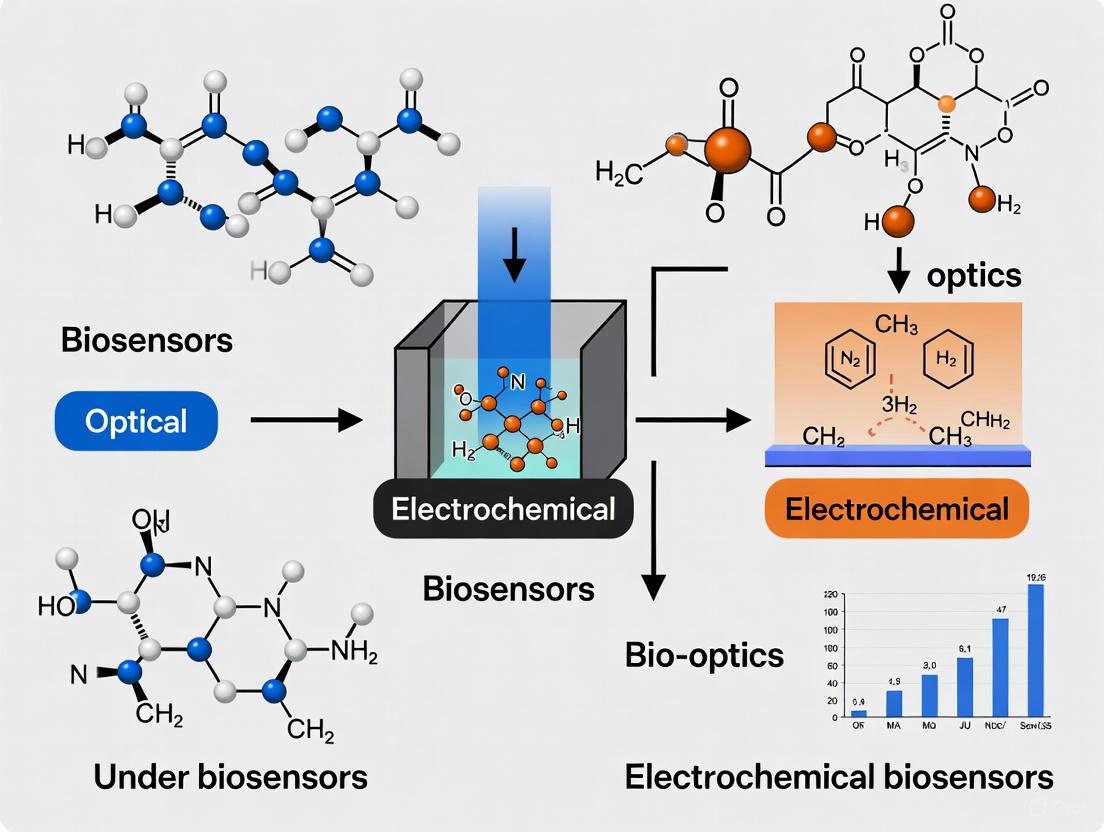
This article provides a comprehensive comparative analysis of optical and electrochemical biosensors, tailored for researchers, scientists, and drug development professionals.
Optical vs. Electrochemical Biosensors: A 2025 Comparative Analysis for Biomedical Research and Diagnostics
Abstract
This article provides a comprehensive comparative analysis of optical and electrochemical biosensors, tailored for researchers, scientists, and drug development professionals. It explores the foundational principles and transduction mechanisms underlying both sensor types, including recent innovations such as AI-integration and nanomaterial enhancements. The review methodically examines their applications in critical areas like disease diagnostics, therapeutic drug monitoring, and pathogen detection. It further addresses key challenges in sensor optimization, reliability, and commercialization, culminating in a direct, evidence-based comparison of their analytical performance, usability, and suitability for point-of-care and clinical settings. The synthesis aims to guide the selection and development of biosensor technologies for advanced biomedical and clinical research.
Core Principles and Transduction Mechanisms: Understanding the Basis of Biosensor Technology
Biosensors represent a convergence of biological recognition and physicochemical detection, forming critical analytical tools for researchers, scientists, and drug development professionals. These devices integrate biological elements with transducers to produce signals proportional to specific analytes, enabling applications ranging from clinical diagnostics to environmental monitoring [1]. The fundamental architecture of any biosensor comprises three essential components: a bioreceptor that specifically recognizes the target analyte, a transducer that converts the biological event into a measurable signal, and a readout system that processes and displays the results [2]. Understanding this architecture is paramount for selecting appropriate biosensing technologies for specific research applications.
Among the diverse biosensor classifications, optical and electrochemical platforms have emerged as the most prominent technologies in research and commercial environments. Optical biosensors detect analytes by measuring changes in light properties, while electrochemical biosensors monitor electrical signals resulting from biochemical reactions [1]. This guide provides a detailed comparison of these technologies, focusing on their operational principles, performance characteristics, and implementation protocols to inform strategic selection for research and development applications.
Core Architectural Components of a Biosensor
Bioreceptors: The Recognition Elements
Bioreceptors serve as the molecular recognition components of biosensors, providing specificity for target analytes through biological binding events. These elements include enzymes, antibodies, nucleic acids, whole cells, and aptamers designed to interact specifically with the target of interest [3] [2]. The selection of appropriate bioreceptors depends on the target analyte and required specificity, with immobilization techniques critical for maintaining biological activity while ensuring stability on the transducer surface [4].
Transducers: The Signal Conversion System
Transducers form the core of the signal conversion mechanism, transforming the biological recognition event into a quantifiable output. They are categorized based on their transduction principles, with optical and electrochemical representing the two primary approaches [2]. Optical transducers monitor changes in light properties including absorbance, fluorescence, reflectance, or refractive index [1] [5]. Electrochemical transducers detect electrical changes—current (amperometric), potential (potentiometric), or impedance (impedimetric)—resulting from biochemical reactions [6] [3].
Readout Systems: Data Processing and Display
Readout systems comprise the electronic components that amplify, process, and present the transducer signal in a user-interpretable format [3]. These systems have evolved significantly with advancements in miniaturization and wireless technologies, enabling portable and wearable form factors for point-of-care testing and continuous monitoring applications [2]. Modern readout systems often integrate with smartphones or cloud platforms for data analysis and storage, facilitating real-time health monitoring and remote patient management [6].
Comparative Analysis: Optical vs. Electrochemical Biosensors
The table below summarizes the key technical differences between optical and electrochemical biosensor technologies.
Table 1: Technical Comparison of Optical and Electrochemical Biosensors
| Parameter | Optical Biosensors | Electrochemical Biosensors |
|---|---|---|
| Detection Mechanism | Interaction of light with target molecule [1] | Measurement of electrical signals [1] |
| Transducer Element | Light [1] | Electrodes [1] |
| Working Principle | Changes in optical properties (absorbance, fluorescence, refractive index) [1] [5] | Electrochemical reactions (redox reactions) [1] [6] |
| Detection Dynamic Range | Wide [1] | Limited [1] |
| Sensitivity | High (particularly SPR) [5] [7] | High [6] [7] |
| Response Time | Slow (minutes) [1] | Fast (seconds) [1] |
| Multiplexing Capability | Excellent (allows simultaneous multi-analyte detection) [1] | Limited [1] |
| Sample Requirement | Often requires purified samples [1] | Works with complex or crude samples [1] |
| Portability | Generally bulky [1] | Compact and portable [1] [7] |
| Cost | Higher (specialized optics) [1] [7] | Lower (simple setup) [1] [7] |
| Lifetime | Up to several years [1] | Up to several minutes (some types) [1] |
Transducer Mechanisms and Signaling Pathways
Optical Biosensor Transduction Mechanisms
Optical biosensors primarily utilize evanescent field effects in close proximity to the sensor surface. Surface Plasmon Resonance (SPR), the predominant optical technique, occurs when polarized light hits a metal (typically gold) surface at a specific interface, generating electron charge oscillations called surface plasmons [5]. Binding events alter the refractive index near the surface, changing the resonance conditions and producing detectable signals [5]. Localized Surface Plasmon Resonance (LSPR) employs metallic nanostructures with unique optical properties that respond to local dielectric environmental changes [5].
Electrochemical Biosensor Transduction Mechanisms
Electrochemical biosensors function through electron transfer mechanisms during biochemical reactions. When target analytes interact with immobilized bioreceptors, biochemical reactions produce measurable electrical signals through amperometric (current), potentiometric (potential), or impedimetric (impedance) techniques [6] [3]. These systems typically employ a three-electrode configuration: working electrode (sensing), reference electrode (stable potential reference), and counter electrode (completing the circuit) [3].
Experimental Protocols and Performance Validation
Experimental Protocol: Electrochemical Biosensor for Pathogen Detection
Recent research demonstrates the development of a high-performance electrochemical biosensor for Escherichia coli detection, achieving exceptional sensitivity [4]. The following protocol outlines the key experimental steps:
Sensor Fabrication:
- Synthesis of Mn-doped ZIF-67 (Co/Mn ZIF): Prepare zeolitic imidazolate framework (ZIF-67) with manganese doping at varying ratios (10:1, 5:1, 2:1, and 1:1 Co:Mn) to enhance electron transfer properties [4].
- Electrode Modification: Drop-cast the synthesized Co/Mn ZIF composite onto the working electrode surface (typically glassy carbon or screen-printed carbon electrodes).
- Bioreceptor Immobilization: Conjugate anti-O specific antibodies to the Co/Mn ZIF-modified electrode surface using EDC-NHS carbodiimide chemistry to ensure specific binding to the O-polysaccharide region of E. coli [4].
Measurement Procedure:
- Sample Preparation: Spike E. coli cultures at varying concentrations (10–1010 CFU mL–1) in appropriate matrices (buffer or tap water).
- Electrochemical Measurement: Employ electrochemical techniques such as cyclic voltammetry (CV) or electrochemical impedance spectroscopy (EIS) using a standard three-electrode system.
- Signal Detection: Monitor changes in electron transfer resistance or redox current upon bacterial binding to the functionalized electrode surface.
- Data Analysis: Quantify E. coli concentration from the calibration curve of electrical signal versus bacterial concentration [4].
Performance Metrics:
- Linear Detection Range: 10 to 1010 CFU mL–1
- Limit of Detection: 1 CFU mL–1
- Selectivity: Successfully discriminates non-target bacteria (Salmonella, Pseudomonas aeruginosa, Staphylococcus aureus)
- Stability: Maintains >80% sensitivity over 5 weeks
- Real-sample Recovery: 93.10–107.52% recovery in tap water samples [4]
Experimental Protocol: Surface Plasmon Resonance (SPR) Biosensing
SPR represents the most common optical biosensing method, particularly valuable for characterizing biomolecular interactions in real-time without labeling [5].
Sensor Preparation:
- Chip Functionalization: Immobilize the ligand (e.g., antibody, receptor) on the gold sensor chip surface using appropriate chemistry (commonly NHS-ester coupling on carboxymethylated dextran matrices).
- System Priming: Prime the SPR instrument with running buffer to establish a stable baseline signal.
Interaction Analysis:
- Analyte Injection: Introduce the analyte solution over the sensor surface using continuous flow at controlled rates.
- Real-time Monitoring: Measure the shift in resonance angle (response units) as analyte binds to the immobilized ligand.
- Dissociation Phase: Replace analyte solution with running buffer to monitor complex dissociation.
- Surface Regeneration: Apply a regeneration solution (typically mild acid or base) to remove bound analyte without damaging the immobilized ligand.
Data Processing:
- Reference Subtraction: Subtract signals from reference flow cells to account for bulk refractive index changes and non-specific binding.
- Kinetic Analysis: Fit the association and dissociation phases to appropriate binding models (e.g., 1:1 Langmuir binding) to determine kinetic rate constants (kon, koff) [5].
- Affinity Calculation: Derive equilibrium constants (KD = koff/kon) from kinetic parameters.
Performance Characteristics:
- Detection Limit: Varies by system and application (e.g., 0.5 nM for FK506-FKBP12 interaction in SPR imaging) [5]
- Throughput: SPR imaging enables high-throughput analysis of multiple interactions simultaneously [5]
- Label-free Operation: Enables monitoring of native molecular interactions without fluorescent or radioactive labels
Essential Research Reagent Solutions
The table below outlines key reagents and materials essential for implementing biosensor research protocols.
Table 2: Essential Research Reagents for Biosensor Development
| Reagent/Material | Function | Application Examples |
|---|---|---|
| Zeolitic Imidazolate Frameworks (ZIF-67) | Porous material with large surface area for enhanced electron transfer and bioreceptor immobilization [4] | Electrochemical biosensor electrode modification |
| Mn-doped ZIF-67 | Bimetallic framework with enhanced conductivity and surface reactivity for improved sensitivity [4] | High-performance pathogen detection |
| Anti-O Antibody | Bioreceptor specific to O-polysaccharide region of E. coli for selective pathogen recognition [4] | Bacterial detection assays |
| EDC-NHS Chemistry | Carbodiimide crosslinking for covalent immobilization of biomolecules on sensor surfaces [4] | Antibody conjugation to transducer surfaces |
| SPR Gold Chips | Sensor substrates with functionalized gold surfaces for plasmon resonance generation [5] | Optical biosensing platforms |
| Carboxymethylated Dextran | Hydrogel matrix for biomolecule immobilization on SPR chips via amine coupling [5] | Ligand attachment in SPR studies |
| Screen-printed Electrodes | Disposable electrode systems for portable electrochemical sensing [6] | Point-of-care biosensor development |
Optical and electrochemical biosensors offer complementary strengths for research and diagnostic applications. Optical platforms, particularly SPR-based systems, provide superior sensitivity, real-time monitoring, and multiplexing capabilities ideal for detailed biomolecular interaction analysis in laboratory settings [5]. Electrochemical systems excel in portability, cost-effectiveness, and operational simplicity, making them suitable for point-of-care testing and field applications [6] [7].
The architectural differences between these technologies dictate their appropriate application domains. Optical biosensors remain the gold standard for mechanistic studies of molecular interactions in drug development and basic research [5]. Electrochemical biosensors demonstrate superior performance for detection of low analyte concentrations in complex samples, with ongoing advancements in nanomaterials and bioreceptor engineering further enhancing their capabilities [6] [4].
Selection between optical and electrochemical platforms should consider the specific research requirements including sensitivity needs, sample matrix, required throughput, portability constraints, and available resources. Future developments in both technologies will likely focus on increased miniaturization, multiplexing capabilities, and integration with wearable platforms for continuous monitoring applications [2].
Electrochemical biosensors represent a cornerstone of modern analytical science, offering powerful tools for researchers and drug development professionals. These devices transform biological interactions into quantifiable electrical signals, providing a platform for detecting everything from simple ions to complex proteins and nucleic acids. Within this domain, three principal techniques—amperometric, potentiometric, and impedimetric sensing—form the essential toolkit. This guide provides a objective comparison of these techniques, framing them within the broader research context of electrochemical versus optical biosensors. It delivers structured performance data, detailed experimental protocols, and essential resource information to inform experimental design and technology selection in scientific and pharmaceutical environments.
Core Principles and Comparative Analysis
Electrochemical biosensors function by integrating a biological recognition element (e.g., enzyme, antibody, aptamer) with a physicochemical transducer that outputs an electrical signal [8]. The classification into amperometric, potentiometric, and impedimetric types is defined by the nature of this output signal.
- Amperometric Sensors measure the current generated by the electrochemical oxidation or reduction of an electroactive species at a constant applied potential. The resulting current is directly proportional to the concentration of the analyte [8]. A classic and widespread application is the glucose meter, which uses the enzyme glucose oxidase to generate a measurable current [9].
- Potentiometric Sensors measure the accumulation of a potential (voltage) at the working electrode relative to a reference electrode under conditions of zero current. This potential difference correlates to the logarithm of the analyte's activity or concentration, as described by the Nernst equation [8]. Common examples include ion-selective electrodes (ISEs) for pH, sodium, potassium, and lead detection [8] [10].
- Impedimetric Sensors measure the electrical impedance of the electrode-solution interface. The binding of a target analyte alters the interfacial properties, changing the charge transfer resistance (in faradaic systems) or the double-layer capacitance (in non-faradaic systems). These changes are typically monitored using Electrochemical Impedance Spectroscopy (EIS) [11].
The table below summarizes the fundamental characteristics and performance metrics of these three sensing modalities.
Table 1: Comparative Analysis of Electrochemical Sensing Techniques
| Feature | Amperometric | Potentiometric | Impedimetric |
|---|---|---|---|
| Measured Quantity | Current | Potential (Voltage) | Impedance (Resistance & Capacitance) |
| Theoretical Basis | Cottrell Equation [8] | Nernst Equation [8] | Nyquist/ Bode Plots (EIS) [11] |
| Typical LoD | Picomoles and above [8] | Micromolar (µM) to Nanomolar (nM) [11] | Low, down to femtomolar (fM) for some targets [11] |
| Key Advantage | High accuracy and sensitivity [8] | Simplicity, low cost, robustness [8] [11] | Label-free, real-time detection, low LoD [11] |
| Key Disadvantage | Dependence on enzymes/redox mediators, higher LoD than impedimetric [11] | Limited to ion sensing/complex biological targets, slower response [11] | Can be sensitive to non-specific binding, data analysis complexity |
| Common Applications | Glucose monitoring, environmental monitoring [9] [8] | pH sensing, ion detection (e.g., Pb²⁺ [10]), wearable sweat sensors [12] [8] | Detection of proteins, pathogens, DNA, and whole cells [11] |
When compared to optical biosensors in the context of point-of-care applications, electrochemical platforms generally offer advantages in cost, portability, and ease of miniaturization [9]. Optical biosensors, while often exhibiting exceptional sensitivity and multiplexing capabilities, can be limited by higher cost, more complex instrumentation, and lower portability [13] [9].
Experimental Protocols and Performance Data
To illustrate the practical application of these techniques, this section details representative experimental protocols for each sensor type, based on recent research.
Amperometric Sensing: Glucose Detection
The glucose meter is a quintessential example of an amperometric biosensor. The experimental workflow involves a bio-recognition layer that triggers a redox reaction, generating a measurable current.
Protocol:
- Electrode Preparation: A screen-printed carbon electrode (SPCE) is commonly used. The working electrode is modified with the enzyme glucose oxidase (GOx).
- Reaction Principle: Glucose in the sample is oxidized by GOx, producing gluconolactone and reducing the enzyme's FAD cofactor to FADH₂. The enzyme is then regenerated by a mediator (e.g., ferricyanide, ferrocene derivatives), which is oxidized at the electrode surface [9].
- Measurement: A constant potential is applied between the working and reference electrodes. The oxidation of the mediator generates a current that is directly proportional to the glucose concentration in the sample.
Performance Data: This well-established technology offers high accuracy and rapid response, making it suitable for routine clinical and personal use.
Potentiometric Sensing: Lead Ion (Pb²⁺) Detection
A recent study developed a high-sensitivity potentiometric sensor for detecting toxic lead ions (Pb²⁺) in aqueous samples using Thiophanate-methyl (TPM) as an ionophore [10].
Protocol:
- Sensor Fabrication: The sensor membrane was prepared by mixing the TPM ionophore with poly (vinyl chloride) (PVC) as a matrix, along with plasticizers (dibutyl phthalate or bis(2-ethylhexyl) sebacate) and additives. This membrane was then coated on a solid electrode surface.
- Measurement: The potential difference between the TPM-modified working electrode and a separate reference electrode (e.g., Ag/AgCl) is measured under zero-current conditions in solutions containing varying concentrations of Pb²⁺.
- Calibration: The measured potential is plotted against the logarithm of the Pb²⁺ concentration to generate a calibration curve.
Performance Data [10]:
- Linear Range: The sensor showed a wide linear response to Pb²⁺ concentration.
- Limit of Detection (LOD): 1.5 × 10⁻⁸ M
- Selectivity: Exhibited high selectivity for Pb²⁺ over other interfering ions (e.g., Zn²⁺, Cd²⁺, Cu²⁺, Na⁺, K⁺), attributed to the specific binding properties of the TPM ionophore.
- Lifetime: The sensor maintained stable performance for over 120 days.
Impedimetric Sensing: Protein Detection
Impedimetric biosensors are highly effective for label-free detection of proteins. A representative protocol involves an antibody-functionalized gold electrode for detecting a specific antigen.
Protocol:
- Surface Functionalization: A gold working electrode is cleaned and modified with a self-assembled monolayer (SAM) of thiolated molecules. Antibodies specific to the target protein are then immobilized onto this SAM surface.
- Faradaic EIS Measurement: Measurements are performed in a solution containing a redox probe, typically [Fe(CN)₆]³⁻/⁴⁻. A small amplitude AC voltage (e.g., 5-10 mV) is applied over a range of frequencies (e.g., 0.1 Hz to 100 kHz).
- Target Binding and Detection: Before analyte introduction, a baseline EIS spectrum is recorded. The binding of the target antigen to the immobilized antibody hinders the electron transfer of the redox probe to the electrode surface, leading to an increase in the charge transfer resistance (Rct). This change in Rct is quantitatively measured.
Performance Data (Exemplar) [11]: Advanced impedimetric biosensors using microelectrodes and nanomaterials have demonstrated detection of protein biomarkers like cardiac troponin I (cTnI) with limits of detection in the femtomolar (fM) range, highlighting their exceptional sensitivity.
The workflow for a faradaic impedimetric biosensor, common in protein detection, is visualized below.
Flowchart of a Faradaic EIS Experiment.
The Scientist's Toolkit: Essential Research Reagents and Materials
Successful implementation of electrochemical sensing requires specific materials and reagents. The following table details key components and their functions based on the protocols discussed.
Table 2: Essential Research Reagents and Materials for Electrochemical Sensing
| Reagent/Material | Function | Example Application |
|---|---|---|
| Screen-Printed Electrodes (SPEs) | Low-cost, disposable, mass-producible platforms for easy experimentation. | Amperometric glucose test strips [9]. |
| Gold (Au) & Platinum (Pt) Electrodes | Provide highly conductive, inert, and easily functionalizable surfaces. | Impedimetric biosensors; Au for thiol-based antibody/aptamer immobilization [11]. |
| Ion-Selective Membranes | Polymer membranes containing an ionophore that selectively binds target ions. | Potentiometric sensors for Pb²⁺ (TPM ionophore [10]), pH, K⁺, Na⁺. |
| Redox Probes (e.g., [Fe(CN)₆]³⁻/⁴⁻) | Mediate electron transfer in faradaic impedimetric and some amperometric sensors. | Measuring charge transfer resistance (Rct) in EIS [11]. |
| Enzymes (e.g., Glucose Oxidase) | Act as biological recognition elements that catalyze specific redox reactions. | Amperometric glucose biosensors [9]. |
| Biorecognition Elements (Antibodies, Aptamers) | Provide high specificity and selectivity for binding target analytes. | Impedimetric and amperometric detection of proteins, pathogens, or other biomarkers [11]. |
| Nafion | A cationic polymer used as a protective top layer to facilitate selective cation transport and enhance sensor stability. | Used in wearable potentiometric sensors to achieve 2-week stability [12]. |
| PEDOT:PSS/Graphene Composite | Serves as an effective ion-to-charge transducer material, enhancing sensitivity and stability. | Used in potentiometric sensors to achieve super-Nernstian response and low drift [12]. |
Amperometric, potentiometric, and impedimetric sensors each occupy a unique and vital niche in the electrochemical realm. Amperometric sensors offer robust, enzyme-driven quantification. Potentiometric sensors provide simple and cost-effective ion monitoring. Impedimetric sensors deliver high-sensitivity, label-free detection for a broad range of biological targets. The choice of technique is not a matter of identifying a universal "best" option, but rather of aligning the sensor's characteristics—its operational principle, sensitivity, cost, and complexity—with the specific requirements of the analytical problem. This objective comparison underscores that ongoing innovation, particularly through nanomaterials and advanced biorecognition elements, continues to push the performance boundaries of all three techniques, solidifying their collective importance in scientific research and drug development.
The rapid and accurate detection of biological and chemical analytes is fundamental to advancements in medical diagnostics, drug development, and environmental monitoring [14] [15]. Biosensors, which combine a biological recognition element with a physicochemical detector, are at the forefront of this analytical revolution. While electrochemical biosensors represent a significant portion of the market, optical biosensors offer distinct advantages, including rapid analysis, portability, high sensitivity, and the potential for multiplexing capabilities [16]. This guide provides a comparative analysis of four principal optical detection techniques—Surface Plasmon Resonance (SPR), Fluorescence, Colorimetric, and Surface-Enhanced Raman Scattering (SERS)—framed within the broader context of optical versus electrochemical sensing approaches. The objective is to offer researchers and drug development professionals a clear, data-driven overview of these technologies to inform experimental design and platform selection.
Fundamental Principles and Comparative Performance
Each optical technique operates on a unique physical principle, which directly influences its performance characteristics, advantages, and limitations. The table below summarizes the core attributes and performance metrics of these four optical methods.
Table 1: Comparison of Key Optical Biosensing Modalities
| Detection Method | Core Principle | Typical LOD | Key Advantages | Primary Limitations |
|---|---|---|---|---|
| SPR | Measures refractive index change from biomolecular binding on a metal surface [17]. | ~0.4 pg/mL (for Influenza H1N1) [15] | Label-free, real-time kinetics, high sensitivity. | Complex instrumentation, bulk refractive index sensitivity. |
| Fluorescence | Detects light emission from labels upon excitation [16]. | 18.50 aM (for miRNA) [18] | Extremely high sensitivity, multiplexing capability, versatile. | Requires fluorescent labels, potential photobleaching. |
| Colorimetric | Measures visual color change from analyte-probe interaction [16]. | 10 CFU/mL (for S. aureus) [16] | Simple, low-cost, naked-eye readout, ideal for POC. | Lower sensitivity than other methods, qualitative without instrumentation. |
| SERS | Enhances Raman signal of molecules on nanoscale metallic surfaces [17] [18]. | Single-molecule level potential [18] | "Fingerprint" specificity, extremely high sensitivity, multiplex potential. | Substrate reproducibility, complex substrate fabrication. |
Synergy with Electrochemical Sensing
A notable trend in biosensing is the development of dual-mode platforms that combine the strengths of optical and electrochemical methods. For instance, SERS-electrochemical (EC) dual-mode biosensors integrate the high sensitivity and molecular fingerprinting of SERS with the rapid response and ease of miniaturization of electrochemical detection [18]. Similarly, electrochemical SPR (ESPR) combines the label-free, real-time kinetic data of SPR with electrochemical readouts, improving reliability and enabling a more comprehensive analysis of binding events [19] [20]. These hybrid approaches are particularly powerful for detecting challenging biomarkers like cancer-related miRNAs at ultralow concentrations [18].
Experimental Protocols and Workflows
The practical implementation of each biosensing technique involves distinct experimental protocols. Below are detailed methodologies for key experiments cited in recent literature, illustrating the standard workflows.
SERS/EC Dual-Mode Biosensor for miRNA Detection
This protocol, adapted from Jin et al. (2025), outlines the steps for creating an ultrasensitive biosensor for cancer-related miRNA-106a [18].
- Core Principle: The sensor uses a DNA walker mechanism on a silver nanorods (AgNRs) electrode. Target miRNA triggers a cyclic cleavage reaction, releasing numerous signal probes.
- Key Reagents:
- AgNRs-based Sensing Electrode: SERS-active and electrochemically active substrate.
- MoS₂-based Dual-Mode (DM) Tags: Carrier for signal molecules (Methylene Blue).
- DNAzyme & Walker Strands: Catalyze the target-dependent cleavage reaction.
- Methylene Blue (MB): Acts as both a Raman reporter and an electrochemical probe.
- Experimental Workflow:
- Sensor Preparation: The AgNRs electrode is functionalized with DNA walker (LW) strands. MoS₂ nanosheets are loaded with MB and reporter DNA (rDNA) to form DM tags.
- Target Recognition: Introducing target miR-106a initiates the DNA walker process. The DNAzyme is activated and cleaves the substrate strands on the electrode, releasing a short trigger DNA (T).
- Signal Amplification & Detection: The released trigger DNA (T) hybridizes with the DM tags, detaching the MB-loaded rDNA. This leads to a decrease in both the SERS and electrochemical signals of MB, allowing for dual-mode quantification of the target.
Fluorescence Biosensor for Available Lead Detection
This protocol, based on Chen et al. (2023), describes a method for ultrasensitive detection of bioavailable lead ions (Pb²⁺) using DNAzyme and hairpin assembly [21].
- Core Principle: The sensor employs Pb²⁺-specific DNAzyme for recognition. The recognition event triggers a cascade of hairpin assembly reactions, producing a Y-shaped scaffold with active DNAzymes that cleave a fluorescent reporter for signal amplification.
- Key Reagents:
- 8-17 DNAzyme: Comprises an enzyme strand and a substrate strand with a ribonucleotide (rA) cleavage site.
- Hairpin Probes (H1, H2, H3, H4): H4 is labeled with a fluorophore (FAM) and a quencher (BHQ).
- Magnetic Beads: For separation and purification.
- Experimental Workflow:
- Target Recognition & Cleavage: Pb²⁺ recognizes the DNAzyme and cleaves its substrate strand at the rA site.
- Trigger Release: The cleavage releases a trigger DNA strand (T).
- Hairpin Assembly Cascade: The trigger T initiates a toehold-mediated strand displacement reaction, self-assembling hairpins H1, H2, and H3 into a Y-shaped structure (H1-H2-H3).
- Signal Amplification & Output: The H1-H2-H3 complex contains multiple active Mg²⁺-DNAzymes. These DNAzymes repeatedly cleave the fluorogenic substrate H4, separating the FAM fluorophore from the BHQ quencher and generating a strong fluorescence signal.
Colorimetric Biosensor for Multiplex Pathogen Detection
This protocol, from Wen et al., illustrates a nanoparticle-based approach for visually detecting multiple pathogens simultaneously [16].
- Core Principle: Different colored plasmonic nanoparticles (AuNPs: red, AgNPs: yellow) are conjugated to antibodies targeting specific pathogens. Magnetic separation is used to isolate pathogen-bound complexes, inducing a visible color change in the solution.
- Key Reagents:
- Plasmonic Nanoparticles: Gold nanoparticles (red), silver nanoparticles (yellow), silver triangular nanoplates (blue).
- Pathogen-Specific Antibodies: Immobilized on nanoparticles and magnetic beads.
- Magnetic Beads: For separation of target-bound complexes.
- Experimental Workflow:
- Form Sandwich Complex: Pathogens in the sample are bound by antibody-conjugated magnetic beads and antibody-conjugated nanoparticles of different colors.
- Magnetic Separation: A magnet pulls the sandwich complexes out of the solution.
- Colorimetric Readout: The supernatant's color changes depending on which pathogen-nanoparticle complexes were removed. The remaining color provides a visual indication of the pathogens present.
The Scientist's Toolkit: Essential Research Reagents
The development and implementation of advanced optical biosensors rely on a suite of specialized reagents and materials. The following table details key components and their functions in typical experimental setups.
Table 2: Key Research Reagent Solutions for Optical Biosensors
| Reagent/Material | Function in Biosensing | Example Applications |
|---|---|---|
| Gold Nanoparticles (AuNPs) | Colorimetric probes due to LSPR; SERS substrates; scaffolds for biomolecule immobilization [17] [16] [22]. | Multiplex pathogen detection [16]; Metal ion sensing [22]. |
| DNAzymes | Catalytic DNA molecules that recognize specific metal ions or act as biocatalysts for signal amplification [21]. | Ultrasensitive detection of Pb²⁺ [21]; miRNA detection [18]. |
| Metal Nanoclusters (Au/Ag/Cu NCs) | Fluorescent probes with high photostability and biocompatibility; used as labels in optical assays [23]. | Fluorescent and colorimetric detection of viruses and bacteria [23]. |
| 11-Mercaptoundecanoic Acid (MUA) | Forms self-assembled monolayers (SAMs) on gold surfaces, providing carboxyl groups for covalent antibody immobilization [20]. | SPR and electrochemical SPR biosensor construction [20]. |
| EDC/NHS Chemistry | Crosslinkers for activating carboxyl groups to form stable amide bonds with primary amines on antibodies or other biomolecules [20]. | Covalent immobilization of antibodies on sensor surfaces [20]. |
| Methylene Blue | Used as a Raman tag (for SERS) and an electrochemical redox probe, enabling dual-mode detection [18]. | SERS/EC dual-mode biosensors [18]. |
The choice of an optical detection method is a critical decision that hinges on the specific requirements of the assay. SPR is unparalleled for label-free kinetic studies, while fluorescence offers exceptional sensitivity for trace analysis. Colorimetric sensors are ideal for rapid, low-cost POC applications, and SERS provides unmatched molecular specificity. The emerging trend of combining optical with electrochemical methods creates powerful hybrid tools that leverage the strengths of both approaches, paving the way for more robust, sensitive, and versatile diagnostic platforms in biomedical research and drug development.
The evolution of biosensing technology is intrinsically linked to the development of novel nanomaterials that push the boundaries of detection sensitivity, selectivity, and miniaturization. As the critical comparative analysis between optical and electrochemical biosensors continues to shape research directions, the integration of advanced nanomaterials has become a pivotal strategy for enhancing biosensor performance. Within this context, metal nanoclusters, graphene, and MXenes have emerged as particularly promising materials, each offering a unique set of physicochemical properties that address specific limitations in biosensor design. This guide provides an objective comparison of how these nanomaterials enhance biosensor performance, supported by experimental data and detailed methodologies, to inform researchers, scientists, and drug development professionals in their selection of materials for next-generation diagnostic platforms.
The fundamental distinction between optical and electrochemical biosensors lies in their transduction mechanisms. Optical biosensors detect analytes by measuring changes in light properties (e.g., absorbance, fluorescence, surface plasmon resonance) resulting from biochemical interactions [1]. In contrast, electrochemical biosensors convert biological recognition events into measurable electrical signals (e.g., current, voltage, impedance) [1]. Each platform presents characteristic advantages and limitations concerning sensitivity, multiplexing capability, portability, and cost, which are further modulated by the choice of nanomaterial.
Performance Comparison of Nanomaterial-Enhanced Biosensors
The integration of nanomaterials into biosensing platforms significantly augments their performance metrics. The table below summarizes key quantitative data comparing the enhancement effects of metal nanoclusters, graphene, and MXenes on both optical and electrochemical biosensors.
Table 1: Performance comparison of biosensors enhanced by different nanomaterials
| Nanomaterial | Biosensor Type | Detection Limit | Key Advantages | Reported Applications |
|---|---|---|---|---|
| Graphene | Electrochemical | Femtomolar (fM) range [24] | Large surface area (~2630 m²/g), high carrier mobility (>200,000 cm²/V·s), excellent biocompatibility [24] | Detection of dopamine, glucose, cancer biomarkers, viral infections [25] [24] |
| Graphene | Optical (SPR) | Not specified | Enhances electromagnetic field, improves SPR sensitivity [24] | Hemoglobin detection for anemia diagnosis [24] |
| MXenes | Electrochemical | Not specified | High electrical conductivity (>20,000 S cm⁻¹), hydrophilicity, facile functionalization, mechanical flexibility [26] [27] [28] | Detection of pollutants, heavy metals, biomarkers (e.g., glucose, H₂O₂) [29] [26] |
| MXenes | Optical | Not specified | Tunable optical properties, strong light-matter interaction [26] | Chemical and biological sensing [26] |
| Metal Nanoclusters | Optical | Not specified | Intense fluorescence, excellent photostability, tunable emission | Not specified in provided search results |
Table 2: Comparative analysis of nanmaterial properties relevant to biosensing
| Property | Graphene | MXenes | Metal Nanoclusters |
|---|---|---|---|
| Electrical Conductivity | Very High (>200,000 cm²/V·s) [24] | Very High (>20,000 S cm⁻¹) [26] | Variable |
| Surface Area | Very High (~2630 m²/g) [24] | High [27] [28] | Moderate |
| Biocompatibility | Excellent [24] | Good [27] [28] | Good |
| Functionalization Ease | Moderate to High [24] | High [27] [28] | High |
| Optical Properties | Fluorescence quenching, SPR enhancement [24] | Tunable absorption, plasmonic [26] | Strong fluorescence |
| Mechanical Flexibility | High [24] | High [26] [27] | Low |
Experimental Protocols and Methodologies
Fabrication of Graphene-Based Electrochemical Biosensors
Protocol Title: Fabrication of Graphene Field-Effect Transistor (GFET) for Protein Detection
Principle: GFETs operate by detecting changes in electrical conductance when target biomolecules bind to receptors on the graphene surface, altering the local electric field [24].
Materials Required:
- Substrate: Silicon wafer with SiO₂ layer
- Graphene synthesis: Chemical vapor deposition (CVD) system
- Electrodes: Photolithography equipment and metal evaporator (Cr/Au)
- Biorecognition element: Specific antibodies or aptamers
- Functionalization reagents: 1-pyrenebutanoic acid succinimidyl ester (PBASE) as a linker molecule
Step-by-Step Methodology:
- Graphene Transfer: Synthesize monolayer graphene via CVD on a copper foil. Transfer onto the SiO₂/Si substrate using a polymer-assisted wet transfer method [24].
- Electrode Patterning: Define source and drain electrode patterns via photolithography and deposit chromium (5 nm) and gold (50 nm) layers by thermal evaporation, followed by lift-off processing [24].
- Surface Functionalization: Incubate the GFET device with a solution of PBASE linker molecule. Wash thoroughly to remove unbound linkers [24].
- Bioreceptor Immobilization: Covalently attach the chosen antibodies or aptamers to the PBASE-modified graphene surface via amine coupling chemistry. Block nonspecific binding sites with bovine serum albumin (BSA) [24].
- Electrical Characterization: Measure the source-drain current versus gate voltage (I-Vg) before and after exposure to the target analyte to establish the detection signal [24].
Development of MXene-Based Electrochemical Biosensors
Protocol Title: MXene (Ti₃C₂Tₓ)-Modified Screen-Printed Electrode for H₂O₂ Detection
Principle: MXenes enhance electron transfer kinetics at the electrode-electrolyte interface. The high conductivity and catalytic activity of Ti₃C₂Tₓ enable sensitive amperometric detection of electroactive species [29] [27].
Materials Required:
- MXene synthesis: MAX phase (Ti₃AlC₂) powder, hydrofluoric acid (HF) or other etching agents
- Electrode: Commercial screen-printed carbon electrodes (SPCEs)
- Instrumentation: Electrochemical workstation (potentiostat)
- Analyte: Hydrogen peroxide (H₂O₂) solutions of known concentrations
Step-by-Step Methodology:
- MXene Synthesis: Etch the aluminum layer from Ti₃AlC₂ powder using HF (e.g., 5-30 wt%) for 24-48 hours at room temperature. Centrifuge and wash the resulting multilayered Ti₃C₂Tₓ until the supernatant reaches neutral pH [27].
- Delamination: Intercalate dimethyl sulfoxide (DMSO) between the MXene layers. Subject the mixture to sonication in water to produce a colloidal suspension of single- or few-layer Ti₃C₂Tₓ nanosheets [27].
- Electrode Modification: Drop-cast a precise volume (e.g., 5 µL) of the Ti₃C₂Tₓ dispersion onto the working electrode of SPCEs and allow to dry under ambient conditions [29].
- Electrochemical Detection: Perform amperometric measurements by applying a constant potential (e.g., +0.4 V vs. Ag/AgCl) to the MXene-modified SPCE while successively adding aliquots of H₂O₂ standard solution under stirred conditions. The measured current is proportional to the H₂O₂ concentration [29].
Signaling Pathways and Experimental Workflows
The following diagram illustrates the general working principles of nanomaterial-enhanced optical and electrochemical biosensors, highlighting the role of the nanomaterials in the signal transduction process.
The Scientist's Toolkit: Essential Research Reagents and Materials
Successful development of nanomaterial-enhanced biosensors requires specific reagents and materials. The following table details key components and their functions for researchers in this field.
Table 3: Essential research reagents and materials for nanomaterial-based biosensor development
| Item Name | Function/Application | Specific Examples |
|---|---|---|
| MAX Phase Precursors | Starting material for MXene synthesis | Ti₃AlC₂ powder for producing Ti₃C₂Tₓ MXenes [27] |
| Etching Agents | Selective etching of the 'A' layer from MAX phases | Hydrofluoric Acid (HF), Fluoride salts (e.g., LiF) in HCl [27] |
| Chemical Vapor Deposition (CVD) System | Synthesis of high-quality, large-area graphene films | CVD with CH₄ gas source and Cu/Ni foil substrate [24] |
| Linker Molecules | Immobilization of biorecognition elements on nanomaterial surfaces | 1-pyrenebutanoic acid succinimidyl ester (PBASE) for graphene [24] |
| Screen-Printed Electrodes (SPEs) | Disposable, miniaturized platforms for electrochemical sensing | Carbon, gold, or platinum working electrodes [29] |
| Biorecognition Elements | Provide specificity for the target analyte | Antibodies, DNA aptamers, enzymes (e.g., Glucose Oxidase) [9] [24] |
| Electrochemical Workstation | Measures electrical signals in electrochemical biosensors | Potentiostat for amperometric, potentiometric, impedimetric measurements [1] |
The strategic integration of nanomaterials represents a cornerstone in the advancement of both optical and electrochemical biosensing platforms. Graphene excels in applications demanding ultra-high electrical conductivity and large surface area, making it particularly effective in field-effect transistors and electrochemical sensors. MXenes offer a compelling combination of metallic conductivity, hydrophilicity, and ease of functionalization, showing outstanding promise for flexible and wearable electrochemical sensors. While specific data for metal nanoclusters was limited in the provided sources, their strong fluorescence properties make them inherently valuable for optical sensing applications.
The choice between optical and electrochemical platforms, and the selection of the most appropriate nanomaterial, ultimately depends on the specific application requirements, including the desired sensitivity, portability, multiplexing capability, and cost constraints. Future research will likely focus on overcoming challenges related to the scalable synthesis and long-term stability of these nanomaterials, as well as their integration into multifunctional, point-of-care diagnostic devices that can revolutionize healthcare monitoring and disease management.
Electrochemical and optical biosensors have independently established themselves as powerful platforms for detection across clinical, environmental, and food safety domains. Electrochemical biosensors excel with their high sensitivity, portability, and capacity for miniaturized, low-cost point-of-care (POC) testing [9] [30]. Optical biosensors, including those based on fluorescence, chemiluminescence (CL), and surface plasmon resonance (SPR), offer advantages in real-time monitoring, visual readouts (in some formats), and high specificity [9] [31]. However, each modality faces inherent limitations: electrochemical methods can suffer from electrode fouling and interference in complex samples, while optical techniques may be limited by photobleaching, light scattering, and the need for sophisticated instrumentation [32] [15].
To overcome these constraints and meet the demand for more robust, reliable, and information-rich analytical systems, a new frontier has emerged: hybrid and dual-modality systems that integrate electrochemical and optical techniques. These systems synergistically combine the strengths of both approaches, enabling cross-validation of results, enhancing detection accuracy, expanding dynamic range, and providing complementary information from a single assay [32]. This convergence, often facilitated by advancements in nanomaterials and machine learning, represents a significant leap forward in biosensing capability, paving the way for next-generation diagnostics and monitoring platforms.
Comparative Analysis: Performance of Individual Modalities
Understanding the foundational characteristics of electrochemical and optical biosensors is crucial for appreciating their synergy in hybrid systems. The table below summarizes their core attributes, which directly inform their integration strategy.
Table 1: Comparative analysis of electrochemical and optical biosensors.
| Feature | Electrochemical Biosensors | Optical Biosensors |
|---|---|---|
| Sensitivity | Very high (nanomolar to picomolar) [30] | High (e.g., single molecule detection possible with SERS) [9] [23] |
| Selectivity | High, dependent on bioreceptor (enzyme, antibody, aptamer) [6] [30] | High, dependent on bioreceptor and label specificity [9] |
| Portability | Excellent; compact electronics, low power requirements [9] [32] | Varies; colorimetric LFIA strips are highly portable, SPR/SERS systems less so [9] [31] |
| Cost | Generally low-cost and disposable [9] [30] | Varies; simple colorimetric strips are low-cost, while fluorescent/SPR systems are more expensive [15] |
| Multiplexing Capability | Good, with multi-electrode arrays [32] | Excellent, via multiple wavelengths or spatial encoding [31] |
| Key Advantages | Miniaturization, ease of integration with electronics, low sample volume [6] [32] | Visual readouts (in some cases), real-time monitoring, immunity to electromagnetic interference [9] [31] |
| Key Limitations | Susceptibility to electrode fouling, signal interference in complex matrices [32] | Potential for photobleaching, light scattering in turbid samples, may require complex optics [31] |
The Hybrid Paradigm: Mechanisms and Synergistic Benefits
Hybrid electrochemical-optical systems are not merely the physical co-location of two sensors. They are engineered platforms where the two modalities interact to create a combined output greater than the sum of their parts. The core mechanisms and benefits of this integration include:
Signal Amplification and Cross-Verification
Nanomaterials play a pivotal role in enhancing both signals. For instance, metal nanoclusters (MNCs) and nanoparticles can serve as electro-catalysts to amplify an electrochemical current while also acting as fluorescent or plasmonic labels for optical detection [23]. This dual functionality allows for internal validation, where the electrochemical signal confirms the optical readout and vice versa, drastically reducing false positives/negatives. A classic example is an electrochemiluminescence (ECL) system, where an electrochemical reaction generates an excited state species that then emits light, combining the controlled electrode reactivity of electrochemistry with the sensitive detection of optical methods [32].
Multi-Parameter and Multiplexed Detection
Hybrid systems can simultaneously monitor different aspects of a biological event. An electrochemical sensor can track a binding event via a change in impedance (e.g., using electrochemical impedance spectroscopy, EIS), while a concurrent optical measurement like SPR or fluorescence can monitor a conformational change or the recruitment of a labeled secondary molecule [31]. This provides a more comprehensive picture of the analyte-bioreceptor interaction. Furthermore, this is powerful for multiplexing, where different optical labels (e.g., quantum dots with different emission wavelengths) can be used in conjunction with electrode-specific electrochemical signals to detect multiple targets in a single, small sample volume [32] [15].
Experimental Protocols for Hybrid Systems
Developing and characterizing a hybrid biosensor requires a methodical approach. The following is a generalized experimental workflow, adaptable for specific targets like pathogens, neurotransmitters, or cancer biomarkers.
Generalized Workflow for a Model Hybrid Biosensor
This protocol outlines the development of a biosensor using nanomaterials that exhibit both electrochemical and optical properties for the detection of a viral pathogen.
Table 2: Key stages in developing a hybrid biosensor.
| Stage | Description | Key Outputs |
|---|---|---|
| 1. Probe Design & Synthesis | Functionalize gold nanoclusters (AuNCs) with a specific DNA aptamer for the target virus. The AuNC acts as both a fluorescent probe and an electroactive label. | Bioconjugated AuNCs with stable fluorescence and redox activity. |
| 2. Substrate Fabrication | Fabricate a microfluidic chip with an integrated 3-electrode system (WE, CE, RE). The working electrode is modified with a complementary DNA capture probe. | A ready-to-use sensor chip with immobilized capture probes. |
| 3. Assay Procedure & Detection | 1. Sample Incubation: Introduce the sample into the microfluidic chamber. If the target is present, it binds the AuNC-aptamer conjugate and the capture probe, forming a "sandwich" on the WE.2. Optical Measurement: Wash and measure the fluorescence intensity of the captured AuNCs.3. Electrochemical Measurement: In the same chamber, perform square-wave voltammetry (SWV) to measure the oxidation current of the AuNCs. | Two independent signals (fluorescence intensity and electrochemical current) proportional to the target concentration. |
| 4. Data Fusion & Analysis | Use a machine learning algorithm to correlate and analyze the dual signals, generating a calibrated and robust concentration readout. | A single, validated result with high confidence. |
Figure 1: Experimental workflow for a dual-modality aptasensor, showing the parallel optical and electrochemical detection paths culminating in data fusion.
Detailed Methodology: Electrochemical and Optical Interrogation
Following the assay formation, the detailed measurement steps are critical.
Optical Detection (Fluorescence):
- Excitation: Illuminate the sensor chamber with a light-emitting diode (LED) at the AuNC's excitation wavelength (e.g., 365 nm).
- Emission Capture: Collect the emitted fluorescence light through a miniaturized spectrometer or a filter-photodiode setup. A smartphone camera can also be used as a simple detector [9].
- Quantification: Measure the fluorescence intensity at the characteristic emission peak (e.g., 610 nm). Plot intensity against a calibration curve of known target concentrations.
Electrochemical Detection (Square-Wave Voltammetry - SWV):
- Buffer Condition: Ensure the chamber is filled with a suitable electrolyte (e.g., 10 mM PBS, pH 7.4).
- Parameter Setup: Apply a square-wave potential waveform to the working electrode versus the reference electrode. Typical parameters: potential window from 0.0 V to +0.8 V, step potential 4 mV, amplitude 25 mV, frequency 15 Hz.
- Current Measurement: Record the faradaic current generated from the oxidation of the AuNCs. The peak current is directly proportional to the number of AuNC labels captured, and hence, the target concentration.
- Data Processing: Integrate the oxidation peak and plot the charge or peak height against the calibration curve.
Essential Research Reagent Solutions
The performance of hybrid biosensors is critically dependent on the materials and reagents used. The table below catalogs key components and their functions in these advanced sensing systems.
Table 3: Key research reagents and materials for hybrid biosensor development.
| Category / Reagent | Function in Hybrid Biosensors | Example Use Case |
|---|---|---|
| Gold Nanoclusters (AuNCs) | Fluorescent labels with well-defined redox electrochemistry; enable simultaneous optical and electrochemical signaling. | Signal probe in a sandwich assay for pathogen detection [23]. |
| Graphene & Carbon Nanotubes | Electrode modifiers that provide high conductivity, large surface area, and excellent electrocatalytic activity; enhance electrochemical signal and can quench fluorescence for "turn-on" assays. | Base material for working electrode to improve sensitivity for dopamine or cancer biomarkers [30]. |
| Polydimethylsiloxane (PDMS) | Flexible, optically transparent polymer used for microfluidic chip and wearable sensor fabrication; allows for optical interrogation through the substrate. | substrate for a flexible wearable sensor that combines electrochemical sensing with optical readout via integrated LEDs [31]. |
| Specific Aptamers | Synthetic bioreceptors with high affinity for targets (ions, small molecules, proteins, cells); offer better stability and easier modification than antibodies. | Biorecognition element for the specific capture of a target like serotonin or a virus [6] [33]. |
| Machine Learning Algorithms | Software tools for multivariate analysis and fusion of dual-signal data; compensate for sensor drift, minimize interference, and improve quantification. | Algorithm to deconvolute mixed electrochemical signals or correlate optical and electrical data for a more accurate diagnosis [32]. |
Signaling Pathways and System Logic
The core logic of a hybrid biosensor can be visualized as a process where a single biological event triggers two parallel, measurable physical changes. This is fundamental to understanding their design and advantage.
Figure 2: The core signaling logic of a hybrid biosensor, where a single biorecognition event, transduced by a nanomaterial, generates two parallel signals for fusion and validation.
Translating Technology to Practice: Applications in Disease Management and Diagnostics
Precision diagnostics for critical illnesses like cancer and autoimmune diseases rely on the sensitive and specific detection of biomarkers such as proteins, autoantibodies, and nucleic acids. Among the most promising technologies advancing this field are electrochemical and optical biosensors, which function as analytical devices by combining a biological recognition element with a physicochemical transducer [34] [9]. These systems convert specific biological interactions into quantifiable signals, enabling the detection and measurement of target analytes. Electrochemical biosensors detect electrical changes resulting from biorecognition events, while optical biosensors measure alterations in light properties [13] [9]. The evolution of these biosensing platforms is particularly crucial for diagnosing complex diseases, where early and accurate detection of biomarkers like carcinoembryonic antigen (CEA) for cancers or specific autoantibodies for autoimmune conditions can dramatically influence treatment strategies and patient outcomes [34] [35]. The global biosensors market, projected to grow from US$30.6 billion in 2024 to US$49.6 billion by 2030, underscores their increasing clinical importance, with electrochemical biosensors currently dominating over 70% of the market share [36].
This comparative analysis examines the fundamental principles, performance characteristics, and practical applications of electrochemical and optical biosensors for detecting cancer biomarkers and clinically relevant antibodies. By evaluating recent experimental data and technological advancements, this guide provides researchers and drug development professionals with a critical framework for selecting appropriate biosensing platforms based on their specific diagnostic requirements, whether for point-of-care testing, continuous monitoring, or high-throughput laboratory analysis.
Fundamental Principles and Comparative Mechanisms
Electrochemical Biosensing Platforms
Electrochemical biosensors operate on the principle of detecting electrical changes—current, potential, or impedance—resulting from specific biological recognition events occurring at the electrode surface [6] [9]. These platforms typically employ a three-electrode system (working, reference, and counter electrodes) integrated within an electrochemical cell. When target biomarkers interact with biological recognition elements (such as antibodies, aptamers, or enzymes) immobilized on the electrode surface, subsequent electrochemical reactions generate measurable signals [6]. The key detection methodologies in electrochemical biosensing include amperometric techniques, which measure current from redox reactions at a constant potential; voltammetric methods like differential pulse voltammetry (DPV) and cyclic voltammetry (CV), which apply potential sweeps and measure resulting currents; and impedimetric approaches, which monitor changes in electrical impedance due to binding events [37] [9].
A significant advancement in this field involves nanoengineering electrode surfaces to enhance sensitivity and specificity. For instance, researchers have developed highly sensitive immunosensors by modifying glassy carbon electrodes with composite nanomaterials including sodium alginate (SA), gold nanoparticles (AuNPs), and gamma-manganese dioxide/chitosan (γ.MnO₂-CS) [37]. This multi-layer architecture creates a high-surface-area scaffold that improves both biomolecule immobilization and electron transfer kinetics, significantly boosting detection capabilities for low-abundance biomarkers.
Optical Biosensing Platforms
Optical biosensors function by transducing biorecognition events into measurable optical signals through various mechanisms including absorption, fluorescence, chemiluminescence, or refractive index changes [9] [38]. These platforms leverage the interaction between light and biological recognition elements to detect and quantify target analytes. Common optical biosensing approaches include surface plasmon resonance (SPR), which detects refractive index changes near a metal surface; fluorescence-based sensors, which measure light emission from excited fluorophores; colorimetric sensors, which visualize color changes detectable by eye or simple spectrometers; and optical cavity-based sensors, which monitor resonance shifts in confined light structures [39] [38].
Advanced optical systems like optical cavity-based biosensors (OCB) utilize Fabry-Perot interferometer principles, where an optical cavity structure is created between two partially reflective surfaces [38]. When biomolecular binding occurs within this cavity, it alters the local refractive index and consequently modifies the resonance transmission spectrum. By employing differential detection methods using multiple laser wavelengths and monitoring intensity changes with CCD or CMOS sensors, these systems can achieve highly sensitive, label-free detection of target analytes without requiring complex optical instrumentation [38].
Comparative Operational Principles
The table below summarizes the core operational principles and signal transduction mechanisms for both biosensor types:
Table 1: Fundamental Comparison of Biosensing Mechanisms
| Feature | Electrochemical Biosensors | Optical Biosensors |
|---|---|---|
| Transduction Principle | Detection of electrical changes from bio-recognition events | Measurement of optical property modifications |
| Key Measurement Parameters | Current, potential, impedance | Refractive index, fluorescence, absorbance, light intensity |
| Common Techniques | Amperometry, voltammetry (DPV, CV), impedimetry | SPR, fluorescence, colorimetric, optical cavity resonance |
| Signal Output | Electrical current/potential | Light intensity/wavelength shift |
| Label Requirement | Often label-free; sometimes uses enzymatic labels | Mix of label-free (SPR, OCB) and labeled approaches (fluorescence) |
Performance Comparison: Experimental Data and Detection Capabilities
Sensitivity and Detection Limits for Cancer Biomarkers
Both electrochemical and optical biosensors have demonstrated exceptional sensitivity in detecting clinically relevant cancer biomarkers at concentrations crucial for early diagnosis. Recent experimental studies highlight their advancing capabilities:
Table 2: Comparison of Biosensor Performance in Cancer Biomarker Detection
| Biomarker | Biosensor Type | Detection Mechanism | Linear Range | Limit of Detection (LOD) | Reference |
|---|---|---|---|---|---|
| Carcinoembryonic Antigen (CEA) | Electrochemical | Label-free immunosensor with γ.MnO₂-CS/AuNPs/SA modified GCE | 10 fg/mL - 0.1 µg/mL | 9.57 fg/mL | [37] |
| C-reactive Protein (CRP) | Optical (OCB) | Label-free cavity resonance shift | - | 377 pM | [38] |
| Streptavidin (Model System) | Optical (OCB) | Optimized APTES functionalization with cavity resonance | - | 27 ng/mL (3x improvement with methanol-based protocol) | [38] |
| Let-7a (Lung Cancer) | Electrochemical | DSN-based electrochemical biosensor | - | Not specified | [34] |
| ORAOV1 (Urothelial Carcinoma) | Electrochemical | TE-RPA electrochemical biosensor | - | Not specified | [34] |
Electrochemical biosensors have shown remarkable performance in detecting protein biomarkers like CEA, achieving detection limits as low as 9.57 fg/mL through sophisticated electrode modifications [37]. These platforms benefit from advanced nanocomposite materials that enhance electrode surface area and electron transfer efficiency. Similarly, optical biosensors like the OCB system have demonstrated continuous improvement in detection capabilities, with researchers achieving a threefold enhancement in streptavidin detection (LOD: 27 ng/mL) through optimized surface functionalization protocols using methanol-based APTES deposition [38].
Real-World Applicability and Analytical Performance
Beyond pure detection limits, several additional factors determine the practical utility of biosensing platforms in clinical settings:
Table 3: Analytical Performance and Practical Considerations
| Performance Parameter | Electrochemical Biosensors | Optical Biosensors |
|---|---|---|
| Multiplexing Capability | Moderate | High (especially imaging-based platforms) |
| Sample Volume Requirements | Low (microliters) | Variable (microliters to milliliters) |
| Measurement Time | Seconds to minutes | Minutes (including equilibrium time) |
| Portability | High (miniaturizable, low-power) | Moderate (some require complex optics) |
| Integration with POC Devices | Excellent | Good (lateral flow, smartphone-based) |
| Susceptibility to Environmental Interference | Low to moderate | Moderate to high (sensitive to ambient light, temperature) |
Electrochemical platforms demonstrate particular strength in point-of-care settings due to their miniaturization potential, low power requirements, and compatibility with portable electronics [34] [36]. Optical biosensors excel in multiplexing applications and offer superior sensitivity in laboratory environments, with ongoing research focused on enhancing their field-deployability through smartphone integration and simplified optical components [39] [9].
Experimental Protocols and Methodologies
Protocol 1: Electrochemical Immunosensor for CEA Detection
The development of a highly sensitive CEA immunosensor exemplifies the sophisticated methodology employed in electrochemical biosensing [37]:
Electrode Modification Protocol:
- Glassy Carbon Electrode (GCE) Preparation: Polish the GCE with alumina slurry, followed by sequential sonication in ethanol and deionized water, then dry at room temperature.
- Sodium Alginate (SA) Modification: Deposit 6 μL of SA solution (2.5 mM prepared in phosphate buffer) onto the GCE surface and allow it to dry.
- Gold Nanoparticles (AuNPs) Immobilization: Drop-cast 6 μL of citrate-modified AuNPs (250 μM) onto the SA-modified GCE and dry.
- Nanocomposite Integration: Apply 6 μL of the γ.MnO₂-CS nanocomposite suspension onto the AuNPs/SA/GCE assembly and dry.
- Antibody Immobilization: Introduce 6 μL of anti-CEA antibody (12 μg/mL in PBS, pH 7.4) to the modified electrode and incubate overnight at 4°C.
- Blocking Step: Treat the electrode with 6 μL of bovine serum albumin (BSA, 1% w/v) for 1 hour at room temperature to block non-specific binding sites.
Measurement Conditions:
- Employ differential pulse voltammetry (DPV) measurements in a solution containing 2.5 mM K₃[Fe(CN)₆]/K₄[Fe(CN)₆] (1:1 mixture) with 0.1 M KCl as supporting electrolyte.
- Apply a potential range from -0.2 to 0.6 V with a modulation amplitude of 0.025 V and a step potential of 0.005 V.
- Quantify CEA concentrations by monitoring current variations at the oxidation peak resulting from antibody-antigen complex formation.
Protocol 2: Optical Cavity-Based Biosensor with Optimized APTES Functionalization
The enhanced performance of optical biosensors relies critically on controlled surface chemistry, as demonstrated in this streptavidin detection protocol [38]:
Surface Functionalization Optimization:
- Substrate Cleaning: Treat soda lime glass substrates with oxygen plasma for 5 minutes to create hydrophilic surfaces.
- APTES Functionalization (Methanol-Based Optimal Protocol):
- Prepare a fresh solution of 0.095% (v/v) APTES in anhydrous methanol.
- Immerse the cleaned substrates in the APTES solution for 30 minutes with gentle agitation.
- Rinse thoroughly with methanol to remove physically adsorbed silane.
- Cure the functionalized substrates at 110°C for 10 minutes to stabilize the silane layer.
- Biotin Receptor Immobilization:
- Incubate the APTES-functionalized surface with sulfo-NHS-biotin (0.5 mg/mL in PBS, pH 7.4) for 2 hours at room temperature.
- Wash with phosphate buffer to remove unbound biotin.
- Biomolecule Attachment: Introduce streptavidin samples in PBS buffer and monitor binding in real-time.
Optical Measurement Setup:
- Utilize a differential detection approach employing two laser diodes at 808 nm and 880 nm.
- Direct collimated light through the optical cavity structure and measure transmission intensity with a CCD or CMOS camera.
- Monitor intensity changes resulting from streptavidin-biotin binding-induced refractive index modifications within the optical cavity.
Signaling Pathways and Experimental Workflows
Electrochemical Biosensor Signaling Pathway
Electrochemical Biosensor Signaling Pathway
Optical Biosensor Experimental Workflow
Optical Biosensor Experimental Workflow
The Scientist's Toolkit: Essential Research Reagents and Materials
Successful implementation of biosensing platforms requires carefully selected materials and reagents optimized for specific detection methodologies:
Table 4: Essential Research Reagents for Biosensor Development
| Category | Specific Examples | Function in Biosensing | Application Notes |
|---|---|---|---|
| Electrode Materials | Glassy carbon electrode (GCE), Gold, Platinum | Provides conductive surface for electron transfer | GCE offers excellent electrochemical properties and modification versatility [37] |
| Nanomaterials | Gold nanoparticles (AuNPs), Manganese dioxide (γ.MnO₂), Carbon nanotubes | Enhances surface area, electron transfer, and bioreceptor immobilization | AuNPs improve conductivity and biomolecule attachment [37] |
| Polymers & Biopolymers | Chitosan (CS), Sodium alginate (SA) | Creates 3D scaffolds for biomolecule encapsulation and stabilization | SA provides stable matrix for retaining nanocomposite structure [37] |
| Surface Functionalization | (3-Aminopropyl)triethoxysilane (APTES) | Forms amine-terminated linker layers for subsequent biomolecule attachment | Methanol-based protocol (0.095% APTES) optimal for uniform layers [38] |
| Recognition Elements | Anti-CEA antibodies, Streptavidin-Biotin pair | Provides specific molecular recognition for target analytes | Antibodies selected for high specificity and affinity [37] |
| Blocking Agents | Bovine serum albumin (BSA) | Reduces non-specific binding on sensor surfaces | 1% BSA solution typically used for effective blocking [37] |
| Electrochemical Mediators | K₃[Fe(CN)₆]/K₄[Fe(CN)₆] | Facilitates electron transfer in redox reactions | 2.5 mM concentration in supporting electrolyte [37] |
| Optical Components | Laser diodes (808 nm, 880 nm), CCD/CMOS detectors | Enables precise optical signal generation and detection | Differential detection with multiple wavelengths enhances sensitivity [38] |
Electrochemical and optical biosensors represent complementary technologies advancing precision diagnostics for critical illnesses. Electrochemical platforms offer superior portability, minimal sample requirements, and cost-effectiveness—attributes ideal for point-of-care testing and resource-limited settings [34] [36]. Their dominance in the current market (over 70% share) reflects these practical advantages, particularly for applications like glucose monitoring and rapid cancer biomarker screening [36]. Optical biosensors provide exceptional sensitivity, robust multiplexing capabilities, and strengths in laboratory environments where complex sample analysis is required [39] [38].
The evolving integration of both technologies with artificial intelligence, nanotechnology, and IoT connectivity promises to further enhance their diagnostic capabilities [39] [36]. For researchers and drug development professionals, selection between these platforms should be guided by specific application requirements: electrochemical biosensors for decentralized testing and rapid results, optical biosensors for maximum sensitivity and multi-analyte detection in controlled settings. As both technologies continue to mature through ongoing research in materials science, surface chemistry, and device integration, they will undoubtedly play increasingly pivotal roles in the future landscape of precision medicine for cancer and critical illness management.
The rapid and accurate detection of pathogenic bacteria and viruses is fundamental to safeguarding public health, enabling timely interventions, and preventing the spread of infectious diseases [40]. Conventional detection methods, such as culture techniques, polymerase chain reaction (PCR), and enzyme-linked immunosorbent assays (ELISAs), are often hindered by lengthy processing times, high costs, and the need for specialized equipment and personnel [40] [41] [16]. In recent years, biosensors incorporating metal nanoclusters (MNCs) have emerged as powerful diagnostic platforms that address these limitations [40].
Metal nanoclusters, composed of a few to hundreds of atoms (typically <3 nm), occupy a unique space between single atoms and larger nanoparticles [42]. Their ultra-small size confers molecule-like properties, including discrete electronic energy levels, strong photoluminescence, and size-dependent catalytic activity, making them superior to traditional nanoparticles for many sensing applications [40] [42]. This review performs a comparative analysis of optical and electrochemical biosensors utilizing MNCs for pathogen detection. It objectively evaluates their performance based on sensitivity, specificity, and operational characteristics, providing researchers and drug development professionals with a clear guide to the current state of this rapidly advancing technology.
Metal Nanoclusters: Synthesis and Functional Properties
Synthesis and Tunability
The synthesis of metal nanoclusters has evolved significantly beyond classical wet-chemical reduction methods. Emerging strategies such as microwave-assisted, photochemical, and sonochemical synthesis have improved efficiency, structural control, and environmental compatibility [42]. For instance, microwave-assisted synthesis of histidine-stabilized gold nanoclusters (AuNCs) not only reduced reaction time to 30 minutes but also yielded clusters with a fourfold higher photoluminescence intensity compared to those synthesized via classical room-temperature protocols [42]. These advances enable the precise tuning of MNC properties by controlling their size, composition (e.g., Au, Ag, Cu), and surface chemistry through the selection of protecting ligands like peptides, proteins, and nucleic acids [43] [42]. This tunability is critical for designing biosensors with optimized performance for specific pathogenic targets.
Key Functional Properties for Biosensing
The exceptional properties of MNCs make them ideal transducers and signal amplifiers in biosensors:
- Strong Photoluminescence: MNCs exhibit strong and tunable fluorescence, which arises from their discrete electronic states and ligand-metal interactions [40] [42]. Mechanisms such as ligand-to-metal charge transfer (LMCT) and aggregation-induced emission (AIE) can be harnessed for highly sensitive optical detection [42].
- Electrocatalytic Activity: Atomically precise MNCs possess high specific surface areas and unique electronic structures, enabling them to promote electron exchange and act as redox mediators in electrochemical sensing platforms, significantly enhancing signal response [43].
- Biocompatibility and Stability: The use of biocompatible ligands (e.g., glutathione, proteins) for stabilization facilitates the functionalization of MNCs with biological recognition elements and ensures performance in complex biological matrices [40] [42].
Comparative Analysis: Optical vs. Electrochemical MNC-Based Biosensors
The integration of MNCs into biosensing platforms has led to significant advancements, primarily in optical and electrochemical modalities. The table below provides a comparative overview of their operating principles, advantages, and limitations.
Table 1: Comparison of Optical and Electrochemical MNC-Based Biosensors
| Feature | Optical Biosensors | Electrochemical Biosensors |
|---|---|---|
| Primary Transduction Mechanism | Measures changes in light properties (e.g., intensity, wavelength) [16] | Measures changes in electrical properties (e.g., current, impedance) [43] [44] |
| Key Sub-types | Fluorescence, Colorimetric, Surface-Enhanced Raman Scattering (SERS) [40] [16] | Voltammetry (DPV, SWV), Amperometry, Electrochemical Impedance Spectroscopy (EIS) [43] [44] |
| Typical Limit of Detection (LOD) | Very high (e.g., 10 CFU/mL for colorimetric [16]; can detect single molecules) | Very high (e.g., attomolar-femtomolar for biomarkers [43]) |
| Advantages | High sensitivity and specificity; potential for multiplexing and visual readouts; portability [45] [16] | High sensitivity; rapid detection; low fabrication cost; ease of miniaturization and analysis [43] [44] |
| Limitations/Challenges | Susceptible to light quenching and autofluorescence in complex samples [44] | Can have weaker stability and be susceptible to fouling in complex matrices [44] |
| Example Pathogen Detected | Salmonella, S. aureus, E. coli O157:H7, SARS-CoV-2 [40] [16] | Disease biomarkers (proteins, nucleic acids) for viral and bacterial infections [43] |
Performance Data and Experimental Protocols
The following tables summarize experimental data from representative studies to quantitatively compare the performance of optical and electrochemical MNC-based biosensors in detecting pathogens.
Table 2: Performance of Selected Optical MNC-Based Biosensors for Pathogen Detection
| Target Pathogen | MNC Type & Recognition Element | Detection Mechanism | Limit of Detection (LOD) | Assay Time | Reference |
|---|---|---|---|---|---|
| SARS-CoV-2, S. aureus, Salmonella | AuNPs, AgNPs / Specific antibodies | Colorimetric (sandwich immunoassay with magnetic separation) | Not specified | Not specified | [16] |
| S. aureus, E. coli | Nanoarray / Not specified | Colorimetric (optical image analysis after capture) | 10 CFU/mL | < 10 min | [16] |
| Eight bacterial species | 3-hydroxyflavone derivatives | Ratiometric fluorescence | Not specified | Not specified | [16] |
Table 3: Performance of Selected Electrochemical MNC-Based Biosensors for Disease Biomarkers
| Target Analyte (Model) | MNC Type & Electrode Modification | Detection Technique | Limit of Detection (LOD) | Linear Range | Reference |
|---|---|---|---|---|---|
| miRNA-21 | Not specified / DNA tetrahedral probes | DPV with enzyme catalysis | Not specified | Not specified | [44] |
| miRNA let-7a | MnO2 nanosheets (nanozyme) | DPV | Not specified | Not specified | [44] |
| Glucose, Cholesterol, H2O2 | Au, Ag, Cu NCs / Various ligands | Amperometry, Potentiometry | Nanomolar to picomolar | Several orders of magnitude | [43] |
Detailed Experimental Protocol: Colorimetric Multiplex Detection
To illustrate a typical workflow, here is the detailed methodology for a colorimetric biosensor that simultaneously detects SARS-CoV-2, S. aureus, and Salmonella [16]:
- Synthesis of Reporter Nanoparticles: Red-emitting gold nanoparticles (AuNPs) are functionalized with antibodies specific to SARS-CoV-2. Similarly, yellow-emitting silver nanoparticles (AgNPs) and blue-emitting silver triangular nanoplates are functionalized with antibodies against S. aureus and Salmonella, respectively.
- Preparation of Magnetic Probes: Magnetic beads are conjugated with capture antibodies for each of the three target pathogens.
- Sandwich Immunoassay:
- The sample is incubated with a mixture of the three magnetic probes. If present, the target pathogens bind to their respective magnetic beads.
- The corresponding colored reporter nanoparticles are then added. They bind to the pathogen-magnetic bead complexes, forming a sandwich structure.
- A magnet is applied to separate these sandwich complexes from the unbound reporter nanoparticles in the solution.
- Signal Readout: The color change in the supernatant is observed. The specific hue of the supernatant is determined by which reporter nanoparticles were removed via magnetic separation. Individual infections produce distinct color signatures, enabling simultaneous identification.
Detailed Experimental Protocol: Electrochemical Detection using Nanozymes
A general protocol for an electrochemical sensor utilizing the catalytic activity of MNC-based nanozymes is as follows [43] [44]:
- Electrode Modification: The working electrode (e.g., glassy carbon or gold electrode) is meticulously polished and cleaned. A suspension of the catalytic MNCs (e.g., peptide-protected AuNCs) is drop-casted onto the electrode surface and dried, forming a uniform film.
- Biorecognition Element Immobilization: Specific recognition elements, such as DNA aptamers or antibodies, are immobilized onto the MNC-modified electrode to confer specificity for the target pathogen or biomarker.
- Electrochemical Measurement:
- The functionalized electrode is incubated with the sample solution.
- After washing, the electrode is transferred to an electrochemical cell containing a buffer solution and an electroactive probe (e.g., [Fe(CN)₆]³⁻/⁴⁻).
- Techniques like Differential Pulse Voltammetry (DPV) or Electrochemical Impedance Spectroscopy (EIS) are employed. The binding of the target analyte alters the electron transfer kinetics at the electrode interface, resulting in a measurable change in current (DPV) or charge transfer resistance (EIS).
- Signal Amplification: The intrinsic electrocatalytic properties of the MNCs, such as their ability to catalyze the reduction of H₂O₂, are often exploited to amplify the electrochemical signal, thereby enhancing sensitivity.
Signaling Pathways and Experimental Workflows
The following diagrams, generated using Graphviz, illustrate the core signaling mechanisms and experimental workflows for key MNC-based biosensors.
MNC Biosensor Signaling Mechanisms
Diagram Title: MNC Biosensor Signaling Mechanisms
Multiplex Colorimetric Assay Workflow
Diagram Title: Multiplex Colorimetric Assay Workflow
The Scientist's Toolkit: Essential Research Reagents and Materials
The development and implementation of MNC-based biosensors rely on a specific set of reagents and materials. The following table details key components for researchers in this field.
Table 4: Essential Research Reagent Solutions for MNC-Based Biosensor Development
| Reagent/Material | Function and Role in Biosensing | Specific Examples |
|---|---|---|
| Metal Salt Precursors | Source of metal atoms for nanocluster synthesis. | Gold(III) chloride (HAuCl₄), Silver nitrate (AgNO₃), Copper(II) nitrate (Cu(NO₃)₂) [42] |
| Stabilizing Ligands | Control nucleation, growth, and stability of MNCs; confer biocompatibility and functional groups for conjugation. | Glutathione (GSH), Histidine, Bovine Serum Albumin (BSA), Pepsin, DNA aptamers [43] [42] |
| Reducing Agents | Facilitate the reduction of metal ions to their zero-valent state during MNC synthesis. | Sodium borohydride (NaBH₄), Ascorbic acid, Histidine (can also act as a reductant) [42] |
| Biological Recognition Elements | Provide high specificity for binding to target pathogens or biomarkers. | Antibodies, Monoclonal Antibodies, Nucleic Acid Aptamers, CRISPR-Cas systems [41] [46] |
| Signal Reporters/Probes | Generate a measurable signal (optical or electrical) upon target binding. | Fluorescent MNCs, Enzymes (HRP, ALP), Electroactive probes ([Fe(CN)₆]³⁻/⁴⁻) [16] [44] |
| Solid Supports & Electrodes | Platform for immobilizing MNCs and recognition elements; transducer for signal conversion. | Glassy Carbon Electrode (GCE), Gold Electrode (AuE), Paper-based substrates, Microfluidic chips [41] [16] [44] |
Metal nanocluster-based biosensors represent a transformative advancement in the rapid detection of pathogens for infectious disease control. Both optical and electrochemical platforms leverage the unique properties of MNCs—such as their tunable photoluminescence and superior electrocatalysis—to achieve sensitivity and specificity that often surpass traditional methods. Optical biosensors offer distinct advantages for multiplexed, visual detection, while electrochemical sensors excel in cost-effectiveness, miniaturization, and rapid analysis.
The future of this field lies in the continued refinement of synthesis for atomically precise MNCs, the development of robust multiplexing capabilities, and the seamless integration of these sensors into portable, point-of-care devices. As research progresses, the integration of intelligent detection systems powered by artificial intelligence and the Internet of Things (IoT) will further propel MNC-based biosensors from sophisticated laboratory tools to indispensable assets in global public health, enabling real-time monitoring and rapid response to emerging infectious threats.
Therapeutic Drug Monitoring (TDM), the clinical practice of measuring specific drugs at designated intervals to maintain a constant concentration in a patient's bloodstream, is crucial for optimizing dosage regimens, especially for drugs with narrow therapeutic windows. Traditional TDM relies on invasive blood draws and laboratory-based analyses, which are time-consuming, costly, and lack real-time capabilities. Electrochemical biosensing platforms have emerged as powerful alternatives, offering rapid, sensitive, and cost-effective detection of drug concentrations [47]. These platforms are particularly suited for point-of-care (POC) testing and continuous monitoring, enabling personalized medicine by providing real-time data to guide therapeutic decisions [36].
This guide objectively compares electrochemical platforms with the other predominant technology in the field—optical biosensors—within the broader context of biosensor research. The comparison is grounded in performance data, experimental protocols, and a critical analysis of how each technology addresses the key requirements of TDM, such as sensitivity, specificity, portability, and the ability to function in complex biological matrices.
Comparative Analysis: Electrochemical vs. Optical Biosensors for TDM
The selection between electrochemical and optical transduction principles is fundamental to the design of a TDM biosensor. The table below summarizes the core characteristics of each platform.
Table 1: Performance Comparison of Electrochemical and Optical Biosensors for TDM
| Feature | Electrochemical Biosensors | Optical Biosensors (e.g., Colorimetric, Fluorescence, SPR) |
|---|---|---|
| Principle | Measures changes in current, potential, or impedance from electron transfer in redox reactions [9]. | Measures changes in light properties (e.g., absorbance, emission, wavelength) [48] [9]. |
| Sensitivity | Very high (can achieve pM and even lower detection limits) [49] [50]. | High to very high (e.g., SERS and SPR can be exceptionally sensitive) [13] [9]. |
| Specificity | Achieved via biorecognition elements (enzymes, antibodies, aptamers) [51]. | Achieved via biorecognition elements (antibodies, aptamers) [9]. |
| Portability & POC Suitability | Excellent; inherent miniaturization, low-power requirements, compatible with wearable formats [36] [9]. | Variable; colorimetric LFIAs are highly portable, but SPR and microscopy systems are often benchtop [13] [9]. |
| Cost | Generally low-cost; simple instrumentation, disposable electrodes [51] [47]. | Variable; LFIA strips are low-cost, but sophisticated detectors (SPR, fluorimeters) are expensive [13]. |
| Real-Time Monitoring | Highly suitable for continuous, real-time monitoring (e.g., wearable sensors) [49] [50]. | Less suitable for continuous monitoring; often used for single-point measurements [48]. |
| Multiplexing Capability | Developing; requires multiple electrode arrays or advanced signal processing [36]. | Strong; multiple analytes can be detected simultaneously using different fluorescent tags or SERS reporters [13]. |
| Sample Matrix Effect | Can be significant; requires careful electrode design and shielding to minimize interference [50]. | Can be significant; absorbance and fluorescence can be affected by sample turbidity and autofluorescence [9]. |
Electrochemical biosensors demonstrate a strong potential for on-site TDM applications due to their adaptability, low cost, and portability, whereas optical biosensors exhibit exceptional sensitivity and multiplexing capabilities, though with certain limitations in portability and environmental resilience [13]. The choice depends heavily on the specific TDM application: electrochemical sensors are ideal for decentralized, frequent, or continuous monitoring, while optical sensors are powerful for high-throughput, multi-analyte laboratory testing.
Experimental Protocols and Detection Capabilities
To illustrate the practical application of these platforms, this section details representative experimental methodologies for detecting specific drugs or drug classes.
Experimental Protocol: Voltammetric Detection of an Anticancer Drug
This protocol is adapted from research on monitoring anticancer drug efficacy using electrochemical methods [49].
1. Sensor Fabrication:
- Working Electrode Modification: A glassy carbon electrode (GC) is polished to a mirror finish with alumina slurry and thoroughly rinsed. It is then modified with a nanocomposite material, such as multi-walled carbon nanotubes (MWCNTs) to enhance the electroactive surface area. Finally, a biorecognition element specific to the drug (e.g., an aptamer or molecularly imprinted polymer) is immobilized on the MWCNT surface [49].
- Cell-based Assay (for efficacy): For direct assessment of drug effect, highly proliferative cells (e.g., HepG2 cancer cells) are immobilized on a customized electrode surface. The cell culture is maintained in a suitable medium prior to drug exposure [49].
2. Measurement and Detection:
- Technique: Differential Pulse Voltammetry (DPV) or Linear Sweep Voltammetry (LSV).
- Procedure: The modified electrode is immersed in a buffer solution containing the target drug. A potential is applied in a specific range where the drug undergoes a redox reaction. The resulting current peak is measured, and its intensity is proportional to the drug concentration [49]. For cell-based assays, the electrochemical signal (e.g., from intracellular redox reactions like H₂O₂ production) is measured before and after drug administration to assess cell viability and apoptotic activity [49].
- Data Analysis: The peak current is plotted against drug concentration to create a calibration curve, which is used to determine unknown concentrations in clinical samples (e.g., serum).
Table 2: Exemplary Detection Limits for Various Drug Classes
| Drug Class / Analyte | Electrochemical Platform | Detection Limit | Experimental Method |
|---|---|---|---|
| Anticancer Drug Efficacy | Cell-based Electrochemical Biosensor (e.g., ECIS) | N/A (Monitors cell viability in real-time) | Electric Cell-Substrate Impedance Sensing (ECIS) [49]. |
| H₂O₂ (Apoptosis Marker) | MnO₂-NWs@Au-NPs/GF | 1.9 µM | Amperometry [49]. |
| General Biomarker Detection | AI-Empowered Electrochemical Sensor | Can detect trace biomarkers in complex fluids | Machine Learning-enhanced signal processing [50]. |
Experimental Protocol: Optical LFIA for Drug Monitoring
Lateral Flow Immunoassays (LFIAs) are a common optical platform suitable for qualitative or semi-quantitative POC TDM.
1. Assay Assembly:
- Conjugate Pad: Antibodies specific to the target drug are conjugated to colored nanoparticles (e.g., gold nanoparticles, AuNPs).
- Nitocellulose Membrane: Contains two lines: a Test line with immobilized drug-protein conjugates and a Control line with antibodies that capture the free Ab-AuNP complex.
2. Measurement and Detection:
- Technique: Colorimetric reflection or smartphone-based image analysis.
- Procedure: A sample (e.g., saliva, blood) is applied to the sample pad. It migrates, rehydrates the Ab-AuNP conjugate, and forms a complex. This complex flows across the membrane.
- Result: In a positive sample, the drug in the sample saturates the Ab-AuNP binding sites, preventing binding to the Test line, leading to no color (a "negative" visual result but positive for the drug). The Control line must always appear for a valid test. The intensity of the Test line can be inversely proportional to the drug concentration [9]. For quantification, a portable reflectometer or a smartphone camera can measure the color intensity of the lines.
The workflow below contrasts the fundamental operational principles of these two biosensor types in a TDM context.
The Scientist's Toolkit: Essential Research Reagent Solutions
The development and deployment of advanced TDM biosensors rely on a suite of specialized materials and reagents.
Table 3: Key Research Reagent Solutions for Biosensor Development
| Category / Item | Function in Biosensor Development |
|---|---|
| Biorecognition Elements | |
| Enzymes (e.g., Glucose Oxidase) | Catalyze substrate-specific reactions, generating an electroactive or optical product [51]. |
| Antibodies | Provide high specificity for immunoassays; bind to target drug molecules [51] [9]. |
| Aptamers (ssDNA/RNA) | Synthetic nucleic acid ligands with high affinity for specific targets; offer stability and design flexibility [51] [50]. |
| Nanomaterials | |
| Gold Nanoparticles (AuNPs) | Excellent labels for colorimetric LFIAs; enhance conductivity in electrochemical sensors [9]. |
| Carbon Nanotubes (CNTs) | Increase electrode surface area and electron transfer kinetics in electrochemical sensors [49]. |
| Graphene & Derivatives | High electrical conductivity and large surface area for sensitive electrochemical detection [49] [50]. |
| Transducer Components | |
| Screen-Printed Electrodes (SPEs) | Disposable, low-cost, mass-producible platforms for decentralized electrochemical sensing [51]. |
| Microfluidic Chips | Precisely manipulate small fluid volumes, enabling automated sample preparation and analysis [50]. |
| Smartphone-based Detectors | Serve as portable detectors for colorimetric, fluorescent, or electrochemical readouts, enabling POC use [9]. |
The future of TDM is inextricably linked to the advancement of biosensing platforms. Key trends include the integration of artificial intelligence (AI) and machine learning (ML) to enhance sensor capabilities. AI algorithms can screen optimal sensor materials, predict performance, and, crucially, process complex sensing data to extract meaningful information from noisy signals, mitigating interference from complex sample matrices [50]. Furthermore, the development of multiplexed biosensors capable of simultaneously monitoring a drug and key biomarkers (e.g., organ function markers) will provide a more holistic view of a patient's therapeutic response [36].
Another significant frontier is the creation of fully integrated, wearable and implantable sensors for continuous TDM, moving from intermittent snapshots to real-time pharmacokinetic profiling [36] [50]. These devices will generate rich, dynamic data that can be wirelessly transmitted to clinicians, paving the way for truly personalized and adaptive dosing regimens.
In conclusion, while optical biosensors, particularly LFIAs, offer robust and visually interpretable solutions for specific TDM applications, electrochemical platforms present a compelling combination of performance, portability, and cost-effectiveness. Their compatibility with miniaturization, real-time monitoring, and emerging AI-powered analytics positions them as a cornerstone technology for the next generation of therapeutic drug monitoring systems. The choice between them is not a matter of superiority but of strategic alignment with the specific clinical need—be it a rapid qualitative test at home or a continuous quantitative readout in a hospital setting.
The paradigm of healthcare is progressively shifting from centralized, hospital-based diagnostics towards personalized, decentralized, and continuous health monitoring. This transformation is largely propelled by the development of wearable and point-of-care (POC) biosensors, which empower individuals and clinicians with real-time physiological data [52] [53]. These devices leverage flexible materials and advanced sensing technologies to enable non-invasive or minimally invasive monitoring of biomarkers in various biological fluids, thereby facilitating early disease detection and personalized medicine [54] [55].
A critical frontier in this field is the comparative performance of the two dominant sensing principles: optical versus electrochemical transduction. This guide provides a structured, objective comparison of these technologies, framing them within a broader thesis on their research and application. It is designed to equip researchers, scientists, and drug development professionals with a clear understanding of their respective strengths, limitations, and optimal use cases, supported by experimental data and methodological details.
Biosensing Fundamentals and Detection Modalities
Transduction Mechanisms at a Glance
At their core, biosensors consist of a biological recognition element (e.g., enzyme, antibody, nucleic acid) and a transducer that converts the biological event into a quantifiable signal. The choice of transduction mechanism fundamentally defines the sensor's capabilities, performance, and suitability for specific applications.
- Electrochemical Biosensors measure electrical signals (current, potential, or impedance) arising from biochemical reactions. For instance, enzymatic oxidation of glucose generates electrons, producing a measurable current proportional to concentration [9] [56]. They are known for their high sensitivity, low cost, and excellent compatibility with miniaturization and continuous monitoring.
- Optical Biosensors detect changes in light properties (e.g., absorbance, fluorescence, luminescence, or surface plasmon resonance) induced by the target analyte. A common example is a lateral flow immunoassay (LFIA), where the accumulation of colored nanoparticles at a test line provides a visual or spectrophotometric readout [9].
The following diagram illustrates the core signaling pathways and logical relationships for these two transduction mechanisms.
The Scientist's Toolkit: Essential Research Reagents and Materials
The development and function of advanced biosensors rely on a suite of specialized materials and reagents. The table below details key components used in the featured research and their critical functions.
Table 1: Key Research Reagent Solutions for Biosensor Development
| Item | Function in Biosensors | Examples & Experimental Context |
|---|---|---|
| Biological Recognition Elements | Provides high selectivity and specificity for the target analyte. | Enzymes (e.g., Glucose Oxidase), Antibodies, Aptamers, Whole cells [9] [57] [56]. |
| Nanomaterials | Enhances signal transduction, increases surface area, and improves sensitivity. | Reduced Graphene Oxide (rGO), MXene, Metal Nanoparticles (for colorimetric LFIAs or SERS), Carbon Nanotubes [52] [9]. |
| Flexible Polymer Substrates | Provides a soft, stretchable base for comfortable, conformable skin contact. | Polyvinyl Alcohol (PVA), Polydimethylsiloxane (PDMS), Thermoplastic Polyurethane (TPU), Hydrogels [52] [57]. |
| Metal-Organic Frameworks (MOFs) | Emerging porous materials that enhance sensitivity and selectivity for biomarker detection, often combined with conductive materials. | Used in composite materials for electrochemical detection of glucose, lactate, and cortisol in sweat [56]. |
| Electroactive Mediators | Facilitates electron transfer between the recognition element and the electrode in electrochemical sensors, improving efficiency. | Ferrocene derivatives, organic dyes, and other redox compounds used in amperometric sensors [56]. |
| Chromogenic/Flurogenic Substrates | Produces a color or fluorescence change in response to the target analyte in optical sensors. | Tetramethylbenzidine (TMB) in ELISA; substrates for Horseradish Peroxidase (HRP) in LFIAs; Raman reporter molecules [9]. |
Comparative Analysis: Optical vs. Electrochemical Biosensors
A direct comparison of optical and electrochemical biosensors reveals a trade-off between the high multiplexing potential of optical methods and the superior integrability for continuous monitoring offered by electrochemical systems.
Table 2: Performance Comparison of Optical and Electrochemical Biosensors
| Feature | Optical Biosensors | Electrochemical Biosensors |
|---|---|---|
| Detection Principle | Colorimetric, Fluorescence, Chemiluminescence, SPR, SERS [9] | Amperometric, Potentiometric, Impedimetric [9] [56] |
| Sensitivity | High (e.g., fM-nM for fluorescence/SPR) [9] | High (e.g., nM-μM for amperometric) [52] [56] |
| Multiplexing Capability | High (e.g., multiple wavelengths, spatial resolution) [9] [39] | Moderate (requires multiple electrode arrays) |
| Miniaturization & Portability | Good (e.g., smartphone readers), but can be limited by optical components [9] | Excellent (inherently small electrodes, low-power) [9] [56] |
| Cost & Complexity | Higher (lasers, detectors, optical alignment) [9] | Lower (simple electronics, low-cost fabrication) [9] [55] |
| Sample Matrix Interference | Can be high (scattering, absorption, autofluorescence) [9] | Can be managed with membranes and surface modifications [56] |
| Integrability with Wearables | Moderate (e.g., colorimetric patches) [55] | High (dominant modality for continuous sweat sensing) [52] [56] |
| Key Applications | LFIA tests, multiplexed pathogen detection, SERS-based diagnostics [9] [57] | Continuous glucose monitors, wearable sweat sensors, metabolite tracking [52] [53] [56] |
Experimental Protocols and Data
To ground this comparison in practical research, the following section outlines detailed methodologies for representative experiments in both optical and electrochemical sensing.
Experimental Protocol: Electrochemical Sweat Glucose Monitoring with MOF-Composites
This protocol is adapted from research on enhancing wearable electrochemical biosensors using Metal-Organic Frameworks (MOFs) for high-sensitivity detection [56].
Sensor Fabrication:
- Synthesis of Conductive MOF Composite: A MOF (e.g., ZIF-8) is hydrothermally synthesized. To overcome low intrinsic conductivity, it is combined with a conductive polymer (e.g., PEDOT:PSS) or carbon nanotubes to form a composite ink.
- Electrode Modification: The composite ink is drop-cast or screen-printed onto a flexible carbon electrode and dried.
- Enzyme Immobilization: Glucose oxidase (GOx) is immobilized onto the MOF composite layer via cross-linking with glutaraldehyde or a hydrogel matrix (e.g., PVA).
Experimental Setup:
- The functionalized electrode is integrated into a flexible, adhesive patch containing a microfluidic channel for sweat collection.
- The patch is applied to the skin (e.g., forearm), and sweat is induced by exercise or pilocarpine iontophoresis.
- The sensor is connected to a portable potentiostat for amperometric measurement.
Measurement & Data Acquisition:
- A constant potential (+0.5 V vs. Ag/AgCl) is applied.
- The oxidation current generated from the enzymatic reaction (GOx catalyzing glucose oxidation) is measured in real-time as sweat passes over the sensor.
- The current is calibrated against known standard concentrations of glucose to create a calibration curve.
Experimental Protocol: Multiplexed Pathogen Detection via SERS-Based Lateral Flow Assay
This protocol details a sophisticated optical method combining lateral flow assay simplicity with the quantitative power of Surface-Enhanced Raman Spectroscopy (SERS) [9].
Assay Preparation:
- SERS Nanotag Synthesis: Gold nanoparticles (AuNPs) are synthesized and conjugated with specific antibodies. They are then loaded with a unique Raman reporter molecule (e.g., 4-aminothiophenol), creating a SERS nanotag with a distinct spectral fingerprint.
- Test Strip Fabrication: Multiple test lines are printed on a nitrocellulose membrane, each immobilized with a different capture antibody targeting a specific pathogen (e.g., Pseudomonas fluorescens gyrB and aprX genes) [57].
Experimental Procedure:
- The liquid sample (e.g., milk, saliva) is applied to the sample pad.
- The sample rehydrates the SERS nanotags, and the mixture migrates along the strip via capillary action.
- If the target analyte is present, it forms an antibody-antigen-antibody "sandwich" complex, trapping the SERS nanotags at the corresponding test line.
Signal Readout and Quantification:
- Qualitative: The appearance of visible colored lines indicates a positive result.
- Quantitative: A portable Raman spectrometer is used to irradiate the test lines and collect the SERS spectrum. The intensity of the characteristic Raman peak of the reporter molecule is quantified and is directly proportional to the amount of captured analyte, enabling multiplexed detection [9] [57].
The workflow for this multiplexed optical detection method is summarized below.
Supporting Experimental Data
Representative quantitative data from recent studies highlights the performance benchmarks achieved by both sensing modalities.
Table 3: Comparative Experimental Performance Data from Recent Studies
| Analyte | Sensing Platform | Detection Mechanism | Linear Range | Detection Limit | Experimental Context |
|---|---|---|---|---|---|
| Glucose | Wearable electrochemical patch [56] | Amperometry with MOF composite | 0–500 μM | ~1–10 μM | Real-time monitoring in artificially induced sweat. |
| Pseudomonas fluorescens | RAA-TS-DTL biosensor [57] | Optical (Colorimetric LFIA) | - | 50 CFU/mL (gyrB gene) | Detection in spiked milk samples; result in 90 min. |
| Lactate | Wearable sweat sensor [52] [56] | Electrochemical (enzymatic) | 0–25 mM | ~0.1–1 mM | On-body monitoring during exercise. |
| Cortisol | Wearable immunosensor [56] | Electrochemical (impedimetric) | 0.1–100 ng/mL | ~0.01 ng/mL | Detection in sweat for stress monitoring. |
| Viral/Bacterial Targets | SERS-based LFIA [9] | Optical (SERS) | - | fM-nM range | Multiplexed pathogen detection in clinical samples. |
The comparative analysis underscores that the choice between optical and electrochemical biosensors is not a matter of superiority but of application-specific suitability. Electrochemical biosensors currently lead in the domain of continuous, wearable monitoring due to their inherent miniaturization, low power consumption, and high compatibility with flexible electronics [52] [56]. They are the cornerstone of devices for tracking metabolites like glucose and lactate in sweat.
Conversely, optical biosensors excel in scenarios requiring high multiplexing and specificity, such as in sophisticated POC diagnostics for infectious diseases or conditions requiring parallel measurement of multiple biomarkers [9] [57]. The integration of advanced techniques like SERS brings quantitative rigor to traditionally qualitative assays like LFIAs.
The future of this field lies in the convergence of these technologies with emerging trends, including the integration of Artificial Intelligence (AI) for intelligent signal processing and pattern recognition [39], the development of novel materials like MOFs to push the boundaries of sensitivity [56], and the seamless connection of sensors to the Internet of Things (IoT) for holistic health data ecosystems [53] [55]. This synergy will be instrumental in reshaping healthcare towards true predictive, personalized, and participatory medicine.
The integration of artificial intelligence (AI) and machine learning (ML) represents a paradigm shift in biosensor technology, fundamentally enhancing how optical and electrochemical biosensors process complex signals and perform multiplexed analyses. Biosensors, which combine biological recognition elements with physicochemical transducers, have long been valued for their sensitivity and specificity in detecting analytes across medical, environmental, and pharmaceutical domains [51]. However, traditional biosensing approaches face significant challenges in complex real-world applications, including signal interference from non-target analytes, electrode fouling, matrix effects in biological samples, and the difficulty of resolving overlapping signals from multiple targets [58] [32]. These limitations become particularly pronounced in point-of-care settings where control over operating conditions is reduced compared to laboratory environments [32].
AI and ML algorithms are now overcoming these barriers by bringing sophisticated data processing capabilities to both optical and electrochemical biosensing platforms. For optical biosensors, which utilize mechanisms such as surface plasmon resonance (SPR), fluorescence, and bio-layer interferometry, ML enhances sensitivity, specificity, and multiplexing capabilities through intelligent signal processing, pattern recognition, and automated decision-making [59]. Similarly, for electrochemical biosensors—which measure electrical signals generated by chemical reactions—ML algorithms significantly improve peak resolution in voltammetric analysis, lower detection limits, and enable the interpretation of complex signal patterns that are typically imperceptible to conventional analytical methods [58] [32]. This transformative integration is enabling a new generation of biosensors capable of precise, real-time analysis in complex matrices, thereby advancing applications in clinical diagnostics, drug discovery, and environmental monitoring.
Performance Comparison: Optical vs. Electrochemical Biosensors Enhanced by AI
The incorporation of machine learning produces distinct enhancements for optical and electrochemical biosensing platforms, each with characteristic performance profiles. Table 1 summarizes the key quantitative performance metrics of both sensor types with AI integration, while Table 2 compares their operational characteristics and AI applicability.
Table 1: Quantitative Performance Metrics of AI-Enhanced Biosensors
| Performance Parameter | AI-Enhanced Optical Biosensors | AI-Enhanced Electrochemical Biosensors |
|---|---|---|
| Detection Limit | Capable of detecting influenza virus (H1N1) at 0.03 pg/mL in water and 0.4 pg/mL in human serum [15] | LODs of 0.8-14.4 μM for quinones in deionized water; 1.3-14.6 μM in tap water using square wave voltammetry [58] |
| Multiplexing Capability | High multiplexing through spectral separation; quantum dot barcode technology can detect multiple pathogens simultaneously [15] | Effective for qualitative and semi-quantitative multiplexed analyses of complex mixtures (e.g., hydroquinone, benzoquinone, catechol) [58] |
| Analysis Speed | Rapid detection; SPR-based sensors can detect influenza in 5 minutes [15] | Real-time data analysis with immediate feedback; square wave voltammetry provides rapid results [58] |
| Sensitivity Enhancement | ML improves sensitivity through advanced signal processing and pattern recognition [59] | AI significantly improves resolution of peak overlap in voltammetric signals [58] |
| Reproducibility (RSD%) | Not explicitly quantified in results | 8-12% RSD in tap water matrices [58] |
Table 2: Operational Characteristics and AI Applicability
| Characteristic | Optical Biosensors | Electrochemical Biosensors |
|---|---|---|
| Primary AI Applications | Enhanced image analysis in sub-optimal conditions, pattern recognition in spectroscopic data, multiplexed detection through spectral separation [59] [32] | Resolving peak overlap, noise reduction, concentration prediction in complex matrices, interference compensation [58] [32] |
| Key Advantages with AI | Immunity to electromagnetic interference, real-time monitoring with high specificity, label-free detection, compatibility with multiplexed detection [59] [31] | High sensitivity and specificity, portability, cost-effectiveness, automation of calibration and error detection [58] [32] |
| ML Integration Challenges | Data privacy concerns, integration complexity, need for clinical validation [59] | "Black box" decision-making, substantial computational requirements, large training datasets needed [58] [32] |
| Common ML Approaches | Machine learning and deep learning for intelligent signal processing [59] | Machine learning and deep learning for signal interpretation; Gramian Angular Field transformation for data conversion [58] |
Experimental Protocols: Methodologies for AI-Enhanced Biosensing
AI-Assisted Electrochemical Sensing for Complex Mixture Analysis
A pioneering study demonstrates the application of AI for resolving peak overlap in electrochemical analysis of complex organic samples [58]. The research investigated members of the quinone family—hydroquinone (HQ), benzoquinone (BQ), and catechol (CT)—analyzed individually and in mixtures using cyclic voltammetry (CV) and square wave voltammetry (SWV). The experimental protocol employed bare screen-printed electrodes (SPEs) with working and counter electrodes made from graphite ink and a reference electrode fabricated using silver/silver chloride ink.
Key Methodology Steps:
- Sensor Preparation: Custom-made SPEs (3 × 1 cm) with working electrode active surface area of 0.07 cm² were used for all voltammetric analyses [58].
- Sample Analysis: Measurements were performed at concentrations ranging from 0.01 μM to 2 mM in triplicate for each analyte in both deionized water (dW) and tap water (tW) to simulate real-world matrix complexity [58].
- Data Collection: Cyclic voltammetry and square wave voltammetry were employed to capture electrochemical signals from individual analytes and complex mixtures.
- Signal Processing: The Gramian Angular Field (GAF) transformation was applied to convert time-series voltammetric data into images, enabling the use of convolutional neural networks (CNN) for analysis [58].
- Machine Learning Integration: A customized CNN architecture was implemented with multiple convolutional layers, max pooling layers, dropout layers for regularization, and batch normalization to stabilize training [58].
This approach successfully addressed the significant challenge of identifying and quantifying individual electroactive species in mixtures where traditional electrochemical methods showed only two distinct oxidation and reduction peaks despite the presence of multiple analytes [58].
AI-Enhanced Optical Biosensing for Medical Diagnostics
Optical biosensors leveraging AI technologies employ different experimental frameworks focused on optical signal processing. Surface plasmon resonance (SPR), fluorescence, and bio-layer interferometry represent the primary optical sensing mechanisms enhanced by machine learning [59] [60].
Key Methodology Steps:
- Sensor Design: Optical biosensors are designed with specific recognition elements (antibodies, aptamers) immobilized on transducer surfaces to capture target biomarkers [59].
- Signal Acquisition: Optical signals including wavelength shifts, fluorescence intensity, or interferometry patterns are recorded upon biomarker binding.
- Data Preprocessing: Raw optical data undergoes noise reduction, baseline correction, and feature extraction to prepare for machine learning analysis [59].
- Multimodal Data Integration: For comprehensive analysis, AI algorithms integrate optical signals with complementary data sources, mimicking clinical decision-making where multiple parameters are weighed against each other [32].
- Pattern Recognition: Machine learning algorithms, particularly deep learning networks, analyze complex optical patterns to identify specific biomarkers, often achieving sensitivity beyond human interpretation capabilities [59].
This methodology has demonstrated remarkable success in applications such as pathogen detection, with SPR-based nanobiosensors capable of differentiating between influenza subtypes (H3N2, H7N7, H9N2) within 5 minutes [15].
Signaling Pathways and Workflow Visualization
The integration of machine learning with biosensor data follows a sophisticated workflow that transforms raw signals into actionable analytical results. The following diagram illustrates this process for both optical and electrochemical biosensors:
AI-Enhanced Biosensor Workflow
The workflow begins with raw sensor data acquisition from either optical transducers (measuring absorbance, fluorescence, or refractive index changes) or electrochemical sensors (measuring current, potential, or impedance) [59] [58]. This data undergoes crucial preprocessing steps including noise reduction, outlier removal, and baseline correction to improve signal quality [32]. Feature extraction then identifies the most relevant characteristics from the preprocessed data, which may include peak parameters, shapes, or temporal patterns. The processed features are fed into machine learning algorithms—typically convolutional neural networks for image-like data or recurrent networks for sequential data—which perform the final classification, concentration prediction, or anomaly detection [58] [32]. This structured approach enables both types of biosensors to overcome traditional limitations in complex sample analysis.
Research Reagent Solutions: Essential Materials for AI-Biosensor Integration
The development and implementation of AI-enhanced biosensing platforms rely on specialized research reagents and materials that enable high-performance detection and compatibility with machine learning analysis. Table 3 details these essential components and their functions in advanced biosensing applications.
Table 3: Essential Research Reagents and Materials for AI-Enhanced Biosensing
| Research Reagent/Material | Function in Biosensing | Application in AI Integration |
|---|---|---|
| Screen-Printed Electrodes (SPEs) | Custom-made electrodes with graphite ink working/counter electrodes and Ag/AgCl reference electrodes for voltammetric analysis [58] | Provide consistent signal generation for ML training; enable high-throughput data collection [58] |
| Functional Nanomaterials | Carbon-based nanomaterials, metallic nanostructures, quantum dots; enhance sensitivity and signal-to-noise ratio [32] [31] | Improve data quality for ML analysis; enable detection of low-abundance analytes [32] |
| Flexible Polymer Substrates | PDMS, PI, PET used in wearable optical biosensors; provide mechanical adaptability and biocompatibility [31] | Facilitate continuous monitoring for longitudinal data collection required by ML algorithms [31] |
| Biorecognition Elements | Enzymes, antibodies, aptamers; provide specificity for target analytes [51] | Generate specific signal patterns that ML algorithms learn to recognize and classify [32] [51] |
| Redox Probes | Ferrocyanide/ferricyanide couple, quinone families; serve as reference electroactive markers [58] | Provide standardized signals for ML model calibration and validation [58] |
| Signal Amplification Reagents | Prussian blue nanoparticles, polymeric gels for enzyme entrapment [51] | Enhance signal magnitude, facilitating more accurate ML pattern recognition [51] |
These research reagents form the foundation for developing biosensors whose signals are amenable to machine learning analysis. The consistency, stability, and performance of these materials directly impact the quality of training data and subsequent AI model performance [58] [32] [51]. For instance, nanomaterials with large surface-to-volume ratios not only enhance electrochemical sensitivity but also provide more consistent signals that machine learning algorithms can process more effectively [32] [51]. Similarly, flexible polymer substrates enable the development of wearable biosensors that generate the continuous data streams required for training robust ML models in real-world conditions [31].
The integration of artificial intelligence with both optical and electrochemical biosensing platforms represents a transformative advancement in analytical science, enabling unprecedented capabilities in signal processing, multiplexed analysis, and real-time decision-making. Optical biosensors benefit from AI through enhanced pattern recognition in complex optical signals, improved multiplexing capabilities through spectral separation, and robust analysis in sub-optimal conditions [59]. Electrochemical biosensors leverage ML to resolve overlapping signals, reduce detection limits, and compensate for matrix effects and interference in complex samples [58] [32].
While both platforms demonstrate significant enhancements through AI integration, their optimal applications differ according to specific user requirements. Optical biosensors excel in scenarios requiring high multiplexing, immunity to electromagnetic interference, and applications where label-free detection is prioritized [59] [31]. Electrochemical biosensors offer advantages in point-of-care settings where cost-effectiveness, portability, and rapid response are critical [58] [32]. Future developments will likely focus on overcoming current challenges, including the "black box" nature of deep learning algorithms, substantial computational requirements, and the need for extensive clinical validation [59] [58]. As these technologies mature, the convergence of AI with biosensing platforms will continue to push the boundaries of detection capabilities, enabling more precise, personalized, and accessible diagnostic solutions across healthcare, environmental monitoring, and drug development applications.
Overcoming Practical Hurdles: Stability, Scalability, and Signal Integrity
Biosensors, which integrate a biological recognition element with a physicochemical transducer, are powerful tools in clinical diagnostics, environmental monitoring, and food safety [1]. However, their performance in real-world samples is consistently challenged by signal interference, which manifests primarily as biofouling, electrical noise, and matrix effects [32] [61]. These phenomena can compromise sensor sensitivity, specificity, and reproducibility.
Biofouling refers to the non-specific adsorption of proteins, cells, or other biomolecules onto the sensor surface, effectively passivating it and weakening the electrochemical signal [61] [62]. Matrix effects arise when the complex composition of a sample (e.g., blood, saliva) influences the analytical signal, leading to inaccuracies [32]. Meanwhile, noise can stem from electrical interference or the intrinsic heterogeneity of biological samples, resulting in a poor signal-to-noise ratio [32]. Effectively mitigating these challenges is critical for developing reliable biosensors, particularly for point-of-care (POC) applications. This review objectively compares the strategies employed by optical and electrochemical biosensors to overcome these hurdles, supported by experimental data and protocols.
Fundamental Differences in Transduction and Interference
Optical and electrochemical biosensors are fundamentally distinguished by their transduction mechanisms. Optical biosensors measure changes in light properties (e.g., absorbance, fluorescence, refractive index) resulting from a biorecognition event [1]. Conversely, electrochemical biosensors transduce this event into a measurable electrical signal, such as current (amperometry), potential (potentiometry), or impedance (impedimetry) [9] [1].
This fundamental difference dictates their respective interference profiles and mitigation strategies. Table 1 summarizes their core characteristics and general susceptibility to interference types.
Table 1: Core Characteristics and Interference Profiles of Optical vs. Electrochemical Biosensors
| Parameter | Optical Biosensors | Electrochemical Biosensors |
|---|---|---|
| Transduction Mechanism | Measurement of light properties (absorbance, fluorescence, refractive index) [1] | Measurement of electrical signals (current, potential, impedance) [9] [1] |
| Typical Biofouling Impact | Increased background signal from light scattering/absorption; reduced signal-to-noise ratio [62] | Electrode passivation, hindering electron transfer and reducing sensitivity [61] |
| Common Noise Sources | Ambient light fluctuations, source lamp instability, autofluorescence of samples [1] | Electromagnetic interference, stochastic binding events, instrumental electronic noise [32] [1] |
| Susceptibility to Matrix Effects | High (e.g., colored samples affect absorbance; turbid samples scatter light) [1] | Moderate to High (e.g., redox-active species in sample cause interference) [32] [1] |
| Multiplexing Capability | High (e.g., multiple wavelengths or spatial resolution) [1] | Limited, but improving with array designs and machine learning [32] [1] |
Comparative Analysis of Mitigation Strategies
Combatting Biofouling
Biofouling is a primary cause of sensor failure. Both sensing platforms leverage advanced antifouling surface chemistries, with zwitterionic materials emerging as a superior solution.
Antifouling Peptides in Electrochemical Sensors: Yang et al. designed a multifunctional branched peptide for an electrochemical sensor detecting the SARS-CoV-2 spike protein in saliva [61]. The peptide integrated three distinct sequences: a zwitterionic antifouling segment (EKEKEKEK), an antibacterial segment (KWKWKWKW), and a specific recognition aptamer. This design provided a dual barrier against interference.
- Experimental Protocol: The biosensor was fabricated by electrodepositing PEDOT:PSS and gold nanoparticles (AuNPs) on a glassy carbon electrode. The branched peptides were then immobilized via gold-sulfur bonds. Antifouling performance was quantified using quartz crystal microbalance (QCM-D), showing a significant reduction in non-specific protein adsorption. Antibacterial efficacy was confirmed with an electrical bacterial growth sensor (EBGS) and laser confocal microscopy, demonstrating effective inhibition of bacterial growth on the modified surface [61].
- Key Result: The integrated antifouling and antibacterial functions enabled accurate detection of the target protein in complex human saliva, with results comparable to a commercial ELISA kit [61].
Antifouling Peptides in Optical Sensors: Awawdeh et al. addressed the high fouling susceptibility of porous silicon (PSi) optical biosensors by covalently immobilizing zwitterionic peptides onto the PSi thin films [62]. A systematic screening of peptide sequences identified EKEKEKEKEKGGC as the most effective.
- Experimental Protocol: PSi films were functionalized with various zwitterionic peptides and exposed to complex biofluids, including gastrointestinal fluid and bacterial lysate. Non-specific adsorption was measured by monitoring shifts in the PSi optical interference spectrum. The optimized peptide-formed sensor was then configured as an aptasensor for lactoferrin detection [62].
- Key Result: The peptide-modified PSi aptasensor demonstrated more than an order of magnitude improvement in the limit of detection (LOD) and signal-to-noise ratio compared to sensors passivated with conventional polyethylene glycol (PEG). It also showed broad-spectrum resistance to adhesion from proteins, bacteria, and mammalian cells [62].
The following diagram illustrates the general experimental workflow for developing and evaluating such antifouling biosensors.
Mitigating Noise and Matrix Effects with Machine Learning
Machine learning (ML) is a transformative tool for "unscrambling" complex data, minimizing the impact of noise, interference, and variable operating conditions [32] [50].
ML in Electrochemical Sensing: ML algorithms are particularly adept at handling the non-linear relationships and low signal-to-noise ratios often encountered with electrochemical biosensors in POC settings [32]. They can isolate the target analyte signal from interfering compounds and correct for signal drift or electrode fouling.
- Experimental Protocol: A standard workflow involves collecting large datasets of electrochemical signals (e.g., voltammograms) from target analytes in the presence of known interferents and under varying conditions. These datasets are used to train ML models (e.g., Support Vector Machines, Convolutional Neural Networks). The trained model can then predict analyte concentration or classify samples directly from raw or pre-processed sensor data, effectively filtering out interference [32] [50].
- Key Result: ML-aided electrochemical biosensors have been successfully developed to handle challenges like electrode fouling, poor signal-to-noise ratio, chemical interference, and matrix effects, leading to improved accuracy and reliability in complex physiological microenvironments [50].
ML in Optical Sensing: In optical platforms like Surface-Enhanced Raman Spectroscopy (SERS), ML helps compensate for signal variability. For instance, a SERS-based immunoassay for α-fetoprotein used an Au-Ag nanostars platform to generate intense signals. While not explicitly using ML for noise reduction in this case, the intrinsic vibrational modes of the biomarker were used for detection, a strategy often combined with ML for analysis [63]. ML is widely applied to SERS data to handle variability from molecule orientation and to extract subtle spectral features obscured by noise [32].
Table 2 provides a condensed comparison of key mitigation strategies and their performance outcomes as documented in recent research.
Table 2: Experimental Comparison of Interference Mitigation Strategies
| Mitigation Strategy | Biosensor Type | Key Experimental Finding | Reference |
|---|---|---|---|
| Zwitterionic Peptide (EKEKEKEK) | Electrochemical | Enabled accurate SARS-CoV-2 RBD protein detection in human saliva; exhibited strong antibacterial and antifouling properties. | [61] |
| Zwitterionic Peptide (EKEKEKEKEKGGC) | Optical (Porous Silicon) | Improved LOD and signal-to-noise ratio by >10x compared to PEG; prevented fouling from proteins, bacteria, and mammalian cells. | [62] |
| Machine Learning Integration | Electrochemical | Enhanced accuracy, sensitivity, and repeatability; effectively addressed electrode fouling, low SNR, and matrix effects in complex samples. | [32] [50] |
| Nanostructured Composites | Electrochemical | A nanostructured composite electrode (porous Au/PANI/Pt) achieved high sensitivity (95.12 ± 2.54 µA mM−1 cm−2) and stability for glucose sensing. | [63] |
The Scientist's Toolkit: Essential Research Reagents and Materials
The experimental strategies discussed rely on a specific set of reagents and materials. The following table details key items central to fabricating advanced antifouling and sensitive biosensors.
Table 3: Essential Research Reagents and Materials for Biosensor Development
| Reagent/Material | Function in Biosensor Development | Experimental Example |
|---|---|---|
| Zwitterionic Peptides (e.g., EK-repeat sequences) | Forms a strong hydration layer on the sensor surface, providing a physical and energetic barrier against non-specific adsorption of proteins and cells. | Used to passivate both electrochemical [61] and optical (PSi) [62] sensor surfaces, drastically reducing biofouling. |
| Antibacterial Peptides (e.g., KW-repeat sequences) | Kills bacteria via electrostatic interaction with negatively charged cell membranes, preventing biofilm formation on the sensor. | Integrated into a branched peptide on an electrochemical sensor to inhibit bacterial growth and maintain long-term function [61]. |
| Gold Nanoparticles (AuNPs) | Enhances electrical conductivity and surface area for bioreceptor immobilization; used as a plasmonic material in optical sensors. | Electrodeposited on a PEDOT:PSS-modified electrode to facilitate peptide attachment and improve signal transduction [61]. |
| Conductive Polymers (e.g., PEDOT:PSS) | Serves as a stable, conductive substrate for electrode modification, promoting electron transfer and biomolecule immobilization. | Served as the foundational layer for depositing AuNPs and peptides in an electrochemical biosensor [61]. |
| Specific Aptamers | Acts as a synthetic biorecognition element that binds to a specific target analyte (e.g., a protein) with high affinity. | Immobilized on the sensor surface to specifically capture target biomarkers like lactoferrin [62] or SARS-CoV-2 RBD [61]. |
The comparative analysis reveals that while optical and electrochemical biosensors are both vulnerable to signal interference, the strategies to mitigate these challenges are converging. The development of advanced antifouling materials, particularly zwitterionic peptides, has proven to be a highly effective, universal strategy that significantly enhances sensor performance in complex media for both platforms.
The integration of machine learning represents a paradigm shift, moving mitigation efforts from hardware alone to intelligent software-based signal processing. This is especially powerful for electrochemical biosensors, enabling them to overcome traditional limitations like fouling and matrix effects. Ultimately, the choice between optical and electrochemical sensing depends on the specific application requirements, but the most robust future biosensors will likely incorporate a combination of advanced antifouling surface chemistry and machine learning-powered analytics to ensure reliable and accurate operation in real-world conditions.
Ensuring Long-Term Stability and Biocompatibility in Complex Biological Samples
For researchers and drug development professionals, the transition of biosensors from controlled laboratory settings to real-world clinical applications hinges on two critical, often interconnected, challenges: long-term stability and biocompatibility. Stability ensures that a biosensor provides reliable, reproducible data over extended periods, whether implanted for continuous monitoring or stored before use. Biocompatibility ensures that the sensor can perform its function within complex biological matrices—such as blood, serum, or interstitial fluid—without provoking an adverse immune response or having its performance degraded by fouling or interference. The approaches to solving these challenges differ fundamentally between optical and electrochemical biosensing platforms, influenced by their distinct transduction mechanisms and material requirements. This guide provides a comparative analysis of these approaches, supported by experimental data and methodologies, to inform the selection and development of robust biosensing systems.
Comparative Analysis of Fundamental Challenges
The core mechanisms of optical and electrochemical biosensors predispose them to different stability and biocompatibility profiles. The table below summarizes the primary challenges and corresponding strategic solutions for each platform.
Table 1: Core Stability and Biocompatibility Challenges and Strategies
| Aspect | Electrochemical Biosensors | Optical Biosensors |
|---|---|---|
| Primary Stability Concerns | Electrode fouling, enzyme denaturation, leaching of electron mediators, reference electrode potential drift [6] [64]. | Photobleaching of fluorophores, degradation of optical components, drift in light source intensity or detector sensitivity [39] [31]. |
| Primary Biocompatibility Concerns | Inflammatory response to electrode materials, biofouling affecting electron transfer kinetics, potential cytotoxicity of nanomaterials [65] [64]. | Immune response to implanted waveguides, interference from ambient light or sample autofluorescence, scattering due to cell adhesion [9] [66]. |
| Material Strategies | Use of antifouling membranes (e.g., Nafion), biocompatible conductive polymers (e.g., PEDOT), and stable nanomaterials (e.g., graphene, AuNPs) [31] [64]. | Use of flexible, biocompatible substrates (e.g., PDMS, hydrogels), integration of plasmonic nanostructures (e.g., Au-Ag nanostars), and protective optical coatings [63] [31]. |
| Signal Stability Solutions | Potentiostatic circuits for stable potential application, redox probes with stable electrochemical signatures, continuous calibration algorithms [6]. | Ratiometric measurements using internal references, dual-wavelength detection, plasmonic signal enhancement to mitigate light source drift [63] [66]. |
Performance Data and Experimental Comparisons
Quantitative Stability Metrics in Recent Studies
Recent experimental studies have quantified the long-term performance of both sensor types. The following table summarizes key metrics from peer-reviewed research, providing a benchmark for expected performance.
Table 2: Comparative Experimental Data on Stability and Performance
| Sensor Type & Target | Key Material/Design for Stability | Stability Performance | Biocompatibility & Interference Test |
|---|---|---|---|
| Electrochemical: Glucose | Nanocomposite of porous gold, polyaniline, and Pt nanoparticles on PCB [63]. | >95% signal retention after 30 days in interstitial fluid [63]. | Stable performance in interstitial fluid; excellent selectivity [63]. |
| Electrochemical: Lactate | Lactate oxidase immobilized on a large-area, ordered PEDOT film [64]. | Excellent operational stability (specific duration not stated) [64]. | High selectivity in sweat; good flexibility for wearables [64]. |
| Optical SERS: α-Fetoprotein | Au-Ag nanostars platform for intense plasmonic enhancement [63]. | Not explicitly stated for long-term; signal stable during assay [63]. | Surfactant-free, aqueous platform; detection in clinical samples [63]. |
| Optical Fluorescence: Volatile Sulfur Compounds | ZnO-PDMS nanocomposite dental protector [31]. | Continuous monitoring for 7 hours without signal degradation [31]. | Cell viability >95% after 72 hours; excellent biocompatibility [31]. |
| Optical SPR: C-reactive Protein | Nano-grating structures replicated in PDMS [31]. | Not explicitly stated for long-term [31]. | Platform designed for biofluid analysis [31]. |
Standardized Experimental Protocols for Validation
To ensure data comparability, researchers employ standardized protocols for stability and biocompatibility testing. The following workflows detail common experimental designs.
Protocol 1: Accelerated Shelf-Life Stability Testing This protocol is used to predict the long-term storage stability of biosensors.
Protocol 2: In Vitro Biocompatibility and Fouling Assessment This protocol assesses the sensor's resilience to complex biological samples.
Material Innovations and Signaling Pathways
The core strategies for enhancing stability and biocompatibility involve specific material choices and functionalization pathways that differ between electrochemical and optical sensors.
Material Pathways for Enhanced Performance
The following diagram illustrates the decision pathway for selecting and functionalizing materials to address specific sensor challenges.
The Researcher's Toolkit: Essential Reagents and Materials
Table 3: Key Research Reagent Solutions for Stable, Biocompatible Biosensors
| Reagent/Material | Core Function | Application in Sensor Type |
|---|---|---|
| Polydimethylsiloxane (PDMS) | Flexible, optically transparent, gas-permeable substrate [31]. | Widely used in wearable optical sensors; substrates for electrochemical sensors [31]. |
| Poly(3,4-ethylenedioxythiophene) (PEDOT) | Conductive polymer with excellent electrochemical stability and biocompatibility [64]. | Coating for electrodes in electrochemical sensors to enhance stability and signal-to-noise ratio [64]. |
| Gold Nanoparticles (AuNPs) | Provide high surface area, excellent conductivity, and strong plasmonic effects [64] [66]. | Electrode modification in electrochemical sensors; plasmonic element in optical (SPR, SERS) sensors [63] [64]. |
| Graphene & Carbon Nanotubes | High electrical conductivity, large surface area, and potential for functionalization [65] [64]. | Primarily used in electrochemical sensors to facilitate electron transfer and increase bioreceptor loading [64]. |
| Nafion | Cation-exchange polymer with antifouling properties [64]. | Coating for electrochemical electrodes to repel negatively charged interferents (e.g., proteins, uric acid) [64]. |
| Hydrogels | Hydrated, porous polymers that mimic biological tissues, reducing immune response [31]. | Matrices for embedding bioreceptors in implantable optical and electrochemical sensors; diffusion-controlling membranes [31]. |
The pursuit of long-term stability and biocompatibility continues to drive innovation in biosensor research. Electrochemical biosensors benefit from a mature toolkit of conductive polymers and nanostructures that effectively combat fouling and enhance electron transfer, making them strong candidates for robust, cost-effective, and portable monitoring. Optical biosensors, while sometimes more susceptible to environmental interference, are advancing rapidly through the use of flexible biocompatible materials and sophisticated signal referencing schemes, offering unparalleled sensitivity and potential for miniaturization in implantable formats. Future progress will likely hinge on the convergence of these technologies with artificial intelligence for data correction and predictive diagnostics, and the development of increasingly sophisticated multifunctional materials that actively resist biofouling while maintaining high signal fidelity [39] [31]. For researchers and drug developers, the choice between optical and electrochemical platforms must be guided by a careful balance of these stability and biocompatibility factors against the specific requirements of the intended application, whether it is for single-use point-of-care testing or long-term continuous monitoring.
Biosensors represent a transformative technology at the intersection of biology, chemistry, and engineering, capable of converting biological recognition events into measurable physical signals [67]. The global biosensor market, valued at USD 32.3 billion in 2024 and projected to reach USD 68.5 billion by 2034, underscores their significant economic and clinical potential [68]. Among the diverse sensing modalities, optical and electrochemical biosensors have emerged as leading technologies for point-of-care (POC) diagnostics, each with distinct advantages and translation challenges [48] [69]. While fundamental research has produced numerous promising designs, the path from laboratory validation to clinical implementation remains fraught with obstacles in fabrication complexity, miniaturization limitations, and mass production scalability [70] [69].
The World Health Organization's ASSURED criteria (Affordable, Sensitive, Specific, User-friendly, Robust and rapid, Equipment-free, Deliverable) provides a framework for evaluating POC devices, yet few biosensors fully meet all these requirements [15] [69]. This comparative analysis examines the technical and manufacturing challenges facing optical and electrochemical biosensors, with particular focus on their structural components, detection capabilities, and production limitations. By objectively evaluating experimental data and fabrication methodologies, this guide aims to provide researchers and drug development professionals with critical insights for advancing these technologies toward clinical implementation.
Fundamental Principles and Comparative Mechanisms
Operational Mechanisms of Optical Biosensors
Optical biosensors function by detecting changes in light properties resulting from biomolecular interactions [71]. These platforms utilize various optical phenomena including surface plasmon resonance (SPR), localized SPR (LSPR), whispering gallery mode (WGM) resonators, and photonic crystal cavities [70] [71]. The fundamental detection principle relies on the evanescent wave mechanism—a wave that exponentially decays at the interface between the sensor surface and the medium [71]. Biomolecular binding events alter the local refractive index, which in turn modifies the properties of the evanescent wave, enabling label-free detection of analytes [71].
Advanced optical platforms such as plasmonic biosensors and metasurface-based devices have demonstrated exceptional sensitivity, in some cases capable of detecting single biomolecule interactions without labeling [71]. For instance, WGM resonators have detected single influenza A virus virions with a mass of approximately 5.2 × 10⁻¹⁶ grams [71]. Similarly, photonic crystal nanocavities have achieved detection of human IgG molecules at sensitivities of 1.5 femtograms [71].
Operational Mechanisms of Electrochemical Biosensors
Electrochemical biosensors measure electrical changes occurring at electrode-solution interfaces when target analytes bind to recognition elements immobilized on working electrode surfaces [51] [69]. These transducers employ various measurement techniques including amperometry (current measurement), potentiometry (electrode potential evaluation), voltammetry, and impedimetry [51] [69]. The integration of nanomaterials such as carbon nanotubes, graphene, and metallic nanoparticles has significantly enhanced sensor performance by increasing surface area-to-volume ratios, improving charge transfer kinetics, and providing larger active surfaces for bioreceptor immobilization [51] [69].
Electrochemical biosensors are categorized into generations based on their operational principles. First-generation sensors utilize oxygen electrodes or pH electrodes for indirect substrate detection, while second-generation sensors incorporate non-oxygen mediators to create "enzyme-mediator-electrode" systems [67]. Third-generation systems leverage nanomaterials and molecular engineering to achieve direct electron transfer, achieving sensitivity exceeding femtomolar levels [67].
Table 1: Fundamental Comparison of Biosensor Mechanisms
| Parameter | Optical Biosensors | Electrochemical Biosensors |
|---|---|---|
| Transduction Principle | Light-molecule interactions, refractive index changes | Electron transfer, electrical property changes |
| Key Techniques | SPR, LSPR, fluorescence, interferometry | Amperometry, potentiometry, impedimetry, voltammetry |
| Detection Signal | Resonance wavelength/angle shift, fluorescence intensity | Current, potential, impedance, conductance |
| Label Requirement | Often label-free; some fluorescent labels | Frequently label-free |
| Sample Volume | Typically µL-mL range | Can work with µL-nL volumes [69] |
| Sensitivity Range | Single molecule to pM-nM [71] | fM to nM [67] |
Comparative Performance Analysis: Experimental Data and Detection Capabilities
Detection Sensitivity and Limits of Detection
Both optical and electrochemical biosensors have demonstrated remarkable sensitivity across various applications. Optical biosensors, particularly those based on resonance phenomena, have achieved exceptional detection limits for specific biomarkers. For example, photonic crystal nanocavities have detected human IgG at 1.5 fg, while microcavity sensors have identified vascular endothelial growth factor (VEGF) at concentrations as low as 17.8 fg/mL [71]. Metasurface-based platforms and advanced SPR configurations continue to push these boundaries, with some achieving refractive index unit (RIU) sensitivities exceeding 200 deg/RIU for angular interrogation methods [71].
Electrochemical biosensors have similarly progressed, with third-generation systems leveraging nanomaterials to achieve femtomolar sensitivity [67]. Non-enzymatic sensors using molecularly imprinted polymers and advanced nanostructures demonstrate robust performance for continuous monitoring applications. For cholesterol detection, screen-printed electrodes modified with Prussian blue nanoparticles have shown excellent performance, while microneedle-shaped glucose biosensors achieve clinical accuracy (±20%) in just 30 seconds using minimal sample volumes [51].
Table 2: Experimental Detection Performance for Clinical Biomarkers
| Biosensor Type | Target Analyte | Detection Limit | Dynamic Range | Reference |
|---|---|---|---|---|
| Optical (WGM) | Influenza A virus | Single virion (5.2 × 10⁻¹⁶ g) | N/R | [71] |
| Optical (Microcavity) | VEGF | 17.8 fg/mL | N/R | [71] |
| Optical (SPR) | Hemoglobin/Glucose | High sensitivity (200 deg/RIU) | N/R | [71] |
| Electrochemical (Screen-printed) | Cholesterol | N/R | N/R | [51] |
| Electrochemical (Microneedle) | Glucose | Clinical accuracy ±20% | 0-35 mM | [51] |
| Electrochemical (Nanomaterial) | Various biomarkers | fM level | N/R | [67] |
Experimental Protocol Comparison
Optical Biosensor Experimental Protocol: A typical SPR biosensor experiment involves surface functionalization of gold thin films using self-assembled monolayers (SAMs) with specific terminal groups for biomolecule immobilization [70]. The sensor surface is first cleaned with oxygen plasma or piranha solution, followed by immersion in thiol solution to form SAMs. Antibodies or aptamers are then covalently immobilized using EDC-NHS chemistry. For detection, baseline signal is established with buffer solution, followed by sample injection. Binding kinetics are monitored in real-time through resonance angle or wavelength shifts, with data fitted to Langmuir or other binding models to determine affinity constants [70] [71].
Electrochemical Biosensor Experimental Protocol: Standard experiments begin with working electrode modification, typically involving nanomaterial deposition (e.g., graphene oxide, carbon nanotubes, or metallic nanoparticles) to enhance surface area and electron transfer [51] [69]. Bioreceptors (enzymes, antibodies, aptamers) are immobilized through physical adsorption, cross-linking, or covalent binding. For amperometric detection, a fixed potential is applied relative to a reference electrode, and current changes from redox reactions are measured. In impedimetric sensors, frequency sweeps are applied to measure charge transfer resistance changes from binding events. Calibration curves correlate signal magnitude with analyte concentration [51].
Fabrication Challenges and Material Requirements
Optical Biosensor Fabrication Complexities
The fabrication of optical biosensors demands precise nanoscale patterning and specialized materials to achieve optimal performance. Photonic crystals require creating periodic dielectric structures with feature sizes comparable to optical wavelengths, typically employing electron-beam lithography or focused ion beam milling on silicon-on-insulator (SOI) substrates [71]. Plasmonic sensors utilizing SPR and LSPR depend on high-quality noble metal films (gold or silver) with controlled thickness and roughness, often requiring deposition techniques like electron-beam evaporation followed by thermal annealing [70] [71]. Emerging metasurface-based biosensors further escalate fabrication complexity by incorporating subwavelength nanostructures with specific geometries to manipulate light phase and amplitude [71].
Material selection critically influences optical sensor performance. Quantum dots, plasmonic nanomaterials, photonic crystals, and specialized polymers must exhibit specific optical properties while maintaining biocompatibility [70]. Functionalization layers for bioreceptor immobilization, including self-assembled monolayers (SAMs) and biocompatible polymers, require precise chemical control to ensure stable and selective sensing surfaces [70]. The transition from conventional prism-based SPR to miniaturized fiber-optic and on-chip platforms introduces additional challenges in maintaining sensitivity while simplifying optical alignment and component integration [71].
Electrochemical Biosensor Fabrication Considerations
Electrochemical biosensor fabrication focuses on electrode design, surface modification, and system integration. Screen-printed electrodes (SPEs) have revolutionized disposable electrochemical sensors by enabling mass production of cost-effective, reproducible platforms [51] [69]. Fabrication involves printing conductive ink (typically carbon, gold, or silver) patterns on ceramic or plastic substrates, followed by modifying working electrodes with recognition elements [69]. Nanomaterial integration presents significant challenges in achieving uniform dispersion, controlled orientation, and stable attachment to electrode surfaces while maintaining bioactivity [51] [69].
Advanced electrochemical systems incorporate microelectromechanical systems (MEMS) technology to create intricate microelectrode arrays and lab-on-a-chip devices [69]. These fabrication processes require cleanroom facilities and specialized equipment for photolithography, thin-film deposition, and etching. Wearable electrochemical sensors introduce additional complexities with flexible substrates, stretchable conductors, and encapsulation materials that withstand mechanical stress and environmental exposure while maintaining reliable electrochemical performance [69].
Miniaturization and Integration Strategies for Point-of-Care Applications
Optical Biosensor Miniaturization Approaches
Miniaturizing optical biosensors while maintaining performance presents significant engineering challenges. Strategies include transitioning from conventional prism-based SPR to fiber-optic SPR probes and integrated photonic circuits [71]. These approaches reduce device footprint and simplify optical alignment but introduce new limitations in sensitivity and multiplexing capability [70]. Smartphone-integrated optical sensors represent a promising direction, leveraging built-in cameras, light sources, and processing power for signal detection and analysis [70] [69]. However, these systems often compromise performance for portability, with reduced sensitivity compared to laboratory instruments [70].
Lab-on-a-chip (LOC) integration for optical biosensors requires combining microfluidic sample handling with optical detection in compact formats [71]. Successful implementations include silicon photonic biosensors with microfluidic channels for automated sample delivery and integrated optical ring resonators for multiplexed detection [71]. The key challenge lies in maintaining precise optical alignment between components while minimizing background noise from fluidic handling systems. Recent advances in planar lightwave circuit (PLC) technology and vertical cavity surface emitting lasers (VCSELs) offer promising pathways toward more compact and robust integrated optical biosensors [70].
Electrochemical Biosensor Miniaturization Approaches
Electrochemical biosensors possess inherent advantages for miniaturization, including compatibility with microfabrication processes and simplified signal detection requirements [69]. Screen-printed electrode technology has enabled dramatic size reduction while facilitating mass production of disposable sensors [51] [69]. Further miniaturization efforts focus on nanostructured electrode arrays that enhance sensitivity despite reduced electrode dimensions, and microfabricated electrode systems with feature sizes down to micrometers [69].
Wearable electrochemical sensors represent the cutting edge of miniaturization, incorporating flexible substrates, stretchable conductors, and wireless connectivity for continuous physiological monitoring [69]. These systems face unique challenges in maintaining stable electrochemical performance under mechanical deformation, minimizing biofouling, and ensuring reliable skin contact for interstitial fluid measurements [69]. Recent innovations include tattoo-based sensors, textile-integrated electrodes, and microneedle platforms that penetrate the skin barrier for enhanced analyte access [51] [69].
Table 3: Miniaturization Potential and Limitations Comparison
| Aspect | Optical Biosensors | Electrochemical Biosensors |
|---|---|---|
| Inherent Miniaturization Potential | Moderate (complex optics) | High (electronic compatibility) |
| Smartphone Integration | Good (camera as detector) [69] | Excellent (simple circuitry) [69] |
| Microfluidic Integration | Challenging (alignment issues) | Straightforward (electrode patterning) |
| Multiplexing Capability | High (wavelength/ spatial encoding) | Moderate (electrode arrays) |
| Power Requirements | High (light sources, detectors) | Low (portable potentiostats) |
| Commercial POC Examples | Limited | Extensive (glucose meters, etc.) |
Mass Production Challenges and Economic Considerations
Scalability and Manufacturing Limitations
The transition from laboratory prototypes to mass-produced commercial devices presents formidable challenges for both optical and electrochemical biosensors. Optical biosensors face significant scalability limitations due to their reliance on precision optics, exacting alignment tolerances, and specialized materials [70] [71]. Fabricating nanophotonic structures with the required uniformity and yield across large production volumes demands sophisticated facilities like Class 100 cleanrooms and advanced lithography equipment, resulting in substantial capital investment [71]. Consistent reproduction of plasmonic surfaces with optimal resonance properties remains particularly challenging at commercial scales [70].
Electrochemical biosensors benefit from more straightforward manufacturing pathways, especially with screen-printing technology that enables high-volume production of disposable electrodes [51] [69]. However, they confront their own scaling challenges related to bioreceptor stability, nanomaterial batch consistency, and reproducible electrode modification [69]. Integrating increasingly complex functionalities into compact, user-friendly formats while maintaining performance reliability and shelf life adds further manufacturing complications [69]. For both technologies, establishing quality control protocols that ensure consistent performance across production batches remains an ongoing challenge [67].
Cost Analysis and Commercial Landscape
Economic considerations profoundly influence the commercial viability of biosensor technologies. The electrochemical biosensor segment currently dominates the market, holding a 41.6% share valued at USD 13.4 billion in 2024, largely driven by successful applications in glucose monitoring for diabetes management [68]. This commercial success stems from the inherently lower manufacturing costs of electrochemical platforms, which avoid expensive optical components and can leverage established electronics manufacturing infrastructure [69] [68].
Optical biosensors typically incur higher production costs due to specialized materials (noble metals, precision optics) and complex assembly requirements [70]. However, they offer advantages for certain applications requiring ultra-high sensitivity or label-free detection [71]. The development of simplified optical readout systems and manufacturing innovations continues to gradually reduce these cost disparities [70]. Market analysis indicates strong growth for both technologies, with the overall biosensor market projected to expand at a compound annual growth rate (CAGR) of 7.9% through 2034, fueled by increasing applications in healthcare, environmental monitoring, and food safety [68].
Essential Research Reagents and Materials
The development and fabrication of advanced biosensors rely on specialized materials and reagents that enable specific biological recognition and efficient signal transduction.
Table 4: Essential Research Reagent Solutions for Biosensor Development
| Category | Specific Materials | Function in Biosensing |
|---|---|---|
| Nanomaterials | Quantum dots, graphene, carbon nanotubes, noble metal nanoparticles | Enhance sensitivity, increase surface area, improve electron transfer, enable plasmonic effects [70] [51] |
| Recognition Elements | Antibodies, aptamers, enzymes, molecularly imprinted polymers | Provide specific binding to target analytes [51] [67] |
| Surface Chemistry Reagents | Self-assembled monolayers (SAMs), EDC/NHS, biotin-streptavidin | Immobilize recognition elements on sensor surfaces [70] |
| Substrate Materials | Silicon wafers, screen-printed electrodes, optical fibers, flexible polymers | Form structural foundation of biosensor platforms [70] [51] [71] |
| Signal Generation Components | Enzymes (horseradish peroxidase, glucose oxidase), redox mediators (ferrocene, Prussian blue) | Generate measurable signals from biological recognition events [51] |
| Microfluidic Components | PDMS, PMMA, microfluidic chips, pumps, valves | Enable controlled fluid handling and sample processing [71] |
The translation of biosensors from laboratory research to clinical applications continues to face significant challenges in fabrication reproducibility, miniaturization complexity, and mass production scalability. Optical biosensors offer exceptional sensitivity and label-free detection capabilities but confront substantial hurdles in cost-effective manufacturing and system integration [70] [71]. Electrochemical biosensors benefit from easier miniaturization and lower production costs but may lack the ultra-high sensitivity required for certain low-abundance biomarkers [51] [69].
Future progress will likely emerge through interdisciplinary approaches combining advanced materials science, microfabrication innovations, and intelligent system design [67] [69]. Promising directions include hybrid sensing platforms that leverage advantages of both optical and electrochemical methods, innovative manufacturing techniques such as roll-to-roll processing for optical elements, and improved surface functionalization strategies for enhanced stability and specificity [69] [71]. Machine learning and artificial intelligence integration offer additional opportunities for compensating manufacturing variations through computational calibration and signal processing [51] [67].
As both technologies continue to evolve, their successful clinical implementation will ultimately depend on addressing the complete ecosystem of requirements—not only technical performance but also usability, affordability, and reliability in real-world settings. Through targeted research and development focused on these translation challenges, optical and electrochemical biosensors hold tremendous potential to revolutionize point-of-care diagnostics and personalized medicine.
The integration of artificial intelligence (AI) and the Internet of Things (IoT) is revolutionizing data processing in fields from medical diagnostics to environmental monitoring. This transformation is particularly evident in the domain of biosensors, where the continuous data streams from optical and electrochemical biosensors create unprecedented opportunities for real-time health assessment and predictive analytics [72]. However, this convergence also introduces significant challenges in managing the resulting data complexity and ensuring robust data privacy and security.
Biosensors, as analytical devices combining a biological recognition element with a physicochemical transducer, are increasingly becoming interconnected nodes in vast IoT networks. The global biosensors market, valued at over USD 30 billion in 2024, is projected to grow significantly, driven by technological advancements and the rising demand for point-of-care testing [36] [72]. This growth is largely fueled by the integration of AI, which enhances the functionality and diagnostic precision of these devices, transforming them from passive detectors into intelligent systems capable of learning, adapting, and predicting physiological changes [72]. This article examines the comparative performance of optical and electrochemical biosensors within this evolving technological landscape, focusing on how their integration with AI and IoT introduces both capabilities and challenges in data handling and privacy.
Performance Comparison: Optical vs. Electrochemical Biosensors
The selection between optical and electrochemical biosensors for integrated AI/IoT applications depends heavily on their respective performance characteristics, which determine their suitability for different use cases. The table below summarizes a comparative analysis of their key attributes.
Table 1: Performance comparison between electrochemical and optical biosensors for AI and IoT integrated systems.
| Performance Characteristic | Electrochemical Biosensors | Optical Biosensors |
|---|---|---|
| Primary Transduction Mechanism | Measures electrical changes (current, potential, impedance) from biochemical reactions [9]. | Measures light-based properties (wavelength, intensity, polarization) changes [60]. |
| Sensitivity | High to very high sensitivity is achievable [13]. | Exceptionally high, often superior for label-free detection [13] [60]. |
| Specificity | High, dependent on biorecognition element (enzyme, antibody, aptamer) [73]. | Very high, also dependent on the quality of the biorecognition element [73]. |
| Portability & Miniaturization | Excellent; naturally suited for compact, portable, and wearable point-of-care devices [13] [36]. | Good, but can be limited by the need for optical components like light sources and detectors [13]. |
| Multiplexing Capability | Limited for simultaneous multi-analyte detection [13]. | Excellent; capable of detecting multiple analytes in a single sample [36]. |
| Cost-Effectiveness | Generally low-cost, disposable electrodes possible; favors widespread deployment [13]. | Higher cost due to more complex instrumentation and optical components [13]. |
| Compatibility with AI/IoT | Strong; simple electronic output integrates easily with microprocessors and wireless modules [72]. | Good; requires signal conversion, but smartphone cameras can serve as detectors [72] [60]. |
| Key Applications in IoT | Continuous glucose monitors, wearable fitness trackers, environmental pollution sensors [36] [72]. | Drug discovery research, food safety monitoring, advanced clinical diagnostics [60]. |
As evidenced in the table, the choice between these two platforms involves trade-offs. Electrochemical biosensors dominate the market, holding over 70% share in 2024, largely due to their portability, cost-effectiveness, and seamless integration into point-of-care and wearable devices like continuous glucose monitors [36]. Their simple electronic output is inherently compatible with the digital infrastructure of AI and IoT, facilitating real-time data transmission and analysis [72].
Conversely, optical biosensors, including those based on surface plasmon resonance (SPR), fluorescence, and bio-layer interferometry (BLI), excel in environments requiring ultra-high sensitivity and multiplexing capabilities. They are invaluable in research and diagnostic settings for studying biomolecular interactions in real-time and without labels [60]. While their instrumentation can be more complex, the use of smartphones as detectors is mitigating portability issues and fostering their use in distributed sensing networks [9].
AI-Enhanced Data Processing in Biosensing
The vast, complex datasets generated by biosensor networks, especially when deployed at scale, necessitate advanced processing capabilities that only AI can provide. Machine learning (ML) and deep learning (DL) algorithms are particularly adept at analyzing this data to identify patterns, detect anomalies, and predict outcomes [72] [74].
For instance, in healthcare, AI-integrated biosensors in wearable devices can monitor physiological parameters like heart rate variability. By applying predictive analytics, these systems can alert users to potential cardiac arrhythmias before symptoms become apparent, enabling proactive healthcare interventions [72]. This capability transforms biosensors from mere monitoring tools into intelligent early-warning systems.
The process involves multiple stages, as illustrated in the workflow below. AI not only interprets the raw signal from the biosensor but can also manage the device's operational state, creating a dynamic feedback loop for optimal performance and personalized response.
Diagram 1: AI-powered biosensor data workflow.
This intelligent processing, however, relies on the availability of large datasets for training, which directly introduces significant data privacy and security concerns that must be addressed.
Data Privacy and Security Challenges
The integration of AI with IoT biosensors intensifies data privacy challenges due to the scale, sensitivity, and continuous nature of the data collected. These systems generate big data, a term describing the massive volumes of information produced and collected from diverse sources [74]. In the context of biosensors, this includes highly sensitive biometric and health data.
Key privacy and security challenges include:
- Data Volume and Sensitivity: IoT biosensors continuously generate a constant stream of personal physiological information. This data is classified as sensitive personal information under regulations like the General Data Protection Regulation (GDPR) and the Health Insurance Portability and Accountability Act (HIPAA), creating a high-stakes environment for data breaches [75].
- Regulatory Compliance: The regulatory landscape is evolving rapidly. New frameworks like the Cyber Resilience Act (CRA) in the EU and Executive Order 14028 in the US mandate stringent security controls and real-time governance over connected devices, raising the compliance burden for organizations [76].
- AI Transparency and Bias: The "black box" nature of some complex AI models, particularly deep neural networks, can make it difficult to understand how decisions are made [74]. Furthermore, if training data is biased, the AI's outputs and predictions will also be biased, potentially leading to discriminatory outcomes in healthcare diagnostics [74].
- Expanded Attack Surface: Billions of interconnected devices create numerous potential entry points for cyberattacks. Vulnerabilities can exist in the sensor hardware, communication protocols, or data storage centers, threatening not only data privacy but also operational safety in critical applications like medical devices [76].
Navigating Privacy Through Technical and Operational Solutions
Addressing these challenges requires a multi-layered approach combining technology, governance, and ethical design.
- AI-Powered Security Automation: Security frameworks are increasingly using AI trust scores, which are dynamic, data-driven metrics that quantify the security posture of a device in real-time. These scores evaluate variables like identity validation, firmware integrity, and behavioral patterns. If a device's score drops below a threshold, the system can automatically revoke access or initiate updates, closing the gap between detection and remediation [76].
- Adoption of Zero Trust Architecture: The Zero Trust principle of "never trust, always verify" aligns perfectly with the needs of distributed IoT biosensor networks. Access to data and network resources is granted on a per-session, per-request basis, contingent on dynamic risk assessments, rather than assuming trust based on network location [76].
- Decentralized Identity and Tokenized Consent: Emerging paradigms like decentralized identity shift control from corporate data warehouses to individuals, allowing users to manage their own digital credentials. Tokenized consent, enabled by smart contracts, records and enforces user privacy preferences as executable logic that travels with the data, ensuring trust without sacrificing utility [75].
- Data Minimization and Anonymization: Applying principles of data minimization—only collecting data that is strictly necessary—and robust anonymization techniques at the point of collection can significantly reduce privacy risks. This is especially relevant for biosensors deployed in consumer settings.
The following diagram illustrates how these technical solutions can be integrated into a coherent security and data flow model for an AI-IoT biosensor system, ensuring privacy is maintained from data collection to end-use.
Diagram 2: Privacy-aware AI-IoT biosensor data flow.
Experimental Protocols and Research Reagent Solutions
To ground the theoretical comparison in practical science, this section outlines a representative experimental protocol for developing a biosensor and details the key reagents required.
Representative Experimental Protocol: Developing an Aptamer-Based Fluorescent Biosensor
This protocol, adapted from research on detecting mycotoxins like Fumonisin B1 (FB1), exemplifies the intricate process behind optical biosensor development and highlights points where data complexity arises [73].
- Biorecognition Element Immobilization: A specific nucleic acid aptamer, selected via the SELEX process, is synthesized with a fluorophore label (e.g., ROX). This aptamer is immobilized onto a solid substrate, often using nanomaterials like graphene oxide (GO), which quenches the fluorophore's signal via π–π stacking interactions.
- Sample Introduction and Binding: The sample solution containing the target analyte (e.g., FB1) is introduced to the sensor surface. The aptamer preferentially binds to the target, inducing a conformational change.
- Signal Transduction: The conformational change separates the fluorophore from the GO surface, terminating fluorescence resonance energy transfer (FRET) and restoring the fluorescent signal. The intensity of this signal is proportional to the target analyte concentration.
- Signal Amplification (Optional): To enhance sensitivity, amplification steps may be incorporated. In one cited approach, the addition of nucleases digest the aptamer-target complex, releasing the target and the fluorophore, which is then re-quenched by GO, allowing for cyclic signal amplification [73].
- Data Acquisition and Processing: A fluorescence detector measures the signal intensity. This raw data is then processed by software algorithms. In an AI-integrated system, machine learning models could be employed to calibrate the signal, account for environmental noise, and quantify the analyte, transforming raw optical data into a quantitative result.
The Scientist's Toolkit: Key Research Reagent Solutions
The performance of biosensors is heavily dependent on the quality and specificity of their core components. The following table details essential reagents and materials used in the development of advanced optical and electrochemical biosensors.
Table 2: Key research reagent solutions for biosensor development.
| Reagent/Material | Function | Application Example |
|---|---|---|
| Nucleic Acid Aptamers | Single-stranded DNA or RNA molecules that act as synthetic biorecognition elements, binding targets with high specificity and affinity [73]. | Used in both fluorescent and electrochemical aptasensors for detecting small molecules like mycotoxins (e.g., Fumonisin B1) [73]. |
| Graphene Oxide (GO) | A two-dimensional nanomaterial with exceptional photoelectric properties. Used as a fluorescence quencher in FRET-based assays and to protect aptamers from degradation [73]. | Serves as a platform for immobilizing fluorophore-labeled aptamers and quenching their signal in "signal-on" fluorescent biosensors [73]. |
| Gold Nanoparticles | Metallic nanoparticles with unique optical properties, such as strong Surface Plasmon Resonance (SPR). Used for label-free detection or as colorimetric labels [9]. | Commonly used in lateral flow immunoassays (e.g., pregnancy tests) and SPR-based biosensors for the label-free detection of biomolecular interactions [9]. |
| Quantum Dots | Nanoscale semiconductor particles with size-tunable fluorescence properties. Offer high brightness and photostability compared to traditional dyes [60]. | Can be used as superior fluorescent donors in FRET-based biosensing platforms for multiplexed detection of various analytes [60]. |
| Enzymes (e.g., Horseradish Peroxidase) | Biological catalysts used as labels in electrochemical and optical assays. Catalyze reactions that generate a measurable signal (e.g., colorimetric, chemiluminescent, or electroactive) [9]. | Used in enzyme-linked immunosorbent assays (ELISA) and electrochemical biosensors to amplify the detection signal, improving sensitivity [9]. |
The comparative analysis of optical and electrochemical biosensors reveals a complementary landscape. Electrochemical biosensors are the workhorses of decentralized, portable, and continuous monitoring due to their cost-effectiveness and ease of integration. In contrast, optical biosensors serve as powerful tools for high-precision, multiplexed analysis in both laboratory and emerging point-of-care settings. The integration of AI and IoT technologies with both platforms is unlocking transformative potential, enabling predictive diagnostics and intelligent, real-time monitoring systems.
However, this convergence fundamentally amplifies the challenges of data complexity and privacy. The path forward requires a balanced and proactive approach. Researchers and developers must prioritize the implementation of privacy-by-design principles, leverage AI-driven security automation like trust scoring, and adhere to evolving regulatory frameworks. By doing so, the scientific community can harness the power of connected biosensing technologies while ensuring the security and privacy of the sensitive data they generate, ultimately fostering trust and driving responsible innovation in this rapidly advancing field.
The commercialization of biosensors represents a critical juncture in translating innovative research into practical tools for healthcare, environmental monitoring, and food safety. For researchers, scientists, and drug development professionals, understanding the pathway from laboratory validation to regulatory approval and market entry is essential for successful technology implementation. While conventional analytical techniques like high-performance liquid chromatography (HPLC) and mass spectrometry remain gold standards for analytical accuracy, they are often hindered by high operational costs, complex instrumentation, and limited field applicability [13]. In response, biosensor technologies have emerged as promising alternatives, offering advantages such as real-time analysis, portability, and cost-effectiveness [13].
The global biosensors market, valued at $33.16 billion in 2025 and projected to reach $61.29 billion by 2034, reflects the growing significance of these technologies [72]. This expansion is particularly driven by optical biosensors, which are emerging as the fastest-growing technology segment due to their advanced capabilities in real-time, label-free detection [72]. However, despite their potential, biosensors face significant commercialization challenges, including stringent regulatory requirements, the need for extensive clinical validation, and technical hurdles related to reproducibility and environmental robustness [13] [6].
This guide provides a comprehensive comparison of optical and electrochemical biosensors through the lens of regulatory compliance and clinical validation strategies, offering researchers a framework for navigating the complex path to commercialization. By examining performance characteristics, regulatory frameworks across major markets, and detailed validation methodologies, we aim to equip professionals with the knowledge necessary to accelerate the translation of biosensor technologies from bench to bedside and beyond.
Performance Comparison: Optical vs. Electrochemical Biosensors
The selection between optical and electrochemical biosensing platforms involves careful consideration of performance characteristics relative to intended applications. The table below provides a systematic comparison of key parameters that influence both technical implementation and regulatory strategy.
Table 1: Performance comparison between optical and electrochemical biosensors
| Performance Parameter | Optical Biosensors | Electrochemical Biosensors |
|---|---|---|
| Fundamental Principle | Measure changes in light properties (absorption, fluorescence, SPR) [73] | Measure electrical changes (current, potential, impedance) [6] |
| Typical Sensitivity | Exceptionally high, capable of single-molecule detection in optimized setups [13] | High to very high, enhanced by nanomaterials [6] |
| Multiplexing Capability | Excellent for simultaneous multi-analyte detection [13] | Moderate, though advancing with array technologies [13] |
| Portability & Miniaturization | Moderate; lab-based systems are bulky, but emerging smartphone-based designs show promise [13] | Excellent; inherently suited for compact, portable point-of-care devices [6] |
| Sample Volume Requirements | Can vary, but often requires minimal volume [73] | Typically very low, suitable for minimal sample availability [6] |
| Cost & Complexity | Higher cost for sophisticated optical components; can be complex [13] | Generally low-cost and simple instrumentation [6] [72] |
| Environmental Robustness | Can be susceptible to environmental interference; limitations in resilience [13] | Generally good, with strong potential for on-site applications [13] |
| Key Commercial Advantage | High sensitivity and multiplexing for complex diagnostics [72] | Cost-effectiveness, portability, and adaptability for widespread use [13] [72] |
The data indicates a complementary relationship between these platforms. Optical biosensors demonstrate superior performance in applications demanding ultra-high sensitivity and multiplexing capabilities, such as in complex clinical diagnostics or detailed biomolecular interaction studies [13]. Conversely, electrochemical biosensors excel in scenarios requiring portability, cost-effectiveness, and field deployment, making them ideal for point-of-care testing, home-based monitoring, and resource-limited settings [13] [6]. These performance characteristics directly influence the validation and regulatory strategy for each platform, as technologies intended for direct medical decision-making undergo more rigorous scrutiny than those for general wellness monitoring [77].
Global Regulatory Frameworks and Compliance Strategies
Navigating the global regulatory landscape is a critical step in the commercialization process. Regulatory classifications vary significantly based on intended use, risk profile, and claims made by manufacturers, creating a complex environment for developers [77]. The following table summarizes the regulatory considerations across major jurisdictions.
Table 2: Overview of global regulatory frameworks for biosensors
| Region/Regulatory Body | Primary Framework/Guidance | Key Considerations for Biosensors | Recent Trends & Developments |
|---|---|---|---|
| United States (FDA) | Digital Health Innovation Action Plan; FD&C Act [77] [78] | Risk-based classification (Class II/III); Focus on intended use and claims [77]. | Guidance on "Digital Health Technologies for Remote Data Acquisition" (Dec 2023) [78]. |
| European Union (EMA) | Medical Device Regulation (MDR), In Vitro Diagnostic Regulation (IVDR) [77] | Stricter requirements for clinical evidence and post-market surveillance under MDR/IVDR [77]. | Emphasis on clinical evidence and technical documentation; GDPR for data privacy [77]. |
| Asia-Pacific | Varied: Japan's PMDA (SAKIGAKE), China's NMPA [77] | Japan has expedited pathways for innovation; China often has stringent localization requirements [77]. | Growing investments in biotech and digital health; increasing demand for point-of-care diagnostics [72]. |
| International Harmonization | International Medical Device Regulators Forum (IMDRF) [77] | Aims to converge regulatory frameworks to reduce fragmentation across markets [77]. | Progress has been slow, with significant divergences remaining in key areas like AI algorithm validation [77]. |
A critical first step in regulatory strategy is determining whether the biosensor meets the definition of a medical device. According to the FDA, Digital Health Technologies (DHTs), which include most biosensors, are classified as medical devices if intended for use in the diagnosis, cure, mitigation, treatment, or prevention of disease [78]. Devices intended for general wellness typically face less stringent requirements than those making specific medical claims [77].
The core regulatory requirement is validation, which involves generating evidence to show the device is accurate, reliable, and fit for its intended purpose. Key performance characteristics that must be validated include accuracy, precision, sensitivity, specificity, linearity, and stability [78]. For biosensors used in clinical investigations—for example, to capture endpoints in a drug trial—this validation is mandatory for regulatory submission [78]. Furthermore, developers must address challenges related to data integrity, security, and privacy, with standards like the EU's GDPR adding another layer of complexity [77].
Clinical Validation Protocols and Methodologies
Clinical validation is the cornerstone of regulatory approval, providing the evidence base that demonstrates a biosensor's safety and effectiveness in real-world scenarios. The validation process must be meticulously planned and executed, with protocols tailored to the device's intended use and target analytes.
Core Validation Performance Parameters
A robust validation protocol systematically assesses key analytical performance metrics. The following parameters are universally required by regulatory bodies [78]:
- Accuracy: The closeness of agreement between a measured value and a true reference value. This is often established by comparing biosensor results against gold-standard methods (e.g., HPLC, MS) using clinically relevant samples [73].
- Precision: The closeness of agreement between a series of measurements obtained from multiple sampling of the same homogeneous sample under prescribed conditions. This includes repeatability (within-run) and reproducibility (between-run, between-operators, between-labs) [78].
- Sensitivity (Analytical): The ability of the method to detect small changes in analyte concentration, often reflected in the limit of detection (LOD) and limit of quantification (LOQ) [40].
- Specificity/Selectivity: The ability to assess unequivocally the analyte in the presence of components that may be expected to be present, such as impurities, metabolites, or structurally similar molecules [73].
- Linearity: The ability of the method to obtain test results that are directly proportional to the concentration of analyte in the sample within a given range.
- Robustness/Ruggedness: A measure of the method's capacity to remain unaffected by small, deliberate variations in method parameters, indicating its reliability during normal usage.
Experimental Design for a Comparative Validation Study
A standardized protocol for validating a biosensor, suitable for head-to-head comparison of optical and electrochemical platforms, is outlined below. This example focuses on detecting a specific analyte, such as a mycotoxin (Fumonisin B1) or a neurotransmitter (Serotonin), in a complex matrix.
1. Objective: To validate and compare the analytical performance of an optical fluorescent aptasensor and an electrochemical aptasensor for the detection of [Target Analyte] in [Sample Matrix, e.g., spiked serum, food extract].
2. Reagents and Materials:
- Synthesized or Commercially Procured Aptamer: Specific to the target analyte [73].
- Target Analyte Standard: High-purity reference standard.
- Nanomaterial Enhancers:
- Chemical Reagents: For preparing buffers and supporting electrolytes.
- Sample Matrix: The biological or environmental sample the sensor is designed for.
3. Sensor Fabrication and Setup:
- Optical Biosensor (Fluorescence-based): The aptamer is labeled with a fluorophore (e.g., ROX, FAM). The sensing platform is prepared by immobilizing or incorporating GO as a quencher. Upon target binding, the conformational change in the aptamer alters the fluorescence signal [73].
- Electrochemical Biosensor: The working electrode (e.g., gold, glassy carbon) is modified with a nanomaterial layer (e.g., AuNCs, graphene) to enhance surface area and electron transfer. The aptamer is then immobilized on this modified surface. The binding of the target analyte causes a measurable change in electrical signal (e.g., current in amperometry, impedance in EIS) [6] [33].
4. Experimental Workflow: The following diagram illustrates the key stages of the biosensor validation workflow, from preparation to data analysis.
Diagram Title: Biosensor Validation Workflow
5. Data Collection and Analysis:
- Generate a calibration curve by plotting the signal response (fluorescence intensity or electrical current) against the logarithm of analyte concentration. Calculate the regression equation and correlation coefficient (R²).
- Calculate the Limit of Detection (LOD) and Limit of Quantification (LOQ) using statistical methods (e.g., 3.3σ/slope and 10σ/slope, respectively, where σ is the standard deviation of the blank) [73].
- For specificity, test against common interferents and calculate the signal change compared to the target. High specificity is indicated by a significantly stronger signal from the target.
- For precision, calculate the relative standard deviation (RSD%) for the repeated measurements. Acceptable RSD is typically <10-15%, depending on the application.
- For real sample analysis, use standard addition methods or compare with a validated reference method to calculate recovery rates (85-115% is often desirable).
The Scientist's Toolkit: Essential Research Reagent Solutions
Successful biosensor development and validation rely on a suite of specialized reagents and materials. The following table details key components and their functions in experimental protocols.
Table 3: Key research reagents and materials for biosensor development
| Reagent/Material | Function in Biosensing | Example Application |
|---|---|---|
| Nucleic Acid Aptamers | Synthetic biorecognition elements that bind targets with high specificity and affinity; selected via SELEX [73]. | Used as alternatives to antibodies in aptasensors for detecting small molecules like mycotoxins (e.g., Fumonisin B1) [73]. |
| Gold Nanoclusters (AuNCs) | Ultra-small nanomaterials with strong photoluminescence and catalytic activity; enhance signal and biocompatibility [40]. | Employed in fluorescent or electrochemical biosensors for pathogen or biomarker detection [40]. |
| Graphene Oxide (GO) | A 2D nanomaterial with exceptional quenching efficiency in Fluorescence Resonance Energy Transfer (FRET) assays [73]. | Serves as a platform in fluorescent aptasensors, where target binding restores a quenched signal [73]. |
| Polymer Membranes (e.g., Polydopamine) | Biocompatible coatings used for surface modification of electrodes, improving stability and antifouling properties [63]. | Used in electrochemical sensors for environmental monitoring to enhance performance in complex matrices [63]. |
| Enzymes (e.g., Nucleases) | Biological catalysts used for signal amplification in enzymatic assays [73]. | Utilized in "signal-on" biosensors to digest probe-target complexes and amplify the detection signal [73]. |
| Monoclonal Antibodies | Highly specific immune-proteins used for molecular recognition in immunosensors [63]. | Immobilized on metal nanostructures (e.g., Au-Ag Nanostars) in SERS-based immunoassays for cancer biomarker detection [63]. |
Integration of Advanced Technologies and Future Directions
The next generation of biosensors is being shaped by the integration of advanced technologies that address current limitations in sensitivity, multiplexing, and real-world applicability. Artificial Intelligence (AI) and machine learning are playing an increasingly transformative role by enabling enhanced data analytics, pattern recognition, and predictive diagnostics [72]. AI algorithms can analyze the complex, high-volume data generated by continuous monitoring biosensors to identify subtle patterns and anomalies, potentially predicting disease onset before clinical symptoms appear [72].
Furthermore, the push for multiplexing capabilities—detecting multiple analytes simultaneously in a single assay—is a major research focus to improve diagnostic efficiency and provide more comprehensive health assessments [72]. The convergence of modular sensor designs with sustainable materials is also outlined as a critical future direction, aimed at enhancing environmental robustness and real-world applicability in diverse CBRN (Chemical, Biological, Radiological, and Nuclear) and clinical scenarios [13].
The relationship between core biosensor components and these enabling advanced technologies is illustrated below.
Diagram Title: Tech Integration in Biosensor Development
From a regulatory perspective, these advancements introduce new complexities. The use of AI/machine learning algorithms in biosensors is an area where regulatory consensus is still evolving, creating uncertainty for developers regarding the necessary validation protocols for approval across multiple markets [77]. Successfully navigating this evolving landscape requires a proactive strategy where validation and regulatory planning are integrated into the research and development process from its earliest stages.
The path to commercializing optical and electrochemical biosensors is multifaceted, requiring a balanced integration of technical excellence, rigorous validation, and strategic regulatory navigation. As demonstrated, optical and electrochemical platforms offer complementary strengths, with the former excelling in sensitivity and multiplexing and the latter in portability and cost-effectiveness. The choice between them should be driven by the intended application and a clear understanding of the associated performance and validation trade-offs.
A successful commercialization strategy must be built on four pillars: First, early and continuous engagement with regulatory bodies to align development with evolving frameworks like the FDA's Digital Health Innovation Action Plan and the EU's MDR [77] [78]. Second, designing robust, multi-phase validation studies that thoroughly address accuracy, precision, specificity, and stability in realistic conditions [78]. Third, proactive planning for global market entry, accounting for the significant fragmentation in regulatory requirements across the U.S., Europe, and Asia-Pacific [77]. Finally, embracing enabling technologies like AI and nanomaterials not only for performance enhancement but also with a clear plan for validating these complex systems to regulatory standards [77] [72].
For researchers and drug development professionals, this comparative guide underscores that the journey from a promising prototype to a commercially successful biosensor is as much about demonstrating reliability and compliance as it is about achieving technical innovation. By adopting a strategic, evidence-based approach to validation and regulatory planning, developers can accelerate the translation of their technologies, ultimately contributing to advancements in healthcare, environmental safety, and personalized medicine.
Head-to-Head Performance Review: Selecting the Right Tool for Your Research
Biosensors are powerful analytical devices that combine a biological recognition element with a physicochemical detector, finding critical applications in clinical diagnostics, environmental monitoring, and food safety. The field is predominantly led by two transduction principles: optical and electrochemical methods. As research advances, a clear understanding of their performance metrics—particularly sensitivity, specificity, and limit of detection (LOD)—becomes essential for selecting appropriate technology for specific applications. This guide provides a direct comparative analysis of these core metrics between optical and electrochemical biosensors, supported by recent experimental data and detailed methodologies to aid researchers, scientists, and drug development professionals in making evidence-based decisions.
Performance Comparison: Optical vs. Electrochemical Biosensors
The table below summarizes key performance characteristics of optical and electrochemical biosensors based on recent research.
Table 1: Comparative performance metrics of optical and electrochemical biosensors
| Performance Metric | Optical Biosensors | Electrochemical Biosensors |
|---|---|---|
| Typical LOD Range | Femtomolar (fM) to nanomolar (nM) [39] [79] | Picomolar (pM) to nanomolar (nM) [63] [80] |
| Representative LOD | 0.1 fM (Graphene-QD hybrid) [79] | 0.05 nM (Dopamine in artificial sweat) [80] |
| Key Strengths | High sensitivity, label-free detection, resistance to electromagnetic interference [39] [81] | High specificity, cost-effectiveness, portability, miniaturization potential [82] [81] [80] |
| Common Techniques | Surface Plasmon Resonance (SPR), fluorescence, colorimetric, SERS, optical resonators [39] [63] [38] | Amperometry, Voltammetry (DPV, CV), Impedance Spectroscopy (EIS) [33] [81] [80] |
Experimental Protocols for Key Studies
Optical Biosensor Protocol: SERS-Based Immunoassay
1. Objective: Sensitive detection of the α-fetoprotein (AFP) cancer biomarker using a surface-enhanced Raman scattering (SERS) platform [63].
2. Materials:
- Au-Ag Nanostars: Serve as the plasmonic substrate for signal enhancement.
- Mercaptopropionic Acid (MPA): Used as a Raman probe molecule.
- Methylene Blue (MB): An alternative Raman probe.
- Anti-α-fetoprotein Antibodies (AFP-Ab): The biological recognition element.
- EDC/NHS Crosslinkers: Facilitate covalent antibody immobilization.
3. Methodology:
- Substrate Preparation: Concentrate Au-Ag nanostars via centrifugation (10, 30, and 60 min) and evaluate their SERS performance using MB and MPA.
- Surface Functionalization: Immobilize the nanostars on a solid support. Incubate with MPA, followed by EDC and NHS to activate carboxyl groups.
- Antibody Conjugation: Covalently attach monoclonal anti-AFP antibodies to the activated surface.
- Antigen Detection: Introduce samples containing AFP antigen. The binding event is detected by monitoring the intrinsic SERS signal of AFP or the change in signal from the Raman reporter.
- Data Analysis: Measure signal intensity across a concentration range of 500–0 ng/mL for antigen and 167–38 ng/mL for antibody. Calculate the LOD using standard statistical methods, determining a value of 16.73 ng/mL for AFP antigens [63].
Electrochemical Biosensor Protocol: Influenza Virus Detection
1. Objective: Detect influenza viruses using an electrochemical biosensor with a 3D immobilization matrix for enhanced sensitivity [82].
2. Materials:
- 3D Structured Materials: Graphene, hydrogels, metal-organic frameworks (MOFs), or metal nanoparticles (e.g., AuNPs) to increase probe density.
- Capture Probes: Oligonucleotides, antibodies, peptides, or glycans specific to influenza surface proteins (e.g., Hemagglutinin (HA) or Neuraminidase (NA)).
- Electrochemical Transducer: A system with working, reference, and counter electrodes.
3. Methodology:
- Electrode Modification: Fabricate a 3D scaffold on the working electrode surface using techniques like spin coating, electrodeposition, or layer-by-layer assembly.
- Probe Immobilization: Attach influenza-specific capture probes (e.g., antibodies) onto the 3D matrix via covalent bonding (e.g., gold-thiol interactions) or physical adsorption.
- Virus Capture and Measurement: Introduce the sample to the functionalized sensor. The binding of influenza virus particles to the capture probes alters the interfacial properties of the electrode.
- Signal Transduction: Employ electrochemical techniques such as Electrochemical Impedance Spectroscopy (EIS) or Differential Pulse Voltammetry (DPV) to measure the change in electrical signal (current or impedance).
- Performance Validation: The 3D architecture significantly increases the active surface area, leading to a lower LOD compared to traditional 2D sensors. The sensor's performance is validated against different influenza strains (e.g., H1N1, H3N2) to ensure specificity [82].
Biosensor Signaling Pathways and Workflows
The following diagrams illustrate the fundamental operational principles of optical and electrochemical biosensors.
General Biosensor Operational Workflow
Biosensor Operational Workflow
Optical Biosensor Transduction Principle
Optical Transduction Principle
Electrochemical Biosensor Transduction Principle
Electrochemical Transduction Principle
The Scientist's Toolkit: Essential Research Reagents and Materials
The development of high-performance biosensors relies on a suite of specialized reagents and materials. The table below details key components and their functions.
Table 2: Essential research reagents and materials for biosensor development
| Category | Specific Examples | Primary Function |
|---|---|---|
| Nanomaterials | Gold Nanoparticles (AuNPs), Graphene, Carbon Nanotubes (CNTs), Quantum Dots (QDs), Molybdenum Disulfide (MoS₂) [63] [82] [81] | Enhance signal transduction, provide high surface area for probe immobilization, improve electron transfer, and increase sensitivity. |
| Capture Probes | Antibodies, Aptamers, Oligonucleotides, Peptides [82] [81] | Serve as the biological recognition element to specifically bind the target analyte (e.g., virus, protein, DNA). |
| Surface Chemistry Reagents | (3-Aminopropyl)triethoxysilane (APTES), EDC/NHS crosslinkers, Polydopamine [63] [38] | Functionalize sensor surfaces to enable stable and oriented immobilization of capture probes. |
| Transducer Materials | Screen-printed Electrodes (SPEs), Gold Electrodes, Optical Fibers, Prisms (for SPR) [81] [38] | Form the core physical platform that converts the biological interaction into a measurable optical or electrical signal. |
| Signal Reporting Molecules | Enzymes (e.g., Glucose Oxidase, Horseradish Peroxidase), Fluorophores, Redox Markers (e.g., Methylene Blue) [81] [79] | Generate or amplify the detectable signal in conjunction with the transducer. |
In modern diagnostics and biomedical research, the performance of a biosensor is critically evaluated on its analysis speed and throughput. These parameters determine how quickly a result can be obtained and how many samples can be processed simultaneously, directly impacting patient care in clinical settings and efficiency in research laboratories. The global biosensors market, projected to grow from $30.6 billion in 2024 to $49.6 billion by 2030, reflects the increasing demand for rapid, high-throughput diagnostic solutions [36]. This comparison guide objectively analyzes the performance benchmarks of two dominant biosensing technologies—optical and electrochemical—within the broader thesis of comparative biosensor research. As the field advances toward point-of-care (POC) testing and continuous monitoring, understanding the inherent speed and throughput characteristics of each modality becomes essential for researchers, scientists, and drug development professionals selecting appropriate technological platforms for specific applications [9].
Fundamental Operating Principles and Their Impact on Performance
The analysis speed and throughput of biosensors are fundamentally governed by their underlying detection principles. Optical biosensors transduce biological binding events into measurable optical signals such as changes in light absorption, fluorescence, refractive index, or spectral characteristics [15] [9]. These platforms include surface plasmon resonance (SPR), localized surface plasmon resonance (LSPR), fluorescence polarization, and chemiluminescence-based systems. Their detection capabilities often rely on sophisticated optical components including light sources, wavelength filters, and detectors, which can influence both the rapidity of analysis and the potential for parallel sample processing.
In contrast, electrochemical biosensors convert biological recognition events into electrical signals such as current (amperometric/voltammetric), potential (potentiometric), or impedance (impedimetric) [9] [83]. These systems typically employ a five-element configuration: recognition layer, transducer, amplifier, processor, and display. The direct translation of biological interactions into electronic signals facilitates miniaturization and often simplifies instrumentation requirements, potentially enhancing analysis speed and enabling decentralized testing.
Figure 1: Fundamental workflow of optical and electrochemical biosensing platforms, highlighting key transduction mechanisms that influence analysis speed and throughput.
Comparative Performance Benchmarks: Speed and Throughput Analysis
Direct Performance Comparison Table
Table 1: Comparative analysis speed and throughput benchmarks for optical and electrochemical biosensors
| Performance Metric | Optical Biosensors | Electrochemical Biosensors | References |
|---|---|---|---|
| Typical Detection Time | 5 minutes - 3 hours | 20 seconds - 30 minutes | [15] [84] [85] |
| Exemplary Rapid Detection | 5 minutes (Influenza virus via LSPR) | 20 seconds (Salmonella spp. via fluorescence polarization) | [15] |
| Throughput Capacity | High (Up to 384 samples in 30 minutes with automated systems) | Moderate to High (Adaptable to multi-electrode arrays) | [84] |
| Exemplary High-Throughput | 384 specimens in 30 minutes (Automated LSPR platform) | Varies with electrode array design | [84] |
| Limit of Detection (LOD) | fM to pM range (e.g., 85 fM for SARS-CoV-2 N protein) | Single CFU for pathogens | [15] [85] |
| Multi-analyte Detection | Well-established (e.g., quantum dot barcodes) | Developing (e.g., multi-electrode arrays) | [15] [36] |
Throughput and Automation Capabilities
Throughput—the number of analyses that can be performed within a given time frame—varies significantly between optical and electrochemical platforms and is highly dependent on the degree of system automation. Advanced optical biosensing platforms have demonstrated remarkable throughput capabilities through automation and parallel processing. For SARS-CoV-2 detection, an automated LSPR platform incorporating robotic arms for sample handling achieved a throughput of 384 specimens in just 30 minutes, significantly surpassing conventional PCR methods that typically require several hours [84]. This high-throughput capacity makes optical platforms particularly suitable for large-scale screening applications.
Electrochemical systems offer inherent advantages for miniaturization and parallelization through electrode arrays, though their throughput in practice often depends on the specific implementation. The integration of electrochemical biosensors with microfluidic systems and multi-electrode configurations has enabled simultaneous detection of multiple analytes, though their maximum throughput typically remains below that of highly automated optical platforms [9]. However, ongoing advancements in screen-printed electrode arrays and microfluidic integration are continuously improving the throughput capabilities of electrochemical systems for applications requiring rapid, parallel analysis.
Experimental Protocols for High-Speed Detection
Protocol: Automated LSPR for High-Throughput SARS-CoV-2 Antigen Detection
This protocol outlines the methodology for rapid, high-throughput detection of viral antigens using an automated localized surface plasmon resonance (LSPR) platform, achieving detection of 384 specimens within 30 minutes [84]:
Biosensor Fabrication: Create a porous silicon resonant microcavity structure and functionalize with gold nanoparticles (approximately 50-100 nm diameter) to establish LSPR properties.
Surface Functionalization: Immobilize engineered trimeric angiotensin-converting enzyme-2 (ACE2) binding proteins onto the LSPR sensor surface via thiol-gold chemistry. The ACE2 protein serves as the recognition element for SARS-CoV-2 spike protein.
Automated Sample Processing: Implement robotic arms for automated sample handling, including:
- Sequential loading of clinical samples (nasopharyngeal swabs in transport media) into 384-well plates
- Incubation of samples with functionalized sensor surfaces for 2 minutes
- Automated rinsing with phosphate-buffered saline (PBS) to remove unbound material
Optical Measurement: Illuminate sensor surfaces with a broadband light source and measure transmission spectra using a portable spectrometer integrated within the automated system.
Data Analysis: Monitor LSPR wavelength shifts relative to baseline, with positive detection indicated by a redshift exceeding threshold values (typically >1 nm). Results are automatically processed and reported.
This method achieves a limit of detection of 100 TCID50/ml for SARS-CoV-2 within 5 minutes per sample, with the automated system processing multiple samples simultaneously to achieve high throughput [84].
Protocol: Dual-Comb Biosensing for Rapid Biomolecule Detection
Dual-comb biosensing represents an advanced optical approach that enhances detection speed and sensitivity through photonic radio-frequency conversion [85]:
System Configuration: Establish two synchronized optical frequency combs (OFCs)—an active sensing OFC and a dummy sensing OFC—with matched cavity parameters to enable active-dummy temperature-drift compensation.
Sensor Integration: Incorporate a multimode-interference (MMI) fiber sensor within the active OFC cavity, functionalized with appropriate biorecognition elements (e.g., antibodies, aptamers).
Surface Modification: Covalently immobilize SARS-CoV-2 nucleocapsid protein antibodies onto the MMI fiber sensor surface using standard EDC-NHS chemistry.
Sample Introduction: Introduce samples containing target analytes (SARS-CoV-2 nucleocapsid protein antigen in PBS buffer) to the functionalized sensor surface.
Signal Acquisition and Processing:
- Measure repetition frequency (frep) shifts in both active and dummy OFCs simultaneously using RF frequency counters synchronized to a rubidium frequency standard
- Subtract the dummy signal from the active sensing signal to compensate for temperature-induced drift
- Correlate the compensated frep shift with antigen concentration
This approach enables rapid detection of SARS-CoV-2 nucleocapsid protein antigen with enhanced sensitivity, facilitated by the multiple interactions between light and analyte within the OFC cavity and the precision of RF frequency measurements [85].
Figure 2: Dual-comb biosensing workflow demonstrating the photonic RF conversion process with active temperature compensation for enhanced detection speed and sensitivity.
Essential Research Reagent Solutions for Biosensing Applications
Table 2: Key research reagents and materials for optical and electrochemical biosensing applications
| Reagent/Material | Function | Exemplary Applications |
|---|---|---|
| Carbohydrate-Binding Modules (CBMs) | Anchoring probes to polysaccharide-based biomaterials | Stress distribution monitoring in biomaterials [86] |
| Quantum Dots | Fluorescent labels for optical detection | Multiplexed detection of HIV and hepatitis B [15] |
| Gold Nanoparticles | LSPR substrates and electrochemical labels | SARS-CoV-2 detection platforms [84] [9] |
| Engineed Trimeric ACE2 | Recognition element for SARS-CoV-2 spike protein | LSPR-based COVID-19 detection [84] |
| FRET-based Tension Sensor Modules | Molecular force probes | Stress visualization in soft biomaterials [86] |
| Screen-Printed Electrode Arrays | Transduction platform for electrochemical sensing | Multi-analyte detection systems [9] |
| Optical Frequency Combs | Dual-comb biosensing with temperature compensation | High-sensitivity antigen detection [85] |
| Porous Silicon Resonant Microcavities | High surface area substrates for optical sensing | Enhanced sensitivity biosensing platforms [84] |
The comparative analysis of optical and electrochemical biosensors reveals distinct advantages for each technology in terms of analysis speed and throughput. Optical biosensors generally offer superior throughput capabilities and faster detection times for automated, high-volume screening applications, with emerging technologies like dual-comb biosensing pushing the boundaries of sensitivity and rapidity [85]. Electrochemical platforms provide excellent performance for decentralized testing and applications requiring minimal instrumentation, with ongoing improvements in multi-analyte detection and integration with wearable devices enhancing their utility for continuous monitoring applications [87] [83].
Future developments in both technologies will likely focus on enhanced multiplexing capabilities, further miniaturization, and improved integration with artificial intelligence for data analysis [36] [83]. The convergence of optical and electrochemical principles in hybrid sensing platforms may potentially combine the advantages of both approaches, offering unprecedented capabilities for rapid, high-throughput biosensing in research, clinical diagnostics, and drug development applications.
The evolution of biosensing technology has fundamentally transformed diagnostic paradigms, creating a distinct divergence between traditional laboratory-based systems and emerging point-of-care (POC) platforms. This deployability face-off transcends mere analytical performance, encompassing critical dimensions of usability, portability, and operational requirements that determine appropriate implementation contexts. Laboratory biosensors represent the conventional approach, offering gold-standard accuracy through sophisticated instrumentation operated by trained personnel in controlled environments [88] [89]. In contrast, POC biosensors prioritize rapid, decentralized testing with minimal technical expertise, aligning with the REASSURED criteria (Real-time connectivity, Ease of sample collection, Affordable, Sensitivity, Specificity, User-friendly, Rapid and robust, Equipment-free, and Deliverable to end-users) that define ideal point-of-care testing [89]. This comparative analysis objectively examines the technological trade-offs between these deployment paradigms, focusing specifically on the context of optical versus electrochemical biosensing platforms within research and drug development applications.
The fundamental distinction lies in their operational philosophy: laboratory systems maximize analytical performance through complexity, while POC systems sacrifice some performance for accessibility. As research into nanomaterials and bioreceptors advances, the performance gap is narrowing, making this comparison increasingly relevant for scientists selecting platforms for specific applications [88] [90]. Understanding these deployability parameters is crucial for researchers designing studies, selecting diagnostic tools, and developing new biosensing technologies that may bridge the divide between these two approaches.
Comparative Analysis: Laboratory vs. POC Biosensors
The distinction between laboratory and point-of-care biosensors extends beyond mere location, encompassing fundamental differences in design philosophy, technical capabilities, and operational requirements. The following comparison delineates these critical parameters across both optical and electrochemical transduction platforms.
Table 1: Comprehensive Comparison of Laboratory and POC Biosensor Deployability Parameters
| Performance Parameter | Laboratory Biosensors | Point-of-Care Biosensors |
|---|---|---|
| Typical Analytical Performance |
|
|
| Analysis Time | Hours to days (including sample transport) [89] | 5-30 minutes [92] [91] |
| Portability & Size | Benchtop instruments, requiring dedicated space [93] | Handheld devices, lateral flow strips, or small cartridges [92] [94] |
| Operational Complexity | Requires trained technicians and specialized laboratories [89] [40] | Minimal training; designed for home use or primary care [92] |
| Cost Structure | High capital equipment and per-test costs | Low per-test cost; minimal equipment requirements [89] |
| Sample Preparation | Extensive, often involving multiple steps [40] | Minimal to none; often direct application [91] |
| Data Connectivity | Integrated with laboratory information systems | Emerging connectivity via smartphones and readers [91] [94] |
| Regulatory Pathway | Well-established, rigorous | Evolving, with specific POC frameworks [94] |
Table 2: Comparison of Optical and Electrochemical Transduction in POC Settings
| Transduction Method | Representative Technology | POC Advantages | POC Limitations |
|---|---|---|---|
| Optical | Colorimetric Lateral Flow Assays (LFA) [92] | Visual readout, simple interpretation, low cost | Limited sensitivity, semi-quantitative |
| Fluorescence-based assays [73] | Enhanced sensitivity versus colorimetric | May require readers, reagent stability issues | |
| Plasmonic biosensors [91] | Ultra-high sensitivity, potential for multiplexing | More complex manufacturing, cost factors | |
| Electrochemical | Screen-printed electrodes [95] [92] | High sensitivity, quantitative results, miniaturization | Requires electrode modification, surface fouling |
| Electrochemical test strips [94] | Mass producible, low cost (e.g., glucose strips) | Mostly single-use, limited multiplexing |
The comparison reveals inherent trade-offs. Laboratory systems provide unmatched analytical performance through complex instrumentation and rigorous protocols, making them indispensable for applications requiring definitive results, such as definitive diagnosis or regulatory submissions [40]. Conversely, POC systems prioritize operational simplicity and speed, enabling clinical decisions in real-time at the cost of some analytical rigor [89]. The choice between platforms ultimately depends on the specific application requirements regarding accuracy, speed, and resource availability.
Experimental Protocols: Methodologies for Performance Validation
Robust experimental protocols are essential for objectively comparing biosensor deployability. The following methodologies detail standard procedures for evaluating both laboratory and POC platforms.
Protocol for Laboratory-Grade Biosensor Validation
This protocol is adapted from procedures used in central laboratories for validation of high-performance biosensors, particularly those utilizing optical transduction methods like Surface Plasmon Resonance (SPR) or electrochemical methods with enhanced nanostructured surfaces [90].
- Sample Preparation: Serially dilute the target analyte (e.g., a protein biomarker) in a relevant biological matrix (plasma, serum, or buffer). Include at least six concentration points across the expected dynamic range, along with appropriate blank and control samples.
- Sensor Surface Functionalization: Immobilize the biorecognition element (antibody, aptamer, or enzyme) onto the transducer surface. For SPR, this involves chemical activation of a gold chip followed by covalent binding. For electrochemical sensors, modify screen-printed or glassy carbon electrodes with nanomaterials (e.g., graphene, carbon nanotubes) and then the bioreceptor [88] [90].
- Binding Assay and Signal Acquisition:
- For optical SPR: Inject samples sequentially over the functionalized surface at a controlled flow rate. Monitor the refractive index shift in real-time to generate a sensogram (binding curve).
- For electrochemical: Incubate the modified electrode with the sample, then perform electrochemical measurement (e.g., Cyclic Voltammetry (CV) or Electrochemical Impedance Spectroscopy (EIS)) in an appropriate redox probe solution [95] [89].
- Data Analysis: Construct a calibration curve by plotting the maximum response (resonance units for SPR, current for amperometry, or charge transfer resistance for EIS) against analyte concentration. Calculate the Limit of Detection (LOD) using the formula LOD = 3σ/S, where σ is the standard deviation of the blank signal and S is the sensitivity (slope of the calibration curve) [89].
- Cross-reactivity Assessment: Test the sensor against structurally similar molecules to determine specificity.
Protocol for POC Biosensor Performance Evaluation
This protocol evaluates key POC attributes, using a state-of-the-art plasmonic coffee-ring biosensor as an exemplar for ultra-sensitive POC testing [91].
- Device Preparation: Use a pre-fabricated test substrate, such as a thermally treated nanofibrous membrane with hydrophobic barriers to define the detection zone.
- Sample Application: Pipette a small volume of sample (e.g., 5 μl of saliva or serum) onto the designated area of the substrate. No pre-treatment of the sample is performed.
- Evaporation and Pre-concentration: Allow the sample droplet to dry completely at room temperature (typically 5-7 minutes). During this process, the "coffee-ring effect" preconcentrates the analyte at the edge of the original droplet [91].
- Signal Generation: Apply a second droplet (e.g., 2 μl) containing plasmonic gold nanoshells (GNShs) functionalized with a corresponding detection bioreceptor (e.g., an antibody). Allow this droplet to dry, forming a visible asymmetric plasmonic pattern due to specific aggregation in the presence of the target analyte.
- Signal Readout:
- Qualitative: Visually inspect for the presence/absence of the characteristic asymmetric pattern.
- Quantitative: Capture an image of the pattern using a smartphone camera. Analyze the image using a dedicated algorithm or a trained deep neural network to correlate pattern features with analyte concentration [91].
- Performance Metrics: Determine the LOD as the lowest concentration yielding a signal distinguishable from the blank. Assess inter- and intra-assay precision by testing replicates at low, medium, and high concentrations.
Figure 1: Experimental Workflow Comparison. The diagram contrasts the multi-step, expert-driven laboratory protocol with the simplified, automated POC workflow.
The Scientist's Toolkit: Essential Research Reagents and Materials
The development and implementation of both laboratory and POC biosensors rely on a suite of specialized reagents and materials. The selection of these components is critical for optimizing sensor performance, particularly sensitivity and specificity.
Table 3: Essential Research Reagents and Materials for Biosensor Development
| Category | Specific Examples | Function in Biosensor Development |
|---|---|---|
| Biorecognition Elements | Monoclonal/Polyclonal Antibodies [92] | Provide high specificity for immunoassays; often used in LFAs and electrochemical immunosensors. |
| Nucleic Acid Aptamers (from SELEX) [73] | Synthetic oligonucleotides with high affinity; offer superior stability over antibodies and design flexibility. | |
| Enzymes (e.g., Glucose Oxidase, HRP) [88] [93] | Catalyze reactions to generate or amplify signals (electrochemical, colorimetric). | |
| Molecularly Imprinted Polymers (MIPs) [95] | Artificial, robust polymer receptors that create specific cavities complementary to a target molecule. | |
| Transducer Materials | Screen-Printed Electrodes (SPE) [92] | Low-cost, disposable electrochemical platforms for mass-produced POC sensors. |
| Gold Nanoparticles (AuNPs) & Nanoshells (GNShs) [91] | Used for colorimetric signal generation (LFA), signal amplification, and in plasmonic biosensors. | |
| Carbon Nanomaterials (CNTs, Graphene) [88] [89] | Enhance electrochemical sensor sensitivity by increasing surface area and electrical conductivity. | |
| Quantum Dots (QDs) [88] [73] | Semiconductor nanocrystals used as fluorescent labels for highly sensitive optical detection. | |
| Signal Generation/Amplification | Enzymatic Substrates (e.g., TMB for HRP) [92] | Produce a colored, fluorescent, or electrochemical product upon enzymatic catalysis. |
| Redox Probes (e.g., [Fe(CN)₆]³⁻/⁴⁻) [89] | Mediate electron transfer in electrochemical sensors, with signal modulation upon target binding. | |
| Functionalized Magnetic Beads [92] | Used for sample pre-concentration and separation to improve sensitivity and reduce matrix effects. |
Figure 2: Biosensor Component Relationships. The diagram illustrates the functional relationship between core biosensor components, showing how target binding is converted into a measurable signal.
The deployability face-off between laboratory and point-of-care biosensors reveals a landscape defined by complementary strengths rather than outright superiority. Laboratory systems remain the undisputed choice for applications demanding the highest possible accuracy, sensitivity, and regulatory rigor, such as drug development and definitive clinical diagnostics [40] [90]. Conversely, POC platforms excel in scenarios where speed, accessibility, and ease of use are paramount, including initial screening, remote monitoring, and home-based testing [89] [94].
The future trajectory of biosensor development points toward convergence, with laboratory systems incorporating greater automation and connectivity, while POC systems achieve progressively higher analytical performance. Key enabling trends include the integration of artificial intelligence for data analysis and interpretation [91], the application of systematic optimization frameworks like Design of Experiments (DoE) to enhance sensor performance and reproducibility [90], and the continued innovation in nanomaterials and synthetic bioreceptors (e.g., MIPs and aptamers) that blur the performance distinction between the two paradigms [95] [88] [73]. For researchers and drug development professionals, the optimal choice hinges on a clear-eyed assessment of the necessary trade-offs between analytical robustness and operational pragmatism for their specific application.
The selection between optical and electrochemical biosensors in scientific and industrial applications is a critical decision that hinges on a thorough understanding of their cost structures and operational efficiencies. While conventional analytical techniques like high-performance liquid chromatography (HPLC), gas chromatography/mass spectrometry (GC-MS), and enzyme-linked immunosorbent assay (ELISA) remain gold standards for analytical accuracy, they are often hindered by high operational costs, complex instrumentation, and limited field applicability [13]. In response, biosensor technologies have emerged as promising alternatives, offering advantages such as real-time analysis, portability, and cost-effectiveness [13].
This comparative guide provides an objective evaluation of optical versus electrochemical biosensors through the lens of instrumentation costs, operational expenses, and accessibility parameters. We present synthesized experimental data and market analyses to equip researchers, scientists, and drug development professionals with evidence-based criteria for technology selection. The global biosensors market, valued at $27.40 billion in 2024 and projected to reach $55.78 billion by 2032, demonstrates the growing economic significance of these technologies, with electrochemical biosensors currently dominating market share and optical variants showing the fastest growth trajectory [96].
Comparative Economic Analysis: Instrumentation and Operational Costs
Key Performance and Economic Metrics
Table 1: Direct Cost and Performance Comparison Between Optical and Electrochemical Biosensors
| Parameter | Electrochemical Biosensors | Optical Biosensors | Traditional Methods (HPLC/ELISA) |
|---|---|---|---|
| Initial Instrumentation Cost | $5,000-$50,000 [96] | $25,000-$150,000+ [97] [60] | $50,000-$300,000+ |
| Cost Per Test | $0.50-$5.00 [97] | $5.00-$50.00 [97] | $10.00-$100.00+ |
| Detection Limit | ~1 CFU/mL (E. coli) [4] | 0.15 ng/mL (Fumonisin B1) [73] | Varies by method |
| Assay Time | Minutes to <15 minutes [98] [99] | Minutes to hours [73] | Hours to days [13] |
| Multiplexing Capability | Moderate | High [13] [45] | Low to moderate |
| Sensor Lifespan | Weeks to months [4] | Months with proper storage | N/A (consumables) |
| Technical Expertise Required | Low to moderate | Moderate to high | High |
Market Share and Growth Projections
Table 2: Market Analysis and Application Distribution (2024-2032)
| Market Segment | 2024 Market Size | Projected 2032 Market Size | CAGR | Primary Applications |
|---|---|---|---|---|
| Total Biosensors Market | $27.40 billion [96] | $55.78 billion [96] | 9.3% [96] | Medical, Environmental, Food |
| Electrochemical Biosensors | 80.6% share of type segment [96] | Maintained dominance | ~8% | Glucose monitoring, Point-of-care diagnostics |
| Optical Biosensors | Fastest growing segment [96] | $14.1 billion [60] | 8.1% [60] | Cancer diagnostics, Drug discovery, Environmental monitoring |
| Medical Applications | ~60% of total market [97] | Maintaining majority share | ~7% | Clinical diagnostics, Health monitoring |
Electrochemical biosensors demonstrate a compelling cost-advantage for routine applications, particularly in medical diagnostics where glucose monitoring dominates the market [96]. Their adaptability to silicon-based manufacturing enables mass production of up to 2,000 sensors per production line in standard semiconductor foundries, dramatically reducing per-unit costs [98] [99]. This technological compatibility creates significant economies of scale, with production costs potentially reduced by 15 times compared to conventional testing methods [99].
Optical biosensors command higher initial investment but offer superior performance for specialized applications. Surface Plasmon Resonance (SPR) systems, while costing $100,000 or more, provide label-free detection and real-time biomolecular interaction data that is invaluable in drug discovery [97] [60]. The emerging trend of high-speed biophotonic sensors further enhances their value proposition for applications requiring rapid results in critical care and environmental safety sectors [60].
Experimental Protocols and Performance Validation
Case Study 1: Electrochemical Detection of E. coli Using Bimetallic MOF
Objective: To demonstrate the cost-efficiency and sensitivity of an electrochemical biosensor for pathogen detection using Mn-doped ZIF-67 (Co/Mn Zeolitic Imidazolate Framework) for E. coli detection [4].
Materials and Reagents:
- Mn-ZIF-67 composite: Bimetallic Metal-Organic Framework with enhanced conductivity and surface area (SBET = 2025 m² g⁻¹ for Co/Mn ZIF 1:1) [4]
- Anti-O antibody: Specifically targets O-polysaccharide region of E. coli [4]
- Phosphate Buffered Saline (PBS): (0.1 M, pH 7.4) for sample preparation and dilution
- Electrochemical cell: Three-electrode setup with Ag/AgCl reference electrode
- Tap water samples: For real-sample recovery studies [4]
Methodology:
- Sensor Fabrication:
- Dope ZIF-67 with manganese at varying ratios (10:1, 5:1, 2:1, 1:1 Co:Mn)
- Functionalize with anti-O antibody via conjugation chemistry
- Drop-cast 5 μL of composite onto glassy carbon electrode surface
- Air-dry for 12 hours at 4°C [4]
- Detection Protocol:
- Incubate modified electrode with E. coli solutions (10-10¹⁰ CFU mL⁻¹) for 15 minutes at 25°C
- Wash with PBS to remove unbound bacteria
- Perform electrochemical impedance spectroscopy (EIS) in 5 mM [Fe(CN)₆]³⁻/⁴⁻ solution
- Measure charge transfer resistance (Rct) changes
- Calculate bacterial concentration from calibration curve [4]
Performance Data:
- Linear Range: 10 to 10¹⁰ CFU mL⁻¹
- Detection Limit: 1 CFU mL⁻¹
- Specificity: Discriminates against Salmonella, Pseudomonas aeruginosa, Staphylococcus aureus
- Stability: >80% sensitivity retention over 5 weeks
- Real-sample Recovery: 93.10-107.52% in spiked tap water [4]
Case Study 2: Fluorescent Aptasensor for Fumonisin B1 Detection
Objective: To develop a cost-effective fluorescent aptasensor for mycotoxin detection using graphene oxide (GO) and nuclease signal amplification [73].
Materials and Reagents:
- ROX-modified aptamer: Specific to Fumonisin B1 (5'-ROX-ACT TCA CAA TCC CTC TCT CCT CCC TAT CAA TTA TAC CCT CAT CAC TAT CTC ACA-3') [73]
- Graphene oxide (GO) nanosheets: Fluorescence quencher through π-π stacking interaction
- Fumonisin B1 standard: 0.5-20 ng/mL concentration range
- Nuclease S1: For signal amplification through digestion of aptamer-FB1 complex
- Buffer components: (10 mM Tris-HCl, 120 mM NaCl, 20 mM KCl, 20 mM MgCl₂, pH 7.4) [73]
Methodology:
- Sensor Preparation:
- Prepare GO solution (0.1 mg/mL) in Tris-HCl buffer
- Mix ROX-aptamer (100 nM) with GO solution
- Incubate 30 minutes at room temperature for adsorption
- Centrifuge at 12,000 rpm for 10 minutes to remove unbound aptamer [73]
- Detection Protocol:
- Add FB1 standards/samples to aptamer-GO mixture
- Incubate 60 minutes at 37°C for target binding
- Add nuclease S1 (0.5 U/μL) for signal amplification
- Measure fluorescence intensity at 610 nm (excitation 580 nm)
- Calculate FB1 concentration from standard curve [73]
Performance Data:
- Linear Range: 0.5-20 ng/mL
- Detection Limit: 0.15 ng/mL
- Assay Time: ~2 hours
- Specificity: High against other mycotoxins (AFB1, OTA, ZEN)
- Cost Per Test: ~$7.50 (vs. $45 for LC-MS) [73]
Essential Research Reagent Solutions
Table 3: Key Research Reagents and Materials for Biosensor Development
| Reagent/Material | Function | Cost Range | Supplier Examples | Storage Conditions |
|---|---|---|---|---|
| Zeolitic Imidazolate Frameworks (ZIF-67) | Porous substrate for enhanced electron transfer | $250-500/g | Sigma-Aldrich, Fisher Scientific | Room temperature, dry |
| Silicon Nanowires | Transducer element for electrical detection | $100-200/wafer | Advanced Silicon Group [98] | Cleanroom conditions |
| Specific Antibodies | Biorecognition elements | $350-600/mg | Abcam, Thermo Fisher | -20°C, avoid freeze-thaw |
| DNA/RNA Aptamers | Synthetic bioreceptors | $150-300/synthesis | Integrated DNA Technologies | -20°C in TE buffer |
| Graphene Oxide | Fluorescence quenching substrate | $100-250/g | Graphenea, Sigma-Aldrich | 4°C, aqueous dispersion |
| Fluorescent Dyes (ROX, FAM) | Signal generation in optical sensors | $200-500/unit | Thermo Fisher, MilliporeSigma | -20°C, protected from light |
| Electrochemical Mediators ([Fe(CN)₆]³⁻/⁴⁻) | Electron transfer in electrochemical detection | $50-150/100g | Sigma-Aldrich, Alfa Aesar | Room temperature |
Economic Decision Framework for Technology Selection
Cost-Benefit Analysis by Application
The choice between optical and electrochemical biosensors requires careful consideration of the specific application requirements and economic constraints. Electrochemical platforms demonstrate clear advantages for high-volume routine testing where cost-per-test is the primary driver. The commercial success of glucose monitoring systems, which account for a significant portion of the electrochemical biosensor market, validates this economic model [96]. The razor-razorblade business model predominates in this segment, where instruments are often subsidized or provided at minimal cost while revenue is generated from consumable test strips [97].
Optical biosensors justify their higher costs through enhanced capabilities in research and development environments. In drug discovery applications, SPR and BLI systems provide real-time binding kinetics data that accelerates candidate screening and reduces overall development timelines [60]. The potential to multiplex numerous analyses simultaneously further enhances their economic value for comprehensive biomarker panels. For pharmaceutical quality control, Advanced Silicon Group's silicon nanowire technology demonstrates how biosensors can reduce protein detection costs by 15-fold while cutting assay time from hours to minutes [98] [99].
Accessibility and Implementation Considerations
Technical expertise requirements significantly impact the true accessibility of biosensor technologies. Electrochemical systems generally feature simpler operation and minimal training requirements, making them suitable for point-of-care settings and resource-limited environments [34]. Optical platforms typically require specialized technical staff for operation and data interpretation, limiting their deployment to well-equipped laboratories [45].
Regulatory considerations and validation requirements also influence implementation costs and timelines. Electrochemical biosensors for clinical diagnostics face stringent certification processes, but their established use in glucose monitoring has created clearer regulatory pathways [96]. Emerging optical technologies may encounter greater regulatory scrutiny, particularly for novel detection mechanisms or applications in therapeutic monitoring.
The evolving competitive landscape continues to drive accessibility improvements. Startups like Advanced Silicon Group are leveraging silicon manufacturing infrastructure to reduce production costs while improving sensor reproducibility [99]. Academic-industry partnerships are further accelerating the translation of research innovations into commercially viable products, with government funding agencies increasingly prioritizing cost-effectiveness alongside technical performance [96].
Biosensors, which combine a biological recognition element with a physicochemical transducer, have become indispensable tools in medical diagnostics, environmental monitoring, and food safety [100]. For researchers and drug development professionals, selecting the appropriate biosensing technology is paramount to developing effective diagnostic solutions. The two predominant transducer technologies in the field are optical and electrochemical biosensors, each with distinct operating principles, performance characteristics, and application suitability.
Optical biosensors function by detecting changes in light properties resulting from biological interactions, utilizing techniques such as absorbance, fluorescence, surface plasmon resonance (SPR), and interferometry [101] [100]. Conversely, electrochemical biosensors transduce biological recognition events into measurable electrical signals such as current, potential, or impedance changes [102] [100]. This guide provides a detailed, evidence-based comparison of these technologies, offering a structured framework for matching their inherent strengths to specific diagnostic requirements in research and clinical development.
Comparative Analysis: Optical vs. Electrochemical Biosensors at a Glance
The table below summarizes the core characteristics of optical and electrochemical biosensors, synthesizing data from performance analyses and application studies.
Table 1: Core Characteristics of Optical and Electrochemical Biosensors
| Parameter | Optical Biosensors | Electrochemical Biosensors |
|---|---|---|
| Detection Mechanism | Interaction of light with target molecule [100] | Measurement of electrical signals from redox reactions [100] |
| Key Performance Metrics | High sensitivity & resolution; Wide dynamic range [100] | High sensitivity; Limited dynamic range [100] |
| Sample Requirements | Often requires purified samples [100] | Works effectively with complex, crude samples (e.g., blood) [102] [100] |
| Multiplexing Capability | High - allows simultaneous multi-analyte detection [100] | Limited multiplexing capabilities [100] |
| Response Time | Slower (minutes to hours) [100] | Fast (seconds) [100] |
| Instrumentation & Cost | Generally higher cost; specialized optics [100] | Lower cost; compact, simple setup [100] |
| Key Applications | Medical diagnostics, research, environmental monitoring [101] [100] | Clinical diagnostics (e.g., glucose monitoring), food safety, point-of-care testing [102] [100] [68] |
Experimental Protocols: Methodologies for Biosensor Evaluation
To ensure the reliability and reproducibility of biosensor data, standardized experimental protocols are essential. The following sections detail common methodologies for evaluating the performance of both optical and electrochemical biosensors.
Protocol for a Quantum Dot Fluorescence-Based Optical Biosensor
This protocol is adapted from fluorescence-based methods used for detecting pathogens like influenza virus and M. tuberculosis [15] [66].
1. Sensor Surface Preparation:
- Immobilize a biological recognition element (e.g., an aptamer or antibody specific to the target analyte) onto a solid substrate such as a glass slide or gold film [100].
- Block the surface with a solution of bovine serum albumin (BSA) or casein to prevent non-specific binding.
2. Sample Incubation and Binding:
- Introduce the sample containing the target analyte (e.g., influenza H1N1 DNA) to the functionalized sensing surface.
- Incubate for a predetermined time (e.g., 30-60 minutes) to allow for specific binding between the target and the recognition element [15].
3. Signal Transduction and Detection:
- Employ bifunctional aptamers conjugated with fluorescent quantum dots (QDs) [15].
- Upon target binding, a change in fluorescence polarization or intensity occurs.
- Use a fluorescence spectrophotometer or a miniaturized reader with laser excitation and a photomultiplier tube (PMT) or CCD camera to detect the emitted fluorescent signal [9] [15].
4. Data Analysis:
- Quantify the target concentration by measuring the intensity of the fluorescent signal or the degree of fluorescence polarization.
- Generate a calibration curve using standards with known analyte concentrations. Reported detection limits for such assays can be as low as 3.45 nM for viral DNA or 1 CFU for bacteria in blood samples [15].
Protocol for an Amperometric Electrochemical Biosensor
This protocol is typical for glucose sensors and can be adapted for other protein biomarkers using enzymatic labels [102] [103].
1. Working Electrode Modification:
- Prepare a three-electrode system: Working Electrode (WE), Counter Electrode (CE), and Reference Electrode (RE) [103].
- Modify the WE surface with functional nanomaterials (e.g., graphene oxide functionalized with Au nanoparticles, MoS2-functionalized carbon nanotubes) to enhance surface area and electron transfer [103].
- Immobilize the capture antibody (Ab1) onto the modified WE surface via covalent binding or adsorption [103].
2. Immunoreaction and Signal Generation:
- Incubate the modified WE with the sample containing the target antigen to form an immunocomplex.
- For sandwich-type assays, a secondary antibody (Ab2) conjugated with an enzyme (e.g., Glucose Oxidase, GOx) is introduced [102] [103].
- Add an enzyme substrate. For GOx, the reaction consumes oxygen and produces hydrogen peroxide (H₂O₂) [102].
- Reaction: β-D-Glucose + O₂ → D-gluconic acid + H₂O₂ [102]
3. Electrical Measurement:
- Apply a constant potential (e.g., +0.6 V to -0.1 V vs. RE) to the WE.
- Measure the resulting current generated by the oxidation or reduction of the electroactive species (e.g., H₂O₂) [102] [103].
- Use techniques such as amperometry or differential pulse voltammetry (DPV) for measurement.
4. Data Analysis:
- The measured current is directly proportional to the concentration of the electroactive product, which in turn correlates with the target analyte concentration.
- This approach can achieve detection limits in the micromolar to picomolar range, depending on the nanomaterial used for signal amplification [102] [103].
Essential Research Reagent Solutions
The performance of biosensors is heavily dependent on the quality and functionality of the reagents used. The table below details key materials and their roles in biosensor development.
Table 2: Key Research Reagents for Biosensor Development
| Reagent/Material | Function | Application Context |
|---|---|---|
| Gold Nanoparticles (AuNPs) | Signal amplification; colorimetric changes upon aggregation; enhance electron transfer in electrochemical sensors. | Plasmonic biosensors; electrode modification [66] [103]. |
| Quantum Dots (QDs) | Fluorescent labels with high brightness and photostability. | Fluorescence-based optical biosensors [15]. |
| Enzymes (e.g., Glucose Oxidase, Horseradish Peroxidase) | Biocatalysts that generate measurable products (e.g., H₂O₂) from substrates. | Enzymatic electrochemical biosensors; sandwich immunoassays [102]. |
| Antibodies & Aptamers | Biological recognition elements that provide high specificity for the target analyte. | Immobilization on sensor surfaces for immunoassays and aptasensors [103]. |
| Functionalized Nanomaterials (e.g., GO@Au, MoS₂@MWCNTs) | Increase electrode surface area, facilitate electron transfer, and immobilize biomolecules. | Electrode modification in electrochemical biosensors to enhance sensitivity [103]. |
| CRISPR-Cas System & gRNA | Provides highly specific nucleic acid recognition and signal amplification via trans-cleavage activity. | Fluorescence-based nucleic acid detection for ultra-sensitive diagnostics [66]. |
Workflow and Signaling Pathways
The following diagrams illustrate the general workflows and signaling principles for optical and electrochemical biosensors, highlighting the key steps involved in each technology.
Optical Biosensor Workflow
Electrochemical Biosensor Signaling Principle
Application-Specific Selection Guidelines
Choosing between optical and electrochemical biosensors requires a careful analysis of the diagnostic application's primary constraints and objectives.
Scenarios Favoring Optical Biosensors
- Requiring Ultra-High Sensitivity and Multiplexing: Optical biosensors are the preferred choice when detecting multiple analytes simultaneously (multiplexing) or when extreme sensitivity is required. Techniques like SIMOA can detect proteins at femtomolar concentrations, and SPR allows for label-free, real-time monitoring of biomolecular interactions [101] [66]. This makes them ideal for fundamental research, drug discovery, and detecting low-abundance biomarkers in neurological diseases [66].
- Complex Sample Matrices Are Not a Primary Concern: When sample purification is feasible, the superior resolution and wide dynamic range of optical biosensors can be fully leveraged.
Scenarios Favoring Electrochemical Biosensors
- Point-of-Care Testing (POCT) and Resource-Limited Settings: For rapid, on-site diagnostics, electrochemical biosensors are unparalleled. Their fast response time (seconds), compact size, and ability to function with minimal sample processing make them ideal for use in clinics, pharmacies, and home settings [9] [102] [100]. The dominance of electrochemical biosensors in the glucose monitoring market, which constitutes a significant portion of the global biosensors market, is a testament to their suitability for POCT [102] [68].
- Working with Complex Biological Fluids: If the protocol demands direct analysis of blood, serum, or other complex media without extensive purification, electrochemical biosensors offer greater robustness against matrix effects [100].
- Budget and Portability Constraints: When the project requires cost-effective device manufacturing, miniaturization, and simple instrumentation, electrochemical platforms are generally more advantageous [100].
The comparative analysis confirms that there is no universally superior biosensor technology. The decision between optical and electrochemical platforms is fundamentally application-dependent. Optical biosensors provide powerful capabilities for high-sensitivity, multiplexed analysis in controlled settings, while electrochemical biosensors excel in delivering rapid, cost-effective, and portable solutions for point-of-care diagnostics. For researchers and drug development professionals, a meticulous assessment of the required detection limits, sample type, desired throughput, cost framework, and intended use environment is critical for aligning technology strengths with diagnostic needs and driving the successful development of next-generation biosensing tools.
Conclusion
The comparative analysis underscores that both optical and electrochemical biosensors are powerful, yet complementary, technologies driving innovation in biomedical research. Electrochemical sensors excel in portability, cost-effectiveness, and suitability for miniaturized, point-of-care devices, showing significant promise for continuous monitoring [citation:1][citation:3]. Optical biosensors offer superior sensitivity, multiplexing capabilities, and are increasingly enhanced by AI for complex data interpretation [citation:2][citation:6]. The future lies in converging these technologies, as seen in dual-modality systems that cross-validate results for unparalleled reliability [citation:8]. Key future directions will involve the intelligent integration of AI and IoT, the development of robust, multifunctional flexible materials for wearables, and a concerted effort to overcome translational challenges through standardized validation and sustainable manufacturing. This evolution will be crucial in advancing personalized medicine, decentralized diagnostics, and intelligent health management systems on a global scale.
References
- 1. . Optical : Key... | RF Wireless World vs Electrochemical Biosensors [https://www.rfwireless-world.com/terminology/optical-vs-electrochemical-biosensors]
- 2. Transducer Technologies for Biosensors and Their ... [https://www.mdpi.com/2079-6374/12/6/385]
- 3. Electrochemical Biosensors - Sensor Principles and ... [https://pmc.ncbi.nlm.nih.gov/articles/PMC3663003/]
- 4. High-performance electrochemical biosensor comprising ... [https://www.nature.com/articles/s42004-025-01703-y]
- 5. Optical biosensors - PMC [https://pmc.ncbi.nlm.nih.gov/articles/PMC4986466/]
- 6. Electrochemical Biosensors: A Prospective Insight to ... [https://www.sciencedirect.com/science/article/abs/pii/S2451910325001358]
- 7. Analysis of Comparative Market Technologies: Biosensor .... Optical vs [https://www.linkedin.com/pulse/comparative-analysis-biosensor-market-9tkcc]
- 8. Electrochemical Sensors and Their Applications: A Review [https://www.mdpi.com/2227-9040/10/9/363]
- 9. Electrochemical vs. Optical Biosensors for Point-of-Care ... [https://www.mdpi.com/2227-9040/11/10/546]
- 10. Preparation and utilization of a new TPM potentiometric ... [https://www.sciencedirect.com/science/article/abs/pii/S0039914025013803]
- 11. Advances in Impedimetric Biosensors: Current Applications ... [https://www.mdpi.com/2072-666X/16/11/1244]
- 12. Wireless Flexible Potentiometric Microsensors for ... [https://pmc.ncbi.nlm.nih.gov/articles/PMC12203469/]
- 13. The role of electrochemical and optical biosensors in ... [https://pubmed.ncbi.nlm.nih.gov/41128785/]
- 14. Recent Advances in Biosensor Technology for Potential ... [https://pmc.ncbi.nlm.nih.gov/articles/PMC4754454/]
- 15. A comparison of optical, electrochemical, magnetic, and ... [https://pmc.ncbi.nlm.nih.gov/articles/PMC6736529/]
- 16. Research Progress on Multiplexed Pathogen Detection ... [https://pmc.ncbi.nlm.nih.gov/articles/PMC12191064/]
- 17. Plasmon-Enhanced Optical Sensors: A Review - PMC [https://pmc.ncbi.nlm.nih.gov/articles/PMC4274271/]
- 18. SERS and electrochemical dual-mode biosensor powered ... [https://www.sciencedirect.com/science/article/abs/pii/S0925400525010202]
- 19. Electrochemistry combined-surface plasmon resonance ... [https://www.sciencedirect.com/science/article/pii/S0165993622002497]
- 20. Electrochemical surface plasmon resonance based ... [https://www.nature.com/articles/s41598-025-99351-8]
- 21. Fluorescence biosensor for ultrasensitive detection of the ... [https://www.sciencedirect.com/science/article/abs/pii/S0048969723058801]
- 22. A critical review on the metal sensing capabilities of optically active nanomaterials: Limiting factors, mechanism, and performance evaluation - ScienceDirect [https://www.sciencedirect.com/science/article/abs/pii/S016599361830284X]
- 23. Optical and Electrochemical Biosensors for Detection of ... [https://pmc.ncbi.nlm.nih.gov/articles/PMC12293134/]
- 24. A comprehensive review of graphene-based biosensors [https://pmc.ncbi.nlm.nih.gov/articles/PMC12448920/]
- 25. Recent advances in graphene-based electrochemical ... [https://www.sciencedirect.com/science/article/pii/S2451910325000961]
- 26. Progress towards efficient MXene sensors [https://www.nature.com/articles/s43246-025-00907-y]
- 27. Multifunctional MXenes nanocomposite platforms for ... [https://link.springer.com/article/10.1007/s42114-024-01118-8]
- 28. MXenes in biosensing: Enhancing sensitivity and flexibility [https://www.sciencedirect.com/science/article/pii/S2214180424001144]
- 29. Recent advances in biosensors based on the electrochemical ... [https://pubs.rsc.org/en/content/articlehtml/2025/an/d5an00235d]
- 30. Research Progress of Electrochemical Biosensors for ... [https://www.mdpi.com/2079-6374/15/4/231]
- 31. Recent Advances in Flexible Materials for Wearable ... [https://pmc.ncbi.nlm.nih.gov/articles/PMC12467128/]
- 32. Machine‐Learning‐Aided Advanced Electrochemical ... [https://pmc.ncbi.nlm.nih.gov/articles/PMC12369699/]
- 33. Recent advances of electrochemical and optical point-of- ... [https://pubmed.ncbi.nlm.nih.gov/39270361/]
- 34. Biomedical field applications of electrochemical biosensors ... [https://www.sciencedirect.com/science/article/abs/pii/S2451910325000973]
- 35. Next-generation clinically relevant antibody detection [https://www.sciencedirect.com/science/article/pii/S2211383525005672]
- 36. Biosensors Global Market Report 2025: Electrochemical [https://www.globenewswire.com/news-release/2025/04/21/3064484/28124/en/Biosensors-Global-Market-Report-2025-Electrochemical-Biosensors-Dominate-with-Over-70-Market-Share-in-2024.html]
- 37. A novel electrochemical immunosensor based on ... [https://www.nature.com/articles/s41598-025-09547-1]
- 38. Improvement of the optical cavity-based biosensor's limit ... [https://www.nature.com/articles/s41598-025-92151-0]
- 39. Emerging trends in AI-integrated optical biosensors for point ... [https://pubs.rsc.org/en/content/articlehtml/2025/cc/d5cc04899k]
- 40. Optical and Electrochemical Biosensors for Detection of ... [https://www.mdpi.com/2079-6374/15/7/460]
- 41. Engineering biosensing platforms for rapid and accurate ... [https://www.sciencedirect.com/science/article/abs/pii/S095656632500822X]
- 42. Recent Advances in Metal Nanoclusters: From Novel ... [https://www.mdpi.com/1420-3049/30/19/3848]
- 43. Advances in precise synthesis of metal nanoclusters and their ... [https://pubs.rsc.org/en/content/articlehtml/2025/nr/d4nr04714a]
- 44. Nanomaterial-Mediated Electrochemical and Optical ... [https://pmc.ncbi.nlm.nih.gov/articles/PMC12473853/]
- 45. Recent advances in nanomaterial-based optical ... [https://www.sciencedirect.com/science/article/pii/S2095177925001662]
- 46. Recognition Element-Based Strategies for Rapid Detection ... [https://www.mdpi.com/2079-6374/15/11/717]
- 47. Electrochemical biosensors represent promising detection ... [https://www.sciencedirect.com/science/article/pii/S2773045X23000365]
- 48. Comparative analysis of electrochemical and optical ... [https://www.sciencedirect.com/science/article/pii/S095656632400099X]
- 49. Recent Advances in Electrochemical Biosensors for ... [https://pmc.ncbi.nlm.nih.gov/articles/PMC9775431/]
- 50. AI-Empowered Electrochemical Sensors for Biomedical ... [https://pmc.ncbi.nlm.nih.gov/articles/PMC12384469/]
- 51. Recent Advances in Electrochemical Biosensors [https://pmc.ncbi.nlm.nih.gov/articles/PMC8472208/]
- 52. Flexible and Wearable Biosensors for Monitoring Health ... [https://pmc.ncbi.nlm.nih.gov/articles/PMC10296135/]
- 53. Reshaping healthcare with wearable biosensors [https://www.nature.com/articles/s41598-022-26951-z]
- 54. Flexible, wearable biosensors for digital health [https://www.sciencedirect.com/science/article/pii/S2590093522000054]
- 55. A Systematic Review on the Advanced Techniques of ... [https://pmc.ncbi.nlm.nih.gov/articles/PMC10001196/]
- 56. Research progress of wearable electrochemical ... [https://link.springer.com/article/10.1007/s42114-025-01357-3]
- 57. Biosensors, Volume 15, Issue 8 (August 2025) – 85 articles [https://www.mdpi.com/2079-6374/15/8]
- 58. Artificial intelligence-assisted electrochemical sensors for ... [https://pubs.rsc.org/en/content/articlehtml/2025/dd/d4dd00318g]
- 59. Emerging trends in AI-integrated optical biosensors for ... [https://pubs.rsc.org/en/content/articlelanding/2025/cc/d5cc04899k]
- 60. Optical Biosensor Market Report | Global Forecast From ... [https://dataintelo.com/report/optical-biosensor-market]
- 61. A low-fouling electrochemical biosensor based on ... [https://www.sciencedirect.com/science/article/abs/pii/S0925400524000510]
- 62. Porous silicon biosensors meet zwitterionic peptides [https://pubs.rsc.org/en/content/articlehtml/2025/nh/d5nh00478k]
- 63. Biosensors, Volume 15, Issue 9 (September 2025) [https://www.mdpi.com/2079-6374/15/9]
- 64. Research Progress of Electrochemical Biosensors for ... [https://pmc.ncbi.nlm.nih.gov/articles/PMC12024860/]
- 65. Advancing protein biosensors: redefining detection through ... [https://pubs.rsc.org/en/content/articlehtml/2025/ra/d4ra06791f]
- 66. Optical biosensors for diagnosing neurodegenerative ... [https://www.nature.com/articles/s44328-025-00040-3]
- 67. Recent advances in biosensors: structure, principles ... [https://www.sciencedirect.com/science/article/abs/pii/S1046202325001665]
- 68. Biosensors Industry Forecast Report 2025-2034 - The U.S. [https://www.globenewswire.com/news-release/2025/06/17/3100408/28124/en/Biosensors-Industry-Forecast-Report-2025-2034-The-U-S-Biosensors-Market-Thrives-Amid-Regulatory-Challenges-with-Innovation-and-Partnerships-Fuelling-Expansion.html]
- 69. New challenges in point of care electrochemical detection ... [https://www.sciencedirect.com/science/article/abs/pii/S0925400521009175]
- 70. Advances and challenges in portable optical biosensors for ... [https://www.sciencedirect.com/science/article/abs/pii/S0165993624001225]
- 71. Advancements and Perspectives in Optical Biosensors - PMC [https://pmc.ncbi.nlm.nih.gov/articles/PMC11170745/]
- 72. Biosensors Market Size to Worth USD 61.29 Bn by 2034 [https://www.precedenceresearch.com/biosensors-market]
- 73. A comprehensive review on optical and electrochemical ... [https://www.frontiersin.org/journals/nutrition/articles/10.3389/fnut.2025.1596673/full]
- 74. Artificial Intelligence and Privacy – Issues and Challenges [https://ovic.vic.gov.au/privacy/resources-for-organisations/artificial-intelligence-and-privacy-issues-and-challenges/]
- 75. 7 trends shaping data privacy in 2025 [https://www.aidataanalytics.network/data-governance/articles/7-trends-shaping-data-privacy-in-2025]
- 76. From Regulation to Remediation: How AI IoT Risk ... [https://deviceauthority.com/from-regulation-to-remediation-how-ai-iot-risk-management-simplifies-with-trust-scores/]
- 77. Regulatory Standards for Wearable Biosensors in ... [https://eureka.patsnap.com/report-regulatory-standards-for-wearable-biosensors-in-pharmaceuticals]
- 78. Validation of DHTs (Digital Health Technologies) for use in ... [https://innovenn.com/software-as-a-medical-device-samd/validation-of-dhts/]
- 79. Biosensors, Volume 15, Issue 5 (May 2025) – 69 articles [https://www.mdpi.com/2079-6374/15/5]
- 80. Polymer-Based Electrochemical Sensors for the Diagnosis of ... [https://pmc.ncbi.nlm.nih.gov/articles/PMC12106273/]
- 81. Point-of-care biosensors for infectious disease diagnosis [https://pubs.rsc.org/en/content/articlehtml/2025/ra/d5ra03897a?page=search]
- 82. Electrochemical biosensors based on the 3D immobilization of ... [https://pubs.rsc.org/en/content/articlehtml/2025/ra/d5ra03744a]
- 83. North America Electrochemical Biosensors Market [https://www.linkedin.com/pulse/north-america-electrochemical-biosensors-market-nrljf]
- 84. A high-throughput fully automatic biosensing platform for ... [https://pmc.ncbi.nlm.nih.gov/articles/PMC9630290/]
- 85. Rapid, high-sensitivity detection of biomolecules using ... [https://www.nature.com/articles/s41598-023-41436-3]
- 86. Tailorable biosensors for real-time monitoring of stress ... [https://pmc.ncbi.nlm.nih.gov/articles/PMC11772616/]
- 87. Biosensors Market Size, Share & Trends Report 2030 [https://www.marketsandmarkets.com/Market-Reports/biosensors-market-798.html]
- 88. A Review on Biosensors and Recent Development of ... [https://pmc.ncbi.nlm.nih.gov/articles/PMC7915135/]
- 89. Point-of-care biosensors for infectious disease diagnosis [https://pmc.ncbi.nlm.nih.gov/articles/PMC12377050/]
- 90. Perspectives on systematic optimization of ultrasensitive ... [https://pubs.rsc.org/en/content/articlehtml/2024/tc/d4tc02131b]
- 91. Plasmonic coffee-ring biosensing for AI-assisted point-of- ... [https://www.nature.com/articles/s41467-025-59868-y]
- 92. Point-of-care biosensors in medicine: a brief overview ... [https://pmc.ncbi.nlm.nih.gov/articles/PMC7592446/]
- 93. A Review on Optical Biosensors for Monitoring of Uric Acid ... [https://www.mdpi.com/2079-6374/15/4/222]
- 94. Biosensors for Point-of-Care Diagnostics 2022-2032 [https://www.idtechex.com/en/research-report/biosensors-for-point-of-care-diagnostics/863]
- 95. A review of point-of-care (POC) and lab-on-chip (LOC) ... [https://www.sciencedirect.com/science/article/abs/pii/S000326702500474X]
- 96. Biosensors Market Size, Share & Analysis | Growth Report ... [https://www.fortunebusinessinsights.com/industry-reports/bio-sensors-market-100146]
- 97. Market Size and Economics for Biosensors - PMC [https://pmc.ncbi.nlm.nih.gov/articles/PMC7152385/]
- 98. Startup's biosensor makes drug development and ... [https://news.mit.edu/2025/startup-biosensor-makes-drug-development-and-manufacturing-cheaper-0615]
- 99. Nanowire Biosensors Could Slash Drug Development Costs [https://www.asme.org/topics-resources/content/nanowire-biosensors-could-slash-drug-development-costs]
- 100. Optical vs. Electrochemical Biosensors: Key Differences | RF Wireless World [https://www.rfwireless-world.com/terminology/other-wireless/optical-vs-electrochemical-biosensors]
- 101. Advances in Optical Biosensors for Biomedical Applications [https://pmc.ncbi.nlm.nih.gov/articles/PMC11161368/]
- 102. Application of Electrochemical Biosensors in Clinical ... [https://pmc.ncbi.nlm.nih.gov/articles/PMC6807684/]
- 103. Electrochemical protein biosensors for disease marker ... [https://www.nature.com/articles/s41378-024-00700-w]