OCT System Selection Guide 2024: TD-OCT vs. SD-OCT vs. SS-OCT for Biomedical Research and Drug Development
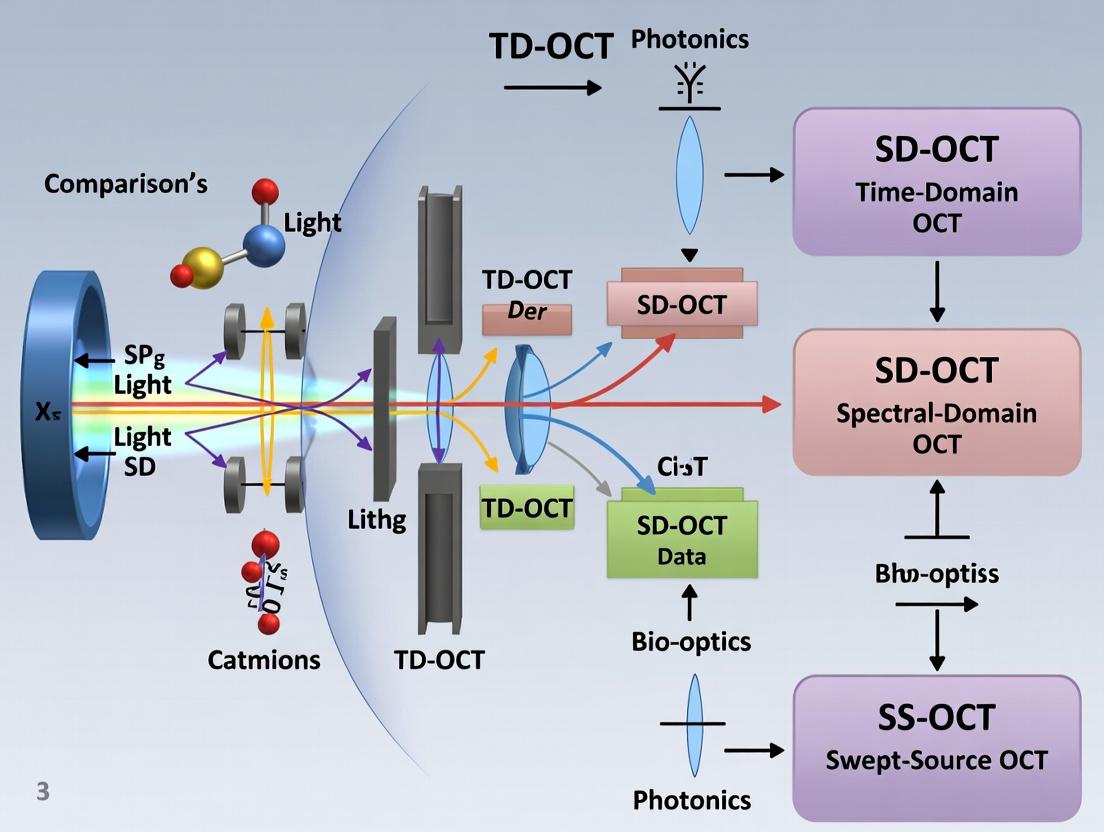
This comprehensive guide provides researchers, scientists, and drug development professionals with a critical analysis of Time-Domain (TD), Spectral-Domain (SD), and Swept-Source (SS) Optical Coherence Tomography technologies.
OCT System Selection Guide 2024: TD-OCT vs. SD-OCT vs. SS-OCT for Biomedical Research and Drug Development
Abstract
This comprehensive guide provides researchers, scientists, and drug development professionals with a critical analysis of Time-Domain (TD), Spectral-Domain (SD), and Swept-Source (SS) Optical Coherence Tomography technologies. We explore the fundamental principles, compare key performance metrics (speed, depth, resolution), detail methodology-specific applications in preclinical and clinical research, address common operational challenges, and provide a validated framework for selecting the optimal OCT system based on specific research intents, from high-throughput screening to deep-tissue imaging.
Understanding OCT Technology: Core Principles of TD, SD, and SS-OCT for Researchers
Troubleshooting Guides & FAQs
FAQ: What is the core principle that all OCT systems share? All Optical Coherence Tomography (OCT) systems are based on the fundamental principle of low-coherence interferometry (LCI). They use a broadband light source with a short coherence length to perform optical sectioning. Interference fringes are detected only when the optical path lengths of the sample and reference arms match within the coherence length of the source. This allows for precise, micrometer-scale depth-resolved imaging of scattering tissues or materials.
Troubleshoot: Poor Axial Resolution in My A-Scan
- Issue: Blurred or thick layers in depth profiles.
- Potential Cause & Solution: Axial resolution is inversely proportional to the bandwidth of the light source. A narrow spectral bandwidth results in poor resolution.
- For TD-/SD-OCT: Verify the central wavelength and bandwidth specification of your superluminescent diode (SLD). Spectral output can degrade over time.
- For SS-OCT: Check the tuning range and linearity of your swept-source laser. Use an external optical spectrum analyzer to monitor the actual output.
- Protocol: Systematically measure the point spread function (PSF) using a mirror as the sample. Calculate the full-width-at-half-maximum (FWHM) of the PSF peak. Compare it to the theoretical resolution: Δz = (2 ln2/π) * (λ₀²/Δλ), where λ₀ is the central wavelength and Δλ is the FWHM bandwidth.
Troubleshoot: Low Signal-to-Noise Ratio (SNR)
- Issue: Noisy, low-contrast images.
- Potential Causes & Solutions:
- Insufficient Reference Power: Optimize the reference arm power to maximize interference fringe contrast without saturating the detector. Use neutral density filters.
- Source Power Drift: Monitor source output power. SLDs and swept sources can exhibit power instability.
- Detector Issues (SD-OCT): For spectrometer-based SD-OCT, ensure the CCD/CMOS linescan camera is cooled properly to reduce thermal noise. Check pixel well-depth saturation.
- Detection Roll-off (SS-OCT): In SS-OCT, signal strength decreases for deeper structures due to finite laser tuning speed and detector bandwidth. Characterize the system roll-off and ensure your sample depth range is within an acceptable roll-off limit (e.g., -6 dB point).
FAQ: How does the detection scheme differentiate TD-OCT, SD-OCT, and SS-OCT within the LCI framework? While all three use LCI, they differ in how they acquire depth information:
- TD-OCT: The reference mirror is mechanically scanned in time. Depth information is encoded in the time-domain signal from a single-point detector.
- SD-OCT (Spectral-Domain): The reference arm is fixed. The interference spectrum is captured simultaneously by a broadband detector (spectrometer). Depth information is obtained by a Fourier transform of the spectral data.
- SS-OCT (Swept-Source): The reference arm is fixed. The wavelength of a narrowband laser is rapidly swept over time. The interference signal at each wavelength is recorded by a single-point detector, building a spectrum in time. A Fourier transform yields depth information.
Troubleshoot: Mirror Image Artifacts
- Issue: A symmetrical, "ghost" image appears on the opposite side of zero-delay.
- Cause & Solution: This is due to the Hermitian symmetry of the real-valued Fourier transform used in SD-OCT and SS-OCT. The sample must be placed entirely on one side of the zero optical path delay (OPD). Protocol: Precisely adjust the position of the reference mirror so that the entire sample structure is offset from zero OPD. Use post-processing algorithms (e.g., phase-shifting) to achieve complex conjugate artifact removal if necessary.
Troubleshoot: Sensitivity Roll-off Discrepancy Between SD and SS Systems
- Issue: Faster signal decay with depth than theoretically expected.
- SD-OCT Protocol: Measure the relationship between detected signal strength and mirror position. The primary cause is limited spectral resolution of the spectrometer. Ensure the spectrometer is well-calibrated; the grating and camera lens should focus the full spectrum sharply across the sensor array.
- SS-OCT Protocol: Characterize roll-off by measuring PSF amplitude vs. depth. Key factors are the instantaneous linewidth of the swept source and the data acquisition sampling method (e.g., use of a k-clock for non-uniform sampling in wavenumber, k). Always use the built-in or an external k-clock for optimal performance.
Quantitative Comparison of OCT Modalities
Table 1: Key System Parameter Comparison for OCT Modality Selection
| Parameter | TD-OCT | SD-OCT (Spectrometer-based) | SS-OCT (Swept-Source) |
|---|---|---|---|
| Axial Resolution | 8-15 µm (in tissue) | 4-7 µm (in tissue) | 5-10 µm (in tissue) |
| Imaging Speed | Slow (1-5 A-scans/sec) | Very Fast (20k-350k A-scans/sec) | Fast to Very Fast (20k-5M A-scans/sec) |
| Max. Sensitivity | ~100 dB | 95-105 dB | 105-110 dB |
| Sensitivity Roll-off | None | Medium (~2-4 mm typical) | High (~5-10 mm typical) |
| Central Wavelength | 800-1300 nm | 800-900 nm (Ophthalmic) | 1050-1310 nm (Biomedical) |
| Key Advantage | Simple, direct depth encoding | High speed & sensitivity | Long depth range, high penetration |
| Key Limitation | Mechanical scanning limits speed | Sensitivity roll-off, spectral calibration | Complex source, relative intensity noise |
Experimental Protocol: Measuring System Point Spread Function (PSF) & Resolution
Objective: To empirically determine the axial resolution and sensitivity roll-off of an SD-OCT or SS-OCT system. Materials: OCT system under test, high-quality mirror, neutral density filter (OD 1.0-2.0), translation stage with micrometer, data acquisition computer. Procedure:
- Replace the sample with a mirror.
- Attenuate the sample arm beam using the neutral density filter to avoid detector saturation.
- Precisely align the sample arm to reflect light directly back into the interferometer.
- Adjust the reference mirror to place the interference signal (peak) at a shallow depth (e.g., ~100 µm). Record the A-scan. Measure the FWHM of the peak. This is the axial PSF at that depth.
- Move the reference mirror in precise increments (e.g., 0.5 mm steps) to translate the mirror peak to greater depths. Record an A-scan at each position.
- For each depth, measure the peak amplitude (in dB).
- Plot peak amplitude (dB) vs. depth. The slope indicates sensitivity roll-off. The FWHM of the first peak is the effective axial resolution.
The Scientist's Toolkit: Key Research Reagent Solutions
Table 2: Essential Materials for OCT System Characterization & Experimentation
| Item | Function in OCT Research |
|---|---|
| SLD or Swept Laser Source | Provides the low-coherence, broadband light essential for interferometry and defines axial resolution. |
| Photodetector / Spectrometer | Converts the optical interference signal into an electrical signal for digitization (TD/SS) or spectral dispersion and detection (SD). |
| Reference Arm Mirror | Provides the stable reference beam. Precision translation stages (TD-OCT) or fixed mounts (SD/SS-OCT) are critical. |
| Optical Isolator | Prevents back-reflected light from re-entering and destabilizing the laser source. |
| Fiber Optic Circulator | Used in SS-OCT setups to efficiently direct light to the sample and back-reflected light to the detector. |
| k-Clock Module (SS-OCT) | Provides a uniform sampling trigger in wavenumber (k-space), crucial for maintaining depth resolution over range and avoiding artifacts. |
| Calibration Mirror & Attenuator | A high-quality mirror and set of neutral density filters for system PSF, resolution, and SNR characterization. |
| Dispersive Compensation Prisms/Glass | Corrects for material dispersion mismatch between sample and reference arms, especially important in ultra-broadband systems. |
System Selection & Signal Processing Workflows
OCT Modality Selection Logic
OCT Signal Processing Pathways
Technical Support Center
Troubleshooting Guides
Issue: Poor Signal-to-Noise Ratio (SNR) in A-Scans
- Symptoms: Noisy, low-contrast images; difficulty resolving tissue layers.
- Probable Causes & Solutions:
- Low Reference Power: Check alignment of reference mirror and beam splitter. Ensure reflective coating is clean.
- Sample Arm Misalignment: Re-align sample arm optics. Ensure sample is within focus and the beam is perpendicular to the interface.
- Source Intensity Drift: Monitor source power with a photodetector. Allow source to warm up for 30 minutes before acquisition.
- Detector Saturation or Low Gain: Adjust neutral density filters in reference arm. Verify detector gain settings.
Issue: Depth Range Artifacts (Mirror Images)
- Symptoms: Duplicate structures appear symmetrically around zero delay.
- Probable Causes & Solutions:
- Fourier Transform of Real-Valued Signal: This is inherent to TD-OCT processing. Ensure proper post-processing to discard negative depth information or use complex (quadrature) demodulation techniques if your system supports it.
- Incorrect Zero-Delay Positioning: Physically adjust the reference mirror position so the region of interest is away from the zero-delay point.
Issue: Axial Resolution Degradation
- Symptoms: Blurring of closely spaced tissue layers.
- Probable Causes & Solutions:
- Broadband Source Issues: Check source spectral bandwidth. Contamination or aging of superluminescent diode (SLD) can reduce bandwidth.
- Dispersion Mismatch: Use identical optics in reference and sample arms. For complex samples, implement software or hardware-based dispersion compensation.
Frequently Asked Questions (FAQs)
Q1: How does the axial resolution of our TD-OCT system compare theoretically to newer SD-OCT systems? A: Axial resolution (Δz) is inversely proportional to the spectral bandwidth (Δλ) of the light source. While both TD-OCT and SD-OCT share this relationship, SD-OCT typically achieves higher practical resolution because it uses a broadband source without a scanning reference mirror, avoiding mechanical limitations. Our TD-OCT system with a 50 nm bandwidth SLD at 1300 nm has a theoretical Δz of ~12 μm in tissue. Modern SD-OCT systems with 150 nm bandwidth can achieve <5 μm.
Q2: Why is our acquisition speed so limited compared to published Fourier-Domain OCT papers? A: This is a fundamental characteristic. TD-OCT speed is limited by the physical, mechanical scanning of the reference mirror. The mirror's velocity and stability constrain the A-scan rate to typically a few hundred Hz. In contrast, SD-OCT uses a stationary reference and a spectrometer, enabling rates of tens to hundreds of kHz.
Q3: We are studying dynamic processes. Is TD-OCT suitable, or should we consider SS-OCT for our next system? A: For dynamic imaging (e.g., cellular kinetics, blood flow), TD-OCT's slow speed is a major drawback. Swept-Source OCT (SS-OCT) is the superior choice for such research. SS-OCT offers high speed (MHz A-scan rates), longer imaging range, and better sensitivity roll-off, making it ideal for in vivo, volumetric, and functional imaging.
Q4: How do I calibrate the depth scale (μm per pixel) in my acquired data? A: The depth scale is determined by the reference mirror scan velocity. Record an interferogram from a known, single reflective surface. The distance between the positive and negative mirror images in pixels corresponds to a known optical path difference. Use this to calculate the scale factor (e.g., μm/pixel).
Quantitative Comparison of OCT Modalities
Table 1: Key Performance Parameters of OCT Technologies
| Parameter | Time-Domain (TD-OCT) | Spectral-Domain (SD-OCT) | Swept-Source (SS-OCT) |
|---|---|---|---|
| Core Mechanism | Moving reference mirror | Stationary mirror, spectrometer | Tunable laser, single detector |
| A-Scan Rate | 100 - 2,000 Hz | 20,000 - 500,000 Hz | 100,000 - 5,000,000+ Hz |
| Axial Resolution | 5 - 15 μm (in tissue) | 2 - 7 μm (in tissue) | 2 - 10 μm (in tissue) |
| Sensitivity | ~90 dB | 95 - 105 dB | 100 - 110 dB |
| Advantage | Simple concept, direct depth mapping | High speed & sensitivity | Very high speed, long range, deep imaging |
| Limitation | Slow speed, mechanical wear | Sensitivity roll-off, limited range | Complex laser source, cost |
Experimental Protocol: Measuring System Point Spread Function (PSF)
Purpose: To characterize the axial resolution and sensitivity roll-off of a TD-OCT system. Materials: See "The Scientist's Toolkit" below. Method:
- System Setup: Power on the SLD source and allow 30 minutes for stabilization. Align the interferometer for optimal fringe contrast.
- Sample Preparation: Use a clean, single-surface mirror as the sample. Place it at the focal plane of the sample arm objective.
- Data Acquisition:
- Position the reference mirror to place the sample reflection at zero optical path difference (OPD).
- Slowly move the reference mirror to place the sample reflection at a known OPD (e.g., 0.5 mm).
- Acquire a single A-scan. Save the raw interferometric signal.
- Repeat step 3, incrementally increasing the OPD in steps (e.g., 0.1 mm) up to the maximum scan range of the mirror.
- Data Analysis:
- For each saved A-scan, apply a windowing function (e.g., Hanning) and compute the Fourier transform.
- Plot the peak signal intensity (in dB) versus the OPD position. This is the sensitivity roll-off curve.
- At the OPD with maximum signal, measure the full-width-at-half-maximum (FWHM) of the peak. Convert this to micrometers using the system's calibration to determine the experimental axial resolution (PSF).
System Diagrams
The Scientist's Toolkit
Table 2: Key Research Reagent Solutions for TD-OCT Experiments
| Item | Function in TD-OCT Experiment |
|---|---|
| Superluminescent Diode (SLD) | Broadband, low-coherence light source. Determines central wavelength and axial resolution. |
| Precision Linear Translation Stage | Drives the reference mirror with micron-scale precision to perform depth scanning. |
| Photodetector (e.g., InGaAs PIN) | Converts the interferometric light signal into an electrical current. |
| Lock-in Amplifier | Extracts the interference signal amplitude at the modulation frequency, rejecting noise. |
| Neutral Density (ND) Filters | Attenuates light in the reference arm to optimize interference contrast and prevent detector saturation. |
| Single-Surface Mirror | Used as a calibration sample to measure system PSF, resolution, and sensitivity roll-off. |
| Optical Phantom (e.g., Silicone) | Tissue-mimicking standard for validating imaging performance, contrast, and penetration depth. |
| Index Matching Fluid | Reduces unwanted reflections at optical interfaces (e.g., glass-sample). |
Technical Support Center
Troubleshooting Guides & FAQs
Q1: Our SD-OCT system shows a sudden and severe drop in signal-to-noise ratio (SNR) and axial resolution. What are the primary culprits and how can we diagnose them?
- A: This typically indicates a failure in the spectral detection chain. Follow this diagnostic protocol:
- Check Source Spectrum: Use an optical spectrum analyzer to verify the broadband source's output power and spectral shape. Degradation here directly reduces system performance.
- Inspect Spectrometer Alignment:
- Diffraction Grating: Ensure it is clean and securely mounted. Misalignment will disperse light incorrectly onto the line camera.
- Line Camera: Run a dark frame calibration. An increase in fixed-pattern noise or dead pixels suggests camera issues.
- Optical Focus: Verify that the spectrum is sharply focused across the entire camera sensor array. A defocused spectrum broadens individual wavelength bins, reducing resolution.
- Reference Arm Power: Confirm the reference arm power is optimized. Too high a signal can saturate the camera; too low increases shot noise.
Q2: We observe persistent, high-frequency horizontal stripes (fixed-pattern noise) in all our B-scans, which averaging does not remove. How do we eliminate this artifact?
- A: This is classic fixed-pattern noise arising from imperfections in the spectrometer. It must be removed via background subtraction in pre-processing.
- Experimental Protocol for Fixed-Pattern Noise Removal:
- Block the sample arm beam completely.
- Acquire a set of raw spectrometer readings (e.g., 100-500 acquisitions). This captures the system's background pattern, including camera bias and interference fringes from static reflections.
- Average these readings to create a master background frame.
- For all subsequent acquisitions, subtract this master background frame from each raw spectral interferogram before applying the Fourier transform.
- Experimental Protocol for Fixed-Pattern Noise Removal:
Q3: During longitudinal in vivo studies, we notice inconsistent depth positioning of the same anatomical layer. What calibration steps are we missing?
- A: Depth scaling in SD-OCT requires precise calibration. Implement this protocol:
- Materials: A calibrated glass model eye or a mirror with a known, precise axial offset (e.g., a coverslip of known thickness).
- Method:
- Acquire an interferogram from the known sample.
- Process the data with your standard algorithm.
- Measure the resulting peak position in the A-scan (in pixels).
- Calculate the depth scaling factor:
Δz_physical / Δz_pixels. - Apply this linear scaling factor to all A-scans. Recalibrate whenever the spectrometer configuration (grating, lens, camera) is altered.
Q4: For drug development studies quantifying retinal layer thickness, how do we choose between SD-OCT and the other modalities (TD-OCT, SS-OCT) mentioned in the broader thesis?
- A: The choice hinges on the specific requirement of speed, depth range, and resolution. See the comparative table below.
Comparative Performance Data: OCT Modalities
Table 1: Key system parameter comparison for OCT modality selection in biomedical research.
| Parameter | TD-OCT | SD-OCT (Spectral-Domain) | SS-OCT (Swept-Source) |
|---|---|---|---|
| Core Mechanism | Time-domain scanning of reference arm. | Fourier transform of spectrum from broadband source. | Fourier transform of time-varying signal from wavelength-swept laser. |
| Max. A-scan Rate | Low (~4 kHz) | Very High (50k – 500k Hz) | High (100k – 2M Hz) |
| Typical Sensitivity | ~100 dB | 110 – 115 dB | 105 – 110 dB |
| Depth Range (in air) | Limited by scan range. | Limited by spectrometer resolution (~1-3 mm). | Extended by laser coherence length (5-20 mm). |
| Common Central Wavelength | ~830 nm (retina), ~1300 nm (dermis) | ~830 nm (retina), ~1300 nm (dermis) | ~1050 nm (deeper retina), ~1300 nm (anterior eye, skin) |
| Key Advantage for Drug Dev. | Lower cost, simplicity. | Best sensitivity & speed for most in vivo applications. | Deeper penetration, reduced sensitivity roll-off. |
Experimental Protocol: Standard SD-OCT A-scan Acquisition & Processing
This protocol details the steps from acquisition to A-scan generation.
- Spectral Interferogram Acquisition: The balanced detector in the spectrometer outputs a digitized signal, I(k), representing light intensity as a function of wavenumber, k.
- Pre-processing:
- Background Subtraction: Subtract the master background frame (see FAQ #2).
- DC Subtraction: Remove the constant intensity component (e.g., by subtracting the mean of I(k)).
- Dispersion Compensation: Apply numerical correction to match dispersion in sample and reference arms.
- Resampling: Resample I(k) from wavelength (λ) to linear wavenumber (k) space.
- Fourier Transformation: Apply a Fast Fourier Transform (FFT) to the processed interferogram, I(k).
- Conversion to Depth Profile: The magnitude of the FFT output yields the depth-resolved reflectivity profile, or A-scan:
A(z) = |FFT{I(k)}|².
SD-OCT Signal Processing Workflow
The Scientist's Toolkit: Key Research Reagent Solutions for SD-OCT Validation
Table 2: Essential materials for system characterization and biological phantom development.
| Item | Function & Application in SD-OCT Research |
|---|---|
| Optical Spectrum Analyzer (OSA) | Characterizes the broadband source's central wavelength, bandwidth (Δλ), and stability, which define axial resolution. |
| Calibrated Reflection Phantom | A sample with known reflectivity and discrete reflective surfaces at precise depths (e.g., a multilayer coverslip) for measuring system sensitivity roll-off and depth scaling. |
| Tissue-Mimicking Phantoms | Scattering hydrogels (e.g., with TiO₂ or polystyrene microspheres) of known optical properties. Used to validate intensity measurements and contrast mechanisms in drug response studies. |
| Reference Mirror on Precision Stage | Allows precise variation of the reference arm length for calibration and can simulate Doppler shifts for flow system validation. |
| Dedicated FFT/GPU Processing Library | High-speed software (e.g., FFTW, CUDA libraries) is critical for real-time processing of the large spectral datasets generated by high-speed SD-OCT systems. |
Technical Support Center
Troubleshooting Guide
Issue 1: Reduced Imaging Depth or Signal Drop-off
- Symptoms: Signal quality degrades rapidly with depth. Unable to image deeper tissue layers.
- Probable Causes & Solutions:
- Cause A: Laser output power degradation or sweep nonlinearity.
- Solution: Use an optical power meter to verify laser output across the sweep. Consult manufacturer specifications for power stability metrics. Recalibrate the laser sweep using a built-in k-clock or external Mach-Zehnder interferometer (MZI).
- Cause B: Dispersive mismatch between sample and reference arms.
- Solution: Introduce a dispersion compensation block (e.g., a pair of diffraction gratings or customized glass elements) in the reference arm. Systematically adjust while imaging a known sample to maximize signal uniformity with depth.
- Cause A: Laser output power degradation or sweep nonlinearity.
Issue 2: Increased Coherence Artifacts or "Ghost Images"
- Symptoms: Repeated, faint mirror images or structured noise appear in the A-scan.
- Probable Causes & Solutions:
- Cause A: Multiple reflections within the system (e.g., from unused fiber ends or lens surfaces).
- Solution: Ensure all unused fiber ports are terminated with angle-polished connectors (APC). Use anti-reflection coated optics. Introduce optical isolators if necessary.
- Cause B: Insufficient suppression of the laser's instantaneous linewidth.
- Solution: This is often a laser source design limitation. Ensure the laser is operating at the specified temperature and current. Implement digital filtering in post-processing if the artifact's frequency is consistent.
- Cause A: Multiple reflections within the system (e.g., from unused fiber ends or lens surfaces).
Issue 3: Axial Resolution Degradation
- Symptoms: Blurring of layer boundaries in A-scans, resolution worse than system specification.
- Probable Causes & Solutions:
- Cause A: Laser sweep bandwidth has narrowed.
- Solution: Characterize the laser's instantaneous wavelength sweep using a high-finesse optical spectrum analyzer (OSA) or a calibration interferometer. Compare the achieved bandwidth to the original spec.
- Cause B: Improper calibration of the k-space linearization (resampling) process.
- Solution: Re-acquire the calibration signal from the MZI. Ensure the data acquisition is triggered precisely by the k-clock. Verify the resampling interpolation algorithm.
- Cause A: Laser sweep bandwidth has narrowed.
Issue 4: Spatial Distortion in B-Scans
- Symptoms: Images appear stretched or compressed laterally or in depth.
- Probable Causes & Solutions:
- Cause A: Non-uniform scanning velocity of the galvanometric scanner.
- Solution: Characterize the scanner's duty cycle and waveform. Use a position sensor detector (PSD) to verify linearity. Adjust the driving waveform (often a triangular wave with adjusted turning points) for linear spatial sampling.
- Cause B: Incorrect scaling factor between optical and digital depth.
- Solution: Re-measure the system's effective central wavelength and total sweep range. Recalculate the digital-to-depth scaling factor:
Δz = λ0²/(4nΔλ), where λ0 is central wavelength, Δλ is sweep bandwidth, and n is tissue refractive index.
- Solution: Re-measure the system's effective central wavelength and total sweep range. Recalculate the digital-to-depth scaling factor:
- Cause A: Non-uniform scanning velocity of the galvanometric scanner.
Frequently Asked Questions (FAQs)
Q1: In my thesis comparing TD-, SD-, and SS-OCT, what is the single most compelling performance advantage of SS-OCT I should highlight? A1: The combination of superior imaging depth range and high acquisition speed. SS-OCT's sensitivity roll-off is significantly slower than SD-OCT, allowing for deeper imaging. Simultaneously, its detection scheme allows for much faster A-scan rates (hundreds of kHz to MHz) compared to both TD-OCT and SD-OCT, enabling real-time, volumetric imaging.
Q2: My SS-OCT system's signal-to-noise ratio (SNR) is lower than theoretically expected. What are the key parameters to check? A2: First, verify the reference arm power is optimized for your camera's full-well capacity, avoiding saturation. Second, measure the laser's coherence length; a shorter than specified length will reduce SNR. Third, ensure balanced detection (if used) is perfectly balanced to suppress relative intensity noise (RIN). Fourth, check the digitizer's bit depth and effective number of bits (ENOB); insufficient digitization adds noise.
Q3: How do I rigorously quantify the "superior performance" of SS-OCT for my research in drug development? A3: Design a comparative experiment using a standardized phantom (e.g., a multi-layer polymer) and biological sample (e.g., ex vivo retina or skin). Measure and tabulate the following metrics side-by-side with SD-OCT (if available):
- Sensitivity Roll-off: Measure SNR drop over depth.
- Imaging Speed: Volumetric acquisition time for a defined field of view.
- System Sensitivity: Peak SNR with a near-perfect reflector.
- Dynamic Range: In vivo imaging of highly reflective structures (e.g., rodent skull) alongside faint structures (e.g., underlying cortex).
Q4: What are common failure modes of wavelength-swept lasers, and how can I diagnose them? A4:
- Sweep Rate Instability: Caused by malfunctioning MEMS scanner or fiber stretcher driver. Diagnose with a photodetector and oscilloscope to view the temporal fringe pattern.
- Bandwidth Collapse: Often due to misalignment of the intracavity tuning filter or gain medium degradation. Diagnose with an OSA.
- Increased Phase Noise: Results in reduced coherence length. Diagnose by monitoring the linewidth of the MZI calibration signal or directly measuring the laser's linewidth with a delayed self-heterodyne/interferometric method.
Quantitative Performance Data: OCT Modalities
Table 1: Key Performance Metrics of Primary OCT Modalities
| Metric | Time-Domain (TD-) OCT | Spectral-Domain (SD-) OCT | Swept-Source (SS-) OCT |
|---|---|---|---|
| Typical A-Scan Rate | 1 - 10 kHz | 20 - 100 kHz | 100 - 1,500+ kHz |
| Axial Resolution (in tissue) | ~5 - 15 μm | ~3 - 7 μm | ~3 - 7 μm |
| Sensitivity | ~100 - 110 dB | ~95 - 105 dB | ~105 - 110 dB |
| Sensitivity Roll-off | None | Rapid (~1-3 mm) | Very Slow (~5-20 mm) |
| Central Wavelength | ~840 nm, 1300 nm | ~840 nm, 1050 nm, 1300 nm | ~1050 nm, 1300 nm, 1550 nm |
| Key Advantage | Simplicity, low cost | High sensitivity at shallow depth | High speed & deep imaging |
Table 2: Common Wavelength-Swept Laser Technologies
| Laser Type | Tuning Mechanism | Typical Sweep Rate | Typical Sweep Range | Key Characteristics |
|---|---|---|---|---|
| MEMS-VCSEL | Micro-Electro-Mechanical System (MEMS) tuning of a Vertical-Cavity Surface-Emitting Laser (VCSEL) | 100 - 500 kHz | ~100 nm @ 1300nm | Very long coherence length, high linearity in k-space. |
| Fourier Domain Mode-Locked (FDML) | A long fiber delay loop synchronizes a wavelength-swept filter with the roundtrip of light. | 50 - 400 kHz | ~100 nm @ 1300nm | Historically enabled very high sweep rates. |
| Filter-Based Swept Laser | A semiconductor optical amplifier (SOA) with a rotating polygonal mirror or tunable fiber Fabry-Perot filter. | 10 - 100 kHz | ~50-150 nm @ 1300nm | Robust, common in commercial systems. |
Experimental Protocol: Measuring Sensitivity Roll-off
Objective: To quantitatively compare the sensitivity roll-off performance of SD-OCT and SS-OCT systems, a critical parameter for deep-tissue imaging in drug development studies.
Materials:
- OCT system (SD-OCT and SS-OCT).
- A partial reflector (e.g., a glass plate with ~4% reflectivity).
- A high-precision linear translation stage.
- Neutral density (ND) filters.
- Data acquisition and processing software (e.g., MATLAB, Python).
Methodology:
- Setup: Place the partial reflector in the sample arm. Use an ND filter to avoid detector saturation. Align the beam to be normal to the reflector surface.
- Data Acquisition:
- Position the reflector at the zero-delay (maximum signal) point. Acquire a reference A-scan.
- Move the reflector away from zero-delay in precise increments (e.g., 0.5 mm steps) using the translation stage. At each position, acquire and average 100 A-scans.
- Data Processing:
- For each A-scan, locate the peak corresponding to the reflector.
- Calculate the Signal-to-Noise Ratio (SNR) at each depth position:
SNR(z) = 20*log10(Isignal(z)/Inoise), where Inoise is the mean noise floor measured from a region without signal.
- Analysis:
- Plot SNR (dB) vs. Depth (mm) for both systems.
- Extract the roll-off parameter: the depth at which the SNR has decreased by 3 dB or 6 dB from its peak near zero delay.
- Fit the data to the theoretical roll-off curve for each system type.
The Scientist's Toolkit: SS-OCT Research Reagent Solutions
Table 3: Essential Materials for SS-OCT System Characterization & Experiments
| Item | Function in SS-OCT Context |
|---|---|
| Mach-Zehnder Interferometer (MZI) | Generates a constant frequency calibration fringe signal for linearizing the laser sweep in k-space. Critical for achieving optimal axial resolution. |
| k-Clock (Hardware Trigger) | A dedicated photodetector circuit that generates a precise trigger pulse every time the MZI fringe crosses zero. Ensures equidistant sampling in wavenumber (k). |
| Optical Spectrum Analyzer (OSA) | Monitors the time-integrated and instantaneous output spectrum of the swept laser to verify sweep range, bandwidth, and stability. |
| Balanced Photodetector | Receives light from both the sample and reference arms, subtracting common-mode noise (like RIN) to significantly improve system sensitivity and dynamic range. |
| Fiber Collimators & Lenses (AR Coated) | Shapes and directs the sample arm beam. Anti-reflection (AR) coating is mandatory to minimize back-reflections that cause coherence artifacts. |
| Standardized Test Phantom | A multi-layered or microsphere-embedded phantom with known optical properties and structure. Used for daily validation of system resolution, contrast, and calibration. |
System Visualization
SS-OCT System Block Diagram
OCT Modality Selection Logic
Technical Support Center
Troubleshooting Guide & FAQs
Q1: My OCT image appears blurred with poor axial detail. Which system parameter is most likely the culprit, and how can I verify this? A: This typically indicates degraded axial resolution. In SD-OCT and SS-OCT, axial resolution is decoupled from depth scanning and is primarily determined by the light source's center wavelength and bandwidth. To verify, measure the system's point spread function (PSF) using a mirror as a sample.
- Protocol: Place a mirror at the sample arm focus. Acquire an A-scan. The full-width at half-maximum (FWHM) of the reflected peak in optical path length units is your measured axial resolution. Convert to geometrical units using the group refractive index of your medium. Compare this to the theoretical resolution: Δz = (2 ln2/π) * (λ₀²/Δλ), where λ₀ is the center wavelength and Δλ is the FWHM bandwidth.
- Action: If measured resolution is worse than theoretical, check your spectrometer calibration (SD-OCT) or laser sweep linearity (SS-OCT). Ensure the light source spectrum has not degraded.
Q2: I am experiencing significant signal loss when imaging deeper than ~1.5 mm in a scattering sample. What are the primary parameters to investigate? A: This is directly related to sensitivity roll-off and imaging depth. Sensitivity roll-off describes the decrease in signal-to-noise ratio (SNR) with increasing imaging depth.
- For SD-OCT: Roll-off is a fundamental limitation caused by finite spectrometer pixel resolution. It is characterized by the roll-off parameter, often given as the depth at which sensitivity drops by 6 dB.
- For SS-OCT: Roll-off is significantly better and is primarily limited by the coherence length of the swept-source laser.
- Protocol: To characterize, acquire A-scans from a mirror placed at the zero-delay position. Then, translate the mirror to known depths using a calibrated translation stage. Plot the measured signal peak intensity (in dB) versus depth. The slope of this line defines your system's roll-off.
- Action: For SD-OCT, ensure optimal spectrometer alignment and that the mirror sample beam is focused onto the grating. For SS-OCT, verify laser performance specifications.
Q3: When switching from a low A-scan rate to the system's maximum rate, my image becomes noisier. Why does this happen, and what is the trade-off? A: This highlights the critical balance between A-scan rate and system sensitivity. Higher A-scan rates reduce the integration (or exposure) time per scan, which directly lowers the collected signal and thus the SNR.
- Protocol: Perform a sensitivity measurement at different A-scan rates. Place a neutral density filter (e.g., ND 1.0, attenuating ~90% of light) and a mirror in the sample arm. Measure the SNR of the reflected peak at each rate. The sensitivity is calculated as: Sensitivity (dB) = SNR (dB) + Attenuation (dB).
- Action: You must choose an A-scan rate that provides sufficient SNR for your sample. For in vivo imaging where motion artifacts are a concern, you may prioritize speed and use frame averaging or pixel binning to recover SNR.
Q4: How does lateral resolution differ between system types (TD/SD/SS), and what are common causes of lateral blurring in practice? A: Lateral resolution is independent of the OCT technique (TD, SD, SS) and is determined solely by the sample arm optics. It is given by the spot size of the focused probe beam (Δx = (4λ/π) * (f/d), where f is the lens focal length and d is the beam diameter).
- Common Issue: Lateral blurring in scanned systems is often due to non-telecentric scanning or optical aberrations. If the scan pivots at a point other than the pupil plane of the objective lens, the beam will shift (walk-off) at the focus, causing defocus and resolution loss at the image edges.
- Protocol: Image a resolution target or a sparse distribution of sub-resolution scatterers (e.g., nanoparticles). Measure the FWHM of the point spread function across the field of view (FOV).
- Action: Ensure the scanning galvanometer mirror is placed at the back focal plane (pupil) of the objective lens (telecentric design). Use objective lenses corrected for your source's wavelength range.
Comparison of Key OCT Parameters
The following table summarizes the defining characteristics of TD-, SD-, and SS-OCT systems in relation to the key parameters, crucial for system selection in research and drug development.
Table 1: Comparative Analysis of TD-OCT, SD-OCT, and SS-OCT Systems
| Parameter | TD-OCT | SD-OCT (Spectrometer-based) | SS-OCT (Swept-Source-based) |
|---|---|---|---|
| Axial Resolution | Decoupled from scan, depends on source bandwidth (Δλ). | Decoupled from scan, depends on source bandwidth (Δλ). | Decoupled from scan, depends on source bandwidth (Δλ). |
| A-Scan Rate | Slow (Hz to kHz). Limited by mechanical mirror scanning. | Fast (kHz to ~100s of kHz). Limited by line scan camera readout. | Very Fast (kHz to several MHz). Limited by laser sweep rate. |
| Imaging Depth | Defined by reference arm scan range. | Limited by spectrometer resolution. Depth-dependent SNR roll-off. | Limited by laser coherence length/sweep. Superior roll-off performance. |
| Sensitivity Roll-off | None within scan range. | Rapid. Key limiting factor, set by spectrometer pixel spacing. | Slow. Typically >10x better than SD-OCT. |
| Key Advantage | Simplicity, high phase stability. | Speed & sensitivity advantage over TD-OCT. | Highest speed and best depth performance. Enables long-range imaging. |
| Key Disadvantage | Very slow, moving parts limit stability. | Roll-off limits usable depth. Camera noise dominates. | More complex source, potential for intensity noise. |
Essential Experimental Protocols
Protocol 1: System Sensitivity & Roll-off Measurement Objective: Quantify the system's detection sensitivity and its decay with depth.
- Setup: Place a mirror in the sample arm at the focus. Attach a calibrated neutral density filter (NDF) of known high attenuation (e.g., 40-50 dB) in front of the mirror.
- Data Acquisition: For the chosen A-scan rate, acquire a single A-line (or average a few for stability). Record the peak intensity value (in digital counts or volts) from the mirror reflection.
- Calculation: Compute the Signal-to-Noise Ratio (SNR) as the ratio of the peak signal power to the mean noise floor power (measured far from the peak). Sensitivity (dB) = SNR (dB) + NDF Attenuation (dB).
- Roll-off: Repeat steps 1-3 with the mirror translated to increasing depths using a precision stage. Plot signal (dB) vs. depth (mm). The 6-dB roll-off depth is a standard metric.
Protocol 2: Axial & Lateral Resolution Validation Objective: Empirically measure the system's point spread function.
- Axial Resolution: Use the mirror setup without the NDF at the zero-delay position. Acquire an A-scan. The FWHM of the interference peak in optical path length (converted to geometrical depth using tissue refractive index ~1.38) is the axial resolution.
- Lateral Resolution: Replace the mirror with a sub-resolution scattering target (e.g., a diluted suspension of 200-nm polystyrene beads dried on a coverslip, or a USAF 1951 resolution target). Acquire a 3D volume. For beads, the FWHM of the intensity profile of a single bead in the en face (XY) plane is the lateral resolution.
The Scientist's Toolkit
Table 2: Key Research Reagent Solutions for OCT Imaging
| Item | Function in OCT Experiments |
|---|---|
| Optical Phantoms (e.g., Silicone with TiO₂ or Al₂O₃ scatterers) | Mimic tissue scattering properties for system calibration, resolution testing, and protocol standardization. |
| Resolution Target (USAF 1951 or Siemens Star) | A standardized slide for directly quantifying and monitoring lateral resolution across the field of view. |
| Neutral Density (ND) Filters | Precisely calibrated attenuators for performing critical sensitivity measurements of the OCT system. |
| Index Matching Fluids/Gels | Reduce strong, unwanted surface reflections from glass-tissue or glass-sample interfaces that can saturate the detector. |
| Fixed Tissue Sections (e.g., mouse brain, artery) | Well-characterized biological samples for benchmarking image quality, contrast, and penetration depth across different system configurations. |
System Selection & Performance Relationships
OCT System Selection Decision Logic
Interdependence of Key OCT Performance Parameters
Matching OCT Modality to Research Goals: Applications in Preclinical and Clinical Studies
Technical Support Center
Troubleshooting Guides & FAQs
Q1: Our legacy TD-OCT system produces images with significantly lower signal-to-noise ratio (SNR) compared to newer SD-OCT systems in our lab. What are the primary hardware limitations, and are there protocol adjustments to mitigate this for longitudinal in-vitro drug response studies?
A1: The lower SNR is inherent to the TD-OCT design due to its use of a moving reference mirror and single-pixel detector, which limits its sensitivity and imaging speed. For modern drug development applications, consider these protocol adjustments:
- Extended Averaging: Increase the number of A-scan averages per B-scan location (e.g., from 4 to 16-32). This directly improves SNR at the cost of increased acquisition time.
- Optimized Sample Preparation: Use optical clearing agents (e.g., glycerol, FocusClear) on ex-vivo tissue samples to reduce scattering and improve penetration depth, partially offsetting sensitivity limits.
- Stable Environmental Control: Conduct experiments in a temperature-stable environment (e.g., ±0.5°C) to minimize thermal drift in the mechanical scanning mechanism, reducing motion artifacts that degrade effective SNR.
Q2: When using a TD-OCT for dynamic process monitoring (e.g., microfluidic channel flow), we encounter severe "stitching" artifacts in cross-sectional images. What is the likely cause and solution?
A2: This is a classic TD-OCT artifact stemming from jitter and non-linearity in the galvanometer-driven reference mirror delay line. The mismatch between assumed and actual mirror position during a B-scan distorts the image.
- Cause: Wear in older galvanometer bearings or degradation of positional feedback sensors.
- Solution:
- Perform a System Re-Calibration: Follow the manufacturer's legacy procedure for mirror linearity calibration using a known target (e.g., a coverslip). This often involves recording the interference fringe pattern vs. commanded voltage.
- Software Post-Processing: If hardware calibration is insufficient, implement a software correction. Acquire a profile of a sharp, known interface (mirror) across the scan. Use the deviation from the expected straight line to create a pixel re-mapping lookup table for all subsequent biological image data.
Q3: Can a TD-OCT system be reliably used to measure the thickness of a thin polymer coating (≈10-50 µm) on a drug-eluting implant stent, and what precision can we expect?
A3: Yes, this is a niche application where TD-OCT excels due to its inherent depth ambiguity resolution and typically broader spectral bandwidth (leading to high axial resolution).
- Protocol:
- Mount the stent in a custom holder to minimize vibrations.
- Use a low numerical aperture (NA) objective to maintain a long depth of focus.
- Acquire M-mode data (repeated A-scans at one lateral position) with high averaging (>100) to stabilize the interference fringe signal from the coating surfaces.
- Use the system's built-in Fourier transform algorithm on the fringe data to locate the peak corresponding to the optical path difference between the coating's front and back surfaces.
- Expected Precision: With a 800nm center wavelength and 100nm bandwidth source, axial resolution is ≈1.7µm (in air). With careful fringe analysis (sub-pixel peak fitting), sub-micron precision (0.5-0.8 µm) in geometric thickness is achievable, assuming the group refractive index of the polymer is known.
Q4: Our lab's legacy TD-OCT system software runs on an old Windows XP computer and cannot export data in a modern format. How can we integrate this data into our automated analysis pipeline?
A4: This is a common interoperability challenge. A two-step solution is recommended:
- Data Acquisition Layer: Use a National Instruments (or similar) data acquisition (DAQ) card installed in the legacy PC. Bypass the proprietary software by directly acquiring the analog output signal from the TD-OCT photodetector, synchronized with the mirror scan voltage. Write a simple LabVIEW or Python script to sample this signal and save it as a standard
.binor.csvfile. - Data Processing Layer: On a modern computer, process the raw fringe signal using open-source OCT reconstruction libraries (e.g., in Python using
numpy,scipy). This involves digital filtering, resampling, and FFT to reconstruct the A-scan.
Quantitative Comparison: OCT Modalities in Research Context
Table 1: Key Performance Parameters of OCT Modalities for System Selection
| Parameter | TD-OCT (Legacy) | SD-OCT (Spectral-Domain) | SS-OCT (Swept-Source) |
|---|---|---|---|
| Typical Axial Resolution | 1-3 µm | 1-3 µm | 1-5 µm |
| Typical Imaging Depth | 1-2 mm | 1-2 mm | 2-10 mm |
| Maximum A-scan Rate | 1-10 kHz | 20-200 kHz | 100k-2 MHz |
| Sensitivity (typical) | 90-100 dB | 95-105 dB | 100-110 dB |
| Key Strength for Drug Dev | High res, low cost, depth ambiguity | Excellent sensitivity/speed balance | Superior depth & speed for in-vivo |
| Major Limitation | Very slow, mechanical scanning | Depth roll-off | Sensitivity roll-off with depth |
Table 2: Niche Application Suitability for Legacy TD-OCT
| Application | Why TD-OCT Can Be Suitable | Critical Protocol Consideration |
|---|---|---|
| High-Resolution Profilometry | No complex conjugate artifact, often broad bandwidth. | Vibration isolation is paramount. |
| Phase-Sensitive Measurements | Stable, common-path interferometer setups possible. | Requires external phase stabilization hardware. |
| Teaching OCT Fundamentals | Direct visualization of interference fringes. | N/A |
| Low-Cost Monitoring of Static Samples | Adequate for endpoint thickness measurements. | Extensive signal averaging required. |
Experimental Protocol: Measuring Drug-Induced Retinal Layer Changes in Ex-Vivo Tissue
Title: TD-OCT Protocol for Ex-Vivo Pharmacodynamics
Methodology:
- Tissue Preparation: Isolate rodent retinal tissue and mount on a membrane in a perfusion chamber with oxygenated Ames' medium.
- Drug Application: Introduce the drug candidate to the perfusion line. Maintain chamber at 34°C.
- TD-OCT Imaging:
- Align the TD-OCT beam to the tissue surface using the co-aligned view camera.
- Set the reference mirror to the approximate depth of the photoreceptor layer.
- Acquire M-mode data (repeated A-scans) at a single location for 10 minutes pre-drug (baseline) and 60 minutes post-drug application.
- Manually move the sample to image 5 distinct locations per sample, repeating the M-mode protocol.
- Data Analysis:
- Reconstruct A-scans from fringes via FFT.
- Align sequential A-scans to correct for bulk tissue drift.
- Calculate the optical scattering coefficient (µs) from the slope of the intensity decay in the outer nuclear layer.
- Compare pre- and post-drug µs values as a biomarker of cellular integrity.
Visualizations
Title: Ex-Vivo Drug Study OCT Workflow
Title: OCT System Selection Guide
The Scientist's Toolkit: Research Reagent Solutions
Table 3: Key Materials for TD-OCT Experiments in Drug Development
| Item | Function | Example/Notes |
|---|---|---|
| Optical Clearing Agents | Reduces light scattering in ex-vivo tissue, improving penetration and SNR for TD-OCT. | Glycerol (30-70%), FocusClear, SeeDB. |
| Agarose or Matrigel | For embedding/immobilizing soft tissue or 3D cell cultures to minimize motion artifacts during slow TD-OCT scans. | Low-melting-point agarose (1-2%). |
| Refractive Index Matching Fluid | Placed between objective and sample to reduce surface reflections that can saturate the TD-OCT detector. | Immersion oil or saline. |
| Custom Vibration Isolation Table | Isolates the sensitive moving reference mirror from environmental vibrations. | Critical for high-resolution profilometry. |
| National Instruments DAQ Card | Enables raw signal acquisition from legacy systems for modern data pipeline integration. | Model NI-6115 or similar. |
| Standardized Phantom | Calibrates system resolution and SNR performance over time. | Silicone polymer with embedded titanium dioxide scatterers. |
SD-OCT for High-Resolution, Fast Surface and Volumetric Imaging (e.g., Retina, Skin).
Technical Support Center
FAQs & Troubleshooting for SD-OCT System Operation
Q1: My SD-OCT images exhibit a severe signal drop-off with depth, making deeper structures in skin or retinal pigment epithelium difficult to visualize. What is the likely cause and how can I troubleshoot this? A: This is a fundamental characteristic of SD-OCT technology due to finite spectrometer resolution and pixel crosstalk. The sensitivity falls off as a function of depth (z). To diagnose and mitigate:
- Verify System Calibration: Ensure the spectrometer is properly calibrated. Use a calibrated reflection standard and follow the system's built-in calibration routine. Misalignment between the line camera and diffraction grating drastically increases roll-off.
- Check Source Bandwidth: A broader light source bandwidth improves axial resolution but can accelerate signal roll-off if the spectrometer's pixel sampling is insufficient. Confirm the source spectrum is centered and optimized for your spectrometer.
- Software Correction: Apply software-based sensitivity roll-off correction if available in your system software. This uses a pre-measured fall-off curve to flatten the signal.
- Sample Arm Optimization: For skin imaging, ensure optimal coupling of light into the tissue using appropriate matching gels or immersion fluids to reduce scattering losses at the surface.
Q2: I observe horizontal stripes (fixed pattern noise) in my B-scans, which persists even with a blocked sample arm. How do I eliminate this artifact? A: This noise is typically caused by internal reflections within the spectrometer optics (e.g., from the camera window or grating) and appears at constant depth positions.
- Troubleshooting Protocol: Acquire a background spectrum (block sample arm, take reference spectrum). Subtract this averaged background spectrum from all acquired spectra during live imaging or in post-processing. All commercial SD-OCT systems have a "Background Subtraction" function—ensure it is enabled and regularly updated.
- Advanced Step: If noise persists, it may indicate saturation. Verify that the reference arm power is adjusted so the spectrometer camera is operating within its linear range (typically 60-80% of full well capacity).
Q3: For volumetric imaging of a mouse retina, my scan is too slow, causing motion artifacts. How can I optimize scan speed and what are the trade-offs? A: SD-OCT speed is limited by the line scan camera's maximum line rate.
- Reduce Scan Dimensions: Decrease the number of A-scans per B-scan (e.g., from 1024 to 512) and/or the number of B-scans per volume. This is the most direct trade-off between speed, sampling density, and field of view.
- Protocol for Motion-Resistant Imaging:
- Use the system's highest camera speed mode.
- Implement a "flyback" elimination or resonant scanning mode if available.
- For in vivo retinal imaging, synchronize image acquisition with the animal's cardiac and respiratory cycle using a physiological monitor.
- Consider post-processing volume registration algorithms to correct for residual motion.
Q4: When comparing my SD-OCT system performance to specifications, my axial resolution is worse than advertised. What factors should I check? A: Axial resolution (Δz) is theoretically given by Δz = (2 ln2/π) * (λ₀²/Δλ), where λ₀ is the central wavelength and Δλ is the FWHM bandwidth.
- Troubleshooting Checklist:
- Source Spectrum: Measure the output spectrum directly with an optical spectrum analyzer. Aging superluminescent diodes (SLDs) can experience bandwidth narrowing.
- Dispersion Mismatch: A significant mismatch in dispersion between reference and sample arms broadens the point spread function (PSF). Use the system's software dispersion compensation or manually adjust compensation elements in the reference arm.
- Optical Alignment: General misalignment in the interferometer reduces overall system performance.
Comparative System Data for Thesis Research
Table 1: Key Performance Parameter Comparison for OCT Modalities in Biomedical Imaging
| Parameter | TD-OCT (Historical Reference) | SD-OCT (Spectral-Domain) | SS-OCT (Swept-Source) | Implication for Research |
|---|---|---|---|---|
| Acquisition Speed | Slow (~400 A-scans/sec) | Very Fast (20k – 312k A-scans/sec) | Very Fast (100k – 5M+ A-scans/sec) | SD/SS enable in vivo volumetric imaging; SS has speed advantage for wide-field angiography. |
| Sensitivity & Roll-off | Constant with depth | High, but sensitive fall-off with depth | High, with longer fall-off range | SS-OCT is superior for imaging deeper structures (e.g., whole anterior eye, skin vasculature). |
| Axial Resolution | ~10-15 µm | High (~2-7 µm in tissue) | High (~2-7 µm in tissue) | SD/SS provide superior detail for retinal layers or epidermal stratification. |
| Central Wavelength | ~830 nm (retina) | ~830-880 nm (retina); ~1300 nm (skin) | ~1050 nm (retina); ~1300-1550 nm (skin, anterior eye) | 1050nm SS-OCT penetrates deeper into retina; 1300nm+ is optimal for highly scattering tissues like skin. |
| Key Limitation | Mechanical scanning limits speed & sensitivity. | Depth range limited by spectrometer; fixed pattern noise. | Limited instantaneous linewidth & non-linear tuning can cause artifacts. | Selection depends on priority: SD for cost-effective high-res, SS for deep, fast imaging. |
Experimental Protocol: Measuring System Point Spread Function (PSF) and Resolution
Objective: To empirically validate the axial and lateral resolution of an SD-OCT system. Materials: See "Research Reagent Solutions" below. Procedure:
- Sample Preparation: Affix a planar, high-reflectivity mirror to a translation stage in the sample arm. Use a neutral density filter if necessary to avoid camera saturation.
- Axial PSF Measurement:
- Place the mirror at the zero-delay position (maximum signal).
- Acquire an A-scan. The full-width at half-maximum (FWHM) of the reflected peak in optical distance is the axial PSF. Convert to spatial resolution in tissue by dividing by the average refractive index (e.g., n ≈ 1.38 for retina).
- Lateral PSF Measurement:
- Translate the mirror laterally through the focused beam spot.
- Plot the peak A-scan signal intensity versus lateral translation. The FWHM of this plot is the lateral PSF (beam waist).
- Validation: Compare measured values with theoretical predictions based on source bandwidth (axial) and objective numerical aperture (lateral).
The Scientist's Toolkit: Research Reagent Solutions
Table 2: Essential Materials for SD-OCT System Characterization & Sample Preparation
| Item | Function in SD-OCT Research |
|---|---|
| Calibrated Reflection Standard (e.g., Metal Mirror) | Provides a known, high-reflectivity surface for system calibration, PSF measurement, and sensitivity roll-off characterization. |
| Neutral Density (ND) Filter Set | Attenuates reference or sample arm power to prevent camera saturation and operate within the linear dynamic range. |
| Index Matching Fluid/Gel | Reduces strong surface reflections and scattering at the air-tissue interface (critical for skin & corneal imaging). |
| Model Eye (for ophthalmic OCT) | Allows for safe practice of alignment, focusing, and scanning protocols without a live subject. |
| Spectral Calibration Source (e.g., Gas Cell) | Provides known absorption lines for accurate wavelength-to-pixel calibration of the spectrometer. |
| Kinetic Phantom (e.g., Silicone with micro-channels) | Mimics tissue scattering and fluid flow for validating angiographic and functional OCT protocols. |
System Selection Workflow Diagram
Title: Decision Logic for OCT Modality Selection
SD-OCT Image Artifact Identification Flowchart
Title: Troubleshooting Common SD-OCT Artifacts
SS-OCT for Deep-Tissue and Anterior Segment Imaging (e.g., Whole-Eye, Intravascular)
Technical Support Center
Troubleshooting Guides & FAQs
Q1: Our SS-OCT system shows significantly reduced imaging depth in whole-eye experiments compared to specifications. What could be the cause? A: This is often due to signal roll-off. SS-OCT has a finite depth range determined by the spectral sampling of the detector. Ensure your system's central wavelength and bandwidth are optimized for the eye's optical media. Check the alignment of the reference arm and the coherence gate. For whole-eye imaging, a longer central wavelength (e.g., 1060 nm) is preferred over 840 nm for deeper penetration through the sclera and retinal pigment epithelium.
Q2: We observe strong artifacts and signal fading when imaging anterior chamber structures like the iridocorneal angle. How can we mitigate this? A: These are likely due to specular reflections from corneal surfaces. Tilt the sample or the imaging beam slightly off-perpendicular to the corneal surface. Implement polarization diversity detection in your SS-OCT system to reduce polarization-sensitive artifacts. Using a matched fluid (e.g., saline or gel) between the objective and the cornea can also reduce surface reflections.
Q3: What is the optimal way to calibrate the k-clock in a swept-source laser for intravascular imaging to avoid resolution degradation? A: A non-linear k-clock calibration is critical. Use a high-finesse Fabry-Pérot interferometer (FPI) or a Mach-Zehnder interferometer (MZI) to generate stable, equally spaced frequency markers in optical frequency (k-space). The calibration data must be acquired simultaneously with each A-scan. Regularly verify calibration, as laser tuning non-linearity can drift with temperature and time.
Q4: How do we minimize motion artifacts in in vivo anterior segment SS-OCT imaging? A: Implement a high A-scan rate (>50 kHz) to "freeze" patient motion. Use image registration and tracking algorithms post-acquisition. For patient imaging, employ a bite bar or forehead rest for stabilization. For animal studies, ensure proper anesthetic and use a stereotaxic stage.
Q5: Our system's axial resolution has degraded. What are the primary components to check? A: 1. Swept Source Laser: Check the output spectrum and sweep linearity; a narrowed bandwidth will directly reduce resolution.
- Optical Components: Inspect fibers and connectors for contamination or damage.
- Detection Circuitry: Ensure the photodetector and digitizer bandwidth are not limiting the system's temporal frequency response.
Quantitative Data Comparison: OCT Modalities
Table 1: Key Performance Parameters of OCT Modalities
| Parameter | TD-OCT | SD-OCT (Spectrometer-based) | SS-OCT (Swept-Source) |
|---|---|---|---|
| Typical A-scan Rate | 2 - 4 kHz | 20 - 100 kHz | 100 kHz - 10 MHz |
| Axial Resolution (in tissue) | ~10 µm | ~5 µm | ~5 µm |
| Imaging Depth | ~2 mm | ~2-3 mm | ~5-10 mm (lower roll-off) |
| Central Wavelength | 830 nm, 1310 nm | 840 nm, 1050 nm | 1060 nm, 1300 nm+ |
| Key Advantage | Simplicity, Cost | Good sensitivity speed | Deep penetration, High speed |
| Key Limitation | Very slow, moving parts | Spectral resolution limit | Laser tuning range & complexity |
Table 2: SS-OCT Application-Specific Configurations
| Application | Recommended λ | Key Metric | Typical Setup |
|---|---|---|---|
| Anterior Segment | 1310 nm | Penetration through scattering tissue | Telecentric scan, corneal adapter. |
| Whole-Eye Biometry | 1060 nm | Long depth range (>50 mm in air) | Extended depth-range (EDR) processing. |
| Intravascular (IV-OCT) | 1300 nm | A-line rate >100 kHz | Rotary pullback catheter, 2.7F probe. |
Experimental Protocols
Protocol 1: Deep-Penetration Whole-Eye Imaging in Ex Vivo Porcine Model
- Objective: To visualize simultaneous anterior chamber, lens, and retinal structures.
- Materials: SS-OCT system (1060 nm center λ, 100 nm bandwidth, 100 kHz scan rate), fresh ex vivo porcine globe, saline, custom holder, translation stage.
- Method:
- Mount the porcine globe in a custom holder filled with saline to maintain corneal hydration.
- Align the OCT beam to enter through the central cornea.
- Set the reference arm position to place the zero-delay line near the posterior lens.
- Acquire a long-range B-scan (e.g., 12 mm in depth).
- Apply k-linearization and dispersion compensation algorithms.
- Use EDR techniques by averaging multiple B-scans taken at different reference arm positions to synthesize a single deep image.
Protocol 2: High-Resolution Anterior Chamber Angle Imaging
- Objective: To quantify iridocorneal angle geometry.
- Materials: SS-OCT system (1310 nm, high NA optics), chin rest, fixation target, image analysis software (e.g., ImageJ).
- Method:
- Position subject with stable fixation.
- Acquire radial B-scans (e.g., 8 scans 22.5° apart) centered on the corneal apex.
- Identify key landmarks: corneal endothelium, anterior iris surface, scleral spur.
- Measure angle opening distance (AOD) and trabecular-iris space area (TISA) using software calipers.
- Average measurements from multiple frames/angles.
Visualizations
Title: SS-OCT System Basic Optical Workflow
Title: Deep Whole-Eye OCT Imaging Protocol Steps
The Scientist's Toolkit: Research Reagent Solutions
Table 3: Essential Materials for SS-OCT Experiments
| Item | Function | Example/Note |
|---|---|---|
| Swept-Source Laser | Generates wavelength-tuned light for interference. | Axsun technologies, Santec. Key specs: λ, sweep rate, coherence length. |
| Balanced Photodetector | Converts optical interference signal to electrical signal with high sensitivity. | Newport, Thorlabs. Bandwidth must match laser sweep rate. |
| k-Clock Generator | Provides precise trigger for linear k-space sampling. | Integrated FPI or MZI. Critical for maintaining axial resolution. |
| Data Acquisition Card | High-speed digitizer for analog signal. | National Instruments, AlazarTech. Must have high sampling rate. |
| Dispersion Compensation Optics | Matches dispersion in sample and reference arms. | Prism pairs, grating-based modules, or digital compensation. |
| Animal Model | For in vivo disease or pharmacokinetic studies. | Mouse (myopia), rabbit (anterior surgery), primate (retina). |
| Immersion Fluid/Gel | Index-matching medium for anterior imaging. | Gonioscopic gel (methylcellulose). Reduces surface reflections. |
| Image Processing Software | For visualization, quantification, and analysis. | MATLAB, FIJI/ImageJ with custom plugins, Amira. |
Technical Support Center: Troubleshooting & FAQs
Q1: During SS-OCTA imaging of mouse retina, we observe severe fringe washout and poor signal in deeper vascular plexuses. What could be the cause and solution?
A: This is typically caused by insufficient spectrometer resolution or sampling rate relative to the A-scan rate in your SS-OCT system, leading to fringe frequency exceeding the Nyquist limit. First, verify your system's specifications: for a 1060 nm SS-OCT with 100 kHz A-scan rate, ensure the spectrometer line scan camera has a readout rate >200 kHz. Experimental Protocol for Verification:
- Place a mirror as sample.
- Acquire M-mode data (repeated A-scans at same position).
- Compute the Fourier transform along the time axis for each pixel.
- The peak frequency should be <50% of your A-scan rate. If it exceeds, reduce the A-scan rate or increase camera sampling.
Q2: Our SD-OCTA system shows increased "tail" artifacts in angiograms when imaging patients with dense cataracts. How can we mitigate this?
A: This is due to multiple scattering and depth-dependent sensitivity roll-off in SD-OCT. Implement a computational correction protocol:
- Acquire: Capture repeated B-scans (e.g., 4 repeats) at the same position.
- Process: Apply depth-encoded complex differential variance algorithm (Johnston et al., 2018).
- Correct: Use a sensitivity roll-off curve, measured by placing a neutral density filter at the focus, to equalize signal strength across depth. Formula:
I_corrected(z) = I_raw(z) / S(z), whereS(z)is the measured sensitivity decay function.
Q3: We notice discrepancies in capillary density measurements between our SD-OCTA and SS-OCTA systems on the same human volunteer. Which is more accurate?
A: This discrepancy is expected due to fundamental system differences. SS-OCT generally offers superior sensitivity roll-off, impacting deep capillary plexus visualization. For a standardized comparison protocol:
- Define a Region of Interest (ROI), e.g., a 3x3 mm macular cube.
- For both systems, ensure identical motion correction and projection artifact removal algorithms are applied.
- Use the same binarization threshold (e.g., Huang's fuzzy threshold) for both datasets.
- Calculate capillary density as
% Area = (Vessel Pixels / Total ROI Pixels) * 100. - Compare using the metrics in Table 1.
Q4: How do we optimize the scan pattern for choroidal vasculature imaging in SS-OCTA versus SD-OCTA?
A: Optimization parameters differ significantly due to sensitivity roll-off and speed.
- For SS-OCTA (better for choroid): Use a denser scan pattern (e.g., 500 x 500 A-scans over 6x6 mm) to mitigate fringe washout in deeper tissue. Averaging 4 frames is recommended.
- For SD-OCTA: Use a sparse pattern (e.g., 300 x 300 A-scans) with higher frame averaging (8-10 frames) to compensate for lower signal at depth. Ensure the focus is shifted posteriorly.
Comparative Performance Data
Table 1: Quantitative Comparison of SD-OCTA vs. SS-OCTA for Microvasculature Mapping
| Performance Metric | Typical SD-OCTA (840nm) | Typical SS-OCTA (1050nm) | Implication for Microvasculature |
|---|---|---|---|
| Axial Resolution (in tissue) | 5-7 µm | 6-8 µm | Comparable delineation of capillary layers. |
| A-scan Rate | 50-85 kHz | 100-400 kHz | SS-OCT enables wider, denser scans for better spatial sampling. |
| Sensitivity Roll-off | ~3-6 dB/mm | ~1-2 dB/mm | SS-OCT is superior for deep plexus (DCP) & choroid. |
| Central Wavelength | 840-880 nm | 1050-1060 nm | SS-OCT's longer wavelength penetrates deeper (RPE, choroid). |
| Capillary Contrast (Superficial Plexus) | High | High | Both are effective for SCP. |
| Capillary Contrast (Deep Plexus) | Moderate (affected by roll-off) | High | SS-OCT provides more reliable DCP quantification. |
| Common Artifact | Projection artifacts more pronounced | Fringe washout if not optimized | Requires different algorithmic correction approaches. |
Table 2: Thesis Context: OCT System Selection Guide (TD / SD / SS)
| System Type | Key Principle | Advantages | Limitations for Angiography | Suitability for Drug Development |
|---|---|---|---|---|
| TD-OCT | Time-Domain, moving reference mirror. | Historical, simple design. | Very slow (~400 A-scans/s), prone to motion artifacts. Not viable for OCTA. | Low. Cannot perform dynamic microvasculature imaging. |
| SD-OCT (Spectral-Domain) | Broadband source, spectrometer detector. | Good sensitivity, widely available. | Sensitivity roll-off limits depth range. Speed limited by camera. | High for superficial studies. Standard for clinical retinal OCTA. |
| SS-OCT (Swept-Source) | Tunable laser, single photodetector. | High speed, superior roll-off, deeper penetration (1050/1060nm). | Higher cost, potential fringe washout. | Highest for pre-clinical research. Ideal for choroidal imaging and longitudinal studies. |
Experimental Protocols
Protocol 1: Standardized Microvasculature Density Quantification
- Purpose: To obtain comparable capillary density metrics from different OCTA systems.
- Steps:
- Subject Alignment: Use internal fixation. Align scan pattern centered on fovea.
- Data Acquisition: Acquire 3x3 mm or 6x6 mm volume scan. SD-OCT: Use 4-5 repeats for averaging. SS-OCT: Use 2-3 repeats (benefiting from higher speed).
- Motion Correction: Apply orthogonal registration algorithm (e.g., using en face projections).
- OCTA Generation: Use split-spectrum amplitude-decorrelation angiography (for SD-OCT) or complex-based variance/ decorrelation (for SS-OCT).
- Segmentation: Use validated software to segment SCP (3-15 µm below ILM) and DCP (15-70 µm below IPL).
- Binarization: Apply adaptive threshold (e.g., Otsu, Huang) to en face angiograms.
- Quantification: Calculate vessel area density (VAD), skeletonized vessel density (SVD), and vessel diameter index (VDI).
Protocol 2: Measuring System Sensitivity Roll-off
- Purpose: To characterize depth performance of your OCT system, critical for interpreting deep vascular images.
- Steps:
- Place a mirror at the zero-delay point (highest signal).
- Attach a neutral density filter (ND ~1.0) to the sample arm.
- Acquire A-scans while moving the mirror in known steps (e.g., 0.1 mm) away from zero delay.
- At each depth position
z, record the peak intensityI(z)of the mirror reflection. - Plot
10*log10(I(z)/I(0))vs. depthz. The slope is the sensitivity roll-off in dB/mm.
Diagrams
OCTA System Selection Decision Tree
Standardized OCTA Processing Workflow
The Scientist's Toolkit: Research Reagent & Essential Materials
Table 3: Key Materials for Pre-clinical OCTA Research
| Item | Function / Application | Example / Notes |
|---|---|---|
| Animal Model (Transgenic) | Study disease-specific vascular pathology. | Rd8 mice for retinal degeneration; DR mouse models (e.g., Akimba) for diabetic retinopathy. |
| Vascular Labeling Agent | Histological validation of OCTA findings. | Isolectin GS-IB4 (Alexa Fluor conjugate) for endothelial cell staining in flatmounts. |
| Inducible Ischemia Agents | Model vascular occlusion and regeneration. | Photoactivatable dye (Rose Bengal) for laser-induced choroidal neovascularization (CNV) models. |
| Ophthalmic Viscous Gel | Coupling agent for rodent imaging. | Gonak or generic 2.5% hypromellose. Maintains corneal hydration and optical clarity. |
| Customizable Mounting System | Secure, reproducible animal positioning. | 3D-printed stage adapters for stereotaxic stages (e.g., from SR Research, Thorlabs). |
| Optical Phantoms | System calibration and resolution testing. | Microvascular phantoms with capillary-sized channels (e.g., from Micronit or fabricated via soft lithography). |
| Anti-VEGF Therapeutics | Intervention for angiogenesis studies. | Aflibercept or Bevacizumab. Used to monitor treatment response in CNV models via longitudinal OCTA. |
FAQ 1: Imaging Artifacts & Data Integrity Q: We observe inconsistent pharmacodynamic (PD) signal measurements in our longitudinal murine model study using an SD-OCT system. The angiographic data varies between imaging sessions, complicating biomarker tracking. What could be the cause? A: Inconsistent PD signals often stem from motion artifacts or variations in anesthesia depth. For longitudinal studies, ensure:
- Standardized Anesthesia Protocol: Use inhaled isoflurane (2-3% induction, 1-1.5% maintenance) with a dedicated veterinary circuit. Physiological monitoring (heart rate, temperature) is critical.
- Coregistration Software: Use built-in or third-party software (e.g., FIJI/ImageJ with TurboReg plugin) to align sequential 3D scans. SD-OCT's high axial resolution is sensitive to small positional shifts.
- System Calibration Check: Perform daily calibration (using a standard reference phantom or internal target) to ensure consistent signal-to-noise ratio (SNR).
Q: Our toxicity screening workflow using TD-OCT reveals unexpected hyper-reflective foci in retinal layers. How do we differentiate drug-induced toxicity from imaging artifact? A: Hyper-reflective foci can be real (inflammatory cells, microglial activation) or artifacts (speckle noise, dust). Implement this protocol:
- Multi-Modal Confirmation: Correlate OCT findings with histopathology (H&E staining) on a subset of animals.
- Artifact Rejection Protocol: Acquire 5 consecutive B-scans at the same position. Real biological structures will persist; speckle noise will vary. Use averaging functions.
- Control Cohort Imaging: Always image vehicle-dosed control animals under identical conditions to establish baseline artifact levels.
FAQ 2: System Selection & Performance Q: For our integrated PD/toxicity study requiring deep tissue penetration (e.g., choroid in eye, skin layers), should we choose SS-OCT over SD-OCT? A: SS-OCT is generally superior for deep tissue applications in in vivo models. See the quantitative comparison:
| Performance Metric | TD-OCT | SD-OCT | SS-OCT |
|---|---|---|---|
| Axial Imaging Depth | ~1.5-2.0 mm | ~1.5-2.5 mm | ~3.0-5.0 mm |
| A-Scan Rate | 1-10 kHz | 20-100 kHz | 50-500+ kHz |
| Sensitivity Roll-off | None | Significant (~5-6 dB/mm) | Low (<2 dB/mm) |
| Best for: | Static, high-res | High-speed, cellular | Deep, dynamic processes |
Protocol for Deep Tissue PD Imaging with SS-OCT:
- System Setup: Configure central wavelength to ~1050nm or 1300nm for better tissue penetration.
- Scan Pattern: Use dense radial or raster patterns (e.g., 500x500 A-scans over 3x3 mm) to improve sampling.
- Analysis: Segment deep vascular layers (e.g., choriocapillaris) using intensity-based or phase-variance angiography algorithms.
Q: We need to track very rapid pharmacokinetic/PD events (e.g., vascular dilation post-injection). Is TD-OCT fast enough? A: No. TD-OCT's sequential A-scan acquisition is too slow. Use high-speed SD-OCT or SS-OCT.
Protocol for Dynamic PD Response Imaging:
- System: Use SS-OCT with A-scan rate >200 kHz.
- Triggering: Synchronize image acquisition with stimulus/injection using a TTL pulse from your injection pump.
- Acquisition: Use repeated B-scans or "M-mode" at a single location over time (e.g., 10 frames/sec for 5 minutes).
- Analysis: Measure lumen diameter or layer thickness over time from the B-scan series.
Visualization: OCT System Selection & Integration Workflow
OCT Selection for Drug Development Workflow
The Scientist's Toolkit: Key Reagent & Material Solutions
| Item Name | Function in OCT-Integrated Studies |
|---|---|
| Isoflurane, USP | Standardized inhaled anesthetic for longitudinal in vivo imaging; ensures stable physiology. |
| Artificial Tear Ointment | Prevents corneal desiccation during prolonged ocular imaging sessions. |
| Reference Phantom | (e.g., PDMS-based) Daily system calibration to validate resolution and SNR across longitudinal study. |
| Immobilization Platform | Stereotaxic stage with heating pad for consistent animal positioning and homeostasis. |
| Optical Clearing Agents | (e.g., Glycerol, Iohexol) Applied ex vivo to enhance penetration for deep tissue validation scans. |
| Fiducial Markers | (e.g., Sterile dye points) Applied externally for coregistration of scans across multiple time points. |
| Spectral Domain OCT Agent | (e.g., Gold Nanorods, ICG) Optional contrast agents for enhanced vascular or targeted molecular imaging. |
Optimizing OCT Performance: Troubleshooting Artifacts and Enhancing Data Quality
Troubleshooting Guides & FAQs
Q1: Why do I see a mirrored, weaker duplicate of my sample structure in my TD-OCT or SS-OCT image?
A: This is a mirroring artifact, also known as a complex conjugate artifact. It arises from the Fourier transformation of real-valued spectral data, which cannot distinguish between positive and negative delays.
- Primary Modalities Affected: TD-OCT and SS-OCT (SD-OCT is inherently immune).
- Root Cause: The interferometric signal detected is a real function, and its Fourier transform is Hermitian symmetric, creating a symmetric image around the zero-delay point.
- Solution: Ensure your sample is placed entirely on one side of the zero-delay (reference mirror position). Use phase-shifting techniques or hardware-based frequency modulation (e.g., in SS-OCT) to achieve complex conjugate resolution and effectively double the imaging range.
Q2: Why does the signal intensity and image quality degrade significantly when imaging deeper into my sample?
A: This is due to sensitivity roll-off, the decay of system sensitivity with increasing imaging depth.
- Primary Modalities Affected: SD-OCT and SS-OCT (TD-OCT shows no inherent roll-off).
- Root Cause: In Fourier-domain OCT (SD & SS), finite spectral resolution limits depth range. In SD-OCT, camera pixel resolution is key; in SS-OCT, the instantaneous laser linewidth and sampling are key.
- Solution: Compare roll-off performance specifications when selecting a system. For a given experiment, position the region of interest as close to zero-delay as possible. Select a system with a slower roll-off for deep imaging applications (e.g., ophthalmology, endoscopy).
Q3: What causes blurry, discontinuous, or wavy distortions in my OCT B-scans?
A: These are typical motion artifacts, caused by subject movement during the lateral scan.
- Primary Modalities Affected: All modalities (TD, SD, SS).
- Root Cause: Axial (in-depth) or transverse movement of the sample between successive A-scans distorts the cross-sectional image. This is especially critical in in vivo imaging.
- Solution: Implement hardware stabilization (e.g., bite bars in ophthalmic imaging). Use faster acquisition systems (SS-OCT often excels here). Apply post-processing algorithms for motion correction. For in vitro samples, ensure secure mounting.
Table 1: Characteristic Artifacts by OCT Modality
| Artifact | TD-OCT | SD-OCT (Spectral-Domain) | SS-OCT (Swept-Source) | Primary Mitigation Strategy |
|---|---|---|---|---|
| Mirroring | High Impact | Immune | High Impact | Place sample off-zero-delay; use phase-resolved methods. |
| Sensitivity Roll-off | No inherent roll-off | Moderate to Fast Roll-off | Slower Roll-off | Select system with appropriate roll-off; position region of interest near zero-delay. |
| Motion Artifacts | High Impact (slow scan) | Moderate Impact | Lower Impact (faster scan) | Increase scan speed; use hardware stabilization; software correction. |
Table 2: Key System Parameters Influencing Artifacts
| Parameter | Directly Impacts | Effect on Artifacts | Typical Range/Consideration |
|---|---|---|---|
| A-scan Rate | Motion Artifacts | Higher speed drastically reduces motion blur. | TD: kHz, SD: 50-250 kHz, SS: 100kHz – 1.5+ MHz |
| Roll-off (dB/mm) | Sensitivity Roll-off | Slower roll-off permits deeper, clearer imaging. | SD: 5-15 dB/mm, SS: 1-5 dB/mm (can be better) |
| Central Wavelength | Penetration Depth | Longer wavelengths (e.g., 1300nm) scatter less in tissue, improving deep imaging. | 850nm (eye), 1050nm (eye, deeper), 1300nm (skin, tissue) |
| Zero-Delay Position | Mirroring Artifact | Critical for TD/SS-OCT; sample must be offset. | Configurable in system software/reference arm. |
Experimental Protocols
Protocol 1: Measuring Sensitivity Roll-off Objective: Quantify the signal-to-noise ratio (SNR) decay as a function of depth for SD-OCT and SS-OCT systems. Materials: OCT system, high-reflectivity mirror, neutral density (ND) filter. Method:
- Place a mirror at the sample arm focus, aligned to give the maximum signal.
- Insert an ND filter (e.g., OD 2.0) in the sample arm to avoid detector saturation.
- Acquire a single A-scan signal from the mirror.
- Step the reference mirror (or equivalent path length adjustment) to move the mirror reflection to increasing depth positions
z. - At each depth, record the peak intensity
I(z)of the mirror reflection. - Plot
I(z)(in dB) vs. depthz. The slope of the linear decay region is the sensitivity roll-off in dB/mm.
Protocol 2: Demonstrating Complex Conjugate Resolution (Mirroring Artifact Removal) Objective: To resolve structures on both sides of zero-delay in SS-OCT. Materials: SS-OCT system with phase-stable clocking, sample with features above and below a reference plane. Method:
- Configure the system for standard real-valued FFT processing. Acquire a 3D volume of a sample spanning zero-delay. Observe the mirrored, overlapping structures.
- Reconfigure acquisition to use
k-clock triggering and acquire complex (IQ) spectral data. - Process the data using a complex FFT or dedicated algorithm (e.g., BM-scan, phase-shifting).
- Reconstruct the 3D volume. The full imaging range is now available without mirroring, allowing clear separation of features above and below the reference plane.
Visualization
DOT Diagram: OCT Modality Artifact Profile
DOT Diagram: Sensitivity Roll-off Measurement Workflow
The Scientist's Toolkit: Research Reagent & Material Solutions
Table 3: Essential Materials for OCT Artifact Characterization & Mitigation
| Item | Function in Experiment | Specification Notes |
|---|---|---|
| High-Reflectivity Mirror | Acts as a perfect, discrete reflector for calibrating system point spread function (PSF) and measuring sensitivity roll-off. | Broadband dielectric coating matching OCT source center wavelength (e.g., 850nm, 1300nm). |
| Neutral Density (ND) Filter Set | Attenuates the sample arm signal to prevent detector saturation during roll-off or PSF measurements with a mirror. | Optical Density (OD) range 1.0 to 3.0. Wavelength range matching OCT source. |
| Precision Translation Stage | Allows precise, calibrated movement of the sample or reference mirror to vary path length difference for depth-dependent measurements. | Micrometer or motor-driven, resolution < 10 µm. |
| Phantom Samples | Stable, well-characterized samples for testing imaging performance and artifact susceptibility (e.g., layered polymer, microbead suspensions). | Should have known scattering properties and geometric features. |
| Phase-Stable Clocking Hardware | Critical for SS-OCT systems to enable complex conjugate artifact resolution and achieve full imaging range. | Integrated k-clock module or external Mach-Zehnder interferometer. |
| Motion Stabilization Apparatus | Mitigates motion artifacts for in vivo or delicate in vitro imaging (e.g., animal retina, cell cultures). | Bite bars, head chins, stereotaxic stages, or custom sample holders. |
Technical Support & Troubleshooting Center
FAQ: Time-Domain OCT (TD-OCT)
Q1: My TD-OCT system's SNR is consistently lower than expected. What are the primary factors to check and optimize? A1: In TD-OCT, Signal-to-Noise Ratio (SNR) is fundamentally limited by shot noise from the reference arm power and the detector's bandwidth. Maximizing SNR requires a systematic approach:
- Reference Power: Set the reference arm power as high as possible without saturating the detector or introducing excess noise. Use a calibrated neutral density filter for fine-tuning.
- Scan Speed: Reduce the scan speed (reference mirror velocity) to allow narrower electronic filter bandwidths, reducing noise. SNR is inversely proportional to scan speed for a given source power.
- Source Power & Wavelength: Ensure your broadband source (e.g., superluminescent diode) is operating at specified output power and central wavelength (typically ~830 nm or ~1300 nm for tissue). Power directly improves SNR.
- Detector Alignment: Verify optimal alignment of the single-pixel detector (e.g., photodiode) to maximize coupling of interferometric signal.
Experimental Protocol: TD-OCT SNR Maximization
- Baseline Measurement: Acquire an A-scan from a near-100% reflector (mirror) in the sample arm. Record mean signal and standard deviation of noise in a region with no signal.
- Optimize Reference Power: Gradually increase reference arm power while monitoring the detector's DC output. Aim for 70-90% of the detector's saturation level. Insert an ND filter if needed.
- Adjust Scan Speed & Filtering: Set the lowest permissible scan speed for your application. Synchronously adjust the low-pass filter cutoff frequency to just above the signal bandwidth to minimize noise.
- Verify Source Output: Use a power meter to confirm source output. Check spectrum with an optical spectrum analyzer for expected bandwidth (governs axial resolution).
- Re-measure SNR: Calculate SNR as (Mean Signal) / (Standard Deviation of Noise). Iterate steps 2-4 until SNR is maximized.
Q2: How does the coherence gate work in TD-OCT, and what practical issues affect its performance? A2: The coherence gate is formed by the physical scanning of the reference mirror, which matches the optical path length to a specific depth in the sample. Only backscattered light from that matched depth produces interferometric fringes.
- Common Issues:
- Non-Linear Scanning: Imperfections in the galvanometer or translation stage cause non-uniform depth sampling. Solution: Use hardware linearization or post-acquisition software resampling based on a known calibration signal (e.g., a glass-air interface).
- Phase Instability: Mechanical vibrations cause path length jitter, blurring the gate. Solution: Mount system on a vibration isolation table, use rigid mechanical designs, and minimize air currents.
- Dispersion Mismatch: Different materials in reference and sample paths cause broadening of the coherence gate. Solution: Use a dispersion-compensating element (e.g., matched glass blocks) in the reference arm.
FAQ: Spectral-Domain OCT (SD-OCT)
Q3: I observe a severe signal roll-off (fall-off) with imaging depth in my SD-OCT system. What causes this and how can I manage it? A3: Fall-off in SD-OCT is caused by the finite spectral resolution of the spectrometer. Key factors include:
- Limited Spectrometer Resolution: Determined by pixel spacing and diffraction grating dispersion. Light from deeper depths generates higher frequency spectral fringes, which are undersampled and attenuated.
- Light Source Wavelength: The fall-off distance is inversely proportional to the central wavelength. A 1300 nm system has a longer fall-off than an 830 nm system with the same spectrometer.
- Gaussian Beam Apodization: In the spectrometer, the beam's Gaussian profile reduces effective light coupling at the edges of the grating/camera.
- Camera Integration Time: Mismatch between camera exposure time and fringe period can cause signal washout.
Experimental Protocol: Characterizing & Managing SD-OCT Fall-off
- Measure System Fall-off: Place a mirror in the sample arm. Acquire A-scans while varying the mirror position over the full imaging range (using a calibrated translation stage). Plot signal intensity vs. depth.
- Optimize Spectrometer:
- Ensure the beam is fully illuminating the diffraction grating.
- Precisely focus the spectrally dispersed beam onto the camera sensor (line camera or CMOS/CCD).
- Verify that the fringe period on the camera is at least 2 pixels per period (Nyquist criterion).
- Software Compensation: Create a depth-dependent correction curve from step 1. Multiply acquired A-scans by the inverse of this fall-off curve during post-processing.
- Zero-Delay Positioning: For finite fall-off, place the region of biological interest close to the zero optical path difference (OPD) position, where signal is strongest.
Q4: What are "mirror images" or "complex conjugate artifacts" in SD-OCT, and how do I suppress them? A4: The Fourier transform of real-valued spectral interferograms produces symmetric signals about zero OPD, creating a mirror image that halves the usable depth range.
- Suppression Techniques:
- Phase-Shifting Methods: Acquire multiple A-scans at the same location with precise reference arm phase shifts (e.g., π/2 steps). Requires high phase stability.
- Complex SD-OCT (C-SD-OCT): Implement a 3x3 fiber coupler or a separate polarization channel to extract the complex interferometric signal directly, enabling full-range imaging.
Comparative System Specifications
Table 1: Key Performance Parameters & Limitations of TD-OCT vs. SD-OCT
| Parameter | TD-OCT | SD-OCT | Implication for Experiment Design |
|---|---|---|---|
| Fundamental SNR Advantage | Proportional to (P_ref / Δf). Best for single-point, high-power scenarios. | Proportional to N * P_sample (N=pixel #). ~10-20 dB higher for biological imaging. | SD-OCT enables faster imaging or imaging of sensitive samples. |
| Axial Scan Rate | Slow (Hz to kHz). Limited by mechanical mirror scan. | Very Fast (kHz to MHz). Limited by camera line rate. | SD-OCT is essential for volumetric or dynamic process imaging. |
| Sensitivity Fall-off | None. Sensitivity is constant over depth. | Severe. Typically 1.5-3.0 dB/mm from zero delay. | TD-OCT better for deep, static imaging. Place sample near zero delay in SD-OCT. |
| Axial Resolution | Inversely proportional to source bandwidth. | Inversely proportional to source bandwidth. | Comparable for same light source. |
| System Complexity | Lower. Single detector, scanning reference mirror. | Higher. Requires high-resolution spectrometer & array detector. | TD-OCT can be more robust and cost-effective for dedicated applications. |
Table 2: Research Reagent Solutions for OCT Imaging
| Item | Function | Example Application/Note |
|---|---|---|
| Optical Phantoms (Microsphere Suspensions) | Calibrating resolution, SNR, and attenuation measurements. | Polystyrene or silica microspheres in gelatin/silicone simulate tissue scattering. |
| Dispersion Compensation Prism Pairs | Compensating for material dispersion mismatch between interferometer arms. | Critical for maintaining optimal axial resolution in both TD- and SD-OCT. |
| Broadband Light Sources (SLD, Supercontinuum) | Provides the low-coherence light for OCT. Bandwidth defines axial resolution. | Center wavelength choice (830 nm vs 1300 nm) trades off penetration depth vs. resolution. |
| Reference Arm Delay Line (Oscillating Mirror, VCDL) | Mechanically scans optical path length (TD-OCT) or provides phase modulation. | Linear scanning is critical for TD-OCT SNR. VCDL used for complex SD-OCT. |
| Spectrometer Calibration Lamp | Provides known wavelength peaks for calibrating SD-OCT pixel-to-wavelength mapping. | Mercury-Argon lamps are common. Essential for accurate depth scaling. |
Workflow & System Selection Diagrams
Diagram 1: TD-OCT SNR Troubleshooting Workflow (100 chars)
Diagram 2: SD-OCT Fall-off Cause & Mitigation (95 chars)
Diagram 3: OCT System Selection Logic for Thesis (99 chars)
Sample Preparation and Handling for Consistent, High-Quality OCT Imaging
Troubleshooting Guides and FAQs
FAQ 1: Why does my OCT image have prominent horizontal bands or stripes (fixed pattern noise)? How does this relate to my system type (TD/SD/SS)? Answer: This artifact is often due to specular reflection from sample surfaces, overwhelming the detector. It is particularly pronounced in Spectral-Domain (SD-OCT) and Swept-Source (SS-OCT) systems due to their high sensitivity. In Time-Domain (TD-OCT), it manifests as a bright, saturated vertical line.
- Solution: Tilt the sample or the imaging beam slightly (5-15 degrees) relative to the surface normal to deflect the specular reflection away from the interferometer's detection path.
FAQ 2: My images appear blurry or lack penetration depth. What sample preparation steps might be causing this? Answer: Poor penetration and resolution loss are frequently caused by excessive light scattering.
- Causes & Solutions:
- Inadequate Clearing: For thick tissues, use optical clearing agents (e.g., glycerol, formamide) to reduce scattering.
- Poor Embedding: For ex vivo samples, ensure the embedding medium (e.g., optimal cutting temperature compound - OCT) is homogeneous and free of bubbles. Match the refractive index of the medium to your tissue (~1.38) as closely as possible.
- Sample Dehydration: Keep samples hydrated with phosphate-buffered saline (PBS) and use coverslips with a spacer to prevent compression and drying during in vivo or live imaging.
FAQ 3: I observe severe signal roll-off with depth in my 3D volumetric scans. Is this a sample or system issue? Answer: This is primarily a system characteristic, but sample handling can exacerbate it. Signal roll-off is inherent to Fourier-Domain OCT (SD-OCT and SS-OCT). TD-OCT does not have this issue.
- Mitigation via Sample Prep:
- Orient your sample so the region of interest is within the high-signal zone (closer to zero-delay).
- Flatten or mount the sample to minimize the distance between the surface and the target structure.
FAQ 4: How do motion artifacts differ between OCT modalities, and how can I minimize them during sample handling? Answer: Motion degrades all OCT images but manifests differently.
- TD-OCT: Slow acquisition makes it highly susceptible to bulk motion, causing blurred B-scans.
- SD/OCT & SS-OCT: Faster but can have fringe jitter from axial motion. Micro-saccades during in vivo retinal imaging cause discontinuous jumps.
- Sample Handling Solutions:
- Use appropriate animal or sample immobilization stages.
- Apply viscous gels (e.g., carbomer gel) to stabilize the interface between the probe and ocular or skin surface.
- For SS-OCT, which has the highest speed, use shorter scan times to effectively "freeze" motion.
Experimental Protocols for Optimal Sample Preparation
Protocol 1: Ex Vivo Tissue Preparation for High-Resolution Cross-Sectional Imaging
- Dissection: Harvest fresh tissue sample (≤ 5mm thickness).
- Rinsing: Gently rinse in 1X PBS to remove blood and debris.
- Fixation (Optional): Immerse in 4% paraformaldehyde (PFA) for 4-12 hours at 4°C for structural preservation. Rinse thoroughly with PBS.
- Clearing (Optional): Immerse in 30% (v/v) glycerol in PBS for 24-48 hours at 4°C to reduce scattering.
- Mounting: Embed tissue in a mold with a drop of OCT compound or 2% agarose. Ensure the imaging surface is oriented flat and parallel to the expected beam direction.
- Imaging: Place sample under the scan head. Apply a drop of PBS or index-matching fluid on the surface.
Protocol 2: In Vivo Murine Skin Imaging for Drug Development Studies
- Anesthesia: Induce and maintain anesthesia using isoflurane (2-3% in O₂).
- Hair Removal: Carefully depilate the target skin area using electric clippers followed by a gentle chemical depilatory cream. Rinse area thoroughly with warm water and pat dry.
- Hydration: Apply a thin layer of hypoallergenic ultrasound gel or PBS-soaked gauze to the area for 5 minutes to hydrate the stratum corneum.
- Immobilization: Secure the animal on a heated stage (37°C) using medical tape, ensuring minimal respiratory motion at the target site.
- Interface: Apply a generous amount of index-matching gel (e.g., transparent ultrasound gel) between the OCT objective lens and the skin surface.
- Imaging: Acquire rapid B-scans or volumes using SD-OCT or SS-OCT to minimize motion artifacts.
Data Presentation: OCT System Comparison in Context of Sample Handling
Table 1: Impact of OCT System Selection on Sample Preparation Requirements
| Feature | TD-OCT | SD-OCT | SS-OCT | Implication for Sample Prep |
|---|---|---|---|---|
| Acquisition Speed | Slow (kHz A-scan rate) | Fast (10s-100s kHz) | Very Fast (100s kHz - MHz) | TD-OCT: Requires near-perfect immobilization. SD/SS-OCT: Tolerates minor motion. |
| Sensitivity Roll-off | None | Moderate to Severe | Moderate (better than SD) | SD/SS-OCT: Must orient sample to place ROI near zero-delay. |
| Central Wavelength | ~800-1300 nm | ~800-900 nm | ~1050-1300 nm | SS-OCT (longer λ): Better penetration in scattering tissues (e.g., skin), may reduce need for aggressive clearing. |
| Fixed-Pattern Noise | Less sensitive | Highly sensitive | Highly sensitive | SD/SS-OCT: Mandatory sample/beam tilting for shiny surfaces. |
Visualizations
Diagram 1: OCT Imaging Workflow for Ex Vivo Samples
Diagram 2: Troubleshooting Signal Artifacts Logic Tree
The Scientist's Toolkit: Key Research Reagent Solutions
Table 2: Essential Materials for OCT Sample Preparation
| Item | Function & Rationale |
|---|---|
| Optimal Cutting Temperature (OCT) Compound | A polyvinyl alcohol and glycol-based embedding medium for freezing tissues. Provides structural support and a consistent index-matching interface for imaging. |
| Glycerol (30-50% in PBS) | A common optical clearing agent. Reduces scattering by dehydrating tissue and matching refractive indices of cellular components. |
| Phosphate-Buffered Saline (PBS) | Maintains physiological pH and osmolarity. Used for rinsing, hydration, and as a base for clearing solutions. |
| Transparent Ultrasound Gel | High-viscosity, aqueous index-matching fluid. Ideal for in vivo applications (skin, eye) to eliminate air gaps and maintain hydration. |
| Carbomer Gel | Very high-viscosity gel. Used for immobilizing the eye or other sensitive tissues during in vivo imaging to minimize motion. |
| Agarose (2-4% low-melt) | For embedding delicate or cleared tissues in a stable, rigid matrix that is compatible with aqueous and clearing solutions. |
| Anesthesia System (Isoflurane/O₂) | Critical for in vivo animal studies to ensure complete immobilization and ethical compliance during longitudinal imaging. |
Software and Algorithmic Post-Processing for Noise Reduction and Image Enhancement
Troubleshooting Guides & FAQs
Q1: In our TD-OCT system, post-processing algorithms (e.g., wavelet denoising) introduce significant blurring in retinal layers, reducing axial resolution. How can we mitigate this? A: This is a common trade-off in time-domain systems with lower inherent SNR. Implement a hybrid approach:
- Protocol: First, apply singular value decomposition (SVD) or principal component analysis (PCA) to separate static tissue signals (high Eigenvalue components) from dynamic noise (low Eigenvalue components). Reconstruct using only the high-value components.
- Follow with non-local means (NLM) denoising, which preserves edges better than wavelet filters by averaging similar patches across the image. Use a smaller search window (e.g., 11x11 pixels) to preserve fine details.
- Finally, apply a contrast-limited adaptive histogram equalization (CLAHE) filter locally to enhance layer contrast without amplifying background noise.
Q2: When using a commercial SD-OCT for pharmaceutical efficacy studies, how do we algorithmically compensate for decreased signal intensity at greater depths to ensure quantitative accuracy? A: Depth-dependent signal fall-off is characteristic of Fourier-domain OCT. Apply a depth-resolved compensation algorithm.
- Protocol: Acquire a calibration scan using a uniform scattering phantom (e.g., titanium dioxide in gel). Calculate the average intensity profile, I(z), as a function of depth (z).
- Generate a compensation function, C(z) = 1 / I(z). Normalize C(z) to its maximum value.
- For all subsequent in-vivo scans, multiply each A-scan by C(z). This flattens the intensity roll-off. Validate by ensuring the mean intensity of a deep, homogeneous layer (e.g., choroid) remains constant across time points in longitudinal studies.
Q3: In SS-OCT imaging of scattering tissues (e.g., skin), we observe persistent "speckle noise" that obscures cellular structures. Which post-processing method is most effective? A: Speckle is a multiplicative noise. For SS-OCT's superior depth penetration, use a compounding technique.
- Protocol: Angular Compounding.
- Acquire multiple B-scans (N=5-10) of the same cross-section by slightly varying the incident beam angle (e.g., using a galvanometer offset).
- Register these B-scans using a rigid or affine transformation algorithm.
- Perform per-pixel averaging of the registered frames. As speckle patterns are uncorrelated between angles, averaging reduces speckle contrast while preserving true tissue signals.
- Alternative Digital Method: If hardware compounding isn't possible, use moving window Lee filter on a single B-scan. It estimates local mean and variance to adaptively smooth homogeneous regions while preserving edges.
Q4: Our 3D OCT volumes of engineered tissue constructs have intermittent horizontal striping artifacts. What is the source and algorithmic fix? A: Horizontal stripes (fixed-pattern noise) often originate from imperfections in spectrometer calibration (SD-OCT) or laser source variations (SS-OCT).
- Protocol: Background Subtraction and Spectral Shaping.
- Acquire a "background frame" with the sample arm blocked. Average 50-100 such frames to create a master background, B.
- Subtract B from every raw interferometric line in the dataset before FFT.
- Apply a window function (e.g., Hamming, Hann) to the spectral data before FFT to reduce spectral leakage, which can manifest as faint stripes. This is critical for quantifying porosity or void spaces in constructs.
Q5: For comparing drug effects across TD, SD, and SS-OCT platforms, how do we standardize image texture metrics post-processing? A: You must normalize the Point Spread Function (PSF) and dynamic range algorithmically.
- Protocol:
- PSF Normalization: Image a known microbead sample with each system. Calculate the axial and lateral FWHM of the bead's signal. Use a deconvolution algorithm (e.g., Richardson-Lucy) to deblur all images to a common, target PSF resolution.
- Intensity Normalization: Scale all image histograms to a fixed median value from a reference material (e.g., a neutral density filter).
- Texture Analysis: Apply the same Gray-Level Co-Occurrence Matrix (GLCM) parameters (distance=1, direction=0°) to the normalized volumes to compute comparable contrast, entropy, and homogeneity values.
Quantitative Data Comparison of OCT Modalities in Post-Processing
| Feature / Metric | TD-OCT | SD-OCT (Spectrometer-Based) | SS-OCT (Swept-Source) | Post-Processing Relevance |
|---|---|---|---|---|
| Typical Axial Resolution (in tissue) | 10-15 µm | 4-7 µm | 5-8 µm | Deconvolution algorithms more critical for TD-OCT to approach FD-OCT clarity. |
| Average A-scan Rate | 2-20 kHz | 20-150 kHz | 100,000-1,500,000+ kHz | Higher SD/SS rates enable more frame averaging (speckle reduction) in real time. |
| Typical Imaging Depth (mm) | 1.5-2.0 | 1.5-3.0 | 3.0-8.0+ | Depth-dependent compensation is mandatory for quantitative deep-tissue analysis in FD-OCT. |
| Key Noise Sources | Shot noise, detector noise. | Shot noise, fixed-pattern noise, readout noise. | Shot noise, relative intensity noise (RIN), laser tuning instability. | Fixed-pattern subtraction vital for SD-OCT. Kalman filtering effective for RIN in SS-OCT. |
| Primary Post-Processing Need | Aggressive SNR improvement; Motion artifact correction. | Fixed-pattern removal; Depth attenuation correction; Speckle reduction. | RIN suppression; Optimizing roll-off compensation; High-speed motion correction. | |
| Suitability for Algorithmic 3D Angiography | Poor (slow speed). | Good (requires high SNR). | Excellent (high speed & deep penetration). | Advanced clustering algorithms (e.g., k-means) needed to separate flow signals from noise in SD-OCT vs. SS-OCT. |
Research Reagent & Solutions Toolkit
| Item | Function in OCT Post-Processing Research |
|---|---|
| Uniform Scattering Phantom (e.g., Silicone with TiO₂) | Calibrates intensity, measures PSF, and validates depth-attenuation compensation algorithms. |
| Structured Phantom (e.g., USAF Target, Microbead Lattice) | Quantifies resolution, validates deconvolution algorithms, and tests image registration fidelity. |
| Optical Density (OD) Calibration Filters | Provides known attenuation values to create a linearization LUT, ensuring intensity quantification across systems. |
| Motion Stage (Precision Micrometer) | Introduces known, sub-pixel displacements for testing and validating motion correction and compounding algorithms. |
| Spectral Reference Absorber (e.g., H₂O, Acetylene Gas Cell) | Used for SS-OCT wavelength calibration (k-linearization), which is a crucial pre-FFT processing step. |
| GPU-Accelerated Computing Workstation | Enables practical application of compute-intensive algorithms (3D NLM, SVD, deep learning) on large volumetric datasets. |
Diagram 1: OCT Image Post-Processing Workflow
Diagram 2: Signal Pathway for Speckle Noise Reduction
Best Practices for System Calibration and Maintenance Across Platforms
Troubleshooting Guides & FAQs
Q1: Our SD-OCT system shows a consistent drop in signal-to-noise ratio (SNR) across all depths. What are the primary calibration checks? A: This often indicates a source or spectrometer issue. First, verify the source power with an optical power meter at the output of the sample arm. A >10% drop from baseline requires source replacement. Second, check the spectrometer calibration by imaging a known reflective surface (e.g., a mirror). The detected peak should align within ±2 pixels of its registered position in the calibration file. Re-run the wavelength calibration protocol if a shift is detected.
Q2: We observe horizontal striping artifacts in our SS-OCT B-scans. Is this a scanner or laser maintenance problem? A: Horizontal stripes are typically tied to the swept-source laser's k-clock or trigger synchronization. First, ensure all fiber connections to the k-clock module and balanced detector are secure. Use the system's internal monitoring function to plot the laser's output power over one sweep; it should be smooth. Irregularities indicate laser tuning instability, requiring manufacturer service. Also, verify the trigger signal from the laser to the digitizer using an oscilloscope to ensure it is clean and jitter-free.
Q3: How do we diagnose and correct depth-dependent sensitivity roll-off in our TD-OCT system? A: In TD-OCT, rapid roll-off is frequently due to reference arm mirror alignment or detector condition. Perform these steps:
- Alignment: Use a highly reflective sample. Maximize the interferometric signal by meticulously adjusting the reference mirror's axial (Z) position and angle for peak DC output on the oscilloscope.
- Detector Check: Measure the detector's frequency response. A degraded detector will fail to maintain bandwidth at higher modulation frequencies, directly impacting deep-tissue signal. Replace if specifications are not met.
- Source Coherence: Check the source's coherence length specification. A broadband source nearing end-of-life may have reduced coherence length, accelerating roll-off.
Q4: What is the recommended frequency for performing full system point-spread-function (PSF) validation, and what deviations are acceptable? A: A full PSF validation (measuring axial resolution, lateral resolution, sensitivity, and imaging range) should be performed quarterly or before any critical imaging series. Use a US Air Force target and a near-perfect reflector (mirror) at multiple depths.
| Metric | Acceptable Deviation | Corrective Action if Out of Spec |
|---|---|---|
| Axial Resolution | ≤ 15% from baseline | Check source spectrum; recalibrate spectrometer (SD) or laser sweep (SS). |
| Lateral Resolution | ≤ 10% from baseline | Re-align and clean objective lens; validate scanner voltages. |
| Peak Sensitivity | Drop of ≤ 3 dB | Check all optical connections, source power, and detector gain. |
| 6-dB Imaging Range | Drop of ≤ 10% | Re-optimize reference arm power and digitizer sampling. |
Q5: Our OCT system software frequently crashes during 3D volume acquisition. Is this a hardware or software issue? A: This is commonly a data transfer or storage bottleneck. First, ensure the acquisition computer meets or exceeds the recommended RAM and uses a high-speed SSD (NVMe preferred). Second, verify that the frame grabber/digitizer driver is updated to the version certified by the OCT manufacturer. Third, during acquisition, monitor CPU and RAM usage. If RAM is maxed out, reduce the volume size or enable real-time compression if available. Contact technical support for a software patch if the issue persists.
Key Calibration & Maintenance Protocols
Protocol 1: Daily SD-OCT Spectrometer Wavelength Calibration Check
- Objective: Ensure accurate wavelength-to-pixel mapping.
- Materials: Calibration reference (e.g., sealed tube with uniform scattering medium), system software.
- Method: a. Place the calibration reference at the focal plane. b. Run the "Quick Calibration Check" routine in software. c. The software displays the detected interference pattern's phase. A linear, unwrapped phase indicates proper calibration. A non-linear or discontinuous phase requires a full recalibration. d. Note the RMS error reported; it should be < 0.1 rad.
Protocol 2: Monthly SS-OCT Laser Characteristic Validation
- Objective: Monitor swept-source laser health and performance.
- Materials: Optical power meter, fast photodiode, oscilloscope.
- Method: a. Measure average output power at the sample arm fiber tip. Record value and compare to log. b. Connect the fast photodiode to the oscilloscope to capture the instantaneous power trace over one sweep (using the laser's sync trigger). c. Analyze trace for smoothness. Record any power dips (>5%) or irregularities. d. Measure the sweep repetition rate. Drift >1% from nominal may affect trigger synchronization.
Protocol 3: Quarterly Full System PSF & Sensitivity Measurement
- Objective: Quantify core imaging performance metrics.
- Materials: Mirror, calibrated neutral density (ND) filter set (e.g., OD 1.0 to 4.0), USAF resolution target.
- Method: a. Axial Resolution: Image a mirror with index matching. Measure the FWHM of the A-scan peak in micrometers. b. Lateral Resolution: Image the USAF target. Find the smallest resolvable group element and convert to line pairs/mm. c. Sensitivity: Image the mirror through increasing ND filters. Plot SNR (dB) vs. attenuation. Extrapolate to 0 attenuation to find the system's peak sensitivity.
The Scientist's Toolkit: Research Reagent Solutions for OCT Performance Validation
| Item | Function in OCT Calibration/Maintenance |
|---|---|
| NIST-Traceable Power Meter | Provides accurate absolute measurement of source power for performance tracking and degradation alerts. |
| USAF 1951 Resolution Target | A standardized test pattern for quantifying and validating lateral resolution and scanner linearity. |
| Calibrated ND Filter Set | Enables precise attenuation of signal for measuring system sensitivity and dynamic range. |
| Index-Matching Liquid | Reduces surface reflections when imaging test targets like mirrors, ensuring clean PSF measurements. |
| Singlemode Fiber Optical Cleaner | Kit for cleaning all fiber connectors (FC/APC) to prevent signal loss and artifacts from contamination. |
| Mirror-on-Translation-Stage | Allows precise axial positioning to measure depth-dependent sensitivity roll-off and imaging range. |
System Selection Context: OCT Technology Comparison
Note: The following data and workflows are framed within the thesis context of selecting an OCT technology (TD, SD, SS) for specific research applications in drug development, such as longitudinal in vivo studies or high-resolution ex vivo histology.
Table 1: Key Quantitative Metrics for OCT Platform Selection
| Performance Metric | TD-OCT | SD-OCT (Spectrometer-based) | SS-OCT (Swept-Source) |
|---|---|---|---|
| Typical Axial Resolution (in tissue) | 8 - 15 µm | 4 - 7 µm | 5 - 10 µm |
| Typical Imaging Speed (A-scans/sec) | 1 - 10 kHz | 20 - 150 kHz | 50 - 500 kHz |
| Sensitivity Roll-off | Very Slow | Moderate (~2-3 mm range) | Very Slow (~5-10 mm range) |
| Central Wavelength | ~800 nm, ~1300 nm | ~800 nm, ~1300 nm | ~1050 nm, ~1300 nm, ~1550 nm |
| Best For (Research Context) | Thesis Context: Proof-of-concept, low-cost benchtop setups where speed is not critical. | Thesis Context: High-resolution ophthalmic or dermatological studies requiring excellent resolution at moderate depth. | Thesis Context: Deep-tissue in vivo imaging (e.g., cardiology, oncology), ultra-high-speed functional imaging (angiography). |
| Primary Calibration Focus | Reference arm path matching, detector alignment. | Spectrometer wavelength/pixel calibration, source spectrum. | Laser sweep linearity (k-clock), trigger synchronization. |
Title: OCT Platform Selection Decision Workflow
Title: Quarterly OCT System Performance Validation Protocol
Head-to-Head Comparison: Validating Performance Metrics for Informed OCT System Selection
The following table provides a comparative overview of the three primary Optical Coherence Tomography (OCT) technologies, crucial for system selection in research and drug development.
Table 1: OCT Technology Performance & Cost Comparison
| Parameter | Time-Domain OCT (TD-OCT) | Spectral-Domain OCT (SD-OCT) | Swept-Source OCT (SS-OCT) |
|---|---|---|---|
| Axial Scan (A-Scan) Rate | 1-2 kHz | 20-100+ kHz | 100-2000+ kHz |
| Imaging Depth (in tissue) | ~1.5-2 mm | ~1.5-2.7 mm | ~2-10+ mm |
| Theoretical Axial Resolution | 8-15 µm | 4-7 µm | 4-8 µm |
| Sensitivity Roll-off | Very low | Moderate (~1-2 mm) | Very low (extended range) |
| Central Wavelength | ~830 nm, ~1310 nm | ~830 nm (biomedical), ~1310 nm | 1050 nm, 1300 nm, 1550 nm |
| Key Cost Components | Moving reference arm, lower-speed detector. | Broadband source, high-speed spectrometer. | High-speed swept laser, high-speed detector. |
| Estimated System Cost | Low (legacy) | Medium to High | High to Very High |
| Cost of Ownership (5 yrs) | Lower (but obsolete) | Moderate (common parts) | Higher (specialized laser) |
OCT Technical Support Center
Troubleshooting Guides
Issue 1: Sudden Reduction in Imaging Depth
- Q: My SD-OCT system suddenly images only a shallow depth. The image is bright near zero delay but decays rapidly. What should I check?
- A: This indicates a severe sensitivity roll-off, often due to spectrometer misalignment.
- Protocol: Spectrometer Calibration Check
- Prepare Target: Use a clean, mirror-like surface as the sample.
- Acquire Spectrum: Block the reference arm and capture the source spectrum (M-scan). Ensure it is smooth and centered on the detector array.
- Check Interferogram: Unblock the reference arm, place the sample arm at a known delay (e.g., 0.5 mm), and capture the interferogram (k-space signal). The peak should be sharp and symmetric.
- Diagnosis: If the interferogram peak is broad or has side lobes, the spectrometer pixels are not linearly spaced in wavenumber (k). Re-run the system's built-in k-linearization calibration. If problems persist, the spectrometer grating or lens may have moved; contact service.
Issue 2: Consistent Artifacts (Horizontal Lines) in B-Scans
- Q: I see consistent horizontal lines across all my SD-OCT B-scan images. The lines don't change with the sample.
- A: This is typically caused by fixed-pattern noise.
- Protocol: Fixed-Pattern Noise Reduction
- Acquire Background: Cap or block the sample arm. Acquire 100-200 A-scans with the reference arm unblocked and light on.
- Average: Generate a mean A-scan from this background data. This captures the system's fixed interference noise pattern.
- Subtract: Subtract this mean background A-scan from every raw A-scan in your subsequent data acquisitions before applying the FFT. Most acquisition software has a built-in function for this. Ensure background subtraction is enabled and your background file is current.
Issue 3: Poor Axial Resolution Compared to Specifications
- Q: The measured axial resolution of my system is worse than the manufacturer's spec. What factors can cause this?
- A: Resolution depends on the effective source bandwidth. Degradation can stem from several sources.
- Protocol: Resolution Verification & Diagnostic
- Measurement: Image a clean, sharp reflective surface (mirror). Take an A-scan. Measure the Full Width at Half Maximum (FWHM) of the intensity peak in µm (using the system's calibrated index). This is your effective axial resolution.
- Diagnostic Steps:
- Source Spectrum: Check the output spectrum of your light source with a spectrometer. Compare its bandwidth to the original specs. Sources degrade over time.
- Alignment (TD-OCT/SS-OCT): For TD-OCT, ensure the reference arm dispersion compensates for the sample arm. For SS-OCT, ensure the k-clock (if used) is functioning properly.
- Software Window: Verify that the correct apodization/windowing function is applied in the FFT processing. An overly aggressive window can broaden the peak.
Frequently Asked Questions (FAQs)
Q: For deep tissue imaging in vivo (e.g., brain, rodent), which OCT technology is generally preferred and why? A: Swept-Source OCT (SS-OCT) is often preferred. Its longer central wavelengths (1300nm) scatter less and penetrate deeper. Combined with its very high scan speeds (allowing for more frame averaging to reduce speckle) and minimal sensitivity roll-off, SS-OCT provides superior performance for visualizing structures several millimeters deep in scattering tissue.
Q: We are on a tight budget but need higher speed than TD-OCT. Is there a viable path? A: Yes. Consider a Spectral-Domain OCT (SD-OCT) system based on a CMOS or CCD line-scan camera. These offer a significant speed improvement (20-100x) over TD-OCT at a moderate cost point. While not as fast as high-end SS-OCT, they provide excellent resolution and are the workhorse for many ex vivo and clinical surface imaging applications.
Q: What is the single biggest factor affecting the "Cost of Ownership" for an SS-OCT system? A: The swept laser source is typically the highest-cost consumable. These lasers have a finite lifespan (often 2-4 years of heavy use) and are expensive to replace. When evaluating SS-OCT systems, inquire about the expected laser lifetime, replacement cost, and calibration stability over time.
Q: How does pixel resolution relate to the axial and lateral resolution in OCT? A: They are distinct. Resolution (axial/lateral) is the ability to distinguish two close points, determined by light physics (bandwidth, NA). Pixel resolution is the digital sampling of the image. You must sample finely enough (small pixels) to represent the optical resolution without aliasing, but making pixels smaller than the optical resolution does not provide more real information—it just oversamples the spot.
Experimental Protocol: Measuring System Point Spread Function (PSF)
Purpose: To quantitatively characterize the axial and lateral resolution of any OCT system. Materials:
- OCT System under test.
- Resolution Target: A microscope cover slip with a thin, evaporated metal layer (e.g., aluminum) or a polished silicon wafer. This provides a sharp, reflective interface.
- Precision translation stage (for lateral PSF).
- Data acquisition and processing software (e.g., MATLAB, Python with NumPy/SciPy).
Methodology:
- Axial PSF:
- Place the reflective target perpendicular to the beam.
- Acquire a single A-scan.
- Plot intensity vs. depth.
- Locate the peak from the reflective surface. Measure the Full Width at Half Maximum (FWHM) of this peak. This is the axial resolution.
- Lateral PSF:
- Place the target in the focus of the sample arm objective.
- Use the translation stage to scan the target laterally through the beam in fine steps (steps smaller than the expected spot size).
- At each step, record the maximum intensity of the A-scan peak from the target.
- Plot the peak intensity vs. lateral position.
- Measure the FWHM of this profile. This is the lateral resolution (beam waist).
The Scientist's Toolkit: OCT Research Reagent Solutions
Table 2: Essential Materials for OCT Imaging Experiments
| Item | Function/Application |
|---|---|
| Ultrasound Gel (Phantom) | Tissue-mimicking phantom for system testing & calibration. Provides scattering similar to tissue. |
| Collagen Phantoms (e.g., Matrigel) | 3D cell culture and tumor spheroid imaging. Models tissue microstructure. |
| Intralipid Solution | Standardized scattering agent for creating liquid phantoms of known scattering coefficients. |
| TiO2 or SiO2 Microspheres | Mixed into phantoms as controlled scattering particles. Different sizes alter scattering properties. |
| USAF 1951 Resolution Target | A chrome-on-glass target for empirically measuring lateral resolution and system alignment. |
| Cover Slip with Metal Film | Provides a near-perfect reflective interface for measuring axial PSF and sensitivity. |
| Index Matching Fluid | Reduces surface reflections and aberrations when imaging through glass or between interfaces. |
| Retroreflector (Corner Cube) | Used for system alignment, especially for maintaining beam alignment in the reference arm. |
Visualization: OCT System Selection Decision Pathway
Troubleshooting Guides & FAQs
Q1: When imaging a delicate, light-sensitive biological sample (e.g., live retinal organoid), my SS-OCT system produces a noisier image compared to the SD-OCT. Why might this happen, and how can I mitigate it? A: This is likely due to the higher peak power of the swept-source laser, which can cause sample discomfort or increased shot noise. While SS-OCT typically has a sensitivity advantage, this can be negated on sensitive samples.
- Troubleshooting Steps:
- Reduce Source Power: Attenuate the laser output power to the minimum required for an acceptable signal-to-noise ratio (SNR).
- Adjust Detection Bandwidth: Ensure the detector bandwidth is optimally matched to the laser sweep rate to avoid excess noise.
- Check A-line Rate: A very high A-line rate may reduce integration time per scan, lowering SNR. Consider slightly reducing the speed if sample viability permits.
- Validate Reference Power: Optimize the reference arm power to operate close to the detector's saturation limit without exceeding it to maximize sensitivity.
Q2: I notice persistent "mirror image" artifacts in my SD-OCT results when imaging deep in a scattering sample. How do I eliminate these? A: These are complex conjugate artifacts, a known limitation of Fourier-domain (SD and SS) OCT. They arise from the Fourier transform of real-valued spectral data.
- Troubleshooting Steps:
- Phase-Shifting Methods: Implement a phase-shifting protocol (e.g., 5-step B-scan) in your acquisition software. This is the most effective method but reduces imaging speed.
- Hardware Adjustment: Physically offset the sample so that the entire depth of interest lies on one side of the zero-delay line. This is often the simplest solution.
- Post-Processing: Apply numerical phase-correction algorithms (e.g., Hilbert transform) if your system software supports it.
Q3: My TD-OCT system shows a severe drop in signal intensity at greater depths compared to SD/SS-OCT images of the same sample. Is this a system failure? A: Not necessarily. This is a fundamental characteristic. TD-OCT has a limited depth-dependent fall-off in sensitivity. Its primary advantage is its very short coherence length and high axial resolution, but it suffers from slower acquisition and lower sensitivity.
- Troubleshooting Steps:
- Confirm Specifications: Verify your system's advertised sensitivity roll-off (typically in dB/mm). Compare this to the depth you are imaging.
- Optimize Reference Arm: Meticulously align the reference arm mirror and match dispersion to the sample arm for the sharpest interference signal.
- Sample Preparation: If possible, clear the sample (e.g., using CLARITY protocols) to reduce scattering and improve deep light penetration, though this is not always biologically feasible.
Q4: For dynamic imaging of a beating cardiomyocyte cluster, I get motion artifacts with my SD-OCT but not with my TD-OCT. This seems counterintuitive given TD-OCT's slower speed. Why? A: This is likely related to the phase stability of the system. While slower, a well-engineered TD-OCT system can have very high phase stability per A-line. SD-OCT can be susceptible to phase jitter from the spectrometer's line-scan camera, which is exacerbated by high-speed imaging.
- Troubleshooting Steps:
- Trigger Acquisition: Synchronize (trigger) your OCT image acquisition to the sample's periodic motion, if possible.
- Reduce Frame Rate: Increase the camera exposure time per line (reduce A-line rate) to improve phase stability, if the experiment allows.
- Use a K-Clock: For SS-OCT, ensure you are using a proper k-clock (or equivalent software recalibration) for precise, jitter-free spectral sampling.
Quantitative Comparison of OCT Modalities
Table 1: Key Performance Parameters for TD, SD, and SS-OCT
| Parameter | TD-OCT | SD-OCT | SS-OCT | Notes for Sample Comparison |
|---|---|---|---|---|
| Axial Resolution | 2 - 15 µm | 2 - 7 µm | 3 - 10 µm | In tissue, primarily determined by source bandwidth (λ₀ & Δλ). |
| Typical A-line Rate | 1 - 100 Hz | 20 - 250 kHz | 50 kHz - 10+ MHz | SS-OCT excels for volumetric or dynamic imaging. |
| Sensitivity | Moderate (100-110 dB) | High (110-130 dB) | Very High (120-140 dB) | SS-OCT advantage reduces for high-speed, short-range imaging. |
| Sensitivity Roll-off | None | Rapid (3-20 dB/mm) | Slow (1-5 dB/mm) | Critical for imaging deep structures. TD-OCT has a clear edge here. |
| Dynamic Range | Moderate | High | Very High | SS-OCT better for highly reflective/scattering layered samples. |
| Common Center Wavelength | ~830 nm, ~1300 nm | ~830 nm, ~1300 nm | 1060 nm, 1300 nm, 1550 nm | SS-OCT's 1060nm is ideal for retinal/neural (deeper penetration). |
Table 2: Artifact Profile Across OCT Modalities
| Artifact Type | TD-OCT | SD-OCT | SS-OCT | Mitigation Strategy |
|---|---|---|---|---|
| Complex Conjugate | No | Yes | Yes | Phase-shifting, sample offset. |
| Depth-Dependent SNR Drop | Yes (Severe) | Yes (Moderate) | Yes (Minimal) | Optimize for imaging depth range. |
| Phase Noise / Jitter | Low | Can be High | Moderate | Hardware triggering, k-clock (SS). |
| Spectral Aliasing | N/A | Yes | Yes (if undersampled) | Ensure correct sampling (k-clock for SS). |
Experimental Protocol: Comparative Imaging of a Murine Retina Ex Vivo
Objective: To acquire and compare cross-sectional images of the same murine retinal sample using TD-OCT, SD-OCT, and SS-OCT systems.
Materials:
- Enucleated mouse eye, fixed in 4% PFA.
- Standard microscope slides and coverslips.
- Phosphate-buffered saline (PBS).
- OCT systems: Custom-built or commercial TD-OCT, SD-OCT, and SS-OCT setups.
- Alignment Aid: A custom sample holder with XYZ translation stages that can be transferred between systems.
Procedure:
- Sample Preparation: Hemisect the fixed eye to create a posterior cup with retina. Rinse in PBS and mount flat on a slide with the photoreceptor side facing the incident beam. Add a drop of PBS and coverslip.
- Mounting: Secure the slide into the transferable sample holder.
- TD-OCT Imaging:
- Mount the holder on the TD-OCT stage.
- Align the sample to the beam focus. Adjust the reference arm mirror to place the retinal surface near zero-delay.
- Acquire a B-scan (cross-section) at a speed of 50 Hz (or system max). Save data.
- SD-OCT Imaging:
- Transfer the entire sample holder to the SD-OCT stage.
- Roughly align, then fine-tune using the live preview. Crucially, offset the sample axially so the retina lies entirely above or below the zero-delay line to avoid conjugate artifacts.
- Acquire a B-scan at 20-50 kHz. Save data.
- SS-OCT Imaging:
- Transfer the holder to the SS-OCT stage.
- Align the sample. Ensure the k-clock is properly connected and functioning.
- Acquire a B-scan at 100-200 kHz. Save data.
- Data Analysis: Process all raw data (DC subtraction, dispersion compensation, Fourier transform for FD systems). Scale images to consistent dimensions and compare layers (NFL, INL, ONL, RPE) for visibility, SNR, and penetration depth.
Visualizations
The Scientist's Toolkit: Key Research Reagent Solutions
Table 3: Essential Materials for OCT Sample Preparation & Characterization
| Item | Function in OCT Imaging | Example/Note |
|---|---|---|
| Optical Phantoms | System validation & calibration. Mimic tissue scattering/absorption. | Microsphere suspensions (e.g., polystyrene, SiO₂) in agar/gelatin for scattering; ink for absorption. |
| Index-Matching Media | Reduce surface reflection artifacts at sample interfaces. | Glycerol, saline, ultrasound gel, or commercial optical gels (e.g., Thorlabs G608N3). |
| Fiducial Markers | Enable precise relocation of the same ROI across multiple systems. | Microspheres, patterned metal grids, or ink dots on the sample holder. |
| Immersion Objectives | Increase NA and resolution for high-resolution OCM/OCT. | Water or oil immersion objectives matched to sample medium. |
| Sample Clearing Agents | Reduce scattering for deep penetration (fixed samples). | CLARITY, CUBIC, or Scale solutions. Trade-off between transparency and structure preservation. |
| Viability Media | Maintain live samples during longitudinal in vitro studies. | Phenol-free media specific to tissue type (e.g., Neurobasal for neurons). |
| Anesthesia/Vasodilation Agents | Prepare live animal models for in vivo imaging (e.g., retinal studies). | Ketamine/Xylazine, Isoflurane; Phenylephrine & Tropicamide for pupil dilation. |
Troubleshooting Guides & FAQs
Q1: During a TD-OCT depth scan, my signal decays rapidly after ~1mm, making deep tissue analysis impossible. What is the cause and solution? A: This is a classic limitation of Time-Domain (TD-OCT) systems. The primary cause is the limited spectral bandwidth of the light source and the inherent sensitivity roll-off with depth. To mitigate:
- Verify Source Bandwidth: Ensure your superluminescent diode (SLD) bandwidth is optimal (typically 50-100nm for ~10µm axial resolution). A degraded or narrow bandwidth source increases coherence length, reducing axial resolution and effective penetration.
- Reference Arm Optimization: Precisely match the dispersion and polarization between the sample and reference arms. Use a calibrated dispersion compensation block.
- Consider System Upgrade: For deep tissue (>2mm) studies, Spectral-Domain (SD-OCT) or Swept-Source (SS-OCT) systems are superior due to their inherent lack of sensitivity roll-off and faster acquisition.
Q2: In my SD-OCT system, I observe increased noise and reduced contrast when imaging highly scattering samples. How can I improve image quality? A: This is often related to spectrometer limitations and photon noise.
- Check Spectrometer Calibration: Re-calibrate the wavelength-to-pixel mapping using a known light source. Misalignment reduces sensitivity.
- Optimize Exposure Time: Increase camera exposure time to maximize signal, but ensure it does not saturate the camera's full-well capacity. Use the formula:
Optimal Exposure ≈ 80% of Camera Saturation Level. - Software Background Subtraction: Acquire and subtract a fixed pattern noise image (with the sample arm blocked) from every frame.
- Use a Balanced Detection Setup: If possible, implement a dual-balanced spectrometer to reduce source intensity noise.
Q3: When comparing SS-OCT to SD-OCT for dynamic contrast imaging, my SS-OCT images show poorer contrast in shallow layers. Is this expected? A: Potentially, yes. SS-OCT systems typically operate at longer wavelengths (e.g., 1060nm vs. 840nm), which offer better penetration but slightly lower scattering contrast in superficial layers compared to SD-OCT. This is a fundamental trade-off in OCT system selection. For high-contrast, shallow imaging (e.g., retina, skin epidermis), a high-resolution 840nm SD-OCT may be preferable. For deep, penetrating imaging (e.g., brain, dermis), a 1060nm or 1300nm SS-OCT is superior.
Q4: How do I quantitatively measure and compare the signal decay rate between different OCT systems? A: Follow this standardized protocol:
- Sample Preparation: Use a uniform, highly scattering phantom (e.g., titanium dioxide in silicone) with a known, stable attenuation coefficient (µt).
- Data Acquisition: Acquire a single A-scan (or average 100 A-scans) from the phantom surface deep into the homogeneous region.
- Data Processing: Fit the logarithm of the detected signal intensity (I) vs. depth (z) to a linear model:
log(I(z)) = -2µt * z + C. The slope provides the signal decay rate. A shallower slope indicates better penetration.
Q5: What are the key hardware specifications to check when quantifying contrast in OCT angiography (OCTA) experiments? A: For reliable OCTA contrast (e.g., quantifying microvascular density), system stability is critical. Monitor:
- Phase Stability (for SS-OCT/SD-OCT): Measured in millidegrees. Lower phase noise enables detection of smaller blood vessels. SS-OCT generally offers better phase stability.
- A-line Repeat Rate: Faster scanning reduces motion artifacts. SS-OCT currently offers the highest speeds (>100kHz to MHz), beneficial for in vivo studies.
- System Sensitivity: Must be >95 dB for detecting weak flow signals. Measure by imaging a near-perfect reflector at known attenuation and calculating using the standard formula.
Quantitative Data Comparison: TD-OCT vs. SD-OCT vs. SS-OCT
Table 1: Core Performance Metrics for OCT Modalities
| Metric | TD-OCT | SD-OCT | SS-OCT | Measurement Protocol |
|---|---|---|---|---|
| Typical Axial Resolution | 8-15 µm | 3-7 µm | 5-10 µm | Measure FWHM of point spread function using a mirror. |
| Imaging Depth (in tissue) | 1-2 mm | 1.5-3 mm | 2-8 mm | Depth where signal decays to noise floor in a scattering phantom. |
| Acquisition Speed | 1-10 A-scans/s | 20,000-150,000 A-scans/s | 50,000-1,500,000 A-scans/s | Direct readout of A-line rate from system software. |
| Sensitivity Roll-off | Severe | Moderate (over 2-3mm) | Very Low | Measure signal drop from a mirror over increasing path length difference. |
| Common Center Wavelength | 830 nm, 1310 nm | 840 nm, 930 nm | 1060 nm, 1300 nm | Specified by laser/SLD source. |
| Key Contrast Advantage | Time-domain filtering | High spectral sensitivity | Deep penetration, long wavelength | Qualitative assessment of specific phantoms (e.g., multi-layer). |
Table 2: Suitability for Common Research Applications
| Application | Recommended Modality | Rationale |
|---|---|---|
| High-Resolution Retinal Imaging | SD-OCT | Optimal balance of resolution, contrast, and speed at 840nm. |
| Deep Tissue Imaging (e.g., Brain, Skin) | SS-OCT | Superior penetration at 1060/1300nm with minimal roll-off. |
| Dynamic Processes (e.g., Blood Flow, Cell Migration) | SS-OCT (primary), SD-OCT | Highest speed reduces motion artifacts and enables high-temporal resolution. |
| Bench-top, Cost-sensitive System Development | TD-OCT | Simpler optical setup, easier to construct and modify. |
| Phase-sensitive Measurements (e.g., Elastography) | SS-OCT or high-stability SD-OCT | Superior phase stability and line-to-line correlation. |
Experimental Protocols
Protocol 1: Measuring System Sensitivity & Signal Decay
- Objective: Quantify the minimum detectable signal and the rate of signal attenuation with depth.
- Materials: Neutral density (ND) filters, mirror, scattering phantom.
- Method:
- Place a mirror in the sample arm.
- Attenuate the beam with a series of known ND filters.
- Record the peak signal intensity (Isignal) and noise floor (Inoise) in dB.
- System Sensitivity (dB) =
10*log10(I_signal / I_noise) + Optical Attenuation (dB). - Replace mirror with a uniform scattering phantom.
- Acquire a depth profile and plot log(signal) vs. depth. The linear slope equals -2µt.
Protocol 2: Quantitative Contrast Measurement using a USAF Target
- Objective: Evaluate spatial (contrast) resolution.
- Materials: Negative USAF 1951 resolution target embedded in scattering material.
- Method:
- Image the target and identify the smallest resolvable group.
- Extract a line profile across line pairs.
- Calculate Michelson Contrast:
(I_max - I_min) / (I_max + I_min). - The contrast should be >0.2 for a resolvable element. Plot contrast vs. spatial frequency.
Diagrams
The Scientist's Toolkit: Research Reagent & Material Solutions
Table 3: Essential Materials for OCT Performance Characterization
| Item | Function in Experiment | Example/Specification |
|---|---|---|
| Optical Scattering Phantom | Provides a uniform, stable standard for measuring penetration depth, resolution, and signal decay. | Silicone or epoxy resin embedded with TiO2 or polystyrene microspheres (µt = 2-10 mm⁻¹). |
| Negative USAF 1951 Target | Quantifies spatial resolution and contrast transfer function. | Chromium on glass, often embedded in scattering material for realistic imaging. |
| Dispersive Compensation Kit | Corrects for wavelength-dependent path length differences in TD/SD-OCT, optimizing resolution. | Set of glass blocks (e.g., BK7, SF11) of known thickness. |
| Calibrated ND Filter Set | Precisely attenuates light to measure system sensitivity and dynamic range. | OD 0.1 to 4.0, mounted, calibrated at target OCT wavelength. |
| Kinematic Mirror Mount | Allows precise, repeatable alignment for reference arm calibration and PSF measurement. | High-stability, with micrometer adjustments. |
| Index Matching Fluid | Reduces surface reflection artifacts at tissue or phantom interfaces. | Glycerol or specialized fluid (n ≈ 1.33 - 1.45). |
Troubleshooting Guides & FAQs
Q1: Why does my SD-OCT image show severe signal decay at depths beyond 1.5 mm? A: This is typically caused by the finite spectral resolution of the spectrometer. The sensitivity drops with depth. Ensure your reference arm power is optimally set for your sample reflectivity. Use a dispersion compensation medium in the reference arm that matches your sample. Check that your spectrometer is properly calibrated; recalibrate the wavelength-to-pixel mapping if necessary.
Q2: My SS-OCT system has increased noise and reduced sensitivity after component replacement. What should I check? A: First, verify the alignment of the new component, especially if it's the swept-source laser or the photodetector. Second, check the trigger synchronization between the laser sweep and the data acquisition card; misalignment here causes significant sensitivity roll-off. Third, ensure all optical connectors are clean and properly seated to minimize back-reflections, which are a major noise source in SS-OCT.
Q3: In TD-OCT, I cannot achieve the axial resolution stated in the specifications. What are the likely causes? A: The axial resolution in TD-OCT is primarily determined by the coherence length of your broadband source. Measure the output spectrum of your source with a spectrometer; spectral narrowing due to a failing source or unintended filtering will degrade resolution. Also, ensure the scanning mechanism in the reference arm is linear and calibrated. Check for dispersion imbalance between the sample and reference arms.
Q4: How can I mitigate mirror artifacts (autocorrelation noise) in my SD-OCT images? A: These artifacts arise from strong, discrete reflections. Optimize your reference arm power to be just above the level needed to dominate the detector noise, but not excessively high. Use optical attenuators if needed. Implement post-processing algorithms like simple subtraction of a fixed pattern if the artifact is stable. For in vivo imaging, this artifact is less common as reflections are more diffuse.
Q5: My OCT system shows poor lateral resolution despite using a high NA objective. Why? A: Lateral resolution is governed by the focused spot size. Check for optical aberrations. Ensure the objective is correctly matched to the system's beam diameter (overfilling the objective aperture is ideal). For SD-OCT and SS-OCT, confirm that your scanning lenses are positioned at their correct focal distances from the scanning mirror and objective (telecentric design). Sample-induced aberrations can also be a factor.
Decision Matrix: TD-OCT vs. SD-OCT vs. SS-OCT
Table 1: Core Performance & Cost Comparison
| Parameter | TD-OCT | SD-OCT (Spectrometer-based) | SS-OCT (Swept-Source) |
|---|---|---|---|
| Typical Axial Resolution | 5-15 µm | 4-7 µm | 4-10 µm |
| Imaging Speed (A-line rate) | 1 - 10 kHz | 20 - 400 kHz | 20 kHz - 50+ MHz |
| Max Depth Range (in air) | 1-3 mm | 1.5-3.5 mm (theoretical), limited by spectrometer | 2.5 - 10+ mm |
| Sensitivity Roll-off | None | Severe (~5-10 dB/mm typical) | Very Low (< 2 dB/mm typical) |
| System Cost (Relative) | Low | Medium | High |
| Best For | Slow, high-depth profiling; low-budget setups. | High-speed, high-resolution imaging of shallow tissues. | High-speed, long-depth-range imaging (e.g., full-eye, endoscopic). |
Table 2: Selection Matrix Based on Research Requirements
| Primary Requirement | Recommended System | Key Rationale |
|---|---|---|
| Minimal Budget | TD-OCT | Lower component cost, simpler setup. |
| Maximum Speed | SS-OCT (with high-speed sweep) | Modern tunable lasers offer vastly superior A-line rates. |
| Maximum Depth Penetration | SS-OCT | Superior sensitivity roll-off enables imaging over several cm. |
| Highest Axial Resolution | SD-OCT with broad bandwidth source | Spectrometers can handle very broad bandwidths for ultra-high resolution. |
| System Stability & Simplicity | TD-OCT or SD-OCT | Fewer moving parts than SS-OCT (no sweeping mechanism). |
| Doppler / Angiography | SS-OCT or High-speed SD-OCT | High phase stability and speed are critical for flow detection. |
Experimental Protocols
Protocol 1: Measuring System Sensitivity Roll-off
- Objective: Quantify the signal-to-noise ratio (SNR) decay as a function of depth, a critical parameter for SD-OCT and SS-OCT.
- Materials: OCT system, neutral density filter (ND 1.0 or 2.0), mirror.
- Method:
- Place a mirror in the sample arm at the zero-delay position (same path length as reference arm).
- Attenu the reflected beam with the ND filter to avoid detector saturation.
- Acquire an A-line and plot the log-scale magnitude of the A-line signal (after FFT for SD/SS-OCT).
- Mechanically translate the mirror away from zero-delay in precise steps (e.g., 0.1 mm).
- At each depth position, record the peak intensity of the mirror signal.
- Plot the peak intensity (in dB) vs. depth. The slope of the linear decay region is the sensitivity roll-off (dB/mm).
Protocol 2: Calibrating SD-OCT Spectrometer for Linear k-Space
- Objective: Ensure accurate depth scaling and optimal resolution in SD-OCT.
- Materials: SD-OCT system, known single-frequency laser (e.g., HeNe laser).
- Method:
- Block the sample arm. Direct the single-frequency laser into the interferometer, combining with the broadband source light.
- Acquire a spectral interferogram. A strong, sharp peak will appear at the pixel corresponding to the laser's wavelength.
- Use this known wavelength as a reference point. Repeat with 2-3 lasers of different known wavelengths.
- Fit a polynomial function (usually 3rd-5th order) mapping pixel index to wavenumber (k = 2π/λ).
- Apply this calibration function to resample all acquired spectra into linear k-space before performing the FFT.
System Selection Logic & Workflow
The Scientist's Toolkit: Key Research Reagent Solutions
Table 3: Essential Materials for OCT Phantom Development & Validation
| Item | Function in Experiment |
|---|---|
| Titanium Dioxide (TiO2) or Silica Microspheres | Scattering particles suspended in gelatin or silicone to create tissue-mimicking phantoms for resolution and sensitivity testing. |
| Agarose or Polyacrylamide Gel | Base material for embedding scattering particles to create stable, solid optical phantoms. |
| USAF 1951 Resolution Target | A standard negative pattern target to quantitatively measure the lateral resolution of the OCT system. |
| Cover Glass Slip or Mirror | Used as a reflective surface for system calibration, alignment, and roll-off measurement protocols. |
| Index Matching Fluid | Reduces strong surface reflections at air-glass or glass-sample interfaces, preventing artifacts. |
| Optical Attenuators (Neutral Density Filters) | Precisely control light intensity in the sample or reference arm to avoid saturation and measure dynamic range. |
Technical Support Center: Troubleshooting & FAQs for OCT System Selection and Operation
Context: This support content is designed to assist researchers in selecting and operating Optical Coherence Tomography (OCT) systems (TD-OCT, SD-OCT, SS-OCT) for biomedical research and drug development, aligning with performance characteristics critical to experimental outcomes.
Frequently Asked Questions (FAQs)
Q1: Our lab is purchasing a new OCT system for longitudinal in-vivo retinal studies in rodent models. We are deciding between Spectral-Domain (SD-OCT) and Swept-Source (SS-OCT). What are the key performance trade-offs? A: The choice hinges on required imaging depth, speed, and sensitivity roll-off. SS-OCT typically offers a longer imaging range (e.g., 3-8 mm vs. SD-OCT's 1.5-3 mm) and slower sensitivity roll-off, which is advantageous for imaging curved structures like the rodent eye or large organoids. SD-OCT may offer higher axial resolution for superficial, high-detail imaging. For longitudinal studies, SS-OCT's superior depth penetration provides more consistent imaging even with slight animal positioning variances.
Q2: During a time-series experiment on engineered tissue, our TD-OCT system shows a significant drop in signal-to-noise ratio (SNR) compared to baseline. What are the primary causes? A: For TD-OCT systems, SNR degradation is often mechanically linked. Primary causes to troubleshoot:
- Reference Arm Drift: Thermal fluctuations or mechanical instability in the reference arm path length. Re-run system calibration.
- Source Power Degradation: Aging broadband light source (e.g., superluminescent diode). Check output power with a photodetector.
- Sample Arm Focus Shift: Hydration or contraction of the engineered tissue may have moved it out of the optimal focal plane. Refocus and consider using a water-immersion objective or a coverslip to maintain hydration.
- Vibration: Ensure the system is on an active or passive optical isolation table.
Q3: We are implementing Doppler OCT for blood flow measurement in a microfluidics chip. Our SS-OCT system shows phase unwrapping artifacts. How can we mitigate this? A: Phase unwrapping errors occur when the true phase shift between consecutive A-scans exceeds π radians. Mitigation strategies:
- Increase A-scan Rate: Minimize the time interval between A-scans at the same location, reducing the phase shift for a given velocity.
- Adjust Beam Angle: Ensure the OCT beam is not perpendicular to the flow direction; a known Doppler angle is required for quantitative measurement.
- Software Correction: Implement robust phase unwrapping algorithms (e.g., Goldstein's algorithm) in your post-processing pipeline.
- Reduce Flow Rate: If experimentally permissible, lower the flow rate in the chip to decrease the maximum phase shift.
Q4: When comparing inflammation biomarkers in a murine model using different OCT systems, how do we normalize data acquired from SD-OCT vs. SS-OCT for valid comparison? A: Direct comparison requires normalization to system-specific parameters.
- Use a Standard Phantom: Image a standardized scattering phantom (e.g., microsphere suspension in gel) with both systems to establish a baseline SNR and intensity scale factor.
- Correct for Axial Resolution: Account for differences in axial resolution (Δz), which impacts signal intensity. Normalize intensity metrics by (1/Δz).
- Reference to Internal Layer: Use a consistent, non-changing anatomical layer (e.g., sclera in retina, or the substrate in a tissue culture) as an internal reference for intensity normalization.
- Document Key Parameters: For any published comparison, explicitly state the central wavelength, bandwidth, and calculated axial resolution for each system used.
Comparative Performance Data Table
The following table summarizes key quantitative metrics for OCT system types, crucial for investment and experimental design.
| Performance Parameter | TD-OCT | SD-OCT | SS-OCT | Impact on Research |
|---|---|---|---|---|
| Typical Axial Resolution (in tissue) | 5 - 15 µm | 3 - 7 µm | 3 - 10 µm | Detail of cellular layers and microstructures. |
| Imaging Speed (A-scans/sec) | 10 - 4,000 | 20,000 - 400,000 | 50,000 - 5,000,000+ | Reduces motion artifacts; enables 4D imaging. |
| Sensitivity Roll-off | None | ~2-6 dB/mm | ~1-3 dB/mm | Effective imaging depth in scattering samples. |
| Central Wavelength | ~830 nm, ~1300 nm | ~830 nm, ~1300 nm | ~1050 nm, ~1300 nm, ~1550 nm | Deeper penetration at longer wavelengths (1300nm+). |
| Maximum Imaging Depth (in air) | 1-3 mm | 1.5-3 mm | 3-12+ mm | Critical for full-eye, whole-organoid, or dermatology imaging. |
| Key Advantage | Low cost, simplicity. | High speed & sensitivity for superficial imaging. | Long range, deep penetration, high speed. | Future-proofing favors SS-OCT for versatility. |
| Primary Limitation | Very slow, mechanical scanning. | Limited depth range, sensitivity roll-off. | Higher cost, potential fringe washout. | Budget vs. capability trade-off. |
Experimental Protocol: Longitudinal Assessment of 3D Tissue Construct Maturation
Objective: To quantitatively monitor the structural maturation and ECM deposition of a 3D engineered cartilage tissue construct over 28 days using SS-OCT.
Materials & Reagents:
- SS-OCT System (e.g., 1300 nm center wavelength)
- Sterile, custom-built bioreactor with optical imaging window.
- Chondrogenic cell-laden hydrogel construct (e.g., in agarose or collagen).
- Chondrogenic differentiation medium (High glucose DMEM, ITS+ premix, dexamethasone, ascorbate-2-phosphate, TGF-β3).
- Standard scattering calibration phantom.
Methodology:
- Day 0: Baseline Scan.
- Place construct in bioreactor filled with culture medium.
- Mount biorector on OCT sample stage.
- Acquire a 3D volume scan (e.g., 5x5x3 mm) of the central construct region. Save raw interferometric data.
- System Calibration:
- Weekly, image the standard phantom under identical settings. Use this to normalize signal intensity across time points, correcting for any potential system drift.
- Longitudinal Imaging (Days 7, 14, 21, 28):
- Under sterile conditions, transfer the bioreactor from the incubator to the OCT stage.
- Perform a rapid 3D volume scan at the same XYZ coordinates as Day 0 (use stage markers). Limit scan time to <2 minutes to minimize environmental exposure.
- Return construct to incubator.
- Data Analysis:
- Structural Metrics: Calculate mean tissue thickness and surface roughness from segmented boundaries.
- Scattering Coefficient: Extract depth-resolved attenuation coefficients from normalized A-scans using a fitting model (e.g., single scattering model). An increasing attenuation coefficient suggests increased ECM density and collagen deposition.
- Homogeneity: Analyze the speckle variance or entropy within the construct core to assess tissue uniformity.
The Scientist's Toolkit: Key Reagent Solutions for OCT-Guided Research
| Item | Function in OCT-Based Experiments |
|---|---|
| Optically Clear Tissue Phantoms (e.g., Silicone with TiO2, Agarose with Intralipid) | Calibrating system resolution, SNR, and attenuation measurements. Essential for quantitative comparison between systems/labs. |
| Fiducial Markers (e.g., Polyethylene Microspheres) | Embedded in samples or placed on substrates to enable precise re-registration for longitudinal imaging studies. |
| Index-Matching Gels/ Fluids (e.g., Ultrasound Gel, Glycerol) | Reduces strong surface reflections and minimizes optical aberration at air-tissue interfaces, improving subsurface image quality. |
| Immersion Objectives & Coverslips | Maintains a consistent optical path and sample hydration during live or longitudinal imaging, crucial for in-vitro work. |
| Retroreflective Tape/Targets | Used for rapid, automated alignment and co-registration of the OCT system with other modalities (e.g., fluorescence microscopy). |
Visualization: OCT System Selection & Hybridization Logic
Visualization: OCT Troubleshooting Workflow for Signal Loss
Conclusion
Selecting between TD, SD, and SS-OCT is not merely a technical choice but a strategic decision that defines the scope and quality of biomedical research. While TD-OCT serves historical context and specific low-cost applications, SD-OCT remains the robust workhorse for high-speed, high-resolution volumetric imaging. SS-OCT, with its superior imaging depth, speed, and reduced sensitivity roll-off, is increasingly becoming the gold standard for comprehensive anatomical and angiographic studies, particularly in ophthalmology and deep-tissue investigations. For drug development, this evolution enables more precise, longitudinal, and quantitative biomarkers of disease and treatment efficacy. The future points towards integration with other modalities (multi-modal imaging), increased computational analysis (AI-driven OCT), and further penetration into non-traditional tissues, solidifying OCT's role as an indispensable tool in translational research.