Monte Carlo Methods in Optical Coherence Tomography: A Complete Guide for Research and Development
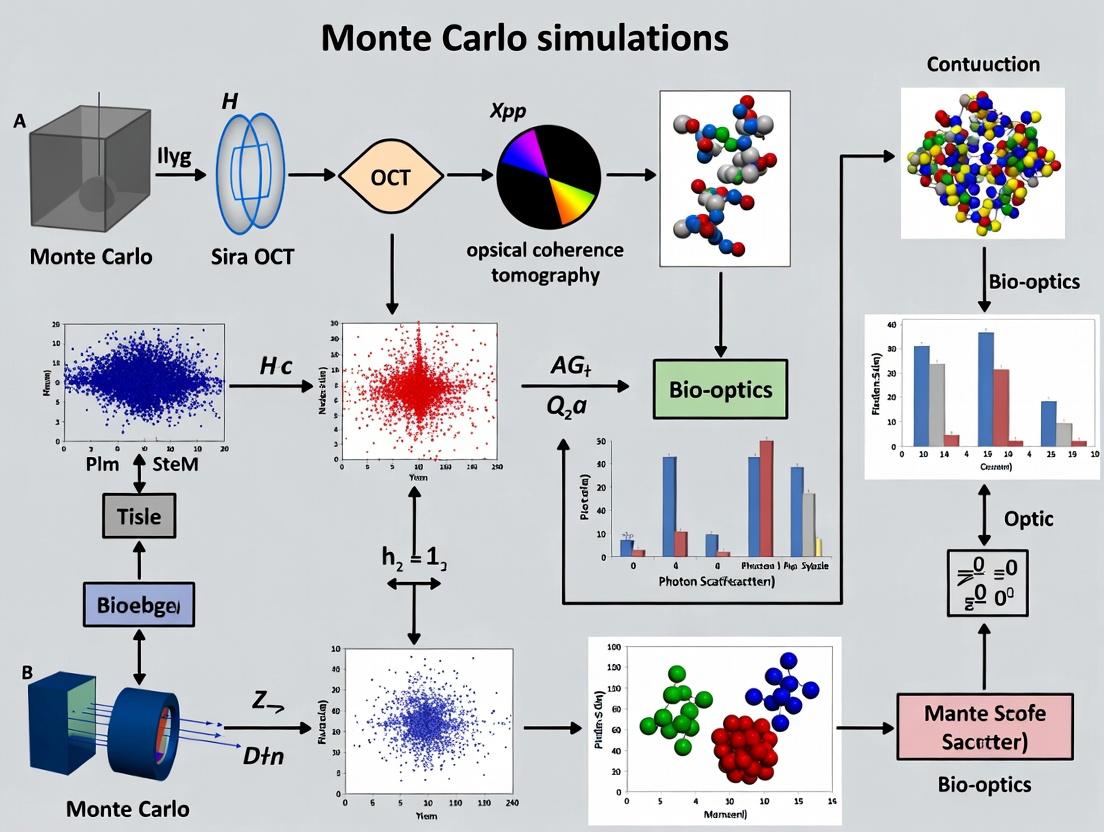
This comprehensive article explores the critical role of Monte Carlo (MC) modeling in advancing Optical Coherence Tomography (OCT) technology.
Monte Carlo Methods in Optical Coherence Tomography: A Complete Guide for Research and Development
Abstract
This comprehensive article explores the critical role of Monte Carlo (MC) modeling in advancing Optical Coherence Tomography (OCT) technology. It begins by establishing the fundamental principles of MC simulations for light-tissue interactions, explaining their necessity for overcoming the limitations of analytical models in complex, heterogeneous biological tissues. The core of the guide details the step-by-step methodology for building and implementing MC models specific to OCT, including key applications in system design, contrast agent development, and novel modality simulation (e.g., Polarization-Sensitive OCT, Angio-OCT). We then address common computational challenges, performance bottlenecks, and optimization strategies for achieving accurate and efficient simulations. Finally, the article provides a rigorous framework for validating MC models against phantom experiments, analytical solutions, and clinical data, and presents a comparative analysis of popular MC software packages. Tailored for researchers, scientists, and drug development professionals, this resource synthesizes current best practices to empower the use of MC simulations as an indispensable tool for OCT innovation, from benchtop to bedside.
Why Monte Carlo? Understanding the Core Physics of Light Scattering in OCT
Analytic models for light-tissue interaction in Optical Coherence Tomography (OCT) often rely on assumptions of homogeneity, simplified geometry, and regular scattering. These models fail to capture the complex, multi-scale, and dynamic nature of real biological tissues, leading to inaccurate predictions of signal penetration, backscattering, and attenuation. Within a broader thesis on Monte Carlo (MC) methods for OCT, this note details how MC simulations address these limitations by numerically modeling photon transport in geometrically complex, heterogeneous media that better mimic biological reality.
Key Quantitative Limitations of Analytic Models
Table 1: Comparison of Analytic Model Assumptions vs. Tissue Realities
| Aspect | Typical Analytic Model Assumption | Biological Tissue Reality | Quantitative Discrepancy Impact |
|---|---|---|---|
| Scatterer Distribution | Uniform, infinite, homogeneous medium. | Highly heterogeneous, clustered (e.g., cell nuclei, organelles). | Under/overestimates backscatter by up to 200% in layered structures. |
| Absorption | Often neglected or considered uniform. | Localized in pigments (melanin, hemoglobin) with µa from 0.1 to 100 cm⁻¹. | OCT signal depth decay error can exceed 50% in vascular or pigmented regions. |
| Refractive Index (n) | Single, constant value (e.g., n=1.38). | Spatially varying (n=1.33-1.55) across organelles, ECM, lipids. | Misestimation of focal spot size and photon path length, affecting resolution. |
| Geometry | Semi-infinite slab or simple layered model. | Complex 3D structures (glands, crypts, papillae), rough surfaces. | Fails to model edge effects, shadowing, and complex depth profiles. |
| Polarization | Often ignored (scalar models). | Birefringent (collagen, muscle, nerve fibers) and depolarizing. | Cannot predict polarization-sensitive OCT (PS-OCT) signals critical for contrast. |
Application Note: Monte Carlo for Realistic OCT Simulation
Monte Carlo methods provide a statistical approach to simulate the random walk of photons in turbid media. By defining a 3D voxelized or mesh-based geometry with spatially assigned optical properties (scattering coefficient µs, absorption coefficient µa, anisotropy g, refractive index n), MC can model the complex realities of tissue, making it the gold standard for simulating OCT signals where analytic solutions fail.
Table 2: Essential Optical Properties for Realistic Tissue MC Simulation
| Tissue Type | µs (cm⁻¹) | µa (cm⁻¹) | g | n | Key Heterogeneity Sources |
|---|---|---|---|---|---|
| Epidermis | 350-500 | 30-100 (melanin-dependent) | 0.70-0.95 | 1.40-1.50 | Melanin clusters, keratinocyte layers. |
| Myocardium | 200-350 | 1.0-5.0 | 0.80-0.98 | 1.38-1.42 | Muscle fiber directionality, blood vessels. |
| Neural Cortex | 150-250 | 0.5-2.0 | 0.85-0.96 | 1.36-1.40 | Neuronal layers, myelinated tracts. |
| Colon Mucosa | 250-400 | 2.0-10.0 | 0.75-0.90 | 1.35-1.38 | Crypt structures, goblet cells, lymphoid follicles. |
Detailed Experimental Protocols
Protocol 1: MC-OCT Simulation for a Multi-Layered Skin Model
Objective: To generate a simulated OCT A-scan/B-scan from a realistic skin model and compare it to an analytic 1D multilayer model.
Materials: High-performance computing cluster or workstation, MC simulation software (e.g., mcxyz, TIM-OS, or custom C++/Python code).
Procedure:
- Model Definition: Define a 3D volume (e.g., 1000 x 1000 x 500 µm³). Assign layers:
- Stratum Corneum: 20 µm thick, µs=100 cm⁻¹, µa=10 cm⁻¹, g=0.85, n=1.45.
- Viable Epidermis: 80 µm thick, embed high-µa (µa=50 cm⁻¹) 5 µm spheres (melanosomes) at 10% volume fraction in a background of µs=350 cm⁻¹, µa=20 cm⁻¹, g=0.90, n=1.40.
- Papillary Dermis: 150 µm thick, µs=250 cm⁻¹, µa=5 cm⁻¹, g=0.85, n=1.39. Embed low-scattering (µs=50 cm⁻¹) capillary loops.
- Reticular Dermis: Semi-infinite, µs=200 cm⁻¹, µa=3 cm⁻¹, g=0.88, n=1.39 with high-scattering (µs=400 cm⁻¹) collagen fiber bundles.
- Photon Launch: Simulate a Gaussian beam (e.g., 5 µm waist) at 1300 nm. Launch 10⁷–10⁸ photon packets.
- Tracking & Detection: Use weighted photon packet method with Russian Roulette for termination. Record the location, momentum, and path length of photons that exit the tissue at the illumination point (backscattered) within the numerical aperture of the simulated OCT system.
- Signal Processing: Construct the interferometric signal. For each detected photon, calculate the effective path length in the reference arm to determine its interference contribution. Sum contributions to build the axial scan (A-scan).
- Validation & Comparison: Compare the simulated A-scan depth decay and layer boundaries to those predicted by a 1D analytic multilayer transfer matrix model.
Protocol 2: Validating MC Model Against Physical Tissue-Phantom OCT
Objective: To empirically validate an MC simulation by comparing its output to OCT images of a fabricated phantom with known, controlled heterogeneity.
Materials: Turbid phantom (e.g., silicone with TiO₂ scatterers and India ink absorber), embedded polystyrene microspheres (10 µm) as discrete high-contrast targets, spectral-domain OCT system, phantom geometry characterization data (micro-CT).
Procedure:
- Phantom Characterization: Precisely measure the bulk optical properties (µs, µa, g) of the phantom base material using integrating sphere techniques. Use micro-CT to map the 3D spatial distribution of the embedded high-contrast microspheres.
- OCT Imaging: Acquate high-resolution 3D OCT scans of the phantom.
- Digital Twin Creation: Reconstruct the phantom's 3D geometry and optical property map in the MC simulation environment using the characterization data.
- MC Simulation: Run an MC simulation that replicates the exact illumination (wavelength, beam profile, NA) and scanning pattern of the physical OCT system.
- Data Comparison: Extract 1D depth profiles (A-scans) and 2D cross-sections (B-scans) from both the experimental OCT data and the MC-simulated data. Quantify similarity using metrics like Pearson correlation coefficient and mean squared error for signal intensity vs. depth.
Visualizations
Title: Monte Carlo OCT Simulation Workflow
Title: Modeling Gap: Analytic Assumptions vs. Tissue Realities
The Scientist's Toolkit: Research Reagent Solutions
Table 3: Essential Materials for MC-OCT Validation Experiments
| Item | Function | Example Product/ Specification |
|---|---|---|
| Tissue-Mimicking Phantoms | Provides a ground-truth sample with known, tunable optical properties and controllable heterogeneity for MC model validation. | Silicone-based phantom with TiO₂ (scatterer), India ink (absorber), and embedded polystyrene microspheres. |
| Integrating Sphere System | Empirically measures the bulk optical properties (µs, µa, g) of phantom materials and ex vivo tissues for accurate MC input parameters. | Systems with >150mm sphere diameter, capable of measuring total reflectance and transmittance. |
| High-Performance Computing (HPC) Resource | Enables the execution of large-scale MC simulations (10⁸-10⁹ photons) with complex 3D geometry in a reasonable time frame. | GPU-accelerated clusters (NVIDIA A100/V100) or multi-core CPU servers (AMD EPYC). |
| Optical Coherence Tomography System | Acquires the experimental OCT data against which MC simulation results are compared and validated. | Spectral-Domain OCT system with >1µm axial resolution, 1300nm central wavelength for deep tissue. |
| Micro-CT Scanner | Provides high-resolution 3D structural data of fabricated phantoms or ex vivo tissue samples to create a precise digital twin for simulation. | Scanner with <5 µm isotropic voxel resolution. |
| Polarization-Sensitive OCT Module | Enables experimental assessment of tissue birefringence and depolarization, guiding the development of vectorial MC models. | Fiber-based PS-OCT module with active polarization state control. |
Application Notes
Monte Carlo (MC) modeling is a stochastic computational technique essential for simulating the propagation of coherent light, particularly in biological tissues. Within Optical Coherence Tomography (OCT) research, MC methods are crucial for understanding signal generation, optimizing system design, and interpreting A-scans and B-scans. Unlike models for diffuse light, coherent light MC must account for interference effects, polarization, and the coherence gating process intrinsic to time-domain, spectral-domain, or swept-source OCT systems.
Recent advancements (2023-2024) focus on accelerating computations using GPU parallelism and incorporating more sophisticated models of tissue optical properties, including birefringence and spatially varying refractive indices. These developments enable the simulation of complex OCT angiography (OCTA) signals and the differentiation of healthy from pathological tissue.
Table 1: Key Parameters for OCT-Monte Carlo Simulations
| Parameter | Typical Range / Value | Description & Impact on Simulation |
|---|---|---|
| Photon Packets | 10⁶ – 10⁹ | Number of launched photon packets. Higher counts reduce statistical noise but increase compute time. |
| Coherence Length (Lc) | 5 – 15 µm (in tissue) | Determines axial resolution and depth gating. Critical for modeling interference conditions. |
| Tissue Layer Thickness | 50 – 1000 µm | Defines the simulated multilayer geometry (e.g., epidermis, dermis). |
| Anisotropy Factor (g) | 0.7 – 0.99 | Scattering direction preference. High g values require variance-reduction techniques. |
| Refractive Index Mismatch | 1.38 (tissue) / 1.0 (air) | Governs Fresnel reflections and specular surface effects at boundaries. |
| Sampling Wavelength | 800 – 1300 nm | Central wavelength of OCT source. Affects scattering and absorption coefficients. |
Table 2: Comparison of MC Acceleration Techniques (2024 Benchmark)
| Technique | Speedup Factor* | Key Advantage | Limitation |
|---|---|---|---|
| Standard CPU MC | 1x (Baseline) | Easy implementation, high precision. | Extremely slow for high photon counts. |
| GPU Parallelization (CUDA/OpenCL) | 50x – 200x | Massive parallelism for photon packet tracking. | Memory bandwidth limits, hardware-dependent. |
| Variance Reduction (e.g., Weighted Photons) | 10x – 30x | Reduces number of packets needed for same SNR. | Can introduce bias if not carefully implemented. |
| Hybrid MC-Deterministic | 100x – 500x | Uses radiative transfer equation in homogenous regions. | Complex to implement; less accurate in highly heterogeneous tissues. |
*Speedup is approximate and problem-dependent.
Experimental Protocols
Protocol 1: Validating OCT-MC Model Against Phantom Measurements
Objective: To calibrate and validate a coherent MC model using a tissue-simulating phantom with known optical properties. Materials: See "The Scientist's Toolkit" below. Procedure:
- Phantom Characterization: Precisely measure the phantom's scattering coefficient (µs), absorption coefficient (µa), anisotropy factor (g), and layer thicknesses using independent methods (e.g., integrating sphere, OCT Mie theory fitting).
- MC Simulation Setup: a. Input the measured phantom properties into the OCT-MC model. b. Set the source parameters to match the experimental OCT system (e.g., central wavelength, bandwidth, beam profile). c. Configure the detector geometry to match the system's numerical aperture. d. Launch a minimum of 10⁷ photon packets.
- Data Collection: a. Experimentally acquire an OCT A-scan (depth profile) of the phantom, averaging 1000 scans to improve SNR. b. Run the MC simulation to generate a simulated A-scan.
- Validation Analysis: a. Normalize both experimental and simulated A-scans to their maximum peak value. b. Compare the depth-dependent signal fall-off (roll-off) and the position of reflection peaks from layer interfaces. c. Calculate the Pearson correlation coefficient (R²) between the two curves. An R² > 0.95 indicates excellent model validation.
Protocol 2: Simulating OCTA Contrast from Microvascular Flow
Objective: To generate synthetic OCTA data for studying angiogenic signatures in drug development. Procedure:
- Tissue Geometry Definition: a. Create a 3D digital tissue model with a static scattering matrix. b. Embed a network of tubular structures (vessels) with diameters from 5µm to 50µm at specified depths.
- Flow Dynamics Implementation: a. Assign a dynamic scattering component to the blood within vessels. This is modeled as a time-varying refractive index shift or particle position change. b. Define flow velocity profiles (e.g., parabolic) for each vessel segment.
- MC Interference Simulation: a. For each time point t, simulate the propagation of coherent photon packets through the dynamic tissue model. b. Record the complex electric field of backscattered photons that arrive within the coherence gate. c. Compute the interference signal with the reference arm field for each t.
- OCTA Signal Extraction: a. Generate a time-series of structural OCT B-scans from the simulated interference signals. b. Apply a differential analysis algorithm (e.g., speckle variance, phase variance) across the time series at each pixel. c. Threshold the resulting variance map to produce a binary microvasculature image (synthetic OCTA).
Visualizations
Title: OCT Monte Carlo Photon Tracking Workflow
Title: Core Components of OCT-MC Research
The Scientist's Toolkit
Key Research Reagent Solutions & Materials
| Item | Function in OCT-MC Research |
|---|---|
| GPU-Accelerated Computing Cluster | Enables simulation of 10^8+ photon packets in feasible timeframes (hours vs. months). Essential for 3D and dynamic simulations. |
| Digital Tissue Phantoms | Software-defined models with adjustable layer thickness, optical properties, and embedded structures (vessels, tumors). Serve as the "sample" in simulations. |
| Validated Physical Tissue Phantoms | Microsphere suspensions or polymer-based phantoms with precisely known and stable scattering properties. Critical for experimental validation of MC models. |
| Open-Source MC Libraries (e.g., mcxyz, TIM-OS) | Provide foundational, peer-reviewed code for photon transport, which can be modified to add coherence and interference calculations for OCT. |
| High-Precision Refractive Index Matching Fluids | Used in experimental setups to minimize unwanted surface reflections when comparing physical phantom data to MC simulations. |
| Polarization-Controlled Light Sources | For experimental systems used to validate advanced MC models that track polarization states of coherent light in birefringent tissues. |
In the development of robust Monte Carlo (MC) simulations for Optical Coherence Tomography (OCT), accurate modeling of light-tissue interaction is paramount. The fidelity of these simulations hinges on the precise definition and experimental validation of four key scattering parameters: the anisotropy factor (g), the scattering coefficient (μs), the absorption coefficient (μa), and the refractive index (n). These parameters form the core input for MC models that simulate photon transport, enabling the prediction of OCT A-scans, B-scans, and the derivation of clinically relevant biomarkers. This document provides application notes and protocols for defining and measuring these parameters to create realistic tissue phantoms, thereby bridging computational models and experimental OCT research.
Definition of Key Scattering Parameters
Anisotropy Factor (g): The mean cosine of the scattering angle. It describes the directionality of a single scattering event. A value of 0 indicates isotropic (uniform) scattering, while values approaching 1 (or -1) indicate highly forward (or backward) directed scattering. Biological tissues typically have high g values (0.8-0.98), meaning scattering is strongly forward-directed.
Scattering Coefficient (μs): The probability of a scattering event per unit path length (units: mm⁻¹). It is the reciprocal of the mean free path between scattering events. A high μs indicates a highly scattering medium.
Absorption Coefficient (μa): The probability of photon absorption per unit path length (units: mm⁻¹). It determines how much light is converted to other forms of energy (e.g., heat).
Refractive Index (n): The ratio of the speed of light in a vacuum to its speed in the medium. It governs reflection and refraction at boundaries (e.g., between tissue layers or at the air-tissue interface).
Quantitative Data for Biological Tissues & Phantom Materials
Table 1: Typical Optical Properties of Human Tissues at Common OCT Wavelengths (~1300 nm, ~800 nm)
| Tissue Type | Wavelength (nm) | μs (mm⁻¹) | μa (mm⁻¹) | g | n |
|---|---|---|---|---|---|
| Epidermis | 800 | 20 - 50 | 0.05 - 0.2 | 0.80 - 0.90 | 1.34 - 1.50 |
| Dermis | 1300 | 4 - 10 | 0.1 - 0.3 | 0.85 - 0.95 | 1.39 - 1.41 |
| Cornea | 800 | 3 - 10 | 0.1 - 0.5 | 0.85 - 0.95 | 1.37 - 1.38 |
| Retina | 800 | 15 - 30 | 0.2 - 0.5 | 0.85 - 0.97 | 1.36 - 1.38 |
| Arterial Wall | 1300 | 5 - 15 | 0.2 - 0.6 | 0.90 - 0.98 | 1.36 - 1.40 |
Table 2: Common Phantom Materials and Their Tunable Parameters
| Material | Base Scatterer | Base Absorber | Tunable μs | Tunable μa | Typical g | Typical n |
|---|---|---|---|---|---|---|
| Polydimethylsiloxane (PDMS) | TiO₂, Al₂O₃ | India Ink, Nigrosin | 0.5 - 20 mm⁻¹ | 0.01 - 1.0 mm⁻¹ | 0.4 - 0.9 | ~1.41 |
| Agarose/Gelatin | Polystyrene Microspheres | India Ink, Food Dye | 1 - 50 mm⁻¹ | 0.001 - 0.5 mm⁻¹ | 0.7 - 0.95* | ~1.33 - 1.35 |
| Polyvinyl Chloride Plastisol (PVCP) | TiO₂, SiO₂ | Acrylic Paint, Ink | 2 - 25 mm⁻¹ | 0.05 - 2.0 mm⁻¹ | 0.6 - 0.9 | ~1.46 - 1.52 |
*g is highly dependent on microsphere size and wavelength.
Experimental Protocols for Parameter Characterization
Protocol 4.1: Inverse Adding-Doubling (IAD) for Measuring μs, μa, and g
Principle: Measures total transmittance (Tt) and total reflectance (Rt) of a thin, slab-shaped sample. An inverse algorithm (Adding-Doubling) solves the Radiative Transfer Equation to extract μs, μa, and g.
Methodology:
- Sample Preparation: Fabricate a phantom slab with parallel, optically smooth surfaces. Accurately measure thickness (typically 1-3 mm).
- Instrument Setup: Use an integrating sphere spectrophotometer. A collimated beam illuminates the sample.
- Measurement:
a. Place sample at the entrance port of the sphere to measure total transmittance (
Tt). b. Place sample at the exit port (with a light trap) to measure total reflectance (Rt). c. Perform reference measurements without the sample. - Data Analysis: Input
Tt,Rt, sample thickness, and sample refractive index (n) into an IAD software algorithm (e.g.,iadc). The algorithm iteratively solves for μs, μa, and g that best match the measuredTtandRt. - Validation: Verify results by comparing measured
TtandRtof a second sample with different thickness predicted using the extracted parameters.
Protocol 4.2: Optical Coherence Tomography (OCT) for Depth-Resolved μs and μa
Principle: Analyzes the depth-dependent decay of the OCT signal (A-scan). The slope is related to the attenuation coefficient (μt = μs + μa), and the intercept is related to backscattering.
Methodology (Single Scattering Model):
- OCT Imaging: Acquire a 3D OCT dataset of a homogeneous phantom or tissue region.
- Data Preprocessing: Correct for confocal function and sensitivity roll-off. Average A-scans spatially within a homogeneous region.
- Curve Fitting: Fit the averaged, corrected logarithmic intensity profile
I(z)vs. depthzto the model:I(z) ∝ ln(μb * exp(-2μt z)), whereμbis the backscattering coefficient. - Parameter Extraction: The fitted slope provides the total attenuation coefficient
μt. Assumingμa << μsfor most tissues in the NIR,μt ≈ μs. For a more advanced separation ofμsandμa, techniques like depth-resolved spectroscopic OCT or combining with diffuse reflectance measurements are required.
Protocol 4.3: Goniometry for Direct Measurement of g
Principle: Directly measures the angular scattering profile (phase function) of a dilute sample to calculate g = <cos θ>.
Methodology:
- Sample Preparation: Prepare a highly diluted suspension of scatterers (e.g., microspheres) to ensure single scattering events dominate.
- Instrument Setup: Use a goniometer with a laser source (at desired wavelength) and a rotatable detector (photodiode or spectrometer).
- Measurement: Record scattered light intensity
I(θ)over a wide angular range (e.g., 10° to 170°). - Data Analysis: Normalize
I(θ)to obtain the phase functionp(θ). Calculateg = ∫ p(θ) cos θ sin θ dθ / ∫ p(θ) sin θ dθover the measured angles.
Protocol 4.4: Refractive Index (n) Measurement by Critical Angle
Principle: Measures the critical angle of a prism-shaped sample using a refractometer.
Methodology:
- Sample Preparation: Cast phantom material into a prism geometry or place a flat sample on the measuring prism of a commercial Abbe refractometer.
- Measurement: Use a sodium D-line source or the OCT source itself. Align the sample. Find the critical angle where the boundary between light and dark fields is sharp in the eyepiece.
- Calculation: The refractometer directly reads
n, or it can be calculated from Snell's law:n_sample = n_prism * sin(θ_critical).
Visualization of Methodologies and Relationships
Title: Workflow for Phantom Parameter Use in OCT MC
Title: Inverse Adding-Doubling (IAD) Measurement Protocol
The Scientist's Toolkit: Research Reagent Solutions
Table 3: Essential Materials for Tissue Phantom Fabrication & Characterization
| Item | Function in Phantom Research | Example Product/Specification |
|---|---|---|
| Polystyrene Microspheres | Acts as well-defined, monodisperse scatterers. Size determines g; concentration determines μs. |
Duke Scientific, 1-10 μm diameter, CV <5%. |
| Titanium Dioxide (TiO₂) Powder | Inexpensive, high-index scatterer for polymer phantoms. Requires careful dispersion to avoid clustering. | Anatase or Rutile, <1 μm particle size. |
| India Ink | Strong, broadband absorber (μa). Added in minute quantities to phantoms to control absorption. |
Higgins Black India, used as a dilutable stock solution. |
| Polydimethylsiloxane (PDMS) | Silicone-based elastomer. Excellent for solid, stable, and reproducible phantom fabrication. | Sylgard 184 Kit (Base & Curing Agent). |
| Agarose Powder | Forms a transparent hydrogel matrix for aqueous-based phantoms, good for cell culture integration. | Low-gelling temperature, molecular biology grade. |
| Integrating Sphere Spectrophotometer | Measures total reflectance and transmittance for IAD and other bulk optical property methods. | Labsphere, 100 mm diameter sphere, NIR-enhanced detector. |
| Goniometer System | Direct measurement of angular scattering profile (p(θ)) to calculate anisotropy factor g. |
Custom-built or commercial (e.g., from ALV). |
| Abbe Refractometer | Measures refractive index (n) of liquid or solid phantom samples. |
Atago or Mettler Toledo, with sodium D-line source. |
| Spectral-Domain OCT System | Primary validation tool. Measures depth-resolved backscatter and attenuation in phantoms. | Central wavelength 830 nm or 1300 nm, bandwidth >100 nm. |
Optical Coherence Tomography (OCT) depth penetration and image quality are fundamentally governed by the scattering properties of tissue. The transition from single to multiple scattering defines the usable imaging depth. In superficial layers (e.g., epithelium), single scattering dominates, providing high-resolution structural information. As the probe beam penetrates deeper into highly scattering tissues (e.g., dermis, stroma), multiple scattering events accumulate, degrading spatial resolution and signal-to-noise ratio (SNR). Understanding and modeling these regimes is critical for interpreting OCT images, developing advanced algorithms, and quantifying tissue properties.
Key Scattering Parameters and Typical Values
The following table summarizes critical parameters defining scattering regimes in biological tissues relevant to OCT.
Table 1: Scattering Parameters in Biological Tissues for OCT (Typical 1300 nm Window)
| Parameter | Symbol | Typical Range in Tissue | Impact on OCT |
|---|---|---|---|
| Reduced Scattering Coefficient | μₛ' | 5 - 15 cm⁻¹ (dermis); 1 - 5 cm⁻¹ (gray matter) | Determines effective penetration depth. Higher μₛ' limits depth. |
| Anisotropy Factor | g | 0.8 - 0.98 (most tissues) | High g indicates forward-scattering; influences scattering regime transition depth. |
| Absorption Coefficient | μₐ | 0.3 - 0.8 cm⁻¹ (most tissues at 1300 nm) | Minor effect at 1300 nm compared to scattering. |
| Transport Mean Free Path (TMFP) | l* = 1/μₛ' | ~0.67 - 2 mm | Average distance before direction is randomized. Key length scale. |
| Single Scattering Regime Depth | ~1 - 3 x l* | Depth where ballistic and quasi-ballistic light dominate. High-resolution imaging. | |
| Multiple Scattering Dominance | > 3-5 x l* | Signal dominated by diffusive light. Resolution degradation. |
Data compiled from recent studies on skin, brain, and epithelial tissue optics.
Monte Carlo Modeling: Core Protocol for OCT Scattering Simulations
Monte Carlo (MC) methods are the gold standard for simulating photon transport in turbid media, providing a flexible numerical approach to model the transition from single to multiple scattering.
Basic Monte Carlo Simulation Protocol for OCT
Objective: To simulate the OCT A-scan (depth reflectivity profile) from a multi-layered tissue model, capturing both single and multiple scattering contributions.
Materials & Computational Setup:
- High-Performance Workstation or Cluster: MC simulations are computationally intensive.
- Programming Environment: Python (with
numpy,numbafor acceleration) or C++. - Source Code: Custom MC code or adapted from validated packages (e.g.,
mcxyzby Steven Jacques, Pythonpymcx).
Procedure:
Define Tissue Geometry and Optical Properties:
- Create a 3D voxelated grid or a layered semi-infinite geometry.
- Assign each layer/voxel its optical properties at the OCT source wavelength (e.g., 1300 nm): μₐ (absorption coefficient), μₛ (scattering coefficient), g (anisotropy factor), and n (refractive index).
- Example Skin Model: Stratum corneum, viable epidermis, papillary dermis, reticular dermis.
Photon Packet Launch:
- Launch photon packets (typically 10⁶ - 10⁹) from the tissue surface at the source position (e.g., Gaussian beam profile).
- Each packet has an initial weight, W, set to 1.
Photon Transport Loop (Core Algorithm):
- Step Size: Calculate a random step size, s = -ln(ξ)/μₜ, where ξ is a uniform random number in (0,1] and μₜ = μₐ + μₛ.
- Move & Absorb: Move the packet by distance s. Decrease its weight by absorption: ΔW = W * (μₐ/μₜ). Deposit ΔW as absorbed energy in the local voxel.
- Scatter: Determine a new propagation direction via sampling of the Henyey-Greenstein phase function using g. Update photon direction.
- Boundary Handling: Apply Fresnel reflection/transmission rules at refractive index boundaries. Use Snell's Law and a random number to decide if a photon is reflected or transmitted.
- Roulette: If photon weight W falls below a threshold (e.g., 10⁻⁴), terminate it using a roulette technique to conserve energy.
OCT-Specific Detection:
- To simulate OCT's coherence gating, track the optical path length of each photon packet.
- Upon photon exit at the tissue surface within the detection numerical aperture (NA) and co-axial area, record its:
- Final weight (W).
- Total travelled path length (L).
- Construct A-scan: The detected intensity at a given depth
z(optical delay) is proportional to the coherent sum of the complex amplitudes of all photons with path lengths within the coherence length of the source around 2z. For simplicity, a non-coherent MC model often bins photons by their maximum penetration depth, which correlates with the OCT signal under multiple scattering.
Post-Processing & Analysis:
- Generate depth-resolved reflectance profiles (A-scans).
- Separate contributions: Analyze photons based on scattering order (e.g., 1 = single, 2-5 = low-order multiple, >5 = high-order multiple).
- Calculate metrics like attenuation coefficient from the simulated A-scan.
Protocol for Validating Regime Transition
Objective: To empirically map the depth at which multiple scattering begins to dominate OCT signal degradation.
Experimental Setup:
- Spectral-Domain OCT System: Central wavelength ~1300 nm, bandwidth ~100 nm.
- Phantom Samples: Tissue-mimicking phantoms with tunable, homogeneous scattering properties (e.g., Intralipid, microsphere suspensions in agarose).
- Reference Sample: A well-characterized, weakly scattering sample (e.g., a diluted suspension) for system calibration.
Procedure:
- Phantom Preparation: Prepare a series of phantoms with known, increasing reduced scattering coefficients (μₛ') but negligible absorption.
- OCT Imaging: Acquire 3D OCT volumes of each phantom. Use a coverslip on top to provide a reference surface reflection.
- Data Analysis - Depth-Resolved SNR/Contrast:
- Extract single A-scans and average laterally to improve SNR.
- Fit the signal decay (ignoring the surface peak) to a single exponential model:
I(z) = I₀ * exp(-2μ_{eff} z), where μ_{eff} is the effective attenuation coefficient. - For each depth
z, estimate the fraction of multiple scattering photons (Fms). One method is to analyze the deviation of the measured μ{eff} from the theoretical μₛ' expected for single scattering only, or by analyzing the widening of the point spread function (PSF) with depth using embedded bead targets.
- Correlation with MC: Input the phantom's μₛ and g into the MC model from Protocol 2.1. Run simulations and compare the simulated depth-dependent signal roll-off and PSF broadening with experimental data. The depth where experimental signal decay deviates from the single-scattering MC prediction indicates the transition zone.
The Scientist's Toolkit: Research Reagent Solutions
Table 2: Essential Materials for OCT Scattering Studies
| Item | Function & Relevance |
|---|---|
| Polystyrene Microspheres (e.g., from ThermoFisher, Sigma-Aldrich) | Tunable scatterers for creating tissue phantoms with precisely controlled μₛ and g. Available in diameters from 0.1 to 10 μm. |
| Intralipid 20% Intravenous Fat Emulsion | A standardized lipid emulsion used as a broadband scattering agent for phantom preparation and system calibration. Its scattering properties are well-documented. |
| Agarose or Polyacrylamide Gel | Forms a stable, transparent solid matrix for embedding scattering particles to create solid tissue-simulating phantoms. |
| TiO₂ or Al₂O₃ Powder | Alternative scattering agents for phantoms, especially in the NIR range. Require careful dispersion. |
| India Ink or Nigrosin | Commonly used absorbers (carbon-based) to tune the absorption coefficient (μₐ) in phantoms to match specific tissues. |
| Optical Phantoms with Known Properties (e.g., from Gammex, Institut für Lasertechnologien) | Commercially available, stable phantoms with certified optical properties for validation and quality control of OCT systems and models. |
| High-Index Matching Fluids/Oils | Used to reduce surface reflections at tissue/coverglass interfaces during ex vivo or phantom imaging, minimizing unwanted artifacts. |
Visualizing Scattering Regimes and Simulation Workflow
Diagram 1: MC Simulation & Scattering Regimes Workflow (100 chars)
Diagram 2: OCT Signal Zones vs Depth (99 chars)
Building Your OCT Monte Carlo Simulator: A Step-by-Step Methodological Guide
Within the broader thesis on Monte Carlo modeling for Optical Coherence Tomography (OCT), the architectural definition of the simulation is foundational. Accurate modeling of light-tissue interaction for OCT A-scan and B-scan generation hinges on the precise mathematical and computational representation of three core components: the sample Geometry, the illumination Source, and the signal collection Detector. This application note details the protocols for defining these components, enabling researchers to simulate physically realistic OCT signals for applications in dermatology, ophthalmology, and drug development efficacy studies.
Defining the Sample Geometry (Layered Tissue Model)
The most common geometry for OCT simulation is a multi-layered turbid medium, representing tissues like skin or retina. Each layer is defined by optical properties at the simulated wavelength (e.g., 1300 nm for dermatology, 840 nm for ophthalmology).
Key Optical Properties per Layer:
- n: Refractive index (dimensionless).
- μa: Absorption coefficient (mm-1).
- μs: Scattering coefficient (mm-1).
- g: Anisotropy factor (mean cosine of scattering angle).
- d: Layer thickness (mm or μm).
Protocol 2.1: Constructing a Multi-Layered Geometry
- Identify Target Tissue: Define the biological tissue and number of discrete layers to model (e.g., epidermis, dermis, hypodermis).
- Assign Optical Properties: For each layer
i, assign a set of properties {ni, μa,i, μs,i, gi, di}. Use peer-reviewed data or inverse methods from measured OCT signals. - Implement in Code: Represent the geometry as an array or structure where photon packets check their current depth (
z) against cumulative layer boundaries to update local properties. - Set Boundary Conditions: Define the refractive index mismatch at the air-tissue (top) and tissue-substrate (bottom) interfaces to calculate Fresnel reflection/transmission.
Table 1: Exemplar Optical Properties for Skin at 1300 nm
| Layer | Thickness (μm) | n | μa (mm-1) | μs (mm-1) | g |
|---|---|---|---|---|---|
| Epidermis | 80 | 1.38 | 0.10 | 20.0 | 0.85 |
| Papillary Dermis | 150 | 1.41 | 0.15 | 25.0 | 0.88 |
| Reticular Dermis | 1200 | 1.40 | 0.12 | 18.0 | 0.87 |
| Hypodermis | Semi-infinite | 1.44 | 0.20 | 12.0 | 0.89 |
Defining the Light Source (Gaussian Beam)
The source model must capture the spatial, temporal, and spectral characteristics of the OCT system's sample arm.
Protocol 3.1: Implementing a Focused Gaussian Beam Source
- Beam Profile: Initialize photon launch positions (x, y) according to a Gaussian distribution with a
1/e^2waist radiusw_0at the beam focus. - Focus & Divergence: Set the focal depth (
z_focus). For a photon launched at a radial distancerfrom the optical axis, assign an initial direction cosine relative to the axis, calculated viaθ = arctan(r / z_focus). - Temporal Coherence (for TD-OCT): For time-domain OCT, assign an initial random path length offset (
δL) to each photon packet, sampled from the coherence function of the source (e.g., a Gaussian distribution with FWHM equal to the coherence lengthl_c). - Spectral Bandwidth (for FD-OCT): For frequency-domain OCT, run parallel simulations for multiple discrete wavelengths (
λ_k) across the source spectrum (e.g., 1250-1350 nm), weighting the results by the source spectral densityS(λ_k).
Table 2: Source Parameters for Typical Spectral-Domain OCT
| Parameter | Symbol | Value | Unit |
|---|---|---|---|
| Central Wavelength | λ0 | 1300 | nm |
| Spectral Bandwidth (FWHM) | Δλ | 100 | nm |
| Coherence Length | lc | ~8.5 | μm |
| Beam Waist at Focus | w0 | 10 | μm |
| Focal Depth | zfocus | 300 | μm |
Defining the Detection Scheme (OCT-Specific)
The detector in Monte Carlo for OCT is not a simple energy tally. It must replicate the interferometric detection process.
Protocol 4.1: Implementing Interferometric Detection for A-Scan Generation
- Photon Packet Recording: For each back-scattered photon packet exiting the tissue at the source plane, record its final position, direction, and total accumulated path length
L. - Weight Adjustment: Apply a factor based on the detector's numerical aperture (NA) and the cosine of the exit angle relative to the surface normal.
- Interference Modeling:
- Time-Domain (TD): For a reference mirror position
z_ref, the interferometric signal is proportional to the sum over all photon packets ofweight * exp(-(2*(L - z_ref)/l_c)^2) * cos(2*k0*(L - z_ref)), wherek0is the central wavenumber. - Frequency-Domain (FD): For each wavelength
λ_k, compute the complex spectral density:A(k) = Σ(weight * exp(i * 2 * k * L)), wherek=2π/λ_k. The A-scan is generated via the Inverse Fourier Transform ofA(k).
- Time-Domain (TD): For a reference mirror position
- Averaging: Repeat the simulation for a large number of photon packets (e.g., 107-109) to obtain a statistically meaningful A-scan.
Workflow Diagram: Monte Carlo OCT Simulation Architecture
Diagram Title: OCT Monte Carlo Simulation Workflow
The Scientist's Toolkit: Research Reagent Solutions
Table 3: Essential Components for Monte Carlo OCT Research
| Item/Component | Function in Simulation/Experiment |
|---|---|
| Validated MCML/MMC Code Base | Core stochastic solver for photon transport in multi-layered tissues. Provides the numerical engine. |
| High-Performance Computing (HPC) Cluster | Enables simulation of the large photon counts (10^9+) required for low-noise OCT A-scans in feasible time. |
| Reference Tissue Phantom | Physical samples (e.g., layered phantoms with TiO2 scatterers, India ink) with known optical properties for model validation. |
| Precision Optical Properties Database | A curated, wavelength-specific library of tissue optical properties (μa, μs, g, n) for accurate geometry definition. |
| Spectral OCT System Data | Exact source spectrum, NA, and scanning parameters from the physical OCT instrument to match simulation source/detector. |
| Numerical Fourier Transform Library | (For FD-OCT) High-performance FFT/IFFT routines (e.g., FFTW) to generate A-scans from simulated spectral data. |
Within the broader thesis on Monte Carlo (MC) methods for Optical Coherence Tomography (OCT) research, the accurate modeling of coherence gating is paramount. The coherence gate, determined by the temporal and spatial coherence properties of the light source, is the fundamental mechanism that enables OCT's superior axial resolution and sectioning capability. Traditional MC models for OCT often treat photon coherence in a simplified manner. This application note details protocols for implementing explicit temporal and spatial coherence gates within a GPU-accelerated Monte Carlo framework, enabling more physiologically accurate simulations of interferometric signal formation, critical for applications in drug development and pre-clinical research.
Quantitative Parameters for Coherence Modeling
The following tables summarize key parameters for modeling coherence gates.
Table 1: Temporal Coherence (Low-Coherence Interferometry) Parameters
| Parameter | Symbol | Typical Value (e.g., Ti:Sapphire) | Function in Model |
|---|---|---|---|
| Central Wavelength | λ₀ | 800 - 1300 nm | Determines the center of the wave number (k) spectrum. |
| Spectral Bandwidth (FWHM) | Δλ | 50 - 150 nm | Governs the width of the temporal coherence envelope. |
| Coherence Length (in air) | L_c = (2 ln2/π) * (λ₀²/Δλ) | ~3 - 15 µm | Defines the axial resolution limit. Key for gate function. |
| Depth of Field (Confocal) | - | Scales with λ₀ / NA² | Interplays with spatial coherence. |
Table 2: Spatial Coherence & Beam Parameters
| Parameter | Symbol | Typical Value | Function in Model |
|---|---|---|---|
| Numerical Aperture | NA | 0.05 - 0.3 | Governs lateral resolution and spatial coherence area. |
| Beam Waist Radius | w₀ | 5 - 30 µm | Defines the incident Gaussian beam profile. |
| Spatial Coherence Area | A_s ~ (λ₀/θ)² | - | Determines the photon collection efficiency and gate. |
| Pupil Function | P(u,v) | Often circular | Modulates the spatial frequency content of backscattered light. |
Experimental Protocols
Protocol: GPU-Accelerated MC with Coherence Gate Tracking
Objective: To simulate the OCT A-scan from a multi-layered scattering sample by tracking both the pathlength and transverse momentum of each photon packet, enabling post-simulation application of temporal and spatial coherence gates.
Materials & Software:
- GPU computing cluster (e.g., NVIDIA A100/V100).
- CUDA/C++ development environment.
- Pre-defined optical properties of sample layers (µs, µa, g, n).
Procedure:
Photon Initialization: Launch millions of photon packets. Each packet is assigned:
- A starting weight,
W = 1. - A normalized wave vector, k, based on the Gaussian beam profile and NA.
- A randomized spectral component,
k_i = k₀ + δk, whereδkis sampled from the source spectral density function (e.g., Gaussian spectrum). - A pathlength accumulator,
L = 0.
- A starting weight,
Propagation & Scattering (GPU Kernel):
- Use standard MC rules for step size, scattering events (Heney-Greenstein), and boundary handling (Fresnel reflections).
- At each step
i, update:L += (step_size_in_layer * refractive_index_of_layer). - Update the photon's transverse momentum vector at each scattering event.
Detection and Bin Assignment:
- Upon exit at the collection aperture, calculate the photon's exit position and angle.
- Determine if the photon's exit vector falls within the collection optics' acceptance function (spatial filter).
- Bin the photon's final weight
Wbased on its total accumulated pathlengthLinto a high-resolution depth array (histogram).
Application of Coherence Gates (Post-Processing):
- Temporal Gate: Convolve the depth-resolved photon weight histogram with the temporal coherence envelope,
G(ΔL) = exp(-(ΔL / L_c)²), whereΔLis the pathlength mismatch relative to the reference arm. - Spatial Gate: Apply a weighting factor based on the overlap integral between the collected photon's wavefront and the mode of the detection fiber/single-mode detector. This is often simplified to a geometric acceptance criterion based on exit position/angle.
- Temporal Gate: Convolve the depth-resolved photon weight histogram with the temporal coherence envelope,
Interferometric Signal Synthesis:
- The coherence-gated depth profile represents the sample field. Multiply by the reference arm field (simulated) and compute the magnitude to synthesize the final OCT A-scan intensity.
Protocol: Validation Using Known Phantom Structures
Objective: To validate the coherence gate implementation by simulating OCT signals from a well-characterized phantom and comparing metrics with analytical models.
Procedure:
- Simulate a Single Reflecting Surface: Model a non-scattering medium with a perfect mirror at depth
z. Vary the reference arm length. - Record Signal: Generate the interferometric signal versus pathlength difference (
ΔL). - Fit Data: Fit the signal peak to a Gaussian envelope. The
1/ewidth corresponds to the simulated coherence length. Compare to the theoreticalL_c. - Simulate a Multi-Layer Scattering Phantom: Use defined optical properties (e.g., µs = 10 mm⁻¹, g = 0.9).
- Measure System Point Spread Function (PSF): Extract the axial resolution (FWHM of coherence gate) and lateral resolution from edge/line spread functions in the simulated B-scan. Compare to theoretical values from
L_candNA.
Diagram: OCT Monte Carlo with Coherence Gate Workflow
Diagram 1: OCT MC with coherence gate workflow.
The Scientist's Toolkit: Research Reagent Solutions
Table 3: Essential Materials for Experimental Validation of Coherence Models
| Item | Function in Experiment | Example/Notes |
|---|---|---|
| Multi-Layer Tissue Phantom | Provides a known, reproducible scattering standard with defined layer depths and optical properties (µs, µa, n). | e.g., Silicone-based phantoms with TiO₂ or Al₂O₃ scatterers. Crucial for validating depth-resolved gate performance. |
| Kinetic FD-OCT System | Experimental counterpart to the simulation. Used to acquire ground-truth data for model validation. | Must have well-characterized source spectrum (for L_c) and known NA. |
| Spectral Calibration Kit | Precisely measures the source spectral density I(k), the key input for temporal coherence modeling. | e.g., Integrating sphere with high-resolution spectrometer. |
| GPU Computing Hardware | Enables the tractable execution of large-scale, coherence-aware MC simulations (billions of photons). | NVIDIA Tesla/Ampere architecture cards with high memory bandwidth. |
| Numerical Libraries (CUDA, FFTW) | Provides optimized functions for random number generation, vector math, and fast convolution (for coherence gating). | CUDA Toolkit, cuRAND, cuFFT. |
Application Notes
Within the broader thesis on Monte Carlo (MC) methods for Optical Coherence Tomography (OCT) research, simulating system performance is a foundational critical application. MC modeling provides a statistical approach to photon transport, enabling the a priori prediction and optimization of key OCT performance metrics—resolution, signal-to-noise ratio (SNR), and penetration depth—under diverse tissue and system configurations. This is indispensable for designing novel OCT systems (e.g., swept-source, multi-spectral) and for planning and interpreting in vivo studies in preclinical drug development, where understanding light-tissue interactions is paramount.
Resolution: MC simulations model the scattering of photons from spatially discrete structures within a sample. By convolving the simulated point spread function (PSF) with a theoretical source spectrum, one can quantify the degradation of axial and lateral resolution due to multiple scattering events. This allows researchers to determine the optimal center wavelength and bandwidth for a target tissue type (e.g., 1300 nm for deeper skin imaging vs. 800 nm for retinal imaging).
SNR: The OCT SNR is fundamentally governed by shot noise, excess noise, and signal strength. MC methods directly compute the fraction of photons that are successfully backscattered and detected, providing the signal term. By simulating various system parameters (source power, detector efficiency, exposure time) and sample properties (scattering coefficient, anisotropy factor), the theoretical SNR can be modeled, guiding hardware selection and scan protocol design to maximize detectability of weak signals from deep tissue layers.
Penetration: Penetration depth, often defined as the depth where SNR falls to 0 dB, is critically dependent on the scattering and absorption properties of the tissue. MC simulations can map photon fluence with depth for complex, multi-layered tissue models, predicting how changes in optical properties (which may occur due to drug-induced inflammation or clearing agents) affect the usable imaging depth.
Data Presentation
Table 1: Simulated Performance Metrics for Common OCT Configurations in Skin Tissue (µs = 100 cm⁻¹, g = 0.9)
| System Configuration | Center Wavelength (nm) | Bandwidth (nm) | Theoretical Axial Resolution (µm) | Simulated Penetration (0 dB depth, mm) | Simulated Max SNR (dB) |
|---|---|---|---|---|---|
| Spectral-Domain | 850 | 150 | 1.8 | 0.9 | 105 |
| Spectral-Domain | 1300 | 200 | 3.5 | 1.6 | 98 |
| Swept-Source | 1310 | 100 | 7.2 | 1.4 | 102 |
| Swept-Source | 1550 | 150 | 5.4 | 1.2 | 95 |
Table 2: Impact of Tissue Scattering on Simulated Performance (1300 nm System)
| Tissue Type (Model) | Scattering Coefficient, µs (cm⁻¹) | Anisotropy Factor (g) | Simulated Penetration (mm) | SNR at 0.5 mm depth (dB) |
|---|---|---|---|---|
| Normal Dermis | 100 | 0.9 | 1.6 | 45 |
| Hypercellular (e.g., Tumor) | 180 | 0.85 | 1.0 | 28 |
| Edematous | 60 | 0.92 | 2.1 | 55 |
Experimental Protocols
Protocol 1: Monte Carlo Simulation for OCT Point Spread Function and Resolution Estimation
Define Simulation Parameters:
- Create a
.inpfile for an open-source MC code (e.g.,mcxyz.c). - Specify number of photons (e.g., 10⁷–10⁸).
- Define source properties: Gaussian beam waist, numerical aperture (NA) matching the OCT system.
- Set optical properties of the sample: refractive index (n), absorption coefficient (µa), scattering coefficient (µs), anisotropy factor (g), and layer thicknesses.
- Create a
Model Sample Geometry:
- For resolution analysis, define a discrete, sub-resolution reflective plane or point at a target depth within a scattering slab.
- Vary the depth of this reflector to assess depth-dependent resolution degradation.
Execute Simulation:
- Run the compiled MC code (e.g.,
./mcxyz run.inp). - Output the 3D spatial distribution of absorbed energy or photon path histories.
- Run the compiled MC code (e.g.,
Post-Process for OCT PSF:
- Extract the time-of-flight or pathlength distribution of backscattered photons from the reflector.
- Convolve this distribution with the theoretical OCT source interferogram (based on its autocorrelation function).
- The resulting profile is the depth-dependent PSF. Measure its full-width at half-maximum (FWHM) to estimate axial resolution.
Protocol 2: Simulating SNR and Penetration Depth in Multi-Layered Tissue
Construct a Layered Tissue Model:
- Define a 3D voxelated geometry representing, for example, epidermis, dermis, and subcutaneous fat.
- Assign each layer literature-based or measured optical properties (µa, µs, g, n).
Configure Detection:
- In the MC input file, specify a co-axial detector matching the system's collection NA and core diameter of the single-mode fiber.
Run Photon Migration:
- Execute a large-scale simulation (>10⁸ photons) to achieve sufficient signal statistics at depth.
- Record the weight and pathlength of every photon that reaches the detector.
Calculate Depth-Resolved Signal:
- Bin detected photons according to their maximum penetration depth in the sample.
- Apply an OCT signal model: the interferometric signal is proportional to the square root of the detected photon weight, modulated by the source coherence function.
Compute Noise Floor and SNR:
- Model the dominant noise sources: shot noise (square root of total signal electrons) and relative intensity noise (RIN).
- Calculate SNR(depth) = 10·log₁₀(Signal(depth)² / Noise²).
- Determine penetration depth as the depth where SNR(depth) = 1 (0 dB).
Mandatory Visualization
MC-OCT Performance Simulation Workflow
From Photon Transport to OCT Metrics
The Scientist's Toolkit
Table 3: Key Research Reagent Solutions for OCT-MC Simulation & Validation
| Item/Category | Function in OCT Performance Simulation |
|---|---|
MC Simulation Software (e.g., mcxyz, tMCimg, CUDAMCML) |
Core computational engines for modeling stochastic photon transport in 3D turbid media. Accelerated (GPU) versions enable simulation of large photon counts. |
| Validated Tissue Phantom Kits (e.g., silicone-based with TiO₂ scatterers, nigrosin absorber) | Provide ground-truth samples with known, stable optical properties to experimentally validate MC predictions of resolution, SNR, and penetration. |
Optical Property Databases (e.g., Oregon Medical Laser Center database, optical-properties.info) |
Source literature values for µa, µs, g of biological tissues at OCT wavelengths, essential for constructing realistic simulation models. |
Computational Environment (Python/R with numpy, matplotlib; MATLAB) |
Platforms for writing custom post-processing scripts to convert raw MC output into OCT A-scans, PSFs, and SNR curves, and for visualizing results. |
| Reference OCT System (Calibrated commercial or benchtop system) | Required to gather empirical data for direct comparison with simulation results, closing the validation loop. System specs define MC input parameters. |
Within the broader thesis on developing a versatile Monte Carlo (MC) simulation platform for optical coherence tomography (OCT) research, modeling contrast agents is a critical application. This module extends the core MC photon transport model to simulate the interaction of light with engineered particles like microbubbles and nanoparticles. This enables in silico optimization of agent design (size, shell, material) for enhanced scattering, absorption, or phase-shift effects, predicting their impact on OCT signal intensity, contrast, and speckle patterns. Such simulations are crucial for rational agent development and for interpreting complex in vivo imaging data in therapeutic and diagnostic applications.
Contrast Agent Mechanisms & Modeling Parameters
MC modeling requires defining the optical and geometric properties of the contrast agent and its environment. Key parameters are summarized below.
Table 1: Core Optical & Geometric Parameters for MC Modeling of Contrast Agents
| Parameter | Microbubbles (MBs) | Solid Nanoparticles (e.g., Au, SiO₂) | Modeling Consideration in OCT-MC |
|---|---|---|---|
| Typical Size | 1 - 10 μm diameter | 50 - 300 nm diameter | Determines scattering regime (Mie, Rayleigh). |
| Core Material | Gas (e.g., C₄F₁₀, SF₆) | Solid (e.g., Gold, Silica) | Defines intrinsic refractive index (n) and absorption (μa). |
| Shell Material | Lipid, Polymer, Protein | Often none, or polymer coating | Thickness and n critically affect scattering cross-section. |
| Key Optical Effect | Strong backscattering due to large n mismatch. Can induce phase modulation. | Plasmon resonance (Au) or tailored scattering/absorption. | Model as a localized perturbation in optical properties (μs, μa, g, n). |
| Primary OCT Signal Source | Backscattering amplitude (Intensity OCT). | Backscattering/absorption (Intensity OCT). | Photon packet scattering probability and direction updated upon agent interaction. |
| Advanced Contrast | Doppler variance (flow), Signal decorrelation (activation). | Photothermal OCT, Magnetomotive OCT. | Requires modeling of dynamic property changes (e.g., time-dependent μa). |
Table 2: Monte Carlo Simulation Inputs for Contrast Agent Modeling
| Input Variable | Symbol | Example Value (Microbubble) | Example Value (Gold Nanorod) | Notes |
|---|---|---|---|---|
| Background μs | μs_bg | 10 cm⁻¹ (tissue) | 10 cm⁻¹ (tissue) | Tissue scattering coefficient. |
| Background μa | μa_bg | 0.1 cm⁻¹ (tissue) | 0.1 cm⁻¹ (tissue) | Tissue absorption coefficient. |
| Background n | n_bg | 1.38 | 1.38 | Tissue refractive index. |
| Agent μs | μs_agent | 500 cm⁻¹ (effective) | 300 cm⁻¹ (effective) | Highly elevated. Calculated via Mie theory. |
| Agent μa | μa_agent | ~0 cm⁻¹ | 1000 cm⁻¹ (at resonance) | Plasmonic particles have high μa. |
| Agent n | n_agent | ~1.0 (gas core) | Varies (e.g., Au: ~0.4+7.1i at 1300 nm) | Complex n for metals. |
| Anisotropy (g) | g_agent | 0.8 - 0.95 (forward scattering) | 0.2 - 0.9 | Depends on size/wavelength. |
| Agent Concentration | C | 10⁶ bubbles/mL | 10¹¹ particles/mL | Used to calculate interaction probability. |
Experimental Protocols for Validation
MC simulation predictions must be validated against controlled in vitro experiments.
Protocol 3.1: Fabrication & Characterization of Tissue Phantoms with Embedded Agents Objective: Create a standardized scattering matrix with known concentrations of contrast agents for OCT imaging and MC validation. Materials: Agarose (2-4%), Intralipid-20% (scattering agent), India ink (absorption agent), contrast agent (MBs or NPs), mold chambers. Procedure:
- Prepare a stock solution of molten agarose (2% in deionized water, 90°C).
- Cool to ~50°C. Add pre-mixed Intralipid and ink to match background tissue optics (e.g., μs' = 1 mm⁻¹, μa = 0.01 mm⁻¹).
- For Agent-Loaded Phantoms: Gently mix a precise volume of contrast agent suspension (e.g., 100 μL of 10⁸ MBs/mL) into the agarose mixture before it gels.
- For Control Phantoms: Omit the contrast agent.
- Pour into mold chambers (e.g., cylindrical wells). Allow to gel at 4°C for 30 minutes.
- Image phantoms using a spectral-domain OCT system. Acquire 3D volumes and multiple B-scans.
- Quantitative Analysis: Extract average intensity in agent-loaded region vs. control, calculate signal-to-noise ratio (SNR) and contrast-to-noise ratio (CNR).
- Input the exact phantom geometry and optical properties into the OCT-MC model. Run simulations matching the experimental scan pattern.
- Validation: Compare the simulated versus experimental intensity profiles, SNR, and CNR.
Protocol 3.2: Dynamic Contrast Enhancement Imaging for Microbubbles Objective: Capture and model the time-dependent signal from microbubbles under ultrasound modulation. Materials: OCT-US combined imaging system, flow phantom, MB suspension, syringe pump. Procedure:
- Set up a flow phantom (tubing in agarose/Intralipid) connected to a syringe pump.
- Infuse MB suspension at a controlled flow rate (e.g., 1 mL/min).
- Acquire a baseline OCT M-scan (repeated A-scans at one lateral position) without ultrasound.
- Initiate a low-power, pulsed ultrasound beam co-focused with the OCT beam.
- Acquire OCT M-scan data during US pulsing. MBs will oscillate, causing time-varying backscatter.
- Process the OCT signal to extract Doppler variance or decorrelation time constants.
- In the MC model, simulate MBs as oscillating spheres with time-varying radius (R(t)) and thus time-varying optical cross-sections.
- Model the photon packet interaction with the oscillating boundary, affecting the scattering angle and phase.
- Validation: Compare the simulated and experimental temporal decorrelation curves or Doppler spectral broadening.
Diagram: OCT-MC Workflow for Contrast Agent Modeling
Diagram 1: OCT-MC modeling workflow for contrast agents.
The Scientist's Toolkit: Research Reagent Solutions
| Item | Function in Contrast Agent OCT Research |
|---|---|
| Lipid-shelled Microbubble Kit (e.g., SonoVue analogues) | Ready-to-use, clinically relevant agents for validating scattering models in vascular flow phantoms. |
| PEGylated Gold Nanorods (e.g., 800-1300 nm LSPR) | Standardized plasmonic nanoparticles for modeling and testing absorption-based (photothermal) OCT contrast. |
| Fluorescently-labeled Silica Nanoparticles | Enable multimodal validation (OCT + fluorescence) to track agent distribution and compare signals. |
| Custom Mie Scattering Calculator Software | Computes essential MC inputs (Qsca, Qabs, g) for spherical particles from user-defined n, size, wavelength. |
| Agarose & Intralipid-20% | Base materials for fabricating tissue-simulating optical phantoms with tunable μs and μa. |
| Flow Phantom System (Syringe Pump, Micro-tubing) | Creates controlled in vitro environments to study agent dynamics and validate flow-related signal models. |
| Combined OCT-Ultrasound Imaging Chamber | Essential setup for studying acousto-optic interactions (e.g., MB modulation) and validating dynamic MC models. |
| High-performance Computing (HPC) Cluster Access | Enables running large-scale, 3D MC simulations with billions of photons and high agent concentrations in feasible time. |
Application Notes
Monte Carlo (MC) simulations are critical for advancing novel Optical Coherence Tomography (OCT) modalities, providing the theoretical foundation for understanding and optimizing complex signal formation. Within a broader thesis on MC for OCT research, these simulations enable the accurate modeling of polarized light-tissue interactions, biomechanical responses, and dynamic flow, which are essential for Polarization-Sensitive OCT (PS-OCT), Optical Coherence Elastography (OCE), and Angiography-OCT (Angio-OCT).
PS-OCT simulations model the propagation of polarized light, tracking Stokes vectors through scattering media to predict measured Mueller matrices. This allows researchers to decode birefringence, optic axis orientation, and depolarization in fibrous tissues like cartilage or retinal nerve fiber layers without a priori assumptions. OCE simulations model tissue displacement in response to applied mechanical load (e.g., air-puff, acoustic radiation force). By simulating the OCT signal before and after deformation, MC methods can validate algorithms that map local strain and shear wave propagation, quantifying elasticity—a key biomarker in oncology and corneal diseases. Angio-OCT simulations model the dynamic scattering from moving particles (e.g., red blood cells) within static tissue. Time-domain or spectral-domain MC models generate synthetic B-scans over time, enabling the development and validation of differential variance, phase-shift, and decorrelation algorithms for microvascular network visualization.
These simulations bridge the gap between abstract theory and practical system design, allowing for the in silico testing of novel laser sources, scanning protocols, and analysis algorithms, thereby accelerating translational research and drug development studies where non-invasive, functional imaging is paramount.
Table 1: Key Parameters for Monte Carlo Simulations of Novel OCT Modalities
| Modality | Core Simulated Property | Typical MC Photons per Run | Common Output Metrics | Representative Tissue Targets (Simulated) |
|---|---|---|---|---|
| PS-OCT | Polarization State (Stokes Vector) | 10^7 - 10^9 | Mueller Matrix Elements, Birefringence (Δn), Axis Orientation, Degree of Polarization | Tendon, Retinal Nerve Fiber Layer, Dental Enamel, Myocardium |
| OCE | Displacement Vector Field | 10^6 - 10^8 (per deformation state) | Axial/Shear Strain Map, Elasticity (kPa), Shear Wave Speed (m/s) | Breast Tumor Margin, Cornea, Skin, Atherosclerotic Plaque |
| Angio-OCT | Temporal Signal Decorrelation | 10^6 - 10^8 (per time point) | Decorrelation Rate, Flow Velocity (mm/s), Vessel Density (%) | Retinal Capillaries, Tumor Vasculature, Cerebral Cortex |
Table 2: Comparison of MC-Enabled Algorithm Validation Advantages
| Advantage | PS-OCT | OCE | Angio-OCT |
|---|---|---|---|
| Gold-Standard Data | Known input birefringence vs. measured. | Known displacement field vs. estimated strain. | Known particle velocity vs. extracted flow map. |
| Noise Isolation | Can isolate depolarization from system noise. | Can separate mechanical noise from true displacement. | Can distinguish flow signal from static tissue speckle. |
| System Optimization | Optimize incident polarization states. | Optimize loading frequency and amplitude. | Optimize A-scan rate and sampling density. |
| Pathology Modeling | Simulate birefringence loss in degenerative tissue. | Simulate elasticity changes in lesions. | Simulate vascular dropout or hyperemia. |
Experimental Protocols
Protocol 1: MC Simulation for PS-OCT Birefringence Measurement Validation
Objective: To generate synthetic PS-OCT data from a known birefringent sample to validate phase-retrieval algorithms. Methodology:
- Define Virtual Sample: Create a 3D mesh with optical properties (scattering coefficient μs, absorption coefficient μa, anisotropy g). Assign a uniform, known birefringence (Δn) and optic axis orientation to a layer within the mesh.
- Configure MC Engine: Use a polarized light MC code (e.g., based on Stokes vectors or Jones formalism). Set source parameters: wavelength (e.g., 1310 nm), beam waist, and known input polarization state (e.g., linear horizontal).
- Photon Launch & Tracking: Launch 10^8 – 10^9 photons. For each scattering event, track the photon's Stokes vector, updating it based on the scattering matrix (e.g., Mie theory) and the accumulated phase retardation from the sample's birefringence.
- Signal Synthesis: For each detected photon, record its exit position, time-of-flight (for time-domain OCT), and final Stokes vector. Synthesize interference signals by combining with a simulated reference arm field.
- Data Analysis: Process synthetic interferograms using standard PS-OCT processing (Fourier transform, phase difference between polarization channels). Calculate measured birefringence and optic axis.
- Validation: Compare the MC-simulated measured values against the known input Δn and orientation. Quantify accuracy and precision under varying SNR conditions.
Protocol 2: MC Simulation for Air-Puff OCE Elasticity Mapping
Objective: To simulate OCT signals before and after a simulated air-puff induced deformation for elastogram algorithm testing. Methodology:
- Define Tissue Model: Create a finite element (FE) mesh representing a tissue sample with regions of different elastic moduli (e.g., a stiff inclusion in a soft matrix). Assign optical properties to each element.
- FE Mechanical Simulation: Apply a simulated air-puff pressure transient to the surface of the FE model. Solve for the 3D displacement vector field for each node in the mesh at multiple time points.
- Pre-Deformation MC Simulation: Perform a standard OCT MC simulation (10^7 photons) on the undeformed tissue mesh. Record the complex-valued (amplitude and phase) signal for each voxel.
- Post-Deformation MC Simulation: Morph the original tissue mesh according to the FE displacement field. Run an identical MC simulation on the deformed mesh, ensuring photon launching geometry is consistent.
- Synthetic Elastogram Generation: Process the paired pre- and post-deformation synthetic OCT datasets using a cross-correlation or phase-shift algorithm to generate a map of estimated axial displacement and strain.
- Validation: Directly compare the algorithm-estimated displacement/strain maps against the known displacement field from the FE simulation. Calculate error metrics (e.g., root-mean-square error).
Protocol 3: MC Simulation for Angio-OCT Flow Detection Thresholds
Objective: To determine the minimum detectable flow velocity under specific system parameters using synthetic dynamic data. Methodology:
- Define Vascular Phantom: Create a 3D volume containing a static tissue background (homogeneous or layered) and a simple cylindrical tube representing a vessel. Assign optical properties.
- Model Dynamic Scatterers: Fill the vessel with simulated moving particles (e.g., red blood cells) with a specified concentration, velocity profile (e.g., parabolic), and direction.
- Time-Series MC Simulation: For each time point t in a sequence (mimicking repeated B-scans at the same location), run an MC simulation (10^7 photons/scan). The position of moving particles is updated between time points according to their velocity.
- Signal Generation: For each A-scan at each time point, synthesize the OCT signal. Introduce realistic system noise (shot noise, detector noise).
- Angiography Processing: Apply a chosen algorithm (e.g., intensity decorrelation, phase variance) to the time-series stack of synthetic B-scans to generate an angiogram.
- Threshold Analysis: Vary the input flow velocity in the simulation. Determine the velocity at which the vessel signal in the angiogram becomes statistically distinguishable from the noise floor of the static tissue. Correlate this with system A-scan rate and SNR.
Diagrams
Diagram 1: Workflow for MC-Driven Novel OCT Modality Development
Diagram 2: Core MC Propagation Logic for PS-OCT
The Scientist's Toolkit
Table 3: Key Research Reagent Solutions for MC-OCT Studies
| Item / Solution | Function in MC-OCT Research | Example / Notes |
|---|---|---|
| Validated MCML/GPU-MC Codebase | Core engine for simulating photon transport in multi-layered or voxelized tissues. Essential for all modalities. | Custom C/C++/CUDA code; open-source packages (e.g., mcxyz, CUDAMCML). |
| Polarized Light MC Extension | Adds Stokes/Mueller or Jones calculus to track polarization state for PS-OCT simulations. | Integration of scattering matrices (e.g., from Mie theory) into core MC code. |
| Finite Element Analysis (FEA) Software | Generates realistic tissue deformation vector fields for OCE simulations. | COMSOL, Abaqus, or open-source FEA tools coupled with MC. |
| Digital Tissue Phantom Library | Provides anatomically and optically realistic 3D models for simulation input. | Voxelized models of skin, retina, or tumors with assigned μs, μa, g, birefringence. |
| Synthetic Noise Injection Tool | Adds realistic system noise (shot, thermal, phase) to simulated ideal signals for robustness testing. | MATLAB/Python scripts adding noise with measured characteristics from target OCT system. |
| High-Performance Computing (HPC) Cluster Access | Enables running large-scale parametric studies (10^9 photons, many configurations) in feasible time. | Cloud computing (AWS, GCP) or institutional HPC resources with GPU nodes. |
| Benchmark Experimental Datasets | Ground-truth data from well-characterized phantoms/biopsies for final MC model validation. | Phantoms with known birefringence, elasticity, or microchannel flow. |
Overcoming Computational Hurdles: Strategies for Efficient and Accurate MC-OCT
Within Monte Carlo (MC) simulations for Optical Coherence Tomography (OCT), the intrinsic statistical noise (variance) inversely scales with computation time. Achieving clinically viable accuracy often requires prohibitive computational resources. This application note details advanced Variance Reduction Techniques (VRTs) that decouple this trade-off, enabling faster, more accurate simulations for biomedical research and drug development applications.
MC simulation is the gold standard for modeling photon transport in turbid media, providing solutions to the Radiative Transfer Equation. For OCT, which detects coherent backscattering, naive MC methods require simulating billions of photons to achieve acceptable signal-to-noise ratios for subtle features (e.g., early apoptotic changes, drug-induced optical property shifts). This creates a critical bottleneck in translating simulation-based research into practical tools for therapeutic development.
Core Variance Reduction Techniques: Theory & Application
VRTs bias the photon random walk to increase the probability of photons contributing to the detectable OCT signal, while maintaining statistical correctness through weight correction.
Key Techniques & Quantitative Impact
The following table summarizes the efficacy of major VRTs in the context of OCT A-line simulation.
Table 1: Comparative Analysis of VRTs for OCT Simulation
| Technique | Core Principle | Theoretical Variance Reduction Factor* | Computational Overhead per Photon | Best Suited for OCT Application |
|---|---|---|---|---|
| Importance Sampling | Biases scattering toward the detector. | 10² - 10⁴ | Low | Enhancing probing depth, general A-line simulation. |
| Russian Roulette & Splitting | Kills low-weight photons, splits high-weight ones. | 10¹ - 10³ | Medium | Focusing on specific regions (e.g., a layered structure, tumor margin). |
| Correlated Sampling | Simulates multiple parameter sets simultaneously. | N/A (Efficiency Gain) | High | Pharmacokinetic studies: observing effect of drug-induced Δμₐ, Δμₛ`. |
| Weight Window Technique | Combines splitting/RR with a spatial importance map. | 10³ - 10⁵ | Medium-High | Full 3D OCT volume generation, angiography simulation. |
| Antithetic Variates | Uses negatively correlated random number pairs. | 2 - 10 | Negligible | Reducing noise in homogeneous region simulation. |
*Relative to analog (naive) MC for same computational time. Actual factor depends on geometry and optical properties.
Protocol: Implementing Weighted Photon Migration with Russian Roulette/Splitting
This protocol is foundational for most VRTs.
Objective: To simulate OCT backscatter from a three-layer skin model (epidermis, dermis, hypodermis) with high efficiency.
Materials (Software Toolkit):
- MCML or MCX: Core light transport simulators.
- Custom OCT Post-Processor: Code to calculate coherent backscatter.
- Weighted Photon Class: Object-oriented structure to track photon weight
w, position, and direction.
Procedure:
- Initialization: Launch photon with initial weight
w = 1.0at the origin, directed along the z-axis. - Pathlength & Interaction: Sample free path length
sfromμₜ. Move photon. Update weight:w = w * (μₛ / μₜ). - Russian Roulette (RR) Decision Point: If photon weight
wfalls below a thresholdW_thresh(e.g., 0.001):- Generate random number
ξ ∈ [0,1]. - If
ξ < 1/m(wheremis a survival factor, e.g., 5), photon survives with new weightw = w * m. - Else, the photon is terminated.
- Generate random number
- Splitting Decision Point: If photon enters a pre-defined "region of importance" (e.g., the dermal-epidermal junction) and
w > W_split(e.g., 0.1):- Create
mdescendant photons. - Divide the original weight
wbymand assign to each descendant. - Propagate each descendant with slightly perturbed directions.
- Create
- Scattering & Detection: Scatter photon via Henyey-Greenstein phase function. If photon re-enters the detection numerical aperture at the source plane, record its weight, path length, and exit coordinates.
- Loop & Coherence Calculation: Repeat for
Nlaunched photons. In post-processing, calculate the interferometric signal by summing the complex contributions (weight * exp(i * k * pathlength)) of all detected photons.
Diagram Title: Weighted MC Photon Lifecycle with RR & Splitting
Protocol: Correlated Sampling for Drug Efficacy Screening
This protocol enables efficient A/B testing of optical property changes.
Objective: Quantify the sensitivity of OCT signal to a 10% reduction in scattering coefficient (μₛ') in a region mimicking a treated tumor.
Reagent Solutions & Computational Toolkit: Table 2: Research Toolkit for Correlated MC Simulation
| Item | Function & Specification |
|---|---|
| Baseline Tissue Model | 3D voxelated geometry defining normal (μₐ₀, μₛ₀`) and tumor regions. |
| Perturbed Tissue Model | Identical geometry, with tumor region μₛ= 0.9 * μₛ₀. |
| Correlated RNG Stream | Pseudo-random number generator (e.g., Mersenne Twister) with fixed seed for reproducibility. |
| Photon History Logger | Database to store partial path lengths in each tissue type for each photon. |
| Post-Processing Engine | Calculates OCT A-line for both parameter sets using the same photon histories. |
Procedure:
- Model Definition: Create the Baseline and Perturbed tissue models as voxelated arrays.
- Photon Launch: Launch photons using the Baseline Model only. Use a fixed random number seed.
- Path Tracking: For each photon step in tissue type
j(e.g., normal, tumor), record the incremental path lengthΔsᵢⱼ. - Termination: Run photons to completion (exit or absorption). This generates one set of photon histories.
- Dual Calculation:
- Baseline Signal: For each detected photon
i, compute its baseline weight contribution using the sum ofΔsᵢⱼ * μₜⱼ(Baseline) for absorption. - Perturbed Signal: For the same photon history
i, compute its perturbed weight usingΔsᵢⱼ * μₜⱼ'(Perturbed), whereμₜ'differs only in the tumor region.
- Baseline Signal: For each detected photon
- Analysis: Compute the differential OCT signal (Baseline - Perturbed). The variance of this difference is dramatically lower than running two independent MC simulations.
Diagram Title: Correlated Sampling Workflow for OCT
The integration of VRTs into OCT MC pipelines is transformative. Importance Sampling and Weight Windows can accelerate single A-line generation by 3-4 orders of magnitude, making 3D volume simulation feasible. Correlated sampling is uniquely powerful for drug development, allowing researchers to simulate the optical impact of a candidate therapeutic in silico with high precision before in vivo testing. By mastering this trade-off, researchers can deploy MC not just as a validation tool, but as a predictive engine for optimizing OCT system design and interpreting biomarker evolution in therapeutic response monitoring.
Within the broader thesis on advancing Monte Carlo (MC) simulations for optical coherence tomography (OCT) research, a critical challenge lies in balancing computational accuracy with practical memory and runtime constraints. OCT, a non-invasive biomedical imaging modality, relies on MC methods to model the complex scattering of light in biological tissues. As model sophistication increases—incorporating layered tissues, polydisperse scatterers, and polarization effects—the computational burden grows exponentially. This document details application notes and protocols for two pivotal strategies to manage this burden: computational parallelization (comparing GPU and CPU architectures) and photon weighting techniques. These approaches are essential for enabling high-fidelity, statistically robust simulations within feasible timeframes for researchers, scientists, and drug development professionals validating OCT biomarkers or optimizing system design.
Parallelization in MC for OCT: GPU vs. CPU
Conceptual Framework
MC simulations are inherently parallelizable at the photon packet level. Each packet's random walk through a virtual tissue model is independent until termination, making the problem "embarrassingly parallel." The choice of architecture—Central Processing Unit (CPU) or Graphics Processing Unit (GPU)—fundamentally impacts runtime, memory access patterns, and implementation complexity.
Quantitative Performance Comparison
Recent benchmarks (2023-2024) for MC light transport simulations highlight the following performance characteristics:
Table 1: GPU vs. CPU Performance Benchmarks for MC Photon Transport
| Metric | Multi-core CPU (e.g., AMD Ryzen 9 7950X) | GPU (e.g., NVIDIA RTX 4090) | Notes |
|---|---|---|---|
| Typical Core/Thread Count | 16 Cores, 32 Threads | 16384 CUDA Cores | GPU offers massive parallelism but simpler individual cores. |
| Memory Bandwidth | ~60-80 GB/s | ~1000 GB/s | GPU's high bandwidth is crucial for parallel RNG and state access. |
| Single-Precision FLOPs | ~1-2 TFLOPS | ~80-100 TFLOPS | GPU excels in floating-point operations required for scattering calculations. |
| Runtime for 10⁸ Photons | ~1800 seconds (30 minutes) | ~45 seconds | Speed-up factor of ~40x is typical for optimized, well-parallelized code. |
| Memory (RAM/VRAM) Limit | System RAM (e.g., 128 GB) | GPU VRAM (e.g., 24 GB) | VRAM limits the number of simultaneous photon states and tissue mesh size. |
| Implementation Complexity | Moderate (OpenMP, std::thread) | High (CUDA, OpenCL, SYCL) | GPU requires explicit memory management and kernel optimization. |
| Optimal Use Case | Prototyping, smaller simulations, complex logic | Large-scale, repetitive photon packet simulations | GPU efficiency drops for highly branching, logic-heavy code paths. |
Experimental Protocol: Benchmarking Parallel Architectures
Protocol 2.3.1: Comparative Runtime and Memory Profiling
Objective: To empirically measure the runtime and memory usage of an identical MC OCT simulation on CPU (multi-threaded) and GPU platforms.
Materials:
- Hardware Test Rigs: 1) A high-core-count CPU workstation (≥16 physical cores) with substantial RAM (≥64 GB). 2) A modern GPU (e.g., NVIDIA RTX 40 series or AMD RX 7000 series) with ≥12 GB VRAM.
- Software Stack: C++17 compiler (e.g., GCC, Clang), CUDA Toolkit (v12.x) or OpenCL/SYCL implementation, Python with
matplotlibandpandasfor analysis. - Reference MC Code: A standardized, modular MC for OCT codebase (e.g., based on MCX or a custom validated model).
Procedure:
- Code Adaptation: Create two equivalent code branches from the reference MC model.
- CPU Branch: Implement parallelism using OpenMP directives to distribute photon packets across available CPU threads.
- GPU Branch: Implement a CUDA kernel where each thread (or group of threads) simulates one or more photon packets. Ensure coalesced global memory access for photon states and tissue properties.
- Simulation Parameters: Define a standard 5-layer skin tissue model (epidermis, papillary dermis, etc.) with standard optical properties (μa, μs, g, n). Set a fixed number of photon packets (e.g., 10⁷, 10⁸) as the primary variable.
- Profiling Runs: a. Execute the CPU code with thread counts varied (1, 2, 4, 8, 16, max). b. Execute the GPU code, varying the block and grid dimensions to optimize occupancy.
- Data Collection: For each run, record:
- Total wall-clock runtime (excluding initialization).
- Peak memory usage (using
getrusageon Linux or Valgrind for CPU;nvidia-smifor GPU). - The resulting OCT A-scan (for validation of numerical equivalence).
- Analysis: Plot runtime vs. photon count and speed-up factor (CPU serial time / Parallel time). Confirm that the OCT A-scans from all runs are statistically identical (e.g., using a correlation coefficient >0.99).
Photon Weighting for Variance Reduction
Conceptual Framework
Photon weighting, specifically the use of "Russian Roulette" (RR) and "Splitting" techniques, is a variance reduction method that improves computational efficiency without increasing the number of launched photons. It manages the memory and runtime cost of tracking photon packets by probabilistically terminating low-weight packets (which contribute little to the final signal) or splitting high-weight packets into multiple descendants to better explore important regions.
Key Concepts:
- Weight Threshold (
W_th): A predefined weight below which a photon packet is considered for RR. - Survival Probability (
P): In RR, if a packet's weightW < W_th, it survives with probabilityW/Pand its weight is set toPif it does. Otherwise, it is terminated. - Splitting Factor (
N): When a packet enters a region of high interest (e.g., a deep layer), it can be split intoNdescendant packets, each with weightW/N, to improve signal-to-noise in that region.
Quantitative Impact Analysis
Table 2: Impact of Photon Weighting on Simulation Efficiency
| Weighting Scheme | Relative Runtime | Memory Overhead | Variance in Deep Layer Signal | Best For |
|---|---|---|---|---|
| Analog (No Weighting) | 1.0 (Baseline) | Low | High | Validation, simplicity |
| Russian Roulette Only | 0.3 - 0.6 | Very Low | Increased (can be high) | Simulating superficial layers, limited memory |
| Splitting Only | 1.5 - 2.5 | High | Very Low | Probing specific deep regions of interest |
| Combined RR + Splitting | 0.7 - 1.2 | Moderate | Low | General-purpose OCT A/B-scan simulation |
Experimental Protocol: Optimizing Weighting Parameters
Protocol 3.3.1: Calibrating Russian Roulette and Splitting for Layered Tissue
Objective: To determine the optimal weight threshold (W_th) and survival probability (P) for RR, and the optimal splitting trigger and factor (N) for a standard multi-layer OCT tissue phantom.
Materials:
- Software: MC simulation code with implemented photon weighting modules.
- Hardware: A standard computing node (CPU or GPU).
- Reference: A ground-truth analog simulation with an extremely high number of photons (10¹⁰).
Procedure:
- Baseline Establishment: Run an analog MC simulation (no weighting) with 10⁸ photons on a 7-layer retinal model. Record the A-scan and the computation time
T_analog. This serves as a qualitative reference. - Russian Roulette Sweep:
a. Disable splitting. Set
P = 0.1(a common value). b. VaryW_thlogarithmically (e.g., 10⁻², 10⁻³, 10⁻⁴, 10⁻⁵). c. For eachW_th, run the simulation with 10⁸ photons. Record runtime (T) and the resulting A-scan. d. Calculate the normalized mean squared error (NMSE) between each A-scan and the baseline A-scan from step 1. e. Identify theW_ththat provides the best trade-off (minimumT * NMSE). - Splitting Optimization:
a. Fix RR parameters to the optimized values from step 2.
b. Define a rule: "Split when a photon packet enters Layer 4 (e.g., the RPE layer)."
c. Vary the splitting factor
N(2, 4, 8). d. For eachN, run the simulation. Record runtime and the NMSE specifically for the signal depth corresponding to Layer 4 and deeper. e. Identify theNthat yields the most significant variance reduction for deep layers without causing excessive runtime or memory use. - Validation: Run a final simulation with the optimized RR and splitting parameters for a range of photon counts (10⁶ to 10⁸). Plot signal-to-noise ratio (SNR) vs. runtime and compare to the analog and weighting-only cases.
The Scientist's Toolkit: Research Reagent Solutions
Table 3: Essential Materials and Computational Tools for Advanced MC-OCT Research
| Item / Reagent Solution | Function / Purpose | Example / Specification |
|---|---|---|
| GPU-Accelerated Computing Node | Provides the hardware for massive parallelism, drastically reducing simulation wall-clock time. | NVIDIA H100 or RTX 6000 Ada (Large VRAM ≥48 GB). |
| CUDA / OpenCL / SYCL Development Kit | Essential software frameworks for programming and optimizing MC kernels for GPU execution. | NVIDIA CUDA Toolkit 12.x, Intel oneAPI. |
| Validated Tissue Optical Property Database | Provides ground-truth absorption (μa) and scattering (μs, g) coefficients for biological tissues at OCT wavelengths. | See Jacques (2013) "Optical properties of biological tissues," or IAD-based measured datasets. |
| Modular, Open-Source MC Codebase | Accelerates development by providing a validated starting point for implementing weighting and parallelism. | MCX (https://mcx.space), TIM-OS (for OCT). |
| High-Performance Random Number Generator (RNG) | Critical for generating uncorrelated random numbers across thousands of parallel threads. Affects simulation accuracy. | XORSHIFT, Philox, or MRG32k3a (CUDA cuRAND library). |
| Profiling and Debugging Tools | Enables identification of performance bottlenecks (compute, memory) in CPU/GPU code. | NVIDIA Nsight Systems, Intel VTune, Valgrind. |
| Numerical Validation Phantom | A digital or physical standard (e.g., layered slab, microsphere suspension) to validate MC code output. | Digital: defined by Mie theory; Physical: commercial tissue-simulating phantoms. |
Visualizations
Diagram Title: MC-OCT Parallelization & Photon Weighting Workflow
Diagram Title: GPU vs. CPU Architecture for MC Parallelization
Within the broader thesis on advancing Monte Carlo (MC) methods for optical coherence tomography (OCT), this document addresses critical implementation challenges. Accurate simulation of photon transport in multi-layered, turbid tissues representing retinal or dermal structures is paramount for quantifying light-tissue interactions, optimizing OCT system design, and interpreting signals for drug development studies. Improper specification of boundary conditions (BCs) and photon step sizes are insidious sources of numerical artifacts that can corrupt simulated data, leading to erroneous conclusions about reflectance, absorbance, and depth-resolved scattering.
Core Concepts and Artifact Mechanisms
2.1 Boundary Condition Artifacts Boundary conditions govern photon behavior at interfaces between tissue layers and at the sample-air boundary. Incorrect implementation leads to systematic errors.
- Fresnel vs. Diffuse Reflection: Assuming a perfectly diffuse or perfectly specular boundary at the tissue-air interface is often inaccurate. The true behavior is governed by the Fresnel equations, dependent on the relative refractive index mismatch and the photon's incident angle.
- Layer Interface Handling: Neglecting internal reflection/transmission at sub-layer interfaces within a multi-layered tissue model (e.g., retinal pigment epithelium (RPE) to choroid) causes erroneous photon redistribution, affecting simulated absorbance profiles.
- Boundary "Leaking": An imprecise numerical check for boundary crossing can allow photons to artificially "tunnel" through thin layers without proper interaction.
2.2 Step Size Artifacts The photon step size, typically the distance to the next scattering or absorption event, is stochastically determined from the total interaction coefficient (μt). Pitfalls arise from its calculation and application.
- Inverse Transform Sampling Error: The standard method derives the step size via s = -ln(ξ)/μt, where ξ is a random number in (0,1]. Using a low-quality random number generator or allowing ξ=0 causes computational faults.
- Material Discontinuity: When a photon crosses into a new layer with a different μt mid-step, failure to re-calculate the remaining step distance biases the photon's statistical path length within each layer.
- Excessive Step Size in High-Gradient Regions: In regions with sharply changing optical properties (e.g., near blood vessels simulated in drug efficacy studies), a single long step can bypass the region, missing localized absorption or scattering events.
Table 1: Impact of Boundary Condition Error on Simulated OCT Signal Intensity Data simulated for a 3-layer retinal model (RNFL, RPE, Choroid) with a 0.5% refractive index mismatch at the RPE-Choroid interface.
| Boundary Condition Model | Peak Signal at RNFL (a.u.) | Signal Drop at RPE Interface (%) | Artifactual Signal in Choroid (a.u.) |
|---|---|---|---|
| Ideal Fresnel Reflection | 1.00 | 12.3 | 0.01 |
| Perfectly Diffuse | 0.97 | 8.7 | 0.15 |
| Perfect Transmission (Neglected) | 1.05 | 0.5 | 0.00 |
Table 2: Errors in Simulated Photon Absorption from Step Size Handling Comparison of absorbed energy in a 10μm thick absorbing layer (μa = 20 cm⁻¹) embedded in a scattering medium.
| Step Size Handling Method | Simulated Absorption in Layer (%) | Error vs. Analytical Solution |
|---|---|---|
| Corrected for Mid-Step μt Change | 4.95 | +0.1% |
| Uncorrected (Single μt per Step) | 3.82 | -22.8% |
| Fixed Macro-Step (1μm) | 6.14 | +24.2% |
Experimental Protocols
Protocol 4.1: Validating Boundary Condition Implementation Objective: To empirically verify the correctness of boundary condition code in an MC simulator. Materials: MC simulation code, reference data (e.g., from MCML or literature). Method:
- Configure a simple two-layer system with a known, large refractive index mismatch (e.g., n1=1.0, n2=2.0).
- Launch photons at a single, oblique incident angle (e.g., 30 degrees).
- Tally the angular distribution of reflected photons.
- Compare the simulated specular reflection intensity and angle against the value calculated directly from the Fresnel equations.
- Repeat for a refractive index match (n1=n2=1.4) to confirm near-zero reflection. Validation: A correct implementation will match the Fresnel prediction within statistical noise (<1% error for >10⁸ photons).
Protocol 4.2: Benchmarking Step Size Accuracy in Heterogeneous Media Objective: To quantify error introduced by improper mid-step μt adjustment. Materials: MC simulation code, a layered phantom geometry with precisely defined layer thicknesses and optical properties. Method:
- Define a digital phantom with three layers: a thin, high-μt layer sandwiched between two thick, low-μt layers.
- Run two simulations with identical random number seeds:
- Simulation A: Implement "null-collision" or "micro-layer" method to adjust remaining step size at each boundary.
- Simulation B: Use the simpler method where a new step is sampled only after the previous one is fully consumed.
- Record the statistical distribution of photon penetration depths and the total absorption per layer.
- Compute the relative difference in absorption within the thin, high-μt layer between Simulations A and B. Analysis: The difference (Simulation B vs. A) directly quantifies the step-size artifact, which can exceed 20% for layers thinner than the mean free path.
Visualization of Concepts and Workflows
Diagram Title: MC Photon Transport with Boundary & Step Logic
The Scientist's Toolkit: Research Reagent Solutions
Table 3: Essential Components for MC-OCT Simulation & Validation
| Item | Function in MC-OCT Research | Example/Note |
|---|---|---|
| Validated Reference MC Code | Provides benchmark results for custom code validation. | MCML, TIM-OS, tMCimg. |
| High-Quality PRNG | Generates the pseudo-random number sequence for stochastic step size & scattering. | Mersenne Twister (MT19937). Crucial for reproducibility. |
| Optical Property Database | Provides realistic μa, μs, g, n for tissues (e.g., retina, skin). | IAD, OCT-based inversion studies, published compilations. |
| Digital Phantom Builder | Software to define complex 3D geometries with layered or voxelated property maps. | Custom scripts (Python, C++), often integrated with mesh generators. |
| Spectral Data Fitting Tool | For converting wavelength-dependent OCT measurements to MC input properties. | Inverse adding-doubling, optimization algorithms (e.g., Levenberg-Marquardt). |
| High-Performance Computing (HPC) Cluster | Enables simulation of >10⁹ photons for clinically relevant 2D/3D OCT scan patterns. | Cloud-based or local GPU/CPU clusters. Essential for practical use. |
Best Practices for Parameter Selection and Convergence Criteria
This Application Note details established and emerging best practices for configuring and validating Monte Carlo (MC) simulations within Optical Coherence Tomography (OCT) research. Accurate modeling of light-tissue interaction is critical for applications ranging from fundamental tissue optics to pre-clinical drug development. The core challenge lies in selecting simulation parameters that ensure a physically accurate result while achieving computational convergence efficiently. These protocols are framed within a broader thesis advancing robust, standardized MC methodologies for quantitative biomedical optics.
Core Parameter Selection: Photon Number and Optical Properties
The accuracy of an MC simulation is fundamentally governed by the number of photons launched (N) and the accurate specification of sample optical properties. Insufficient N leads to high stochastic noise, while excessive N wastes computational resources.
Table 1: Quantitative Guidelines for Key MC-OCT Parameters
| Parameter | Typical Range / Value | Rationale & Convergence Impact | Recommended Starting Point for Skin (e.g., 1300 nm) |
|---|---|---|---|
| Photon Number (N) | 10⁵ – 10¹⁰ | Directly governs signal-to-noise (SNR) of simulated A-line. Variance ∝ 1/√N. | 10⁷ photons per A-line |
| Grid Resolution (Δx, Δz) | 0.5 – 2.0 µm | Must be finer than the coherence length and transport mean free path (lₜ⁽ˢ⁾). Coarser grids distort depth resolution. | 1.0 µm lateral, 0.5 µm axial |
| Temporal/Wavelength Bins | 50 – 200 bins | Adequate sampling of spectrum or time-of-flight distribution. | 100 bins across source bandwidth |
| Anisotropy Factor (g) | 0.7 – 0.99 (biological tissue) | High g values require more scattering events to randomize direction, increasing computation time per photon. | g = 0.9 |
| Absorption to Scattering Ratio (μₐ/μₛ) | ~0.01 – 0.1 (NIR) | Low ratio typical for OCT bands. High μₐ leads to rapid signal attenuation, requiring larger N for deep layers. | μₐ/μₛ = 0.05 |
Protocol 2.1: Determining Minimum Photon Count via Variance Analysis
Objective: To empirically determine the number of photons required for a statistically stable simulated OCT A-line. Materials: MC simulation code (e.g., MCML, tMCimg, or custom), defined optical properties (μₐ, μₛ, g, n). Procedure:
- Define a simple planar two-layer phantom model (e.g., epidermis over dermis).
- Run the simulation 10 times for each of a series of photon counts (e.g., N = 10³, 10⁴, 10⁵, 10⁶, 10⁷), keeping all other parameters identical.
- For each N, calculate the mean OCT A-line signal (average of 10 runs) and the variance at a specific depth (e.g., at the layer interface).
- Plot the log(variance) versus log(N). The slope should approach -1 (variance ∝ 1/N).
- Select the operational N at the "knee" of the curve, where increasing N yields diminishing returns in variance reduction. This is often when the relative error (√variance/mean) falls below a predefined threshold (e.g., 2%).
Convergence Criteria and Validation Protocols
Convergence is assessed by monitoring the stability of output metrics as a function of simulation "effort" (photon count or computation time).
Table 2: Convergence Metrics and Target Thresholds for MC-OCT
| Metric | Calculation Method | Target Convergence Criterion | Physical Interpretation |
|---|---|---|---|
| A-line Stability (RMS) | RMS difference between consecutive averaged A-lines (batches of ΔN photons). | RMS change < 1% of peak signal value. | Simulated depth reflectivity profile is no longer changing. |
| Depth-Resolved Variance | Variance of reflectance across multiple runs, plotted vs. depth. | Variance envelope is narrow and stable, especially in regions of interest. | Confidence in signal at each pixel. |
| Photon Weight Threshold | Minimum surviving photon packet weight (e.g., via Russian Roulette). | W_thresh ≤ 10⁻⁶ of initial weight. | Minimizes computational waste on non-contributing photons. |
| Conservation of Energy | (Total absorbed + escaped + terminated energy) / Launched energy. | Ratio = 1.00 ± 0.01. | Validation of code physics and numerical stability. |
Protocol 3.1: Systematic Convergence Testing with a Benchmark Phantom
Objective: To establish a standardized workflow for declaring an MC-OCT simulation converged. Materials: MC software, digital benchmark phantom (e.g., a discrete absorbing inclusion in a scattering slab). Procedure:
- Batch Mode Execution: Configure the simulation to run in M batches (e.g., M=20), each with N/M photons (e.g., 5x10⁵ photons per batch).
- Cumulative Output: After each batch i, compute the cumulative OCT A-line (average of all photons from batches 1 to i).
- Calculate Differential Error: Compute the normalized root-mean-square difference (NRMSD) between the cumulative A-line from batch i and batch i-1.
- Plot & Assess: Plot NRMSD vs. cumulative photon count. Convergence is achieved when the NRMSD curve plateaus below the target threshold (e.g., 1%) over several consecutive batches.
- Validate vs. Analytic Model: For simple geometries (e.g., infinite homogeneous slab), compare the converged MC result to a diffusion theory or adding-doubling solution to verify quantitative accuracy.
Visualizing the Convergence Workflow and Parameter Relationships
Diagram Title: MC-OCT Convergence Assessment Workflow
The Scientist's Toolkit: Research Reagent Solutions
Table 3: Essential Materials & Digital Tools for MC-OCT Research
| Item / Solution | Function in MC-OCT Research | Example / Specification |
|---|---|---|
| Standardized Tissue Phantoms | Experimental validation of MC simulations. Requires precisely known (μₐ, μₛ, g). | Lipid-based phantoms with India ink (absorber) and TiO₂ (scatterer). |
| High-Performance Computing (HPC) Cluster | Enables running large-scale (10⁹-10¹⁰ photon) simulations in feasible time. | GPU-accelerated MC codes (e.g., CUDAMCML, MCX). |
| Open-Source MC Codes | Foundational frameworks; avoid reinventing core physics. | MCML (multi-layer), MCX (voxelized), TIM-OS (Matlab). |
| Optical Property Databases | Provide realistic input parameters for biological tissues. | omlc.org (Prahl), literature compilations for skin, retina, etc. |
| Numerical Analysis Software | For post-processing, statistical analysis, and convergence plotting. | Python (NumPy, SciPy, Matplotlib), MATLAB. |
| Version Control System (e.g., Git) | Essential for managing simulation code, parameter sets, and results. | GitHub, GitLab. |
| Digital Reference Standards | Benchmark problems to verify new code implementations. | Solutions from ISTUMI or other MC inter-comparison studies. |
Advanced Protocol: Convergence for Complex Geometries (Vessel & Drug Delivery)
Protocol 6.1: Multi-Scale Parameter Optimization for Capillary Network Models Objective: To efficiently achieve convergence when simulating OCT signals from complex microvascular networks, relevant to angiographic OCT and drug delivery monitoring. Rationale: Homogeneous tissue assumptions fail. Importance sampling or perturbation MC methods may be needed. Procedure:
- Geometric Discretization: Import a 3D capillary network model (e.g., from two-photon microscopy or synthetic generation) into a voxelized MC grid.
- Region-of-Interest (ROI) Tagging: Assign distinct optical properties to voxels based on tissue type: vessel lumen (low scattering, high μₐ if blood-filled), vessel wall, and extravascular matrix.
- Adaptive Photon Launch: Implement a focused photon launch strategy, directing more photons towards the vascular ROI to improve SNR where the signal of interest originates.
- Convergence by Region: Monitor convergence separately for the vascular and parenchymal regions by analyzing variance within masked portions of the OCT B-scan.
- Validate with Line Profiles: Extract intensity line profiles across specific vessel locations. Compare profiles from independent simulation runs (different random seeds) to ensure morphological features are reproducible.
Benchmarking Truth: Validating and Comparing Monte Carlo Models for OCT
Within the broader thesis on advancing Monte Carlo (MC) methods for optical coherence tomography (OCT) research, establishing a robust validation framework is paramount. This document details the application notes and protocols for using phantom studies and Mie theory as the gold standard for validating MC-OCT simulations. This validation is critical for researchers, scientists, and drug development professionals who rely on accurate, predictive models of light-tissue interaction for applications in optical diagnostics, pharmacokinetics, and therapeutic monitoring.
Core Validation Principles
MC simulations model photon propagation in scattering media. Validation ensures the simulated signals (e.g., attenuation coefficients, backscattering) accurately represent physical reality. A two-pronged approach is employed:
- Mie Theory: Provides an exact analytical solution for light scattering by homogeneous spheres, serving as a first-principle benchmark for MC code in simulating fundamental scattering events.
- Tissue-Mimicking Phantoms: Offer a controlled experimental counterpart with precisely known optical properties (scattering coefficient µs, anisotropy factor g, absorption coefficient µa), enabling direct comparison between simulated and measured OCT signals.
Table 1: Common Phantom Materials & Their Optical Properties (Typical Range for OCT)
| Material | Scattering Agent | µs range (mm⁻¹) @ 1300nm | g @ 1300nm | Key Function in Validation |
|---|---|---|---|---|
| Silicone/Elastomer | Titanium Dioxide (TiO₂) | 2 - 15 | ~0.4 - 0.8 | Simulates dermal scattering, stable & homogeneous. |
| Polyacrylamide/ Agarose | Polystyrene Microspheres | 1 - 20 | ~0.8 - 0.95 | "Gold standard" phantom; size-defined g via Mie. |
| Epoxy Resin | Alumina Powder (Al₂O₃) | 3 - 12 | ~0.3 - 0.6 | Simulates calcified tissues, lower g values. |
| Intralipid Suspension | Lipid Particles | 0.5 - 10 | ~0.5 - 0.8 | Common liquid reference standard, IEC standard. |
Table 2: Key Output Parameters for MC-OCT Validation
| Parameter | Definition | Validation Method (Phantom vs. Mie) | Typical Agreement Target |
|---|---|---|---|
| Effective Attenuation Coefficient (µeff) | Decay rate of OCT A-scan depth profile. | Fit single/double-layer phantom A-scans. | R² > 0.98 vs. phantom measurement. |
| Backscattered Intensity (µb) | Proportional to OCT signal at zero delay. | Compare simulated vs. measured signal at surface. | Within ±10% of Mie-calculated value. |
| Depth-Resolved Signal | Complete A-scan profile. | Profile shape comparison (normalized). | Pearson correlation > 0.95. |
Experimental Protocols
Protocol 4.1: Validation via Mie Theory Benchmarking
Objective: To verify the fundamental scattering physics in the MC code. Materials: MC simulation software (e.g., GPU-accelerated MCX, MCML), computational environment. Procedure:
- Define Sphere Parameters: Set the refractive index of the surrounding medium (nm) and of the scatterer (np), and the sphere diameter (d).
- Calculate Reference with Mie: Use a trusted Mie solver (e.g., MATLAB
miecode, Pythonmiepython) to compute the exact µs, g, and scattering phase function p(θ) for the defined parameters. - Configure MC Simulation: Input the calculated µs and g into the MC model. Use a non-absorbing, infinite medium geometry. For advanced validation, implement the exact Mie phase function p(θ) directly.
- Run Simulation: Launch MC simulation tracking a large number of photons (e.g., 10⁸) to achieve low statistical noise.
- Extract MC Output: Calculate µs and g from the simulated photon paths by integrating scattering angles and distances.
- Compare: Directly compare the MC-extracted µs and g against the Mie-calculated input values. Discrepancy should be < 1%.
Protocol 4.2: Validation Using Solid Tissue-Mimicking Phantoms
Objective: To validate the MC-OCT model against a physical experiment. Materials: OCT system (e.g., spectral-domain), fabricated phantom with known µs and g (from Mie calculation or independent measurement like integrating sphere), index-matching fluid. Procedure:
- Phantom Characterization: Prior to OCT imaging, verify the phantom's optical properties using a reference method (e.g., integrating sphere + inverse adding-doubling).
- OCT Data Acquisition: a. Position phantom under OCT probe. b. Apply index-matching fluid between probe and phantom if necessary. c. Acquire multiple A-scans/B-scans across a homogeneous region. Average 100-1000 A-scans to improve signal-to-noise ratio. d. Save raw (k-linearized) interference data.
- OCT Signal Processing: a. Process raw data to generate depth profiles (A-scans). b. Correct for confocal function and sensitivity roll-off if required. c. Fit the averaged, decay-corrected A-scan intensity to a single- or multi-exponential model to extract the measured µeff.
- MC Simulation Setup: a. Create a digital twin of the experiment: define phantom geometry and optical properties (µs, g, µa, n) as per phantom specs. b. Model the OCT source (central wavelength, bandwidth) and detection geometry (numerical aperture).
- Run Ensemble Simulation: Execute the MC model for a sufficient number of photons to generate a simulated A-scan.
- Comparison & Analysis: a. Compare the shapes of the simulated and experimental A-scans (normalized). b. Compare the extracted µeff values from both datasets. c. Perform a parametric study by varying phantom properties in the simulation to match experimental results.
Diagrams
Diagram 1: MC-OCT Validation Workflow
Diagram 2: Mie Theory as a Benchmark Generator
The Scientist's Toolkit: Research Reagent Solutions
Table 3: Essential Materials for MC-OCT Validation Experiments
| Item / Reagent | Function in Validation | Key Consideration |
|---|---|---|
| Polystyrene Microspheres | The scattering standard. Provides precise, Mie-calculable µs and g when embedded in hydrogel (e.g., agarose). | Particle size distribution (CV%), concentration accuracy, surface functionalization. |
| Titanium Dioxide (TiO₂) Powder | Common scattering agent for solid, durable silicone phantoms. | Aggregation effects; requires extensive sonication and mixing for homogeneity. |
| Agarose or Polyacrylamide Gel | Hydrogel matrix for embedding microspheres. Creates flexible, water-based phantoms. | Gelling temperature, long-term stability, potential for microbial growth. |
| Sylgard 184 Silicone Elastomer | Matrix for creating stable, long-lasting solid phantoms with TiO₂ or Al₂O₃. | Curing process affects homogeneity; excellent optical stability. |
| Intralipid 20% Intravenous Fat Emulsion | Liquid scattering standard per IEC 62921. Useful for rapid system checks. | Batch variability; must be diluted and used fresh. |
| Index-Matching Fluid (e.g., Glycerol/Water) | Placed between OCT probe and phantom to minimize surface reflections and refraction artifacts. | Match refractive index to phantom surface (n≈1.33-1.45). |
| Spectral Reflectance Standard (e.g., Spectralon) | Provides a >99% diffuse reflectance reference to calibrate OCT signal intensity. | Critical for quantitative comparison of backscattered intensity (µb). |
Within a broader thesis on advancing Monte Carlo (MC) methods for optical coherence tomography (OCT) in biomedical tissue characterization and drug development, establishing a standardized comparative framework is paramount. This document provides application notes and experimental protocols for evaluating the two most critical performance axes of an OCT-focused MC code: Accuracy (fidelity to physical reality or a validated benchmark) and Speed (computational efficiency). For researchers in optical diagnostics and pharmaceutical development, these metrics determine the feasibility of simulating complex, multi-layered tissue models for probing light-tissue interactions and therapeutic agent distribution.
Core Performance Metrics: Definitions & Quantitative Benchmarks
The following table summarizes the primary metrics used for comprehensive evaluation.
Table 1: Core Metrics for MC Code Performance Evaluation
| Metric Category | Specific Metric | Definition & Purpose | Typical Benchmark / Target (Current State) |
|---|---|---|---|
| Accuracy | Photon Conservation | Total energy (sum of absorbed, reflected, transmitted photons) should equal launched energy. Validates core scattering/absorption logic. | Error < 0.01% of total launched photons. |
| Accuracy | Comparison to Analytic Solutions | Agreement with results from diffusion theory or adding-doubling methods for standardized homogeneous slabs. | Root Mean Square Error (RMSE) < 1% for diffuse reflectance/transmittance. |
| Accuracy | Comparison to Established MC Codes | Cross-validation against trusted, peer-reviewed simulators (e.g., MCML, tMCimg) under identical parameters. | Coefficient of Determination (R²) > 0.99 for key outputs (e.g., A-line depth profiles). |
| Accuracy | Sensitivity to Step Size | Measure output variation with photon step size (Δs). Assesses numerical stability and appropriate Δs selection. | Output change < 2% when Δs is halved beyond a critical value. |
| Speed | Phons Per Second (PPS) | Number of photon packets simulated per second of wall-clock time. Measures raw computational throughput. | Ranges: ~10⁵ PPS (single-threaded CPU) to >10⁸ PPS (high-end GPU implementation). |
| Speed | Time to Solution | Total time to achieve a result of sufficient statistical certainty (low variance) for a defined problem. | Problem-dependent. Target: Clinical OCT scan simulation (512 x 500 A-lines) in < 1 hour. |
| Speed | Parallel Scaling Efficiency | Speedup achieved when utilizing multiple CPU cores or GPU threads. Measures parallelization efficacy. | Linear scaling ideal. >70% efficiency on 16+ CPU cores; >50x speedup on modern GPUs vs. single CPU core. |
| Speed-Accuracy Trade-off | Variance vs. Runtime | The rate at which the variance (noise) in the measured output decreases with increased simulation time or photon count. | Quantified by the inverse relationship: Variance ∝ 1 / (Number of Photons). |
Experimental Protocols for Benchmarking
Protocol 3.1: Accuracy Validation Suite
Objective: To quantify the numerical and physical accuracy of the MC code. Materials: Workstation with test MC code installed; reference data (analytic or from benchmark MC code). Procedure:
- Photon Conservation Test:
- Configure a simple simulation: single-layer tissue with known scattering (μs=10 cm⁻¹) and absorption (μa=0.1 cm⁻¹), refractive index mismatch.
- Launch a modest number of photons (e.g., 10⁵).
- Record the sum of weights for all absorbed photons, all reflected photons, and all transmitted photons.
- Calculation: Total Error = \|(Initial Weight - Sum(Recorded Weights)) / Initial Weight\|.
- Benchmark Comparison Test:
- Select a standard validation geometry (e.g., 1-mm thick slab, air-tissue-glass interface).
- Define 3-5 sets of optical properties (μs, μa, g) covering a relevant range for OCT (e.g., μs: 5-100 cm⁻¹, μa: 0.1-10 cm⁻¹, g: 0.7-0.9).
- Run both the test code and the benchmark code (e.g., MCML) for 10⁷ photons per set.
- Extract the depth-resolved absorption profile (A-line) or total diffuse reflectance.
- Calculation: Compute RMSE and R² between the test and benchmark outputs for each set.
- Step Size Sensitivity Test:
- Using a standard geometry, run simulations with decreasing photon step sizes (e.g., Δs = 0.01, 0.005, 0.001 mm⁻¹).
- Plot a key output (e.g., total diffuse reflectance) against Δs.
- Identify the step size where the output change plateaus (<2% variation).
Diagram: Accuracy Validation Workflow
Protocol 3.2: Speed & Scaling Performance Test
Objective: To measure computational throughput and parallel scaling.
Materials: Multi-core CPU and/or GPU system; profiling tools (e.g., /usr/bin/time, NVIDIA Nsight Systems); test MC code.
Procedure:
- Baseline Single-Threaded Performance:
- Disable all parallelization (use 1 CPU thread).
- Run a standard problem (e.g., 10⁶ photons in a two-layer skin model).
- Record the wall-clock time. Calculate PPS = (Number of Photons) / (Time in seconds).
- Repeat 5 times, calculate mean and standard deviation.
- Multi-Core CPU Scaling:
- Enable OpenMP or similar multi-threading.
- Run the same standard problem, increasing the number of CPU threads (1, 2, 4, 8, 16... up to system max).
- For each thread count, record the mean wall-clock time over 3 runs.
- Calculation: Speedup(N) = Time(1 thread) / Time(N threads). Efficiency(N) = Speedup(N) / N * 100%.
- GPU Acceleration Test (if applicable):
- Port or enable the GPU kernel for the MC simulation.
- Run the same problem on the GPU. Record time, calculate PPS.
- Calculation: GPU Speedup = Time(Single CPU thread) / Time(GPU).
- Variance-Runtime Analysis:
- For a fixed geometry, run simulations with increasing photon counts (e.g., 10³, 10⁴, 10⁵, 10⁶, 10⁷).
- For each run, calculate the variance (standard deviation) of a key output (e.g., reflectance from a specific voxel) over 10 independent runs.
- Plot log(Variance) vs. log(Number of Photons). The slope should approximate -1.
Diagram: Speed Performance Evaluation Logic
The Scientist's Toolkit: Research Reagent Solutions
Table 2: Essential Tools & Resources for OCT-MC Benchmarking
| Item / Solution | Category | Function in Evaluation |
|---|---|---|
| Validated Reference Codes (MCML, MCX) | Software Benchmark | Provides gold-standard data for accuracy validation. Essential for Protocol 3.1. |
| Synthetic Optical Property Datasets | Data | Pre-defined sets of μa, μs, g, n for multi-layer tissue models (e.g., epidermis, dermis, blood). Enables systematic testing. |
| High-Performance Computing (HPC) Cluster Access | Infrastructure | Enables large-scale parameter sweeps, high-photon-count simulations, and scaling tests beyond a local workstation. |
| Profiling Software (e.g., gprof, Nsight, VTune) | Diagnostic Tool | Identifies computational bottlenecks (e.g., specific functions, memory access) within the MC code for optimization. |
| Statistical Analysis Scripts (Python/R) | Analysis | Automates calculation of RMSE, R², variance, and generation of comparative plots from raw simulation output. |
| Digital Tissue Phantoms | Model | Standardized 3D voxel-based or multi-layer geometric models with known optical properties. Serves as a consistent testbed. |
Within a broader thesis on Monte Carlo (MC) simulations for optical coherence tomography (OCT) research, selecting the appropriate software package is a critical first step. This review compares the landscape of open-source and commercial MC tools, focusing on their application in modeling light-tissue interaction for OCT system design, algorithm validation, and biological interpretation in preclinical and drug development research.
Software Tool Comparison
The following tables provide a quantitative and qualitative summary of key MC packages relevant to OCT research.
Table 1: General Software Characteristics
| Feature | MCML (Open-Source) | TIM-OS (Open-Source) | COCT (Commercial) | tMCimg (Open-Source) |
|---|---|---|---|---|
| Primary Model | Multi-layered tissue | Tomographic volume (voxels) | Tailored for OCT systems | 3D heterogeneous volumes |
| License/Cost | Free (GNU GPL) | Free | Commercial license required | Free |
| Core Language | C | C++/CUDA | Proprietary (C++/GPU) | C |
| Parallelization | CPU multi-threading | GPU (NVIDIA CUDA) | GPU-accelerated | CPU multi-threading |
| Primary Output | Absorbed energy, fluence | 3D photon paths, Jacobians | A-scans, B-scans, complex fields | 3D fluence maps |
| User Interface | Command line | Command line / MATLAB API | Graphical User Interface (GUI) | Command line |
Table 2: Performance and Application-Specific Metrics
| Metric | MCML | TIM-OS | COCT | Key Implication for OCT Research |
|---|---|---|---|---|
| Simulation Speed (Millions photons/sec)* | ~1-5 (CPU) | ~50-200 (GPU) | ~100-500 (GPU) | Faster iteration for system parameter optimization. |
| OCT-Specific Output | No | Yes (interferometric simulation) | Yes (native A/B-scan generation) | Direct validation of signal formation and artifacts. |
| Sample Flexibility | Layered only | Arbitrary 3D structure | Layered & basic 3D | Modeling complex tissue morphology (e.g., tumors, vessels). |
| Learning Curve | Moderate | Steep | Low (GUI-driven) | Accessibility for researchers new to MC methods. |
| Support & Updates | Community-based | Community-based | Professional, commercial | Guaranteed support for standardized protocols in drug studies. |
*Approximate relative speeds; dependent on hardware configuration.
Detailed Application Notes & Protocols
Protocol 1: Validating OCT Signal Depth-Attentuation Using MCML Objective: To simulate the attenuation profile in a multi-layered epithelial tissue model for comparison with experimental OCT A-lines. Workflow:
- Define Geometry & Optics: Create a
.txtinput file specifying layer thicknesses (e.g., 50 µm epithelium, 200 µm stroma) and optical properties (µa, µs, g, n) at the OCT central wavelength (e.g., 1300 nm). - Photon Launch: Configure MCML to launch 10-100 million photons as a pencil beam or Gaussian beam matching the OCT spot size.
- Execution: Run the compiled
mcmlexecutable via command line:./mcml input.txt. - Data Extraction: Parse the output file (
output.dat) for the depth-resolved absorption (A_rz). Convert absorbed energy to approximate backscattered intensity using a differential backscatter model. - Comparison: Fit the simulated intensity decay to the exponential slope of experimental OCT A-lines to extract and validate the effective attenuation coefficient (µeff).
Protocol 2: Simulating OCT B-Scans Over a Complex Lesion with TIM-OS Objective: To generate a 2D OCT B-scan image of tissue containing a simulated hyporeflective cyst or fluid-filled region. Workflow:
- Construct Volume: Define a 3D voxelated volume (e.g., 500x500x300 voxels, 2 µm/voxel). Assign optical properties to create a background tissue matrix. Define a spherical region with reduced scattering coefficient (µs) to represent the cyst.
- Configure OCT Model: Set the scan parameters in the TIM-OS configuration: number of A-scans per B-scan (e.g., 400), beam waist, central wavelength, and spectral bandwidth.
- GPU Execution: Run the TIM-OS simulation using CUDA-enabled hardware. The software tracks photon histories and computes the interferometric signal.
- Image Formation: Use the provided MATLAB scripts to post-process the raw data: apply digital dispersion compensation, perform Fourier transform, and logarithmically compress the magnitude to generate the final B-scan image.
- Analysis: Quantify the contrast-to-noise ratio (CNR) between the cyst and the surrounding tissue.
Protocol 3: Dose-Response Simulation for Contrast Agent with COCT Objective: To model the increase in OCT signal intensity in a tumor region after the administration of a gold nanoparticle contrast agent. Workflow:
- Build Sample Model: In the COCT GUI, create a two-layer tissue model with an embedded spherical "tumor." Set baseline optical properties for all regions.
- Define Contrast Agent: Specify the agent's absorption cross-section at the OCT wavelength and its assumed concentration within the tumor vasculature (e.g., 0.1 mg/mL, 1.0 mg/mL).
- Simulate Scan: Configure a 3D scan protocol (e.g., 400 x 400 x 512 pixels). Execute the GPU-accelerated simulation for each concentration.
- Quantify Enhancement: Use COCT's built-in analysis tools to calculate the mean intensity within the tumor region for each concentration.
- Generate Curve: Plot the mean signal intensity versus contrast agent concentration to establish a simulated dose-response relationship.
Visualization of Workflows
Title: Generic Monte Carlo Simulation Workflow for OCT
Title: Decision Tree for Selecting an MC Simulation Package
The Scientist's Toolkit: Research Reagent Solutions
Table 3: Essential Materials for MC-Based OCT Studies
| Item | Function in Research | Example / Specification |
|---|---|---|
| High-Performance Computing (HPC) Resource | Executes photon transport simulations in a feasible time. | Workstation with NVIDIA GPU (e.g., RTX 4090, A100) for GPU-accelerated codes (TIM-OS, COCT). |
| Validated Tissue Phantom | Provides ground-truth optical properties for simulation validation. | Silicone-based phantom with titanium dioxide (scatterer) and ink (absorber) at known concentrations. |
| Reference Optical Property Database | Supplies initial µa, µs, g, n inputs for simulations. | Public database (e.g., Oregon Medical Laser Center) or prior publication from similar tissue/ wavelength. |
| Data Analysis Software | Processes raw simulation output into analyzable metrics. | MATLAB or Python with custom scripts for curve fitting, CNR calculation, and image analysis. |
| Version Control System | Manages changes to simulation input files and analysis scripts. | Git repository to track protocols, ensuring reproducibility in long-term drug development studies. |
| Documentation Template | Standardizes simulation reporting for regulatory or peer review. | Pre-formatted document capturing all input parameters, software version, and runtime environment. |
Within the broader thesis on Monte Carlo (MC) methods for optical coherence tomography (OCT), this protocol details the critical step of calibrating and validating simulated light-tissue interactions against empirical clinical OCT data. This integration is essential for transforming phenomenological simulations into predictive, patient-specific models applicable to drug development and disease diagnostics.
Core Methodology: Calibration Workflow
The process involves an iterative loop of simulation, experimental data acquisition, comparison, and model parameter adjustment.
Calibration and Validation Workflow
The following table summarizes critical parameters and outcomes from recent studies integrating MC simulation with OCT data for model calibration.
Table 1: Summary of Calibration Studies Using Clinical OCT Data
| Biological Tissue | Key Calibrated Parameters (Initial → Final) | Experimental OCT System | Validation Metric (Error) | Primary Application |
|---|---|---|---|---|
| Human Skin (in vivo) | Epidermal μs: 25 → 32 mm⁻¹Dermal μs: 18 → 22 mm⁻¹g: 0.85 → 0.82 | Spectral-Domain OCT(λ=1300 nm) | A-scan intensity decay fit (R² improved from 0.76 to 0.94) | Monitoring psoriasis therapy |
| Atherosclerotic Plaque (ex vivo) | Lipid μa: 0.08 → 0.12 mm⁻¹Fibrous Cap μs: 15 → 12 mm⁻¹ | Polarization-Sensitive OCT(λ=1310 nm) | Cap thickness measurement (< 5 μm discrepancy) | Plaque vulnerability assessment |
| Retinal Layers (in vivo) | RPE μa: 0.3 → 0.25 mm⁻¹ONL μs: 6 → 8 mm⁻¹ | Swept-Source OCT(λ=1050 nm) | Layer boundary contrast (CNR improved by 30%) | Age-related macular degeneration |
| Oral Mucosa (in vivo) | Epithelial μs: 20 → 28 mm⁻¹g: 0.90 → 0.87 | Handheld OCT(λ=840 nm) | Scattering coefficient slope (MSE reduced by 45%) | Early cancer detection |
Detailed Experimental Protocols
Protocol 4.1: Calibrating MC Skin Model with Clinical Psoriasis OCT Data
Objective: To calibrate a multi-layered skin MC model using in vivo OCT scans from psoriatic lesions for accurate simulation of treatment response.
Materials: See "Scientist's Toolkit" (Table 2).
Procedure:
- Clinical Data Acquisition:
- Acquire OCT B-scans (e.g., 6x6 mm) from psoriatic plaque and adjacent normal skin using an IRB-approved protocol.
- Apply speckle reduction algorithm (e.g., weighted moving average).
- Manually segment epidermis in both regions using image analysis software (e.g., ImageJ). Extract 50 representative A-scans from each region.
- Average A-scans to create a single, noise-reduced representative profile for plaque and normal skin.
Initial Simulation Setup:
- Define a 3-layer MC model (Stratum Corneum, Viable Epidermis, Papillary Dermis).
- Set initial optical properties (μa, μs, g, n) from published literature for each layer.
- Configure source beam parameters (wavelength, spot size) to match clinical OCT system.
- Run simulation (≥10⁸ photons) to generate a simulated A-scan.
Parameter Optimization & Calibration:
- Define a cost function: Mean Squared Error (MSE) between the logarithmic envelopes of simulated and experimental A-scans, focusing on the epidermal decay slope and dermal peak.
- Use a gradient-based optimizer (e.g., Levenberg-Marquardt algorithm) to adjust μs and μa of the epidermal and dermal layers.
- Constrain adjustments within physiologically plausible ranges (e.g., μs_epidermis: 20-40 mm⁻¹).
- Iterate the MC simulation and optimization loop until the MSE is minimized (< 2% change over 5 iterations).
Validation:
- Use calibrated model to simulate OCT signal from a different, untreated psoriatic lesion.
- Compare simulated A-scan profile with newly acquired experimental data not used in calibration.
- Quantify match using Pearson correlation coefficient (target: R > 0.90).
Protocol 4.2: Validating Plaque Model with Histology
Objective: To validate an MC-calibrated OCT model of atherosclerotic plaque against co-registered histology (gold standard).
Procedure:
- Image human coronary artery segments ex vivo using polarization-sensitive OCT. Acquire B-scans every 100 μm.
- Extract A-scans from regions identified as fibrous cap, lipid pool, and calcification.
- Calibrate a heterogeneous MC model using the fibrous cap and lipid pool A-scans (follow Protocol 4.1 steps).
- Process the tissue for histology (H&E, Masson's Trichrome). Digitally co-register histology sections with OCT B-scans.
- Measure fibrous cap thickness and lipid pool size on histology.
- Input the calibrated optical properties and histology-measured dimensions into the MC model. Generate a simulated OCT B-scan.
- Validate by comparing the simulated cap thickness and lipid arc with the original OCT B-scan, calculating percentage discrepancy.
The Scientist's Toolkit
Table 2: Essential Research Reagents & Solutions
| Item / Solution | Function in Integration Protocol |
|---|---|
| MC Simulation Platform (e.g., GPU-accelerated MCX, custom MATLAB/Python code) | Executes photon transport simulation with high speed, allowing for iterative parameter fitting. |
| Clinical OCT System (e.g., Spectral-Domain, Swept-Source) | Provides the empirical ground-truth data (A-scans/B-scans) required for model calibration. |
Numerical Optimization Library (e.g., scipy.optimize, lsqnonlin in MATLAB) |
Automates the adjustment of optical properties to minimize difference between simulation and experiment. |
| Digital Histology & Co-registration Software (e.g., Philips IntelliSite, custom registration algorithms) | Enables gold-standard validation of tissue morphology and composition for ex vivo studies. |
| Spectral Parameter Database (e.g., IAVO, published extinction coefficients) | Provides physiologically constrained starting points and bounds for tissue optical properties (μa, μs). |
| Phantom Materials (e.g., Silicone with TiO₂/Al₂O₃ scatterers, India ink) | Creates stable, well-characterized test samples for preliminary validation of the MC-OCT system pipeline. |
Pathway from Raw Data to Calibrated Model
Conclusion
Monte Carlo simulations have evolved from a niche theoretical tool into a cornerstone of modern OCT research and development. This guide has illustrated their indispensable role across the innovation pipeline: from providing foundational insights into light-tissue physics, to enabling the precise methodological design of systems and contrast agents, to solving practical computational challenges, and finally, to establishing rigorous validation benchmarks. The key takeaway is that a robust, well-validated MC model serves as a virtual lab, dramatically accelerating the iterative cycle of hypothesis testing, system optimization, and protocol development while reducing reliance on costly and time-consuming physical prototypes. Looking forward, the convergence of more accessible high-performance computing (especially GPU acceleration), advanced tissue optical property databases, and machine learning for parameter inference and model acceleration promises to further democratize and enhance MC-OCT. For drug development professionals, this means better predictive models of drug delivery and efficacy. For clinical researchers, it enables the digital twin paradigm—creating patient-specific simulations to interpret complex images, plan interventions, and develop novel diagnostic biomarkers. Ultimately, mastering Monte Carlo methods is no longer optional for cutting-edge OCT work; it is a critical competency for pushing the boundaries of biomedical optical imaging.