Continuous Arterial Pulse Wave Monitoring with FBG Sensors: Principles, Clinical Applications, and Research Frontiers
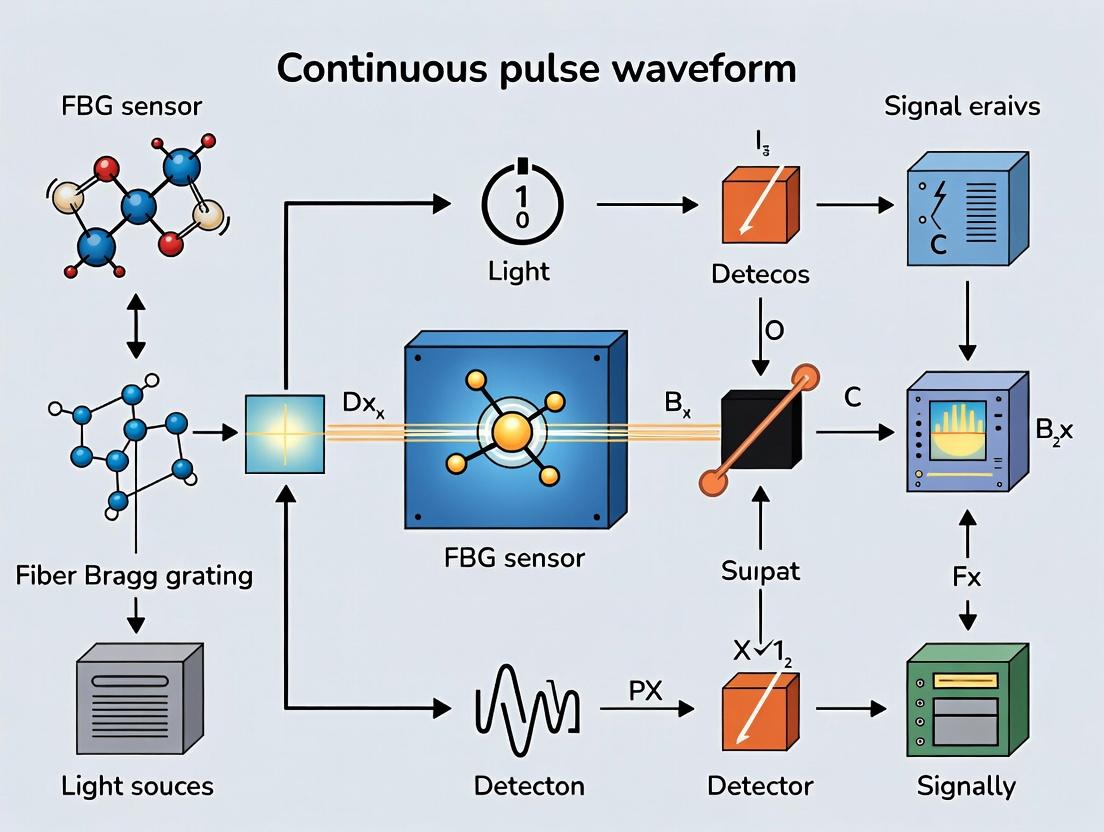
This article provides a comprehensive review of Fiber Bragg Grating (FBG) sensor systems for continuous pulse waveform measurement, tailored for biomedical researchers and pharmaceutical development professionals.
Continuous Arterial Pulse Wave Monitoring with FBG Sensors: Principles, Clinical Applications, and Research Frontiers
Abstract
This article provides a comprehensive review of Fiber Bragg Grating (FBG) sensor systems for continuous pulse waveform measurement, tailored for biomedical researchers and pharmaceutical development professionals. It explores the fundamental principles of FBG technology and its unique advantages for hemodynamic monitoring, details system design, sensor integration, and specific applications in clinical research and drug trials. The content addresses common implementation challenges, optimization strategies for signal fidelity, and comparative analyses against established techniques like tonometry and photoplethysmography. Finally, it examines validation protocols and discusses the transformative potential of FBG-based systems for advancing cardiovascular diagnostics and personalized medicine.
FBG Pulse Sensing Decoded: Core Principles and Advantages for Hemodynamic Research
Fundamental Physics of Fiber Bragg Gratings
A Fiber Bragg Grating (FBG) is a periodic modulation of the refractive index in the core of an optical fiber. This structure acts as a wavelength-specific reflector. The central operating principle is based on the constructive interference of light reflected from each grating plane. According to Bragg's law, the condition for peak reflection occurs at the Bragg wavelength (λ_B), given by:
λB = 2neffΛ
where n_eff is the effective refractive index of the fiber core mode and Λ is the grating period.
When the FBG is subjected to strain (ε) or a temperature change (ΔT), both n_eff and Λ are altered, resulting in a shift in the Bragg wavelength (Δλ_B). The fundamental sensing equation is:
ΔλB / λB = (1 - pe)ε + (αΛ + α_n)ΔT
where p_e is the photo-elastic coefficient, α_Λ is the thermal expansion coefficient, and α_n is the thermo-optic coefficient.
Table 1: Key Material Parameters for Standard Silica FBG Sensing
| Parameter | Symbol | Typical Value | Unit |
|---|---|---|---|
| Bragg Wavelength (Common) | λ_B | 1550 (C-band) | nm |
| Strain Sensitivity (at ~1550nm) | K_ε | ~1.2 | pm/με |
| Temperature Sensitivity (at ~1550nm) | K_T | ~10.0 | pm/°C |
| Photo-Elastic Coefficient | p_e | ~0.22 | - |
| Thermo-Optic Coefficient | α_n | ~6.67 x 10^-6 | /°C |
| Thermal Expansion Coefficient | α_Λ | ~0.55 x 10^-6 | /°C |
| Grating Length | L | 1 - 20 | mm |
| Reflectivity | R | Up to >99 | % |
Optical Sensing Mechanism for Pulse Waveforms
Within the thesis context of continuous pulse waveform measurement, the FBG operates as a dynamic strain sensor. Arterial pulsation induces minute circumferential strain on the skin surface. An FBG, when attached to the skin (e.g., over the radial artery), experiences this dynamic strain, causing a proportional, time-varying shift in its Bragg wavelength. A high-speed optical interrogator detects these sub-picometer to picometer-scale wavelength shifts, converting them into a continuous, calibrated volumetric strain waveform analogous to a photoplethysmogram (PPG) or pressure waveform.
Table 2: Quantitative Requirements for FBG-based Pulse Waveform Monitoring
| Performance Metric | Target Specification for Hemodynamic Research | Notes |
|---|---|---|
| Interrogation Speed | ≥ 1 kHz | To capture rapid systolic upstroke & dierotic notch. |
| Wavelength Resolution | ≤ 1 pm | Corresponds to ~0.8 με resolution. |
| Dynamic Strain Range | ± 500 με | Covers typical arterial wall displacement. |
| Sensor Size (Gauge Length) | 5 - 10 mm | Optimized for arterial applanations. |
| Crosstalk between FBGs | < -40 dB | For multi-parameter (e.g., multi-site) sensing. |
| Thermal Compensation | Required | Use of a reference temperature-sensing FBG. |
Experimental Protocols for FBG Pulse Sensor Characterization
Protocol 1: Calibration of FBG Strain Sensitivity (K_ε)
Objective: To empirically determine the strain-to-wavelength shift coefficient. Materials: FBG sensor, optical interrogator (e.g., SM130), translation stage with micrometer, fiber holders, adhesive (cyanoacrylate). Procedure:
- Mount the FBG fiber at two points on a calibrated translation stage, ensuring the grating region is free and axially aligned.
- Connect the FBG to the interrogator and record the stable baseline λ_B.
- Using the micrometer, apply a known displacement (ΔL) in steps (e.g., 10 μm) over the gauge length (L). Calculate applied strain as ε = ΔL / L.
- Record the corresponding λ_B at each step over a range of ±500 με.
- Plot ΔλB vs. ε. Perform linear regression. The slope is Kε (pm/με).
Protocol 2: In-Vitro Simulation of Pulse Waveform Measurement
Objective: To validate FBG dynamic response using a phantom. Materials: FBG sensor, pneumatic pulse simulator (with programmable pressure waveform), silicone skin/artery phantom, adhesive tape, high-speed interrogator, data acquisition software. Procedure:
- Fix the FBG tangentially onto the surface of the silicone artery phantom using medical-grade tape.
- Connect the phantom to the pneumatic pulse simulator set to generate a physiological waveform (e.g., 72 BPM, 120/80 mmHg profile).
- Start the interrogator at 2 kHz sampling rate.
- Simultaneously record the FBG wavelength shift and the simulator's internal pressure reference for 60 seconds.
- Synchronize the datasets and compare waveform morphology (systolic peak, dierotic notch) and calculate correlation coefficients.
Protocol 3: In-Vivo Pilot Study for Radial Artery Pulse Acquisition
Objective: To acquire continuous pulse waveforms from a human subject. Materials: FBG sensor in a wearable strap/bracket, optical interrogator, laptop, reference blood pressure cuff (optional), thermal compensation FBG. Procedure:
- Ethics & Consent: Obtain IRB approval and informed consent from the subject.
- Sensor Placement: Position the FBG sensor over the subject's radial artery at the wrist, marked via palpation. A secondary FBG for temperature is placed nearby on non-pulsatile tissue.
- Setup: Connect the FBGs to the interrogator. Shield the setup from ambient light and motion.
- Data Collection: With the subject seated and rested, record a 5-minute baseline. Then, record during controlled breathing and post-exercise recovery.
- Analysis: Apply thermal correction using the reference FBG signal. Filter the strain signal (0.5 - 20 Hz bandpass). Extract pulse wave features: Heart Rate (HR), Augmentation Index (AIx), and Pulse Wave Velocity (PWV) if using dual sensors.
Diagrams
Diagram 1: FBG Optical Sensing Signal Chain (94 chars)
Diagram 2: In-Vivo Pulse Measurement Workflow (79 chars)
The Scientist's Toolkit: Key Research Reagents & Materials
Table 3: Essential Materials for FBG Pulse Sensor Development
| Item | Function & Specification | Example/Notes |
|---|---|---|
| FBG Arrays | Core sensing element. Custom wavelengths (1530-1560 nm), specific gauge length (5-10 mm), polyimide coating for better strain transfer. | Manufacturers: TechnicaSA, FBGS, ITF Technologies. |
| High-Speed Optical Interrogator | Measures Δλ_B with pm resolution at kHz rates. Critical for capturing waveform fidelity. | Examples: Micron Optics sm130 (1kHz), FBGS-scan 1300 (2kHz), I-MON 512E (up to 5kHz). |
| Medical-Grade Adhesive | To affix FBG to skin surface with consistent coupling and minimal discomfort. | Silicone-based adhesives (e.g., Bio-Plex), hydrocolloid tapes. |
| Thermal Compensation FBG | Reference sensor to isolate thermal effects from strain signals. Placed on adjacent, non-pulsatile tissue. | Identical FBG in the same array, packaged to be strain-isolated. |
| Optical Fiber Cleaver & Stripper | For precise preparation and termination of fiber ends before connectorization. | Example: Fujikura CT-30 cleaver. |
| Calibration Strain Stage | Micrometer-driven translation stage for precise strain application during sensor calibration. | Must have sub-micron resolution. |
| Phantom/Pulse Simulator | Provides controlled, repeatable physiological waveforms for in-vitro validation. | Silicone artery models; programmable pneumatic pulsatile pumps. |
| Data Acquisition Software | Custom or vendor software to record, visualize, and export high-speed wavelength data. | LabVIEW with instrument drivers, Python with proprietary SDKs. |
This application note details the implementation of Fiber Bragg Grating (FBG) sensors within a research thesis focused on developing a continuous, wearable pulse waveform measurement system. The core mandate is to overcome limitations of traditional electrical (e.g., ECG, PPG) and pneumatic (e.g., sphygmomanometer) methods in high-electromagnetic-interference (EMI) environments, during MRI, or in multi-point sensing scenarios. The intrinsic advantages of FBG technology—immunity to EMI, capacity for miniaturization, and inherent wavelength-division multiplexing—are investigated as the foundational pillars for this research.
Table 1: Comparative Analysis of Pulse Waveform Measurement Modalities
| Feature | FBG Sensor System | Photoplethysmography (PPG) | Piezoelectric (PZT) Sensor | Applanaton Tonometry |
|---|---|---|---|---|
| EMI Immunity | Excellent (Passive, Dielectric) | Poor (Active Electronics) | Poor (Active Electronics) | Moderate (Mechanical) |
| Miniaturization Potential | High (< 1 mm diameter probe) | Moderate (LED/PD assembly) | Low (Crystal size) | Low (Array probe size) |
| Multiplexing Capacity | High (> 20 sensors on single fiber) | Very Low (Independent units) | Low (Complex wiring) | None (Single probe) |
| Sensitivity (Typical) | ~1.2 pm/µε (Strain) | N/A (Voltage output) | ~10-100 mV/µε | Force (g) |
| Bandwidth | >100 Hz | Typically < 20 Hz | 0.1 - 100 Hz | < 50 Hz |
| Key Advantage for Research | MRI-compatible, Multi-point, Durable | Low-cost, Ubiquitous | High sensitivity | Clinical gold standard |
Table 2: FBG System Performance Metrics from Recent Studies (2023-2024)
| Study Focus | FBG Specification | Achieved Resolution | Multiplexing Level | Key Application Context |
|---|---|---|---|---|
| Radial Artery Pulse Wave (Lee et al., 2023) | λB=1550 nm, Length=5 mm | 1.2 µε (≈0.1 mmHg) | 3 FBGs on single fiber | Continuous BP estimation |
| Carotid Tonometry (Zhang et al., 2024) | Polymer FBG, λB=850 nm | 2.5 pm (Wavelength shift) | 1 (Focused on miniaturization) | Wearable CVD monitoring |
| Multi-site Pulse Wave (Ibrahim et al., 2024) | λB=1510-1590 nm array | 5 ms temporal resolution | 8 FBGs on single fiber | Pulse Wave Velocity (PWV) mapping |
Experimental Protocols
Protocol 3.1: In-vitro Validation of EMI Immunity
Objective: To quantitatively demonstrate the FBG sensor's operational stability under high EMI compared to a reference PPG sensor. Materials: FBG interrogator (e.g., Micron Optics si255), single FBG sensor (λB=1550 nm), commercial PPG module (e.g., Maxim Integrated MAX30101), signal generator, Helmholtz coil (for generating controlled EMI), data acquisition system (DAQ), phantom pulsatile vessel model. Procedure:
- Setup: Mount the FBG and PPG sensors on the surface of the pulsatile phantom to measure simulated arterial pressure waveforms.
- Baseline Recording: Acquire simultaneous pulse waveforms from both sensors for 60 seconds in an EMI-shielded environment.
- EMI Exposure: Activate the Helmholtz coil to generate a known, swept-frequency EMI field (e.g., 60 Hz to 1 GHz at 10 V/m). Record data for 120 seconds.
- Data Analysis: Calculate the Signal-to-Noise Ratio (SNR) for both sensors during baseline and EMI exposure. Compute the correlation coefficient between the recorded waveform and the phantom's known input waveform.
Protocol 3.2: Characterization of Miniaturized FBG Array for Multi-point Pulse Measurement
Objective: To deploy and validate a multiplexed, miniaturized FBG array for simultaneous radial and carotid artery pulse waveform acquisition. Materials: 4-channel FBG interrogator, single optical fiber with 4 FBGs (λB spaced 5 nm apart, center 1550 nm, each 3 mm long), custom 3D-printed wearable housings for radial/carotid sites, medical-grade adhesive, DAQ software. Procedure:
- Sensor Fabrication & Calibration: Characterize each FBG's wavelength-strain coefficient via a calibration bench. Encapsulate the fiber in a soft silicone matrix for skin interface, leaving sensing regions exposed.
- Subject Mounting: Affix the sensor housings at the radial artery (wrist) and carotid artery (neck) locations. Align the FBG sensing axis perpendicular to the artery.
- Data Acquisition: Simultaneously acquire wavelength shifts from all 4 FBGs at 1 kHz sampling rate for 5 minutes with the subject in supine rest.
- Post-processing: Convert wavelength data to strain. Apply temporal alignment and calculate Pulse Wave Velocity (PWV) between proximal and distal sensor sites.
Diagram 1: FBG Pulse Measurement System Data Flow (83 chars)
Diagram 2: Signal Transduction Pathway from Artery to FBG Readout (79 chars)
The Scientist's Toolkit: Research Reagent Solutions
Table 3: Essential Materials for FBG-based Pulse Waveform Research
| Item | Function & Specification | Rationale for Use |
|---|---|---|
| FBG Interrogator | High-speed spectrometer (e.g., I-MON 512 E). Resolution: <1 pm, Speed: >1 kHz. | Converts reflected FBG wavelength shifts into digital strain data. High speed is critical for capturing pulse waveform details. |
| Medical-Grade Silicone | Biocompatible, soft encapsulant (e.g., Dow Silastic MDX4-4210). | Encapsulates and protects the FBG fiber while providing compliant mechanical coupling to the skin. |
| Wavelength Division Multiplexer (WDM) | Optical coupler for multiplexing signals from multiple FBGs. | Enables multiple FBGs on a single fiber, reducing system complexity and weight for wearable applications. |
| 3D Printing Resin (Flexible) | For custom wearable sensor housings (e.g., Formlabs Elastic 50A). | Allows rapid prototyping of subject-specific, ergonomic mounts that secure the FBG at the optimal anatomical angle. |
| Optical Fiber with Polyimide Coating | Standard SMF-28 fiber with polyimide recoating for FBG inscription. | Polyimide coating provides excellent strain transfer from the substrate to the FBG core compared to acrylic coatings. |
| Motion Artefact Suppression Gel | High-viscosity ultrasound gel or specialized skin adhesive interface. | Improves mechanical impedance matching between skin and sensor, dampening motion-induced noise. |
Physiological Origins & Hemodynamic Principles
The arterial pulse wave is a pressure wave generated by ventricular systole and propagated through the arterial tree. Its morphology is determined by the interaction of cardiac ejection (stroke volume, ejection velocity), arterial wall properties (compliance, stiffness), and wave reflection phenomena from peripheral sites.
Key Determinants:
- Cardiac Factors: Stroke Volume (SV), Left Ventricular Ejection Time (LVET), rate of pressure rise (dP/dt).
- Vascular Factors: Arterial compliance (ΔV/ΔP), systemic vascular resistance (SVR), aortic impedance.
- Wave Reflection: Reflected waves from bifurcations and high-resistance arterioles augment late-systolic pressure.
Quantitative Waveform Feature Data
Table 1: Normative Temporal and Amplitude Parameters of the Radial Arterial Pulse Wave in Adults at Rest
| Feature | Physiological Origin | Typical Value (Rest) | Clinical/Research Significance |
|---|---|---|---|
| Systolic Peak (P1) | Maximum pressure from ventricular ejection & initial forward wave. | ~120-130 mmHg (aortic) | Correlates with systolic BP; influenced by SV & aortic compliance. |
| Peak-to-Peak Time | Time from systolic peak to diastolic peak. | ~300-400 ms | Related to heart rate and pulse wave velocity. |
| Dicrotic Notch | Incisura caused by aortic valve closure; marks end of systole. | ~250-350 ms after P1 @ ~80-90 mmHg | Key marker for systole end; its elevation indicates increased wave reflection or decreased compliance. |
| Diastolic Peak (P2) | Reflected wave from lower body & diastolic runoff. | Variable | Amplitude and timing are biomarkers of arterial stiffness & central hemodynamics. |
| Augmentation Index (AIx) | (P2 amplitude / P1 amplitude) x 100. Measure of wave reflection. | -10% to +30% (age-dependent) | Non-invasive index of arterial stiffness and central pressure augmentation. |
| Pulse Wave Velocity (PWV) | Speed of pulse wave travel between two arterial sites. | Carotid-femoral PWV: ~6-10 m/s (young) | Gold-standard measure of arterial stiffness; independent cardiovascular risk predictor. |
Table 2: Changes in Pulse Wave Features Under Pathophysiological or Pharmacological Conditions
| Condition | Effect on Systolic Peak | Effect on Dicrotic Notch | Effect on AIx & PWV | Primary Mechanism |
|---|---|---|---|---|
| Arterial Stiffening (Aging, Hypertension) | Increased, sharper rise. | Later, less distinct, elevated. | ↑ AIx, ↑↑ PWV | Reduced arterial compliance, earlier wave reflection. |
| Vasodilator (e.g., Nitroglycerin) | Mild decrease or unchanged. | More distinct, often lowered. | ↓ AIx | Reduced wave reflection via peripheral arteriolar dilation. |
| Increased Systemic Resistance | Increased. | Elevated. | ↑ AIx | Enhanced amplitude of reflected waves. |
| Aortic Valve Stenosis | Reduced amplitude, delayed/absent peak (pulsus parvus et tardus). | May be obscured. | Variable | Impaired ventricular ejection. |
| Aortic Regurgitation | Increased amplitude, rapid fall (water-hammer pulse). | Often absent or minimal. | Variable | Diastolic runoff back into ventricle. |
Experimental Protocols for Pulse Wave Analysis
Protocol 3.1: Non-Invasive Applanatory Tonometry for Central Pulse Waveform Acquisition
Application: Capturing peripheral (e.g., radial) waveforms for central aortic waveform derivation via generalized transfer function. Materials: High-fidelity tonometer (e.g., Millar, SphygmoCor), calibration device (brachial cuff sphygmomanometer), acquisition software, subject restraint. Procedure:
- Participant rests supine for ≥10 minutes in a temperature-controlled room.
- Perform triplicate brachial BP measurements on the non-dominant arm for waveform calibration.
- Position tonometer probe over the radial artery of the dominant wrist at the point of maximum pulsation.
- Apply gentle pressure to partially flatten (applanate) the artery, optimizing the signal until a clean, stable waveform is visualized.
- Acquire a minimum of 20 consecutive, high-quality waveforms.
- Use validated software (e.g., SphygmoCor) to apply a generalized transfer function, generating the estimated central aortic waveform.
- Extract key features: Augmentation Pressure (AP), Augmentation Index (AIx@75), LVET, timing of reflected wave.
Protocol 3.2: Invasive High-Fidelity Pulse Waveform Recording for Validation Studies
Application: Gold-standard measurement for validating non-invasive sensors (e.g., FBG systems). Materials: Fluid-filled catheter system or solid-state micromanometer catheter (e.g., Millar), pressure transducer, signal amplifier, data acquisition system, sterile surgical supplies. Procedure:
- Under aseptic technique, introduce the catheter per standard clinical procedure (e.g., radial or femoral artery access).
- Advance the catheter tip to the desired anatomical site (e.g., ascending aorta, aortic arch).
- Connect catheter to calibrated pressure transducer/amplifier system. Zero and calibrate according to manufacturer guidelines, referencing to atmospheric pressure at the level of the heart.
- Record continuous pressure waveforms at a high sampling rate (≥500 Hz).
- Simultaneously record non-invasive comparator signals (e.g., FBG sensor, tonometer) from a correlated peripheral site.
- Synchronize signals temporally using a shared trigger. Analyze for feature correlation (systolic peak timing/amplitude, dicrotic notch morphology) and derive transfer functions.
Protocol 3.3: Pharmacodynamic Assessment Using Pulse Wave Analysis
Application: Quantifying acute vascular effects of therapeutic compounds in early-phase clinical trials. Materials: Tonometry or FBG sensor system, sphygmomanometer, pharmacologic agent (e.g., nitroglycerin, angiotensin-converting enzyme inhibitor), timing device. Procedure:
- Establish pre-dose baseline: Record pulse waveforms and BP every 5 minutes for 30 minutes until stable.
- Administer standardized dose of the study drug.
- Post-dose monitoring: Record waveforms and BP at fixed intervals (e.g., 5, 15, 30, 60, 90, 120 minutes).
- Primary Endpoint: Change in central Augmentation Index (AIx) from baseline.
- Secondary Endpoints: Changes in central systolic pressure, pulse pressure amplification (radial/aortic PP ratio), timing of reflected wave (TR), and PWV (if multi-site measurement is available).
- Analyze dose-response and time-action relationships.
Visualizations
The Scientist's Toolkit: Research Reagent Solutions & Essential Materials
Table 3: Key Materials for Arterial Pulse Waveform Research
| Item | Function & Application in Research |
|---|---|
| High-Fidelity Tonometer (e.g., Millar tonometer, SphygmoCor system) | Gold-standard non-invasive device for applanation tonometry. Captures peripheral arterial waveforms with high fidelity for central pressure derivation. |
| Solid-State Micromanometer Catheter (e.g., Millar Mikro-Tip) | Invasive gold-standard. Provides direct, high-frequency intra-arterial pressure measurement for validation studies. |
| FBG (Fiber Bragg Grating) Sensor System | Research device. Enables continuous, wearables-friendly pulse waveform measurement via wavelength shift in reflected light from a grating inscribed in an optical fiber. |
| Generalized Transfer Function Software (e.g., within SphygmoCor, Vicorder systems) | Algorithmic software. Mathematically converts a peripherally recorded waveform (e.g., radial) into an estimated central aortic waveform. |
| Pulse Wave Analysis Software (e.g, LabChart modules, custom MATLAB/Python scripts) | For offline analysis. Used to automatically detect waveform landmarks (systolic peak, dicrotic notch), calculate indices (AIx, PWV, LVET), and perform statistical comparisons. |
| Pharmacologic Challenge Agents (e.g., sublingual Nitroglycerin, inhaled Salbutamol) | Vasoactive compounds. Used in pharmacodynamic protocols to induce predictable changes in arterial tone and waveform morphology, testing system sensitivity. |
| Arterial Flow Phantom | In vitro validation setup. A closed-loop system with pulsatile pump and compliant tubing simulating arterial properties, allowing for controlled benchmarking of sensor performance. |
| Signal Conditioner & DAQ | Hardware. Amplifies and digitizes analog signals from pressure transducers or FBG interrogators for computer acquisition (min. 500 Hz sampling rate recommended). |
This application note details the principles and protocols for using Fiber Bragg Grating (FBG) sensors to measure arterial pulse waveforms via strain-induced wavelength modulation. The content supports a thesis focused on developing a continuous, high-fidelity FBG sensor system for hemodynamic monitoring in clinical and pharmacological research.
A Fiber Bragg Grating (FBG) is a periodic modulation of the refractive index in an optical fiber's core. It reflects a specific wavelength of light (the Bragg wavelength, λB) given by λB = 2neffΛ, where neff is the effective refractive index and Λ is the grating period. External strain (ε) applied to the FBG alters Λ and, via the photo-elastic effect, neff, causing a shift in λB (ΔλB). The relationship is ΔλB / λB = (1 - pe)ε, where p_e is the effective strain-optic coefficient (~0.22 for silica fiber). Arterial pulsations impart cyclic circumferential strain on an adjacent FBG sensor, translating the pressure waveform into a measurable optical spectrum shift.
Table 1: Key FBG Parameters for Arterial Pulse Sensing
| Parameter | Typical Value / Range | Notes / Impact on Measurement |
|---|---|---|
| FBG Center Wavelength (λ_B) | 1550 nm (C-band) | Common low-loss telecom window; enables high-resolution interrogation. |
| Strain Sensitivity (Δλ_B/ε) | ~1.2 pm/με at 1550 nm | Derived from (1-pe)λB. Defines system's mechanical-to-optical gain. |
| Typical Arterial Wall Strain (ε) | 100 - 1500 με | Depends on artery, location, age, and cardiovascular health. |
| Expected Δλ_B per Pulse | 0.12 - 1.8 nm | Direct product of strain and sensitivity. Defines required interrogator resolution. |
| FBG Gauge Length | 5 - 10 mm | Must be appropriate for arterial curvature and spatial strain field. |
| System Sampling Rate | ≥ 500 Hz | Required to accurately capture pulse waveform harmonics (≥ 20 harmonics). |
Table 2: Comparison of FBG Interrogation Methods for Pulse Waveforms
| Interrogation Method | Approx. Resolution | Max. Sample Rate | Suitability for Continuous Monitoring |
|---|---|---|---|
| Spectrometer-Based | 1-10 pm | 1-100 Hz | Low. Limited speed for dynamic waveforms. |
| Linear Edge Filter | 1 pm | 1-10 kHz | Medium. Good speed, susceptible to power fluctuations. |
| Tunable Laser Source | < 0.1 pm | 1-10 kHz | High. Excellent resolution & speed; higher cost/complexity. |
| Microwave Photonics | < 0.1 pm | > 10 kHz | Very High. Extreme speed for advanced wave analysis. |
Experimental Protocols
Protocol 4.1: Ex Vivo Arterial Pulse Waveform Measurement
Objective: To characterize the strain-wavelength transfer function of an FBG sensor coupled to an arterial segment under simulated pulsatile pressure. Materials: Excised arterial segment (porcine/ovine carotid), pulsatile perfusion bioreactor, FBG sensor (λ_B=1550 nm, gauge length=5mm), optical interrogator (tunable laser or high-speed spectrometer), pressure transducer (reference), temperature-controlled bath. Procedure:
- Sensor Fixation: Securely affix the FBG sensor to the exterior adventitial surface of the arterial segment along the circumferential axis using minimal, biocompatible cyanoacrylate adhesive. Ensure full gauge length contact.
- System Integration: Mount the instrumented artery in the bioreactor chamber filled with physiological saline (37°C). Connect the artery to the pulsatile pump system. Position the reference pressure transducer inline upstream.
- Optical Connection: Connect the FBG fiber to the interrogator via a circulator (if using reflective setup). Launch optical power and confirm initial reflected spectrum.
- Data Acquisition: Initiate pulsatile flow, ramping pressure from 80 to 120 mmHg over 10 cycles. Simultaneously record:
- FBG reflected wavelength shift (Δλ_B) from interrogator.
- Intraluminal pressure from reference transducer.
- Bath temperature (for thermal compensation).
- Calibration: Post-experiment, apply known static strains via a micrometer stage to establish the exact strain sensitivity (pm/με) for the specific sensor mounting.
- Analysis: Correlate Δλ_B(t) with pressure P(t) to generate the pressure-strain-wavelength transfer function. Calculate the lag/phase difference.
Protocol 4.2: In Vivo FBG-Based Pulse Wave Velocity (PWV) Measurement
Objective: To measure arterial stiffness non-invasively using two spatially separated FBG sensors to determine pulse wave velocity. Materials: Two identical FBG sensors (λB1, λB2), high-speed optical interrogator (≥2 channels, 1 kHz), adhesive sensor patches, physiological monitor (ECG for gating). Procedure:
- Sensor Placement: Adhere FBG1 to the skin over the common carotid artery and FBG2 over the femoral artery. Ensure optimal coupling to transmit arterial wall motion.
- Signal Synchronization: Connect ECG leads to the interrogator's auxiliary input for cardiac cycle timing.
- Baseline Recording: Record 30 seconds of simultaneous data: λB1(t), λB2(t), and ECG R-wave peaks.
- Foot-to-Foot Analysis: For each pulse, identify the "foot" of the waveform as the point of maximum diastolic acceleration (minimum of the first derivative) for both FBG signals.
- PWV Calculation: Measure the time delay (Δt) between the foot of the pulse at the carotid (proximal) and femoral (distal) sites. Measure the surface distance (D) between the two sensor sites. Calculate PWV = D / Δt.
- Validation: Compare FBG-derived PWV with tonometry or ultrasound-based methods.
Visualization Diagrams
Diagram 1: FBG Pulse Sensing: From Artery to Biomarkers (85 chars)
Diagram 2: Protocol for FBG-Based Pulse Wave Velocity Measurement (80 chars)
The Scientist's Toolkit
Table 3: Essential Research Reagent Solutions & Materials
| Item | Function in FBG Pulse Waveform Research |
|---|---|
| FBG Sensor Arrays | Custom or commercial FBGs with specific gauge lengths (3-10mm) and coatings for biomedical strain sensing. Provide the core transduction mechanism. |
| High-Speed Optical Interrogator | Device (e.g., tunable laser or edge-filter based) to measure λ_B shifts with <1 pm resolution and >500 Hz sampling. Enables capture of dynamic waveforms. |
| Biocompatible Adhesive (e.g., Medical Cyanoacrylate/Silicone) | For ex vivo sensor fixation to tissue or in vivo securement to skin. Ensures efficient mechanical coupling without tissue damage. |
| Physiological Saline & Temperature Controller | Maintains tissue viability ex vivo and provides stable thermal environment (37°C) to isolate temperature-induced λ_B drift from strain effects. |
| Reference Pressure Transducer | Gold-standard fluidic pressure measurement (ex vivo) for system validation and calibration of FBG-derived pressure waveforms. |
| ECG Gating Module | Provides synchronized cardiac timing (R-wave) for signal averaging, foot detection, and Pulse Wave Velocity (PWV) calculations. |
| Optical Circulator/Isolator | Directs light from the source to the FBG and from the FBG to the detector, protecting the source from back-reflections. |
| Signal Processing Software (e.g., LabVIEW, Python with SciPy) | For real-time and post-hoc analysis: thermal compensation, filtering, derivative analysis for foot detection, and biomarker computation. |
Fiber Bragg Grating (FBG) sensor systems are revolutionizing continuous physiological monitoring through their unique advantages: immunity to electromagnetic interference, multiplexing capability on a single optical fiber, miniaturization potential, and biocompatibility. This article details application notes and protocols for these systems, framed within a thesis focused on continuous arterial pulse waveform measurement—a critical vital sign for cardiovascular diagnostics and drug efficacy studies.
Application Notes
Wearable FBG Systems for Pulse Wave Velocity (PWV)
- Objective: Non-invasive, continuous measurement of arterial stiffness via PWV, a key biomarker for hypertension and atherosclerosis.
- Principle: Two or more FBG sensors are integrated into a textile cuff or patch and placed over superficial arteries (e.g., carotid and femoral). The time delay (Δt) between proximal and distal pulse waveforms is measured. PWV is calculated as the distance between sensors (Δx) divided by Δt (PWV = Δx/Δt).
- Key Insight: Recent research demonstrates wearable FBG systems achieving PWV measurement accuracy within ±0.5 m/s compared to tonometry, with sampling rates >500 Hz enabling precise fiducial point identification.
Implantable FBG Systems for Intracranial Pressure (ICP) & Intra-Aortic Pressure
- Objective: Long-term, continuous monitoring of deep-tissue pressures in preclinical and clinical settings.
- Principle: A biocompatible FBG sensor, often mounted on a flexible substrate or catheter tip, is implanted. Changes in pressure induce strain on the FBG, shifting its Bragg wavelength (λ_B). In vivo studies use telemetric systems for wireless readout.
- Key Insight: Current miniaturization efforts focus on polymer-based FBGs (PFBGs) and bioresorbable coatings, reducing foreign body response and enabling chronic implantation.
Table 1: Performance Metrics of Recent FBG Monitoring Systems
| Application | Form Factor | Key Metric | Reported Performance | Ref. Year |
|---|---|---|---|---|
| Pulse Waveform | Textile wristband | Sensitivity | 1.21 pm/µm (strain); 15.6 pm/mmHg (pressure) | 2023 |
| PWV | Dual-patch system | Accuracy vs. SphygmoCor | Mean difference: 0.12 ± 0.64 m/s | 2024 |
| ICP Monitoring | Implantable catheter | Resolution / Range | <0.5 mmHg / 0-100 mmHg | 2023 |
| Cardiac Pressure | Catheter-tip sensor | Frequency Response | DC to >100 Hz | 2022 |
| Multiplexing | Wearable array | Number of sensors per fiber | Up to 10 sensors demonstrated in vivo | 2024 |
Table 2: Comparison of FBG Sensor Substrates for Implantation
| Substrate Material | Biocompatibility | Flexibility | Signal Stability | Typical Application |
|---|---|---|---|---|
| Silica Fiber | High (with coating) | Low | Excellent | Bone strain, tendon force |
| Polymer Fiber (CYTOP) | Excellent | High | Good (hygroscopic) | Intracranial, soft tissue |
| Bio-resorbable Silk | Excellent | Moderate | Limited lifetime | Temporary implants |
Detailed Experimental Protocols
Protocol 1: In-Vitro Characterization of FBG Pulse Sensor
- Title: Calibration and Dynamic Response Testing for Wearable FBG Pulse Sensors.
- Purpose: To establish the pressure-strain-wavelength relationship and dynamic frequency response of an FBG sensor intended for arterial pulse monitoring.
- Materials: See "The Scientist's Toolkit" below.
- Procedure:
- Static Calibration: Mount the FBG sensor on a calibrated micro-strain stage. Use an optical interrogator to record the baseline λB.
- Apply known displacements (e.g., 10 µm steps to 100 µm) using the stage. Record the corresponding shift in λB (ΔλB).
- Plot ΔλB vs. Applied Strain (µε). Perform linear regression to obtain strain sensitivity (pm/µε).
- Pressure Calibration: Place the sensor in a sealed chamber connected to a digital pressure calibrator (0-200 mmHg). Record ΔλB at 10 mmHg increments.
- Plot ΔλB vs. Applied Pressure. Perform linear regression to obtain pressure sensitivity (pm/mmHg).
- Dynamic Testing: Affix the FBG sensor to a piezoelectric actuator driven by a function generator.
- Subject the sensor to sinusoidal waveforms (0.5 Hz to 50 Hz) simulating pulse waveforms. Record the sensor's output via the interrogator at a high sampling rate (>1 kHz).
- Compare input and output signals using Fast Fourier Transform (FFT) to identify the -3 dB bandwidth of the sensor system.
Protocol 2: In-Vivo Validation of FBG-Based PWV System
- Title: Simultaneous Multi-Site Pulse Acquisition for Arterial Stiffness Assessment.
- Purpose: To validate an FBG-based wearable system against a commercial tonometer for measuring carotid-femoral PWV in human subjects.
- Materials: Dual-FBG sensor patches, optical interrogator, ECG electrodes, commercial tonometer (e.g., SphygmoCor), data acquisition software.
- Procedure:
- Sensor Placement: Position FBG patch sensors over the carotid and femoral arterial sites. Secure a single-lead ECG for timing reference.
- System Synchronization: Synchronize data acquisition clocks for the optical interrogator, ECG, and tonometer.
- Data Acquisition: Simultaneously record for 5 minutes: a) λ_B shifts from both FBGs, b) ECG, c) tonometer-derived pulse waves from the carotid site.
- Signal Processing: (Workflow in Diagram 1)
- Analysis: Calculate FBG-PWV as Δx / Δt. Perform Bland-Altman analysis to compare FBG-PWV with tonometer-PWV.
Visualizations
Diagram 1: FBG-PWV Signal Processing Workflow
Diagram 2: Implantable FBG Telemetric System Logic
The Scientist's Toolkit: Key Research Reagent Solutions
Table 3: Essential Materials for FBG Biomedical Experimentation
| Item | Function & Relevance | Example/Specification |
|---|---|---|
| Optical Interrogator | Measures Bragg wavelength shifts with high precision and speed. Core of the readout system. | Micron Optics si255, FS22 Series. Key spec: <1 pm resolution, >1 kHz scan rate. |
| Bio-compatible Coating | Encapsulates silica fiber for safe tissue contact, reduces bio-fouling. | Medical-grade silicones (PDMS), polyimide, parylene-C, or bio-resorbable polymers (PLGA). |
| Calibration Phantom | Simulates tissue mechanical properties for in-vitro sensor testing. | Agar/PVA gels or silicone elastomers with tunable Young's modulus. |
| Motion Artifact Mitigation Kit | Critical for wearable applications to isolate arterial pulse from noise. | Viscoelastic polymer overlays, double-sided adhesive rings, rigid housings. |
| Multiplexing Array Fiber | Single fiber with multiple FBGs for simultaneous multi-parameter or multi-site sensing. | Draw tower grating (DTG) array with 5-10 FBGs at defined spacings. |
| Reference Measurement Device | Gold-standard device for validation studies (e.g., PWV, pressure). | SphygmoCor (tonometry), Millar catheter-tip pressure transducer, Finapres. |
Building Your FBG Pulse System: Design, Integration, and Use Cases in Drug Development
This application note details the integrated system architecture for a Fiber Bragg Grating (FBG) sensor system designed for continuous, high-fidelity arterial pulse waveform measurement. Within the broader thesis on cardiovascular monitoring for drug development, this system aims to provide a precise, wearable platform for capturing hemodynamic parameters critical for pharmacokinetic/pharmacodynamic studies.
Interrogator Unit Technology: Comparison & Selection
The interrogator is the core hardware that emits broadband light and detects the wavelength shift from the FBG sensor, which corresponds to mechanical strain (pulse pressure). Current technologies are compared below.
Table 1: Comparison of FBG Interrogator Technologies for Physiological Sensing
| Interrogator Type | Principle | Wavelength Resolution (pm) | Typical Scan Rate (Hz) | Key Advantages | Limitations for Wearable Research |
|---|---|---|---|---|---|
| Spectrometer-Based | Dispersive element + CCD array | 5 - 50 | 1 - 500 | Low cost, robust, good for static/quasi-static measures. | Lower scan rate & resolution limit dynamic waveform fidelity. |
| Tunable Laser Source (TLS) | Wavelength-swept laser | 1 - 5 | 100 - 5,000 | Very high resolution & speed. Excellent for high-frequency dynamics. | Higher cost, more complex, potential laser safety considerations. |
| Edge Filter Detection | Linear optical filter converts wavelength to intensity shift. | 10 - 30 | Up to 10,000 | Very high speed, relatively simple design. | Lower resolution, sensitive to source intensity noise. |
| Fabry-Perot Tunable Filter (FPTF) | Electrically tunable optical filter. | 1 - 10 | 100 - 2,000 | Good compromise between speed, resolution, and cost. | Thermal drift may require calibration during long-term use. |
Protocol 2.1: Interrogator Performance Validation for Pulse Waveforms
- Objective: To validate that the selected interrogator meets the minimum specifications for accurate pulse waveform capture.
- Materials: FBG interrogator unit, calibration FBG sensor on a piezoelectric (PZT) stage, signal generator, data acquisition (DAQ) system, analysis software.
- Method:
- Connect the calibration FBG to the interrogator and the PZT stage.
- Use the signal generator to drive the PZT with a known, sinusoidal strain profile (simulating a primary pulse frequency component).
- Record the wavelength output from the interrogator at its maximum stated scan rate for 30 seconds.
- Analyze the recorded data: Calculate the Signal-to-Noise Ratio (SNR) and compare the applied strain frequency to the detected frequency using a Fast Fourier Transform (FFT).
- Acceptance Criteria: The system must resolve wavelength shifts corresponding to <5 microstrain (approx. 0.5 pm shift) at a bandwidth ≥50 Hz to capture harmonic content of the pulse wave.
FBG Sensor Fabrication & Packaging Protocol
The sensor's sensitivity and mechanical interface are critical for faithful pulse wave transduction.
Protocol 3.1: Fabrication of a Demodulated, Skin-Interfaced FBG Pulse Sensor
- Objective: To create a soft, wearable FBG sensor that optimally couples with the radial artery for tangential strain measurement.
- Materials:
- Polyimide-coated single-mode optical fiber with inscribed FBG (λB ~ 830 nm or 1550 nm).
- Biocompatible silicone elastomer (e.g., PDMS).
- Laser ablation system or chemical etching kit for fiber coating removal.
- Molds for sensor packaging (3D printed, compliant material).
- Optical adhesive.
- Spectrometer for in-process verification.
- Method:
- Fiber Preparation: Carefully remove a 2 cm section of the polyimide coating centered on the FBG using laser ablation, ensuring the grating is fully exposed and undamaged.
- Mold Preparation: Design and print a mold with a central channel for the fiber and a wider, shallow cavity to form a soft, flexible patch (e.g., 15mm x 10mm x 1.5mm).
- Sensor Packaging: a. Secure the prepared fiber in the mold channel, ensuring the exposed FBG region is suspended and not contacting the mold. b. Mix and degas the silicone elastomer. c. Pour the elastomer into the mold, fully encapsulating the FBG region. d. Cure according to the manufacturer's specifications.
- Demodulation Layer Integration: To isolate arterial tangential strain from axial loading, a secondary, rigid layer can be bonded to the skin-side of the patch directly under the FBG. This creates a bending beam structure that amplifies tangential strain.
- Verification: Post-fabrication, characterize the sensor's wavelength response to calibrated pressure/strain before in-vivo use.
The Scientist's Toolkit: Key Reagents & Materials for FBG Pulse Sensor Research
| Item | Function/Application |
|---|---|
| Polyimide-Coated SMF-28 Fiber | Standard telecom fiber with high-temperature coating suitable for FBG inscription and flexible packaging. |
| Phase Mask (e.g., 1070.xx nm period) | Critical component for UV inscription of FBGs via the phase mask technique. |
| KrF Excimer Laser (248 nm) | UV laser source for photosensitivity-induced FBG inscription in germanium-doped fiber. |
| Polydimethylsiloxane (PDMS) | Biocompatible, soft elastomer for sensor packaging; provides mechanical coupling and skin safety. |
| Optical Adhesive (UV-Curable) | For secure, low-loss splicing and component attachment within the optical path. |
| Index Matching Gel | Temporarily reduces Fresnel reflections at fiber connectors or cleaved ends during testing. |
| Calibrated Piezoelectric (PZT) Stage | Provides precise, sub-nanometer mechanical actuation for in-vitro sensor calibration. |
Data Acquisition Hardware & Synchronization
The DAQ system converts optical wavelength data into digital signals for analysis.
Table 2: DAQ System Requirements for Multi-Channel FBG Pulse Recording
| Parameter | Specification | Rationale |
|---|---|---|
| Analog Input Channels | ≥ 2 per FBG interrogator output. | For simultaneous recording of wavelength and optional reference (e.g., ECG). |
| Sampling Rate | ≥ 2x the interrogator's maximum scan rate (Nyquist criterion). | Typical minimum: 1 kS/s per channel. |
| Resolution | 16-bit or higher. | Essential to resolve small wavelength shifts (pm level) from the analog output. |
| Synchronization | Hardware trigger input/output & shared sample clock across devices. | Mandatory for temporal alignment with other physiological signals (ECG, PPG, BP cuff). |
| Connection Bus | USB 3.0, PCIe, or Ethernet. | To handle high, continuous data throughput without loss. |
Protocol 4.1: System Integration and Synchronized Data Capture
- Objective: To integrate the FBG interrogator, DAQ, and ancillary devices for time-aligned multi-parameter data acquisition.
- Materials: FBG interrogator, DAQ device, ECG module, computer with LabVIEW/MATLAB/Python, synchronization cables.
- Method:
- Hardware Connection: Connect the analog output of the FBG interrogator to one channel of the DAQ. Connect the ECG module's output to another channel. Connect a DAQ digital output to the external trigger input of the interrogator (or vice-versa).
- Software Configuration: Configure the acquisition software to use a single, shared sample clock sourced from the master device (e.g., the DAQ card). Configure a hardware-triggered start for all devices.
- Synchronization Verification: Initiate acquisition and generate a simultaneous step signal (e.g., a tap on the FBG sensor and a simulated R-wave pulse). Record all channels.
- Analysis: Verify the timestamp alignment of the step events across all recorded channels. The measured latency should be consistent and less than 1 ms.
Experimental Workflow for In-Vivo Pulse Waveform Study
This workflow outlines a standard procedure for a pilot study using the described system.
Diagram 1: In Vivo FBG Pulse Waveform Study Workflow
System Signal Pathway & Data Flow
The logical and physical flow of data from the physiological event to the analyzed result.
Diagram 2: FBG Pulse Measurement System Signal Pathway
Sensor Packaging and Placement Strategies for Radial, Carotid, and Femoral Arteries
This document provides detailed application notes and experimental protocols for a Fiber Bragg Grating (FBG) sensor system designed for continuous, high-fidelity pulse waveform measurement. These protocols are integral to a broader thesis investigating the use of FBG sensor arrays for non-invasive, multipoint cardiovascular monitoring. Accurate packaging and site-specific placement are critical to extracting physiologically meaningful data from the radial, carotid, and femoral arteries, each presenting unique anatomical and hemodynamic challenges. These standardized methods enable reproducible data collection for research in hemodynamics, vascular aging, and drug response evaluation.
Anatomical and Hemodynamic Site Comparison
Table 1: Arterial Site Characteristics for FBG Sensor Placement
| Parameter | Radial Artery | Carotid Artery | Femoral Artery |
|---|---|---|---|
| Depth (Typical) | 2-5 mm subcutaneous | 10-20 mm deep, near sternocleidomastoid | 30-50 mm deep in femoral triangle |
| Vessel Diameter | 2-3 mm | 5-7 mm | 8-10 mm |
| Pulse Pressure | Amplified (due to distal location) | Representative of central pressure | High amplitude, low-frequency component |
| Primary Challenge | Tendon interference, wrist movement | Safety (baroreceptors, carotid sinus), neck movement | Deep tissue coupling, leg movement |
| Optimal Sensor Type | Low-profile, flexible patch | Lightweight, secure headband/harness | Rigid or semi-rigid housing for deep coupling |
| Primary Research Use | Medication response, waveform analysis validation | Central aortic pressure estimation, wave reflection studies | Aortic stiffness (pulse wave velocity), severe atherosclerosis |
FBG Sensor Packaging Designs
3.1 Packaging Specifications by Artery
- Radial Artery Package: A flexible, breathable silicone elastomer patch (thickness: 1.5 mm). The FBG (polyimide-coated) is embedded in a 5mm-wide, arced silicone channel that conforms to the wrist's dorsal-ventral curvature. An adhesive border ensures fixation without occlusive pressure.
- Carotid Artery Package: A modular, lightweight plastic housing mounted on a neoprene neck collar. The FBG (acrylate-coated) is suspended within a soft gel-filled dome that couples with the skin. The housing allows for precise angular adjustment to align with the vessel's craniocaudal axis.
- Femoral Artery Package: A semi-rigid, rectangular ABS plastic housing (40mm x 25mm) with a central plunger mechanism. The FBG (metal-coated for durability) is affixed to the underside of the plunger, which is spring-loaded (adjustable preload: 5-20 N) to maintain consistent contact pressure through overlying tissue.
3.2 General Packaging Protocol Objective: To fabricate a hermetic, mechanically coupled FBG sensor package for arterial tonometry. Materials: See "Research Reagent Solutions" (Section 6). Procedure:
- Sensor Preparation: Carefully strip the FBG sensor's secondary coating (~20mm at the grating center) using chemical strippers appropriate for the coating type. Clean with isopropanol.
- Mold Preparation: Apply a mold release agent to the negative mold designed for the target artery package.
- Embedding: For radial packages, degas silicone elastomer (e.g., PDMS), pour a base layer, partially cure, lay the FBG in the channel feature, and pour a top layer. For carotid/femoral packages, mechanically fix the FBG within the housing using epoxy at the strain-relief points only, leaving the grating section free.
- Curing & Assembly: Fully cure per material specifications. For femoral packages, integrate the spring-plunger system and calibrate the preload force using a digital scale.
- Validation: Characterize the packaged FBG's wavelength shift response to known pressures in a calibration chamber against a reference transducer (see Protocol 5.1).
Placement and Fixation Protocols
Protocol 4.1: Radial Artery Placement Objective: To achieve consistent coupling over the radial artery for distal waveform capture.
- Locate the maximal radial pulse by palpation, proximal to the radial styloid process.
- Position the sensor package such that the FBG's longitudinal axis is perpendicular to the vessel's path.
- Secure the patch with the adhesive border, ensuring no longitudinal tension. Use a secondary breathable medical tape strap around the wrist for long-term studies.
- Instruct the subject to keep the wrist in a neutral position, slightly extended, supported by an armrest.
Protocol 4.2: Carotid Artery Placement Objective: To safely secure the sensor over the carotid artery without stimulating the carotid sinus.
- Critical Safety Note: Palpate the carotid pulse gently and laterally, inferior to the angle of the mandible and superior to the thyroid cartilage. Avoid bilateral simultaneous application of pressure.
- Fit the neck collar loosely. Position the sensor module over the identified pulse point.
- Adjust the module's angle to align with the presumed vessel direction. Tighten the collar only enough to prevent slippage; it must not constrict the neck.
- Ask the subject to minimize talking and swallowing during recording periods.
Protocol 4.3: Femoral Artery Placement Objective: To achieve sufficient mechanical coupling through deeper tissue layers.
- Position the subject supine with the leg slightly abducted and externally rotated.
- Locate the femoral pulse inferior to the inguinal ligament.
- Place the housing over the site. Activate the plunger lock to apply a constant preload force (start with 10 N).
- Secure the housing to the thigh using circumferential elastic straps with hook-and-loop fasteners. Ensure straps do not cause venous congestion distal to the site.
Validation and Data Acquisition Protocol
Protocol 5.1: System Calibration and Waveform Acquisition Objective: To calibrate the FBG system and acquire synchronized pulse waveforms. Materials: FBG interrogator (e.g., 1 kHz sampling), reference sphygmomanometer, oscillometric device, or applanation tonometer, data acquisition software. Procedure:
- Static Calibration: Subject the packaged FBG sensor to a series of known pressures in a sealed calibration chamber. Record the corresponding Bragg wavelength shift (Δλ_B). Generate a linear pressure-wavelength coefficient (typically in pm/mmHg).
- In-Situ Reference: Simultaneously place the FBG package and a reference sensor (e.g., tonometer) at the target site or a contralateral site for radial arteries.
- Synchronized Recording: Record a 5-minute baseline period with the subject at rest. The FBG interrogator and reference device must be synchronized via a common trigger signal.
- Provocative Maneuvers: Perform protocol-specific maneuvers (e.g., deep breathing, Valsalva, sublingual nitroglycerin administration for drug studies) as required.
- Data Processing: Convert Δλ_B to pressure using the calibration coefficient. Align waveforms temporally with the reference. Apply a low-pass filter (e.g., 40 Hz cutoff) to remove high-frequency noise.
Table 2: Key Waveform Analysis Parameters from FBG Recordings
| Parameter | Description | Extraction Method |
|---|---|---|
| Systolic Pressure (SP) | Maximum pressure in a cardiac cycle. | Direct peak detection from calibrated waveform. |
| Diastolic Pressure (DP) | Minimum pressure in a cardiac cycle. | Direct trough detection from calibrated waveform. |
| Augmentation Index (AIx) | Ratio of augmentation pressure to pulse pressure, indicating wave reflection. | Identify inflection point on systolic upstroke; (P2-P1)/PP. |
| Pulse Wave Velocity (PWV) | Speed of the pressure wave between two arterial sites (e.g., carotid-femoral). | Calculate as vessel path length divided by pulse transit time (foot-to-foot). |
The Scientist's Toolkit: Research Reagent Solutions
Table 3: Essential Materials for FBG Arterial Sensing
| Item | Function & Specification |
|---|---|
| Polyimide-Coated FBG Sensors | Standard sensor for radial/femoral packaging; offers good strain transfer and moderate flexibility. |
| Acrylate-Coated FBG Sensors | More flexible, suited for carotid packaging where minimal rigidity is required. |
| Medical-Grade Silicone Elastomer (PDMS) | Primary packaging material for conformable patches; biocompatible, durable, and easy to mold. |
| Optical FBG Interrogator | Device to illuminate the FBG and detect reflected wavelength shifts; requires ≥1 kHz sampling for waveforms. |
| Adjustable Preload Spring Mechanism | Critical for femoral packaging to apply consistent coupling force through variable tissue depths. |
| Anatomical Pulse Simulator | Phantom with pulsating tubing at physiological pressures for in-vitro package validation. |
| High-Fidelity Reference Tonometer | Gold-standard device (e.g., Millar tonometer) for validating FBG-derived waveform morphology. |
Experimental Workflow and Data Analysis Diagrams
Title: FBG Arterial Sensing Experimental Workflow
Title: Multi-Site FBG Data Integration for Thesis Parameters
This application note details a signal processing pipeline developed within a broader research thesis focusing on Fiber Bragg Grating (FBG) sensor systems for continuous, non-invasive pulse waveform measurement. The reliable extraction of clean hemodynamic waveforms from raw FBG interferometric signals is critical for applications in cardiovascular monitoring, drug response studies, and physiological research. This document provides protocols for demodulating the optical signal, applying adaptive filtering, and removing motion artifacts to yield clean, analyzable waveforms.
The raw signal from an FBG-based pulse sensor is an interferometric output modulated by arterial pulsations and corrupted by noise. The pipeline is structured as follows: Optical Demodulation → Bandpass Filtering → Adaptive Artifact Removal → Waveform Validation.
Pipeline Workflow Diagram
Title: FBG Signal Processing Pipeline Stages
Detailed Protocols & Methodologies
Protocol: FBG Wavelength Shift Demodulation
Objective: Convert the time-varying optical interference pattern from the FBG sensor into a proportional wavelength shift (Δλ) representing arterial wall displacement.
Materials & Setup:
- FBG Interrogator (e.g., Micron Optics sm125, or custom ASE source + OSA).
- Photodetector & DAQ System (≥ 1 kHz sampling rate).
- Calibration phantom with known pressure-displacement relationship.
Procedure:
- Acquire raw photodetector voltage, V(t), at a minimum sampling frequency (f_s) of 1 kHz.
- Apply a quadrature demodulation algorithm to overcome nonlinearity and phase ambiguity in the interferometric signal.
- If using a two-channel quadrature setup, process signals I(t) and Q(t).
- Compute the phase shift: φ(t) = arctan(Q(t)/I(t)).
- Apply phase unwrapping to avoid discontinuities at ±π.
- Convert the phase shift to wavelength shift: Δλ(t) = (λ_0 * Δφ(t)) / (4πnL), where λ_0 is the Bragg wavelength, n is the effective refractive index, and L is the grating length.
- Calibrate Δλ(t) to physical displacement (µm) using the calibration phantom data.
Expected Output: A time-series signal of wavelength shift (or physical displacement) representing the raw pulse waveform, free from interferometric fringe ambiguity.
Protocol: Adaptive Bandpass Filtering
Objective: Isolate the physiological pulse signal (0.5 Hz to 10 Hz) from low-frequency drift (e.g., respiration, thermal) and high-frequency electronic noise.
Methodology: A zero-phase, 4th-order Butterworth bandpass filter is implemented digitally. To adapt to varying heart rates, the high-pass cutoff (f_low) is fixed at 0.5 Hz, while the low-pass cutoff (f_high) is dynamically set to 1.5 times the estimated fundamental heart rate frequency.
Procedure:
- Estimate the fundamental heart rate frequency (f_hr):
- Compute the Power Spectral Density (PSD) of a 30-second window of the demodulated signal.
- Identify the peak in the 0.5-4.0 Hz (30-240 BPM) range as f_hr.
- Set filter cutoffs: f_low = 0.5 Hz, f_high = min(10 Hz, 1.5 * f_hr).
- Apply the zero-phase Butterworth filter using forward and backward processing (
filtfiltfunction in MATLAB/Python) to the demodulated signal. - Validation: Plot PSD of signal before and after filtering. The output should show significant attenuation outside the passband.
Table 1: Filtering Parameters and Performance Metrics
| Parameter | Symbol | Typical Value / Range | Purpose |
|---|---|---|---|
| Sampling Frequency | f_s | 1000 Hz | Must satisfy Nyquist criterion |
| High-pass Cutoff | f_low | 0.5 Hz | Removes baseline wander, respiration |
| Adaptive Low-pass Cutoff | f_high | 2.5 - 10 Hz | Removes high-frequency noise, adapts to HR |
| Filter Order | N | 4 | Trade-off between sharpness and stability |
| Attenuation at 0.1 Hz | - | > 40 dB | Baseline wander removal efficacy |
| Attenuation at 50/60 Hz | - | > 60 dB | Powerline noise rejection |
Protocol: Motion Artifact Removal using Adaptive Noise Cancellation (ANC)
Objective: Subtract motion-induced artifacts using a reference signal from a 3-axis accelerometer co-located with the FBG sensor.
Logical Diagram of ANC Algorithm
Title: Adaptive Noise Cancellation (ANC) System Logic
Procedure:
- Synchronization: Precisely align the filtered FBG signal
d(n)and the accelerometer magnitude signalx(n)in the time domain using a cross-correlation maximization technique. - Filter Initialization: Initialize a Recursive Least Squares (RLS) adaptive filter. The RLS algorithm is chosen for its fast convergence compared to LMS, which is critical for dynamic artifacts.
- Forgetting factor (λ): 0.99
- Filter order: 8 (tuned to capture artifact dynamics).
- Iterative Cancellation: At each time step
n, the filter generates an artifact estimatey(n). This estimate is subtracted from the primary signald(n)to produce the error signale(n) = d(n) - y(n), which is the clean pulse output. - Weight Update: The RLS algorithm updates the filter weights using
e(n)to minimize the mean square error for the next iteration. - Validation: Compute the correlation coefficient between the final output
e(n)and the accelerometer referencex(n). A successful cancellation yields a correlation < 0.1.
The Scientist's Toolkit: Key Research Reagents & Materials
Table 2: Essential Materials for FBG Pulse Signal Processing Research
| Item | Function & Relevance in Pipeline |
|---|---|
| FBG Interrogator | Provides the light source and detects the reflected Bragg wavelength. High speed (>1kHz) is essential for capturing waveform details. |
| Tri-axial Accelerometer | Provides the reference noise signal (x(n)) for the Adaptive Noise Cancellation (ANC) stage. Must be miniaturized and co-located with the FBG sensor. |
| Calibration Phantom | A tissue-simulating material with known mechanical properties. Used to calibrate the FBG wavelength shift to actual physical displacement (µm). |
| Digital DAQ System | Acquires analog signals from photodetectors and accelerometers. Requires high resolution (≥16-bit) and synchronized sampling across channels. |
| RLS/ANC Software Library | Implementation of the Recursive Least Squares algorithm (e.g., in Python scikit-signal or MATLAB dsp.AdaptiveFilterLibrary). Core of the artifact removal stage. |
| Signal Processing Suite | Software (MATLAB, Python with SciPy/NumPy) for implementing demodulation, filtering, PSD analysis, and waveform feature extraction. |
Waveform Validation & Output Metrics
The final clean waveform is evaluated using quantitative metrics to ensure physiological fidelity.
Table 3: Clean Waveform Validation Metrics
| Metric | Formula / Method | Target Value | Indicates | ||
|---|---|---|---|---|---|
| Signal-to-Noise Ratio | SNR = 10 log₁₀(Psignal / Pnoise) | > 25 dB | Overall noise suppression | ||
| Peak Signal-to-Artifact Ratio | PSAR = 20 log₁₀(max(signal) / RMS(artifact)) | > 30 dB | Specific motion artifact removal | ||
| Morphological Consistency | Correlation with gold-standard (e.g., tonometry) waveform over 10 beats | > 0.90 | Waveform shape integrity | ||
| Pulse Rate Accuracy | (Estimated HR - ECG HR) / ECG HR | * 100% | < 2% | Timing information preservation | |
| Augmentation Index | AK = (P2 - Pdia) / (P1 - Pdia) from waveform | Calculated per subject | Clinical feature stability |
1. Introduction and Thesis Context This application note details protocols for leveraging Fiber Bragg Grating (FBG) sensor systems within a broader thesis framework dedicated to continuous, wearable pulse waveform measurement. The FBG system's core capability lies in its high-fidelity, continuous capture of the arterial pulse waveform at superficial sites (e.g., radial, carotid, femoral arteries). This continuous waveform data serves as the primary input for deriving two critical cardiovascular parameters: beat-to-beat Blood Pressure (BP) and Pulse Wave Velocity (PWV), the gold-standard non-invasive measure of arterial stiffness. These metrics are indispensable in clinical research for assessing cardiovascular risk, hemodynamic drug effects, and disease progression.
2. Key Quantitative Data Summary
Table 1: Current Performance Metrics of Cardiovascular Monitoring Technologies
| Parameter / Metric | FBG-based System (Reported Ranges) | Traditional Tonometry | Oscillometric Cuff | Applanation Tonometry (SphygmoCor) |
|---|---|---|---|---|
| BP Measurement Continuity | Continuous (beat-to-beat) | Quasi-continuous | Intermittent (single point) | N/A (for BP) |
| PWV Accuracy (vs. catheter) | Mean difference: 0.1-0.3 m/s | Dependent on sensor placement | Not applicable | Mean difference: ~0.5 m/s |
| Sampling Rate | 500 - 2000 Hz | 128 - 1000 Hz | N/A | 128 Hz |
| Key Advantage | Wearable, robust to motion, high fidelity | High waveform resolution | Clinic/home use, simple | Established clinical reference |
| Primary Research Use | Continuous hemodynamic profiling, drug response | Waveform analysis, PWV | Hypertension screening, ABPM | Central BP, PWV assessment |
Table 2: Clinical Reference Ranges for Arterial Stiffness by PWV (Carotid-Femoral)
| Population / Condition | Normal Range | Elevated / Risk Threshold | High-Risk / Diseased State |
|---|---|---|---|
| Healthy Adults (<30 yrs) | < 7.0 m/s | 7.0 - 10.0 m/s | > 10.0 m/s |
| Older Adults (>60 yrs) | < 10.0 m/s | 10.0 - 12.0 m/s | > 12.0 m/s |
| Hypertension | Varies | 10.0 - 12.0 m/s | > 12.0 m/s |
| Chronic Kidney Disease | N/A | > 10.0 m/s | Often > 12.0 m/s |
3. Experimental Protocols
Protocol 3.1: Continuous Pulse Waveform Acquisition with FBG System Objective: To obtain a clean, continuous arterial pulse waveform from a superficial artery for subsequent BP and PWV analysis. Materials: FBG sensor interrogator unit, flexible FBG sensor patch, adjustable fixation band, optical fiber leads, data acquisition PC with proprietary software, skin preparation kit (alcohol wipes). Procedure:
- Sensor Placement: Identify the target arterial site (e.g., radial artery at wrist). Clean the skin with an alcohol wipe.
- System Calibration: Power on the interrogator and launch software. Perform a baseline calibration on a stable surface as per manufacturer instructions.
- Sensor Fixation: Place the FBG sensor patch directly over the palpated arterial pulse. Secure firmly using the adjustable fixation band, ensuring consistent contact pressure without occluding the vessel.
- Signal Optimization: In software, monitor the real-time waveform. Adjust sensor micron-positioning if necessary to maximize signal amplitude and obtain a characteristic waveform (systolic peak, dicrotic notch).
- Data Recording: Record continuous waveform data at a minimum sampling rate of 500 Hz for a minimum of 5 minutes at rest. Annotate the recording with subject ID and condition.
- Data Export: Export raw wavelength shift/time data and derived waveform data for analysis.
Protocol 3.2: Pulse Wave Velocity (PWV) Assessment via Foot-to-Foot Method Objective: To calculate arterial stiffness by measuring the pulse transit time between two arterial sites. Materials: Two synchronized FBG sensor systems (or a dual-channel system), measurement tape, anatomical landmarks (suprasternal notch, femoral pulse point). Procedure:
- Distance Measurement: With subject supine, measure the direct surface distance (D) in meters from the carotid site (suprasternal notch) to the femoral site (groin pulse point). For carotid-femoral PWV, use subtractive methods (carotid to notch, femoral to notch) per current guidelines to estimate true aortic path length.
- Dual-Site Waveform Acquisition: Apply FBG sensors simultaneously over the common carotid and common femoral arteries per Protocol 3.1. Ensure both sensors are connected to a synchronously sampled system.
- Simultaneous Recording: Record at least 15-20 consecutive, high-quality pulse waveforms from both sites simultaneously during stable rest.
- Transit Time Calculation: In analysis software, identify the "foot" of each waveform, typically as the point of maximum diastolic upstroke tangent. Calculate the average time delay (Δt) in seconds between the foot of the proximal (carotid) waveform and the foot of the distal (femoral) waveform across all recorded beats.
- PWV Calculation: Compute PWV using the formula: PWV (m/s) = D (m) / Δt (s). Report the median or mean value from the recorded beat ensemble.
Protocol 3.3: Continuous BP Estimation via Pulse Wave Analysis & Calibration Objective: To derive a continuous beat-to-beat BP waveform from the FBG pulse waveform. Materials: FBG system, oscillometric brachial cuff, calibration and analysis software implementing a transfer function or model. Procedure:
- Waveform Acquisition: Acquire a continuous FBG pulse waveform per Protocol 3.1.
- Brachial Cuff Calibration: During acquisition, perform at least two oscillometric brachial cuff measurements (start and end of recording) to obtain reference systolic (SBP) and diastolic (DBP) pressures.
- Waveform Scaling: Use a validated algorithm (e.g., normalized transfer function, population-averaged model) to scale the FBG pulse waveform's amplitude and shape to the absolute pressure domain. This involves:
- Normalizing the FBG waveform amplitude.
- Applying a transfer function to reconstruct the central/aortic waveform.
- Scaling the reconstructed waveform using the brachial SBP and DBP values to generate a continuous BP waveform.
- Output: The final output is a time-series of SBP, DBP, and Mean Arterial Pressure (MAP) for each cardiac cycle.
4. Visualizations
Title: FBG System Data Flow for Clinical Research
Title: Protocol for PWV Measurement with FBG Sensors
5. The Scientist's Toolkit: Key Research Reagent Solutions & Materials
Table 3: Essential Materials for FBG-based Hemodynamic Research
| Item | Function in Research | Specification Notes |
|---|---|---|
| FBG Interrogator Unit | Generates laser light & measures wavelength shifts from FBG sensors; core data source. | Ensure sufficient channel count (≥2 for PWV), sampling rate (>500 Hz), and wavelength stability. |
| Flexible FBG Sensor Patch | Transduces arterial wall motion into optical signal. Must conform to anatomy. | Look for biocompatible encapsulation, specific design for radial/carotid application. |
| Oscillometric Cuff Device | Provides essential brachial SBP/DBP values for calibrating continuous BP estimates. | Should be validated per ISO 81060-2, interfaceable with data system. |
| Anatomical Measurement Tape | Accurately measures surface distance between arterial sites for PWV calculation. | Use a non-elastic, flexible tape. Calipers may be used for sternal notch distances. |
| Data Acquisition & Analysis Suite | Software for recording, visualizing, and processing FBG signals and calculating endpoints. | Must include pulse foot detection algorithms, transfer functions, and batch processing. |
| Fixation Bands/Adhesives | Secures FBG sensor to skin with consistent, sub-occlusive pressure. Critical for signal stability. | Adjustable Velcro bands or hypoallergenic medical adhesives are typical. |
| Physiological Trigger Device (Optional) | Marks specific events (e.g., drug infusion, Valsalva) in the continuous data stream. | Can be a simple manual button or integrated electronic marker from infusion pump. |
This application note details the integration of a Fiber Bragg Grating (FBG) sensor system for continuous pulse waveform measurement within cardiovascular (CV) drug trials. This work is framed within a broader thesis positing that high-fidelity, continuous hemodynamic monitoring via FBG systems provides superior temporal resolution and patient comfort compared to traditional intermittent methods (e.g., sphygmomanometry, tonometry), enabling more precise quantification of acute drug effects and early therapy response.
Table 1: Comparison of Hemodynamic Monitoring Modalities for Acute Drug Effect Assessment
| Modality | Measured Parameters | Temporal Resolution | Invasiveness | Key Limitation for Acute Monitoring |
|---|---|---|---|---|
| Sphygmomanometry | SBP, DBP, MAP | Intermittent (≥5-15 min) | Non-invasive | Low resolution for rapid PK/PD modeling. |
| Arterial Catheter | Continuous BP, waveform | Continuous (High) | Invasive (High-risk) | Infection/thrombosis risk, restricts trial populations. |
| Applanatory Tonometry | Continuous BP*, waveform | Quasi-continuous | Non-invasive | Requires precise sensor positioning, motion-sensitive. |
| Pulse Wave Velocity (PWV) | Arterial Stiffness (PWV) | Single/Intermittent | Non-invasive | Snapshot metric, not continuous hemodynamic flow. |
| FBG Sensor System | Continuous Pulse Waveform, HR, derived indices (e.g., AIx, SP/DP) | Continuous (High) | Minimally-invasive/ Wearable | Newer technology, evolving normative databases. |
SBP: Systolic Blood Pressure; DBP: Diastolic Blood Pressure; MAP: Mean Arterial Pressure; HR: Heart Rate; AIx: Augmentation Index; PK/PD: Pharmacokinetic/Pharmacodynamic. Note: Derived continuous BP from tonometry and FBG requires initial calibration.
Experimental Protocols
Protocol 1: Acute Vasoactive Drug Challenge in a Phase I Clinical Pharmacology Unit
Objective: To characterize the magnitude and kinetics of hemodynamic response to a novel vasodilator (e.g., a soluble guanylate cyclase stimulator) versus placebo.
Materials: FBG sensor bracelet/system, calibrated to brachial artery pressure; continuous ECG; IV infusion pumps; phlebotomy kit for PK sampling.
Procedure:
- Baseline Period (-30 to 0 min): Recumbent subjects instrumented with FBG sensor (positioned over radial artery) and ECG. Record ≥30 min of stable baseline hemodynamics.
- Dosing & Monitoring (0 to 240 min): a. Administer single IV dose of active drug or placebo (randomized, double-blinded). b. Record continuous FBG pulse waveform and ECG. c. Synchronize with timed PK blood draws (e.g., 5, 15, 30, 60, 120, 240 min).
- Data Analysis: Extract beat-to-beat parameters: Systolic Peak Amplitude (SP), Diastolic Peak Amplitude (DP), Pulse Waveform Area, Heart Rate. Time-align with PK plasma concentrations. Perform PK/PD modeling (e.g., effect-compartment model) to quantify the concentration-effect relationship and hysteresis.
Protocol 2: Early Therapy Response in Heart Failure with Preserved Ejection Fraction (HFpEF) Trial
Objective: To detect changes in arterial stiffness and ventricular afterload within days of initiating a novel therapeutic (e.g., a cardiac myosin activator).
Materials: FBG sensor system; echocardiography; 6-minute walk test (6MWT) equipment; quality of life questionnaires.
Procedure:
- Day 1 (Pre-dose): Perform comprehensive baseline: FBG recording (supine & upright), echocardiography (incl. diastolic parameters), 6MWT, biomarkers (NT-proBNP).
- Initiation of Therapy: Subjects begin daily oral dosing.
- Day 7 & Day 28: Repeat FBG recordings under identical conditions. Focus on waveform morphology analysis: calculate Augmentation Index (AIx) from the pulse waveform, assess changes in pulse wave morphology indicative of altered arterial compliance and wave reflection.
- Correlative Analysis: Correlate early (Day 7) changes in FBG-derived AIx and waveform characteristics with later (Day 28) changes in echocardiographic E/e' ratio, 6MWT distance, and biomarker levels.
Visualizations
Diagram 1: FBG System Data Acquisition & Analysis Workflow
Diagram 2: PK/PD Modeling of Acute Drug Effect from FBG Data
The Scientist's Toolkit: Research Reagent Solutions & Essential Materials
Table 2: Key Materials for FBG-based Cardiovascular Drug Effect Monitoring
| Item | Function in Protocol |
|---|---|
| FBG Sensor Bracelet/System | Core device. Contains FBG sensors that detect arterial wall distension via wavelength shift, converting it to a continuous pulse waveform. |
| Optical Interrogator Unit | Illuminates the FBG sensors and measures the reflected Bragg wavelength with high frequency (≥100 Hz) for real-time waveform capture. |
| Calibration Cuff (Oscillometric) | Provides initial, periodic brachial SBP/DBP values to calibrate and scale the FBG waveform amplitude to pressure units (mmHg). |
| Pharmacokinetic (PK) Assay Kits | (e.g., LC-MS/MS validated) For quantifying drug plasma concentration in timed samples, enabling PK/PD modeling. |
| Hemodynamic Analysis Software | Custom or commercial software to process raw FBG signal: beat detection, artifact removal, and extraction of parameters (AIx, SP, DP, HR). |
| PK/PD Modeling Software | (e.g., NONMEM, Phoenix WinNonlin) For mathematical modeling of the relationship between drug concentration (PK) and FBG-derived hemodynamic effect (PD). |
| Standardized Posture & Restraint | Positioning equipment (e.g., armrest) to minimize motion artifact during FBG recording, ensuring data quality. |
Optimizing FBG Pulse Signal Fidelity: Troubleshooting Common Challenges
Identifying and Mitigating Motion Artifacts and Baseline Wander
This application note details protocols for identifying and mitigating motion artifacts (MA) and baseline wander (BW) within the context of a Fiber Bragg Grating (FBG) sensor system for continuous pulse waveform measurement. Accurate, high-fidelity photoplethysmogram (PPG)-like waveforms from FBG systems are critical for research in cardiovascular monitoring, pharmacodynamics, and drug development. These artifacts, if unaddressed, corrupt morphological features, distort derived physiological parameters (e.g., heart rate variability, pulse wave velocity), and compromise the validity of continuous monitoring data.
Table 1: Characteristics and Impact of Key Artifacts in FBG Pulse Waveforms
| Artifact Type | Primary Source in FBG Systems | Frequency Range | Typical Amplitude (ΔλB) | Impact on Pulse Waveform |
|---|---|---|---|---|
| Motion Artifact (MA) | Sensor-tissue decoupling, bending of fiber, joint movement, external vibration. | 0.01 - 10 Hz (Broadband) | Can exceed 10x pulse amplitude | Introduces erratic spikes, false peaks/valleys, signal distortion mimicking arrhythmias. |
| Baseline Wander (BW) | Respiration, thermoregulatory vasomotion, slow sensor drift, temperature changes. | < 0.5 Hz (Typically < 0.15 Hz) | Slow, cyclic or monotonic drift | Obscures true DC component, distorts pulse amplitude and interval measurements. |
| Physiological Pulse | Cardiac-induced arterial volume change. | 0.5 - 4 Hz (30 - 240 BPM) | Reference signal (e.g., 1 pm) | Signal of interest for feature extraction. |
Table 2: Common Mitigation Strategies and Their Efficacy
| Mitigation Tier | Strategy | Target Artifact | Key Performance Metric (Typical Result) | Limitation |
|---|---|---|---|---|
| Hardware/Design | Optimal sensor encapsulation & skin coupling | MA | Reduction in MA power by 40-60% | Subject-dependent, not adaptive. |
| Active temperature compensation | BW (Thermal) | Drift reduction to < 0.1 pm/°C | Adds system complexity. | |
| Signal Processing | Adaptive Filtering (e.g., NLMS) | MA | 15-25 dB SNR improvement in dynamic scenarios | Requires clean reference signal. |
| Digital Filtering (High-pass, < 0.5 Hz) | BW | >95% removal of respiratory component | May attenuate very low-frequency physiological data. | |
| Algorithmic (Wavelet, EMD) | MA & BW | Correlation Coefficient >0.9 with clean reference | Computationally intensive, parameter selection critical. |
Experimental Protocols for Artifact Analysis and Validation
Protocol 1: Inducing and Quantifying Motion Artifacts in a Controlled Setting
Objective: To characterize MA morphology and amplitude under standardized movements. Materials: FBG pulse sensor system, motion stage/actuator, reference ECG/PPG, data acquisition unit. Methodology:
- Secure the FBG sensor on the volar wrist (radial artery) of a participant at rest.
- Record 5 minutes of baseline pulse data (resting, no movement).
- Induce standardized motions:
- Step 1 (Horizontal Shift): Use a linear stage to laterally translate the sensor 2mm at 1Hz for 30 seconds.
- Step 2 (Bending): Participant performs controlled wrist flexion-extension at 0.5Hz for 30 seconds.
- Step 3 (Ambulation): Participant marches in place at 100 steps/minute for 60 seconds.
- Synchronously record FBG signal, motion actuator data (steps 1-2), and accelerometer/gyroscope data (step 3).
- Analysis: Calculate Signal-to-Noise Ratio (SNR) and correlation coefficient with the resting baseline for each motion period. Segment and average MA waveforms for each motion type.
Protocol 2: Evaluating Baseline Wander Removal Algorithms
Objective: To compare the efficacy of high-pass filtering vs. ensemble empirical mode decomposition (EEMD) for BW removal. Materials: FBG dataset with respiratory-induced BW, reference impedance pneumography signal, processing software (MATLAB/Python). Methodology:
- Acquire a 10-minute FBG pulse recording from a seated, resting subject with normal respiration.
- Simultaneously record respiratory signal via impedance pneumography as a gold standard for BW.
- Processing Path A (Digital Filter):
- Design a 4th-order zero-phase Butterworth high-pass filter with cutoff frequency (fc) at 0.5 Hz.
- Apply the filter to the raw FBG signal to yield output A.
- Processing Path B (EEMD):
- Decompose the raw FBG signal into Intrinsic Mode Functions (IMFs).
- Identify and sum IMFs corresponding to frequencies ≥ 0.5 Hz (typically IMF1-IMF3) to reconstruct the pulse signal, yielding output B.
- Validation:
- Visually align cleaned signals (A & B) with the reference pulse (from a brief, held-breath segment).
- Quantitatively compare using:
- Spectral Analysis: Power in the BW band (<0.5 Hz) remaining.
- Morphological Fidelity: Root Mean Square Error (RMSE) of pulse peak amplitudes and intervals against the reference segment.
Visualization of Methodologies
Diagram 1: FBG Signal Processing Workflow
Diagram 2: MA Induction & Quantification Protocol
The Scientist's Toolkit: Research Reagent Solutions
Table 3: Essential Materials for FBG Artifact Research
| Item | Function & Rationale |
|---|---|
| FBG Interrogator (High-Speed) | Converts wavelength shift (ΔλB) to digital signal. Requires high sampling rate (>500 Hz) and pm-resolution to capture pulse dynamics and artifact frequencies. |
| Tri-axial Accelerometer/Gyroscope Module | Provides a reference signal for adaptive filtering of motion artifacts. Must be co-located with the FBG sensor for accurate correlation. |
| Medical-Grade Skin Adhesive & Encapsulant | Ensures stable sensor-skin coupling to minimize motion-induced decoupling. Silicone-based encapsulation can also offer passive temperature buffering. |
| Reference Physiological Monitor (ECG, PPG) | Provides "gold-standard" cardiac timing and waveform for validation of artifact removal algorithms and calculation of performance metrics (e.g., SNR, correlation). |
| Programmable Motion Actuator/Stage | Allows for the reproducible, quantitative induction of specific motion artifacts (e.g., controlled displacement, frequency) for algorithm testing and characterization. |
| Signal Processing Software Suite (e.g., MATLAB with Signal Processing Toolbox, Python SciPy) | Platform for implementing, testing, and comparing digital filters, wavelet transforms, EMD/EEMD, and adaptive filter algorithms. |
Application Notes and Protocols
1. Introduction: Context within FBG-Based Pulse Waveform Research Continuous, high-fidelity pulse waveform measurement using Fiber Bragg Grating (FBG) sensors is critical for cardiovascular monitoring and drug development studies assessing hemodynamic responses. The core thesis posits that signal quality is fundamentally limited not by the optical sensor's intrinsic sensitivity, but by the mechanical interface between the sensor and the skin. Suboptimal coupling introduces motion artifacts, distorts the arterial pressure waveform, and reduces signal-to-noise ratio. These Application Notes detail protocols for optimizing the sensor-skin mechanical interface through systematic evaluation of adhesives, application pressure, and interface design.
2. Research Reagent Solutions & Essential Materials Toolkit
| Item Name | Function/Description |
|---|---|
| Medical-Grade Acrylic Adhesive (Hydrocolloid) | Provides secure, flexible, and breathable fixation. Minimizes shear stress and skin irritation during long-term wear. |
| Silicone-Based Adhesive Tape | Offers conformability and gentle adhesion, suitable for sensitive skin and repeated application/removal cycles. |
| Double-Sided Polyurethane Film | Creates a stable, thin mounting layer for the FBG sensor patch, distributing holding force evenly. |
| Precision-Calibrated Force Spring | Integrated into a holder to apply and maintain a known, consistent static pressure on the FBG sensor against the skin. |
| Viscoelastic Silicone Gel Pad (Low Modulus) | Acts as a mechanical impedance-matching layer between the rigid sensor and compliant skin, improving pressure transduction. |
| Textile Strap with Hook-and-Loop Closure | Provides adjustable circumferential force for limb-worn sensors (e.g., wrist, finger), enabling macro-pressure adjustment. |
| Optical Fiber Holder (3D-Printed, Custom) | Houses the FBG sensor element, designed with specific footprint, curvature, and stiffness to optimize contact. |
| Skin-Safe Cleaning Wipes (70% Isopropyl Alcohol) | Ensures removal of oils and debris from the skin site to maximize adhesive bond strength and hygiene. |
| Optical Interrogator Unit | Device for real-time FBG wavelength shift measurement, converting mechanical strain from arterial pulsations into optical data. |
3. Quantitative Data Summary: Adhesive & Interface Performance
Table 1: Comparative Performance of Adhesive Systems for FBG Sensor Fixation
| Adhesive Type | Mean Hold Time (hrs) | Shear Resistance (N/cm²) | Skin Irritation Index (0-5) | Motion Artifact Attenuation (dB) | Best For |
|---|---|---|---|---|---|
| Acrylic (Hydrocolloid) | 48 | 1.8 | 1.2 | -12.5 | Long-term (>24h) continuous monitoring |
| Silicone | 24 | 1.2 | 0.8 | -9.8 | Sensitive skin, short-term studies |
| Polyurethane Film | 36 | 2.1 | 1.5 | -14.2 | High-motion areas, robust coupling |
| Hydrogel | 12 | 0.9 | 0.5 | -7.3 | Pediatric or fragile skin studies |
Table 2: Effect of Application Pressure on FBG Pulse Waveform Signal Quality
| Applied Pressure (kPa) | Signal Amplitude (pm shift) | Signal-to-Noise Ratio (SNR) | Distortion Index* | Recommended Use Case |
|---|---|---|---|---|
| 2-4 | 35 ± 5 | 18.2 | 0.15 | Venous/ capillary waveform analysis |
| 5-7 | 62 ± 8 | 28.5 | 0.05 | Optimal for arterial pulse (radial/carotid) |
| 8-10 | 55 ± 10 | 22.1 | 0.25 | Partial arterial occlusion, risk of waveform distortion |
| >10 | 30 ± 15 | 15.0 | 0.80 | Severe occlusion, not recommended |
*Distortion Index: 0 = pure waveform, 1 = completely distorted. Calculated via cross-correlation with reference tonometer signal.
4. Experimental Protocols
Protocol 4.1: Systematic Evaluation of Adhesive Shear Modulus on Motion Artifact Objective: To quantify the relationship between adhesive layer stiffness and the attenuation of motion-induced noise in the FBG signal. Materials: FBG sensor patch, adhesive samples (see Table 1), optical interrogator, linear translation stage with motion simulator, reference accelerometer. Procedure:
- Mount the FBG sensor patch onto the motion simulator platform using each adhesive type sequentially.
- Apply the sensor-adhesive assembly to a synthetic skin substrate with controlled roughness.
- Program the translation stage to induce defined, repetitive lateral shear motions (e.g., 1mm amplitude, 1Hz frequency).
- Simultaneously record the FBG wavelength shift (noise signal) and the accelerometer output (reference motion) for 60 seconds per trial.
- Calculate the motion artifact attenuation as the ratio of power spectral density of the FBG signal in the motion frequency band to the reference accelerometer power.
- Repeat for n=5 samples per adhesive type. Statistically compare attenuation values using ANOVA.
Protocol 4.2: Optimization of Static Application Pressure for Arterial Waveform Fidelity Objective: To determine the optimal static pressure range that maximizes SNR and minimizes distortion for radial artery pulse waveform acquisition. Materials: FBG sensor embedded in a force-calibrated holder, textile strap, pneumatic pressure reference sensor (gold standard tonometer), optical interrogator. Procedure:
- Identify the radial artery pulsation point on the subject's wrist using palpation.
- Co-locate the FBG sensor and the reference tonometer head over the artery.
- Secure the assembly using the textile strap and adjust tension incrementally. Use the calibrated holder to define and measure the applied pressure (2, 5, 8, 12 kPa).
- At each pressure level, record 30-second simultaneous waveforms from the FBG and the reference sensor while the subject is in a rested, seated position.
- Signal Processing: Bandpass filter (0.5-20 Hz) both signals. Calculate SNR for the FBG signal (peak systolic power / noise floor power 5-15 Hz). Compute the waveform Distortion Index as 1 - (cross-correlation coefficient with the reference waveform).
- Plot SNR and Distortion Index vs. Applied Pressure. The optimal range is defined as pressure where SNR is maximized and Distortion Index is minimized (<0.1).
Protocol 4.3: Assessing Mechanical Interface Design with Impedance-Matching Layers Objective: To evaluate the improvement in pulse waveform amplitude using a viscoelastic interlayer between the FBG sensor and skin. Materials: FBG sensor, rigid sensor housing, low-modulus silicone gel pads of varying thickness (0.5mm, 1.0mm, 2.0mm), reference system (as in 4.2). Procedure:
- Perform a baseline recording with the rigid FBG housing in direct contact with the skin (using a standardized adhesive) at the optimal pressure defined in Protocol 4.2.
- Interpose each thickness of the silicone gel pad between the sensor housing and the skin.
- Repeat the waveform recording for each condition, ensuring total application force (pressure) is kept constant via the calibrated holder.
- Measure the peak-to-peak FBG wavelength shift (amplitude) for 10 consecutive pulse cycles under each condition.
- Normalize the amplitude values to the baseline (no gel) condition. Compare means to determine the optimal gel thickness for maximum signal enhancement.
5. Visualization Diagrams
Diagram Title: Sensor-Skin Coupling Optimization Research Workflow
Diagram Title: Optimal vs Sub-Optimal Sensor-Skin Mechanical Interface
Within the broader research thesis on developing a Fiber Bragg Grating (FBG) sensor system for continuous, high-fidelity pulse waveform measurement, addressing temperature cross-sensitivity is a critical challenge. For cardiovascular monitoring and drug development studies, an artifact-free arterial pulse signal is essential. FBGs are inherently sensitive to both strain (from arterial wall motion) and temperature (from body/environment). This application note details compensation techniques and advanced sensor designs to decouple these parameters, enabling precise, temperature-stable hemodynamic waveform acquisition.
Fundamental Principles and Cross-Sensitivity Challenge
The Bragg wavelength shift (ΔλB) in an FBG due to simultaneous strain (ε) and temperature change (ΔT) is given by: ΔλB / λB = (1 - pe)ε + (αΛ + αn)ΔT where pe is the strain-optic coefficient, αΛ is the thermal expansion coefficient, and α_n is the thermo-optic coefficient.
For a standard silica fiber, the typical sensitivity coefficients are:
Table 1: Typical FBG Sensitivity Coefficients
| Parameter | Sensitivity Coefficient | Typical Value |
|---|---|---|
| Strain (K_ε) | Δλ_B / ε | ~1.2 pm/με |
| Temperature (K_T) | Δλ_B / ΔT | ~10 pm/°C |
This dual sensitivity necessitates compensation strategies to isolate the physiological strain signal.
Compensation Techniques and Protocols
Reference (Dummy) FBG Method
Protocol: Two FBGs are used: one bonded to the measurement site (skin over artery) and an identical, isolated "dummy" FBG subjected to the same thermal environment but isolated from mechanical strain.
- Sensor Preparation: Two FBGs from the same batch are calibrated individually for strain and temperature response.
- Mounting: The active FBG is carefully attached using medical-grade adhesive over the radial/carotid artery. The reference FBG is placed adjacent (<1 cm away) on a rigid, non-pulsatile tissue surface (e.g., nearby bone).
- Data Acquisition: Interrogator records real-time λ_B for both gratings.
- Signal Processing: The wavelength difference (λactive - λreference) is computed, effectively subtracting the common thermal drift.
Table 2: Performance of Reference FBG Method
| Metric | Value/Outcome | Comment |
|---|---|---|
| Temperature Error Reduction | 85-95% | Depends on thermal gradient |
| Complexity | Low | Simple setup & processing |
| Spatial Requirement | Moderate | Needs space for two sensors |
Diagram 1: Reference FBG Compensation Workflow
Dual-Parameter FBG Designs
These designs enable simultaneous, independent measurement of strain and temperature in a single location.
FBG in Series with Different Cladding Diameters
Protocol: Two FBGs are written in series on a fiber, one segment etched to a reduced cladding diameter, altering its strain sensitivity while maintaining similar temperature response.
- Fabrication: A standard FBG (FBGstd) is written. A section adjacent to it is chemically etched to reduce cladding diameter by ~50%. A second FBG (FBGetched) is written in the etched region.
- Calibration: The sensor is placed in a controlled chamber. Strain response (pm/με) is characterized under constant temperature. Temperature response (pm/°C) is characterized under zero strain.
- Matrix Solution: A sensitivity matrix is constructed: [ \begin{bmatrix} \Delta\lambda{std} \ \Delta\lambda{etched} \end{bmatrix} = \begin{bmatrix} K{\epsilon,std} & K{T,std} \ K{\epsilon,etch} & K{T,etch} \end{bmatrix} \begin{bmatrix} \epsilon \ \Delta T \end{bmatrix} ] The matrix is inverted to solve for ε and ΔT from measured Δλ.
Table 3: Performance of Etched/Standard FBG Pair
| Parameter | FBG_std | FBG_etched |
|---|---|---|
| Strain Sensitivity | 1.2 pm/με | 1.8 pm/με |
| Temp Sensitivity | 10.5 pm/°C | 10.3 pm/°C |
| Resolution (Typical) | 0.5 με, 0.1°C |
Combined FBG and LPG (Long Period Grating)
Protocol: An LPG, highly sensitive to temperature but minimally sensitive to strain, is written in series with an FBG.
- Sensor Fabrication: An LPG is inscribed first, followed by an FBG a few centimeters away on the same fiber.
- Interrogation: A broadband interrogator captures the distinct reflection (FBG) and transmission (LPG dip) spectra.
- Decoupling: The LPG dip wavelength shift (ΔλLPG ≈ KT,LPG * ΔT) provides a near-pure temperature measure. This value is used to compensate the FBG's combined signal: ε = (ΔλFBG - KT,FBG * ΔT) / K_ε,FBG.
Diagram 2: FBG-LPG Dual-Parameter Sensing Logic
The Scientist's Toolkit: Research Reagent Solutions
Table 4: Essential Materials for FBG Pulse Sensor Development
| Item | Function in Research | Example/Specification |
|---|---|---|
| Polyimide-Coated FBGs | Primary sensing element. Polyimide coating ensures robust strain transfer from skin/artery and biocompatibility. | Central wavelength: 1550 nm; Reflectivity > 80%; Length: 5-10 mm. |
| Medical-Grade Silicone Adhesive | Bonds FBG to skin for optimal mechanical coupling without irritation. Ensures faithful transmission of arterial wall motion. | Biocompatible, flexible, low-modulence silicone (e.g., Dow Silastic). |
| FBG Interrogator | High-speed, precise measurement of Bragg wavelength shifts. Critical for capturing pulse waveform details. | Micron Optics sm125/sm130 or equivalent; Speed: ≥ 1 kHz; Resolution: < 1 pm. |
| Thermal Calibration Chamber | Characterizes the temperature sensitivity (K_T) of each FBG individually for accurate matrix compensation. | Temperature range: 25-40°C; Stability: ±0.1°C. |
| Micro-Strain Calibration Stage | Applies known, minute strains to characterize strain sensitivity (K_ε) of FBGs. | Piezo-electric or precision translation stage; Resolution: < 1 με. |
| Optical Spectrum Analyzer (OSA) | Used during setup to verify FBG/LPG spectrum quality and initial central wavelengths. | Wavelength accuracy: ±5 pm. |
| Signal Processing Software | Implements real-time matrix inversion, filtering, and display of decoupled pulse and temperature data. | LabVIEW, Python (NumPy/SciPy), or MATLAB. |
Integrated Protocol for Pulse Waveform Measurement
Title: Protocol for Temperature-Compensated Arterial Pulse Waveform Acquisition Using Dual-Parameter FBG.
Objective: To acquire a continuous, temperature-artifact-free arterial pulse waveform using a dual FBG sensor.
Sensor Selection & Calibration:
- Select a pre-fabricated dual-parameter sensor (e.g., etched/standard FBG pair).
- Place the sensor in the thermal chamber. Record Δλ for both FBGs across 25-40°C at zero strain. Calculate KT1 and KT2.
- Mount the sensor on the micro-strain stage. Record Δλ for known applied strains at constant temperature. Calculate Kε1 and Kε2.
- Construct and invert the 2x2 sensitivity matrix K.
Subject Preparation & Sensor Placement:
- Identify the measurement site (e.g., radial artery at the wrist).
- Clean the skin with alcohol.
- Apply a small dot of medical adhesive to the skin. Carefully place the sensor array so the "active" FBG is aligned longitudinally over the artery. The reference/2nd FBG is placed on adjacent non-pulsatile tissue.
Data Acquisition:
- Connect the sensor to the FBG interrogator.
- Initiate data recording at 500 Hz or higher.
- Acquire data for a minimum of 30 seconds per condition.
Real-Time Signal Processing:
- For each time sample t, extract Δλ1(t) and Δλ2(t).
- Apply the inverted matrix: [ε(t), ΔT(t)]^T = K^(-1) * [Δλ1(t), Δλ2(t)]^T.
- Apply a bandpass filter (0.5 - 20 Hz) to the ε(t) signal to isolate the pulse waveform.
- Display and record the filtered ε(t) (pulse) and ΔT(t) channels.
Table 5: Expected Output Data Specifications
| Output Channel | Unit | Typical Range | Bandwidth |
|---|---|---|---|
| Compensated Pulse Waveform (ε) | microstrain (με) | 10 - 50 με | 0.5 - 20 Hz |
| Skin Surface Temperature (T) | °C | 30 - 36 °C | 0 - 0.1 Hz |
This document details the application notes and protocols for calibrating Fiber Bragg Grating (FBG) sensors, specifically within the context of a broader thesis research focused on continuous, high-fidelity pulse waveform measurement for cardiovascular monitoring. Accurate calibration is the critical bridge between the raw optical signal (wavelength shift, Δλ) and the physiologically meaningful pressure units (mmHg) required for clinical and pharmacological research.
Fundamental Principles: From Strain to Pressure
An FBG’s reflected Bragg wavelength (λB) shifts in response to applied strain (ε) and temperature (ΔT). For pulse sensing, the sensor is typically embedded or attached to a compliant medium (e.g., a patch or strap) that couples arterial pulsations to the fiber. The fundamental relationship is: ΔλB = λB * (1 - pe) * ε + λB * (α + ζ) * ΔT where pe is the photo-elastic coefficient, α is the thermal expansion coefficient, and ζ is the thermo-optic coefficient. For pulse waveform measurement, temperature compensation is essential and is often achieved via a reference FBG.
The applied physiological pressure (P) is related to the induced strain via the mechanical properties of the sensor-body interface. This relationship is determined empirically through calibration.
Two-Stage Calibration Protocol
A robust calibration involves two stages: 1) System-Level Optical Calibration, and 2) Physio-Mechanical Calibration.
Stage 1: System-Level Optical Calibration Protocol
Objective: To characterize the FBG interrogator's response and establish the baseline relationship between known mechanical strain and Δλ_B in a controlled environment.
Materials & Setup:
- FBG sensor (embedded in a uniform, low-hysteresis calibration material).
- High-resolution FBG interrogator (e.g., 1 pm wavelength resolution).
- Precision translation stage (e.g., micrometer) with a strain fixture.
- Temperature-controlled chamber.
- Data acquisition software.
Procedure:
- Mount the FBG sensor in the fixture on the translation stage, ensuring axial, tension-only strain application.
- Place the setup inside the temperature chamber, stabilized at 25°C.
- Connect the FBG to the interrogator and initialize the software.
- Record the baseline wavelength (λ_0) at zero strain.
- Apply Strain: Incrementally move the translation stage in precise steps (e.g., 50 µε steps up to 1000 µε). At each step, allow the system to stabilize for 30 seconds, then record the mean λ_B.
- Temperature Sensitivity: Reset strain to zero. Vary the chamber temperature in steps (e.g., 20°C to 40°C in 5°C steps). Stabilize for 5 minutes at each step and record λ_B.
- Data Analysis: Plot ΔλB vs. Applied Microstrain. Perform linear regression to obtain the Strain Sensitivity Coefficient, Kε (pm/µε). Similarly, determine the Temperature Sensitivity Coefficient, K_T (pm/°C) from the temperature data.
Table 1: Exemplar Optical Calibration Results
| FBG ID | λ_B (nm) | Strain Sensitivity, K_ε (pm/µε) | Temp. Sensitivity, K_T (pm/°C) | R² (Strain) |
|---|---|---|---|---|
| Sensor_01 | 1540.250 | 1.20 ± 0.02 | 10.05 ± 0.15 | 0.9998 |
| Ref_01 | 1535.500 | 1.19 ± 0.03 | 10.10 ± 0.20 | 0.9995 |
Stage 2: Physio-Mechanical Calibration Protocol
Objective: To establish the transfer function between FBG wavelength shift (Δλ_B) and applied external pressure (mmHg) in a configuration simulating in-vivo use.
Materials & Setup:
- Calibrated FBG sensor from Stage 1, integrated into its final wearable form (e.g., wrist patch, finger sleeve).
- Programmable pressure calibrator (e.g., Fluke P3125) with a traceable reference pressure gauge (uncertainty < 0.5 mmHg).
- Sealed calibration chamber designed to apply uniform hydrostatic pressure to the sensor.
- Thermostatic water bath for temperature stability (37°C ± 0.1°C).
- Data acquisition system synchronizing interrogator and reference gauge readings.
Procedure:
- Secure the FBG sensor assembly inside the calibration chamber, ensuring its sensing surface is exposed to the pressure medium (water or air).
- Immerse/place the chamber in the water bath set to 37°C. Allow >30 minutes for thermal equilibrium.
- Connect the chamber to the programmable pressure calibrator.
- Pressure Cycling: Program the calibrator to execute a dynamic pressure protocol:
- Ramp from 0 mmHg to 200 mmHg in 25 mmHg steps.
- Hold each step for 60 seconds to allow for stabilization and data recording.
- Ramp back down to 0 mmHg in the same steps.
- Repeat for 3 cycles to assess hysteresis and repeatability.
- Simultaneously record the mean Δλ_B from the interrogator and the absolute pressure from the reference gauge at each stable hold point.
- Data Analysis: Plot ΔλB (corrected for any minor temperature drift using Ref01) vs. Applied Pressure (P). Fit an appropriate model (often a 2nd-order polynomial) to derive the Pressure Sensitivity Coefficients.
Table 2: Exemplar Physio-Mechanical Calibration Results at 37°C
| Calibration Cycle | Pressure Sensitivity (pm/mmHg) | Hysteresis (% FS) | Best-Fit Model |
|---|---|---|---|
| Cycle 1 | 18.5 | 1.8 | P = a(Δλ)² + b(Δλ), R²=0.9995 |
| Cycle 2 | 18.3 | 2.0 | |
| Cycle 3 | 18.6 | 1.9 | |
| Mean ± SD | 18.5 ± 0.15 | 1.9 ± 0.1 |
Final Calibration Equation: P (mmHg) = 0.0021(Δλcorrected)² + 0.0538*(Δλcorrected)*
In-Vivo Validation Protocol
Objective: To validate the calibration by comparing FBG-derived pulse waveforms against a gold-standard reference (e.g., arterial tonometer, fluid-filled catheter).
Procedure:
- Obtain ethical approval and informed consent.
- Co-locate the calibrated FBG wearable (e.g., on the radial artery) and the reference sensor.
- Record synchronized data from both systems for at least 5 minutes under resting conditions.
- Perform maneuvers to induce physiological pressure changes (e.g., deep breathing, mild exercise, pharmacological intervention if part of the study).
- Analysis: Compare key waveform metrics: Systolic Pressure (SP), Diastolic Pressure (DP), Pulse Pressure (PP), and waveform morphology via correlation analysis.
Table 3: Exemplar In-Vivo Validation Metrics (n=1 subject)
| Metric | FBG System (mmHg) | Reference (mmHg) | Difference | Correlation (r) |
|---|---|---|---|---|
| Systolic Pressure | 124.5 | 125.1 | -0.6 | 0.998 |
| Diastolic Pressure | 78.2 | 77.8 | +0.4 | 0.997 |
| Pulse Pressure | 46.3 | 47.3 | -1.0 | 0.995 |
The Scientist's Toolkit: Research Reagent Solutions
Table 4: Essential Materials for FBG Pulse Sensor Calibration
| Item | Function & Specification |
|---|---|
| FBG Interrogator | High-speed, high-resolution device to detect sub-picometer shifts in λ_B. Essential for capturing rapid pulse waveforms. |
| Precision Pressure Calibrator | Generates stable, traceable pressure points from 0-300 mmHg for physio-mechanical calibration. |
| Thermal Chamber/Bath | Provides a stable temperature environment (±0.1°C) to isolate temperature effects during calibration. |
| Optical Adhesives (UV/Epoxy) | For embedding and packaging FBGs in biocompatible, strain-transferring substrates (e.g., silicone, polyimide). |
| Reference Pressure Sensor | Gold-standard, clinically validated device (e.g., Millar tonometer, Finapres) for in-vivo validation. |
| Synchronized DAQ System | Hardware/software to temporally align optical (Δλ) and pressure (P) data streams with millisecond precision. |
| Signal Processing Software | (e.g., LabVIEW, Python w/ SciPy) For implementing calibration polynomials, filtering, and waveform analysis. |
Visualization of Workflows
Diagram 1: FBG Calibration & Validation Workflow (65 chars)
Diagram 2: Signal Chain from Artery to Calibrated Output (73 chars)
Enhancing Signal-to-Noise Ratio (SNR) through Interrogator Choice and Algorithmic Processing
Within the context of a Fiber Bragg Grating (FBG) sensor system for continuous, non-invasive pulse waveform measurement, optimizing the Signal-to-Noise Ratio (SNR) is paramount for deriving clinically and pharmacologically relevant hemodynamic parameters. This application note details how the strategic selection of the optical interrogator and the implementation of advanced post-processing algorithms synergistically enhance SNR, thereby improving the fidelity of pulsatile signals for research in cardiovascular physiology and drug development.
Interrogator Technologies: A Quantitative Comparison
The core hardware determinant of SNR is the optical interrogator. The table below compares the dominant technologies, with data synthesized from current manufacturer specifications and recent research publications.
Table 1: Quantitative Comparison of FBG Interrogator Technologies for Pulse Wave Sensing
| Interrogator Type | Principle | Typical Scan Rate (Hz) | Wavelength Precision (pm) | Dynamic Range (dB) | Typical SNR (dB) for Pulse Wave | Key Advantage for SNR | Key Limitation |
|---|---|---|---|---|---|---|---|
| Spectrometer-Based (CCD/InGaAs) | Dispersive spectroscopy | 1 - 5,000 | 1 - 5 | 30 - 40 | 40 - 50 | High parallel channel count; good for multiplexing. | Susceptible to intensity noise; limited wavelength stability. |
| Tunable Laser Source (TLS) | Narrow-linewidth laser sweep | 100 - 10,000 | 1 - 2 | 40 - 50 | 50 - 65 | Excellent wavelength precision & stability; high optical power. | Higher cost; laser phase noise can be an issue. |
| Edge Filter Detection | Linear wavelength-to-intensity conversion | 1,000 - 100,000 | 5 - 10 | 20 - 30 | 35 - 45 | Very high speed and low cost. | Lower resolution; sensitive to source intensity fluctuations. |
| Optical Frequency Domain Reflectometry (OFDR) | Swept laser with interferometry | 10 - 500 | 0.1 - 1 | 30 - 40 | 55 - 70 | Extremely high spatial & wavelength resolution. | Complex setup; slower for distributed sensing. |
Algorithmic Processing for SNR Enhancement
Post-acquisition algorithmic processing is critical for isolating the physiological pulse signal from noise. The following protocols outline key methodologies.
Protocol: Adaptive Filtering for Motion Artifact Suppression
Objective: To remove motion-induced noise (low-frequency drift & high-frequency jitter) from the FBG pulse waveform. Materials: Raw FBG wavelength shift data, reference accelerometer/gyroscope data (synchronized). Software: MATLAB, Python (SciPy, NumPy), or equivalent.
Procedure:
- Synchronization: Temporally align the FBG signal and the motion reference signal(s) from the inertial measurement unit (IMU).
- Normalization: Normalize both datasets to zero mean.
- Filter Design: Implement a normalized least mean squares (NLMS) adaptive filter.
- Primary Input: The noisy FBG signal (containing pulse + motion artifact).
- Reference Input: The correlated motion signal from the IMU.
- The adaptive filter models the transfer function between the motion reference and the artifact in the FBG signal.
- Filtering: The filter output (estimated noise) is subtracted from the primary input to yield the cleaned pulse signal.
- Validation: Compute SNR before and after processing:
SNR = 10 * log10( Var(Signal) / Var(Noise) ). The noise segment is selected from a quiescent period or derived from the difference between raw and filtered signals in a known clean segment.
Protocol: Wavelet Transform Denoising
Objective: To perform multi-resolution analysis and denoising of the pulse waveform, preserving morphological features. Materials: Pre-filtered FBG pulse waveform data (e.g., after adaptive filtering). Software: MATLAB (Wavelet Toolbox), Python (PyWavelets).
Procedure:
- Decomposition: Select a mother wavelet (e.g., Daubechies 'db6', Symlets 'sym8') suitable for biomedical signals. Decompose the signal into 5-8 levels using a discrete wavelet transform (DWT).
- Thresholding: For detail coefficients at each level, apply a thresholding rule (e.g., universal threshold, SURE threshold). Use a soft thresholding function to minimize abrupt artifacts.
Threshold = σ * sqrt(2 * log(N)), whereσis the noise standard deviation (estimated from Level 1 detail coefficients) andNis the signal length.
- Reconstruction: Reconstruct the signal from the thresholded approximation and detail coefficients using the inverse DWT.
- Analysis: Compare the denoised waveform's morphological features (systolic peak, dicrotic notch) with a concurrent gold-standard (e.g., applanation tonometry) to ensure fidelity is maintained.
Protocol: Kalman Filtering for State Estimation
Objective: To optimally estimate the true pulse waveform in real-time from noisy measurements, modeling both system dynamics and noise statistics. Materials: Stream of FBG wavelength shift measurements. Software: Real-time capable environment (C++, Python, LabVIEW).
Procedure:
- State-Space Model Definition:
- State Vector (x): [Pulse amplitude, Pulse derivative, Baseline drift]^T.
- State Transition Model (F): Models the evolution of the state (e.g., a nearly constant acceleration or physiological model).
- Observation Model (H): Relates the state to the measurement (wavelength shift). Typically, H = [1, 0, 1] to link amplitude + baseline to measurement.
- Noise Covariance Matrices:
- Process Noise (Q): Models uncertainty in the state transition (tuned based on signal variability).
- Measurement Noise (R): Estimated from the interrogator's known noise floor or a quiescent signal period.
- Filter Execution: Implement the standard Kalman Filter prediction and update cycles recursively for each new data point.
- Output: The a posteriori state estimate provides a smoothed, high-SNR estimate of the pulse waveform and its derivative.
Visualizing the Integrated SNR Enhancement Workflow
Integrated Workflow for SNR Enhancement in FBG Pulse Sensing
Kalman Filter Cycle for Real-Time SNR Enhancement
The Scientist's Toolkit: Essential Research Reagent Solutions
Table 2: Key Materials for High-SNR FBG Pulse Waveform Research
| Item | Function & Relevance to SNR |
|---|---|
| High-Finesse TLS Interrogator (e.g., from Luna Innovations, Micron Optics, FAZ Technology) | Provides stable, high-power, narrow-linewidth sweep. Directly maximizes fundamental optical SNR and wavelength precision. |
| FBG Sensor Array with Low Cladding Modes | Specialized fiber with apodized gratings reduces parasitic reflections and intensity noise, improving signal clarity. |
| Optical Isolator | Prevents back-reflections into the laser, minimizing source instability and phase noise, crucial for TLS/OFDR systems. |
| Synchronized Inertial Measurement Unit (IMU) (e.g., BMI160, ADXL355) | Provides reference signal for adaptive filtering algorithms to identify and subtract motion artifacts. |
| Reference Blood Pressure Monitor (e.g., Applanation Tonometry, Cuff-based) | Enables validation of denoised waveform morphology and calibration, ensuring algorithms preserve physiological information. |
| Low-Noise Fiber Optic Circulators/Isolators | Routes light efficiently in reflection-mode FBG setups, minimizing insertion loss and backscatter noise. |
| Mathematical Software Suite (e.g., MATLAB with Signal Processing Toolbox, Python with SciPy/PyWavelets) | Platform for developing, testing, and deploying the algorithmic processing chains described. |
| Thermal Stabilization Chamber | Controls temperature at the FBG sensor to decouple thermal drift (noise) from the mechanical pulse signal. |
FBG vs. Established Modalities: Validation Protocols and Performance Benchmarking
This application note details the methodology and protocols for the direct comparison of pulse waveforms acquired via Fiber Bragg Grating (FBG) sensor systems against the invasive catheter-based gold standard. Framed within a thesis on developing FBG systems for continuous hemodynamic monitoring, it provides researchers with standardized experimental procedures for validation, data analysis, and interpretation.
Invasive intra-arterial catheterization remains the clinical gold standard for high-fidelity, continuous blood pressure and pulse waveform measurement. FBG-based systems offer a promising, non-invasive alternative using optical fiber sensors to detect vessel wall distension. Validation against the invasive standard is critical for establishing the accuracy, reliability, and potential clinical utility of FBG-derived waveforms in research and drug development.
Key Metrics for Comparison: Data Tables
Table 1: Core Waveform Morphology & Timing Parameters
| Parameter | Invasive Catheter Method | FBG Sensor Method | Comparative Metric (Bland-Altman Limits of Agreement) | Physiological Significance |
|---|---|---|---|---|
| Systolic Pressure (SP) | Direct measurement (mmHg) | Derived from calibration & waveform (mmHg) | Mean difference ± 1.96 SD (e.g., -2.5 ± 5.8 mmHg) | Cardiac afterload |
| Diastolic Pressure (DP) | Direct measurement (mmHg) | Derived from calibration & waveform (mmHg) | Mean difference ± 1.96 SD (e.g., 1.0 ± 4.2 mmHg) | Peripheral vascular resistance |
| Mean Arterial Pressure (MAP) | Integral of waveform cycle | Integral of FBG waveform cycle | Mean difference ± 1.96 SD | Organ perfusion pressure |
| Augmentation Index (AIx) | (SP2 - DP) / (SP1 - DP) | Same calculation from FBG fiducial points | Pearson's r (e.g., r > 0.85) | Arterial stiffness, wave reflection |
| Pulse Wave Velocity (PWV) | Δt between proximal & distal waveforms (m/s) | Δt between two FBG sensors (m/s) | Mean difference ± 1.96 SD (e.g., 0.1 ± 0.8 m/s) | Regional arterial elasticity |
Table 2: Frequency Domain Analysis Parameters
| Harmonic Component | Invasive Catheter Amplitude (Relative) | FBG Sensor Amplitude (Relative) | Phase Delay (Degrees) | Relevance |
|---|---|---|---|---|
| Fundamental (Heart Rate) | 100% (Reference) | Comparative % (e.g., 98.5%) | ΔΦ (e.g., -5°) | Cardiac output component |
| 1st Harmonic | Measured | Comparative % (e.g., 95.2%) | ΔΦ | Vascular impedance effects |
| 2nd Harmonic | Measured | Comparative % (e.g., 91.8%) | ΔΦ | Peripheral wave reflection |
| Signal-to-Noise Ratio (SNR) | Typically > 40 dB | Target > 30 dB | N/A | Signal fidelity assessment |
Experimental Protocols
Protocol 1: Simultaneous Data Acquisition Setup
Objective: To record synchronized pulse waveforms from an invasive arterial line and an FBG sensor system. Materials: Institutional review board (IRB) approval, patient/informed consent, invasive pressure transducer kit (e.g., Edwards Lifesciences), FBG interrogator unit (e.g., Hyperion), optical FBG sensor array, data acquisition system (e.g., LabVIEW or Biopac), synchronization module. Procedure:
- Catheter Placement: Aseptically insert a standard fluid-filled arterial catheter (e.g., radial artery) connected to a high-fidelity pressure transducer. Zero and calibrate the transducer per manufacturer protocol.
- FBG Sensor Placement: Position the FBG sensor probe (often housed in a wrist cuff or patch) over the superficial temporal, radial, or carotid artery, adjacent to the catheter insertion site. Ensure optimal skin contact without excessive compression.
- System Synchronization: Connect both the invasive transducer output and the FBG interrogator analog output to a common data acquisition (DAQ) system. Use a hardware trigger or a shared synchronization pulse at the start of recording to align temporal data streams.
- Data Recording: Simultaneously record at least 300 consecutive cardiac cycles at a minimum sampling rate of 500 Hz for both systems in a supine, resting subject.
Protocol 2: Waveform Calibration & Transfer Function Analysis
Objective: To calibrate the FBG waveform magnitude and assess system frequency response. Materials: Recorded synchronized data, MATLAB/Python with signal processing toolkits. Procedure:
- FBG Amplitude Calibration: Use the paired invasive systolic and diastolic values from a 30-second averaged period to perform a two-point linear calibration of the FBG waveform's amplitude.
- Transfer Function Calculation: a. Segment data into 60-second epochs. b. Compute the ensemble-averaged waveform for both modalities for each epoch. c. Perform Fourier Transform on both averaged waveforms. d. Calculate the transfer function as H(f) = PFBG(f) / PInvasive(f), where P(f) is the cross-power spectral density.
- Validation: Apply the derived transfer function (if used) to a separate FBG recording segment and compare the reconstructed pressure waveform to the simultaneous invasive standard.
Protocol 3: Morphological & Hemodynamic Parameter Extraction
Objective: To quantitatively compare key waveform features. Materials: Processed, synchronized, and calibrated waveforms; specialized software (e.g., SphygmoCor, custom algorithms). Procedure:
- Fiducial Point Identification: Algorithmically detect the waveform foot (diastole), systolic peak (SP1), inflection point (SP2, if present), and dicrotic notch for each cycle in both waveforms.
- Parameter Calculation: For each matched cardiac cycle, compute parameters in Table 1 (SP, DP, MAP, AIx). For PWV, use the "foot-to-foot" time delay (Δt) between two FBG sensors placed a known distance apart and compare to a tonometry- or MRI-derived reference.
- Statistical Analysis: Perform Bland-Altman analysis and Pearson/Spearman correlation for all continuous parameters. Report mean bias and limits of agreement.
Visualizations
Title: Experimental Data Acquisition and Analysis Workflow
Title: Core Comparison Pathways for FBG Validation
The Scientist's Toolkit: Research Reagent Solutions & Essential Materials
| Item/Category | Example Product/Specification | Function in Experiment |
|---|---|---|
| FBG Interrogator | Hyperion si255 (Micron Optics) or I-MON 512 USB (IOSensing). | High-speed light source and detector for resolving FBG wavelength shifts due to arterial pulsation. |
| FBG Sensor Array | Custom-designed flexible patch with embedded single-mode optical fiber containing multiple FBGs. | Direct interface with skin/artery; converts mechanical distension into optical wavelength shift. |
| Invasive Pressure Transducer | TruWave Disposable Pressure Transducer (Edwards Lifesciences). | Converts intra-arterial fluid pressure into an electrical signal (gold-standard reference). |
| Data Acquisition System | LabVIEW with NI-DAQmx hardware or Biopac MP160 system. | Synchronizes, amplifies, filters, and digitizes analog signals from both systems. |
| Synchronization Module | National Instruments BNC-2120 or custom trigger circuit. | Generates a common TTL pulse to temporally align data streams from independent devices. |
| Calibration Phantom | Arterial Pulse Wave Simulator (e.g., Cambridge Phantom). | Provides known, reproducible pressure waveforms for pre-validation of both systems. |
| Signal Processing Software | MATLAB with Signal Processing Toolbox, Python (SciPy, NumPy). | For filtering, ensemble averaging, Fourier analysis, transfer function calculation, and parameter extraction. |
| Statistical Analysis Tool | GraphPad Prism, R, or MATLAB Statistics Toolbox. | Performs Bland-Altman analysis, correlation, and other comparative statistics. |
This document presents application notes and experimental protocols for benchmarking a Fiber Bragg Grating (FBG) sensor system for continuous arterial pulse waveform measurement against established non-invasive standards: applanation tonometry (SphygmoCor) and high-fidelity photoplethysmography (PPG). These protocols are designed within the context of advancing a novel FBG system for hemodynamic monitoring in clinical research and drug development.
Table 1: Comparison of Non-Invasive Arterial Waveform Measurement Modalities
| Parameter | Applanation Tonometry (SphygmoCor) | High-Fidelity PPG (Research Grade) | FBG Sensor System (Under Test) |
|---|---|---|---|
| Primary Measurand | Arterial wall displacement (pressure) | Blood volume changes in microvasculature | Vessel wall displacement/strain via wavelength shift |
| Measured Output | High-fidelity peripheral/central pressure waveform | Pulse volume waveform (often at finger/toe) | Continuous, direct arterial wall waveform |
| Key Derived Indices | Central Aortic Systolic Pressure (CASP), Augmentation Index (AIx), Pulse Pressure Amplification | Pulse Arrival Time (PAT), Reflection Index (RI), Stiffness Index (SI) | Pulse Wave Velocity (PWV), AIx, peak timing, morphology indices |
| Sampling Rate | Typically >128 Hz | Typically 500-1000 Hz | Configurable, typically 1000-2000 Hz |
| Calibration Requirement | Requires brachial sphygmomanometry for absolute pressure | Often uncalibrated for pressure; may require physiologic calibration | Requires static calibration to known pressure or displacement |
| Key Advantages | Accepted non-invasive gold standard for central pressure estimation; Extensive validation database. | Continuous, simple sensor placement; Rich microvascular data. | Potential for continuous, direct artery measurement; Highly stable; Immune to electrical interference. |
| Limitations | Operator-dependent; Motion-sensitive; Requires trained technician. | Susceptible to peripheral vasomotion, temperature, motion artifacts. | Requires precise mechanical coupling; Evolving validation framework. |
Table 2: Example Benchmarking Metrics & Target Values
| Benchmark Metric | Target Value (vs. SphygmoCor) | Target Value (vs. High-Fidelity PPG) | Acceptable Tolerance |
|---|---|---|---|
| Waveform Correlation (r) | >0.95 for per-beat morphology | >0.90 for per-beat morphology | ±0.05 |
| Augmentation Index (AIx) Difference | Bias < 2% (units) | N/A (PPG AIx differs) | LOA ±5% |
| Pulse Timing (Peak-to-Peak Delay) | Consistent (<5 ms jitter) | Used for PAT/PWV calculation | <10 ms systematic |
| Systolic Peak Amplitude Agreement | Coefficient of Variation (CV) < 5% | CV < 10% (after amplitude normalization) | -- |
Experimental Protocols
Protocol 1: Simultaneous Tri-Modal Acquisition for Waveform Fidelity
Objective: To capture synchronized arterial waveform data from the SphygmoCor, high-fidelity PPG, and the FBG sensor system for direct morphological comparison.
Materials: SphygmoCor XCEL or VISION system, research-grade high-fidelity PPG system (e.g., Finapres Nova, Portapres), FBG sensor system with interrogation unit, data acquisition synchronizer (e.g., Biopac MP160), blood pressure cuff, standard ECG electrodes, subject chair.
Procedure:
- Subject Preparation & Instrumentation:
- Recruit normotensive subjects per IRB protocol. Subjects rest in a supine position for 15 minutes in a temperature-controlled room (22-24°C).
- Apply ECG electrodes (lead II configuration) for heartbeat triggering.
- Apply the SphygmoCor tonometer to the radial artery of the dominant wrist per manufacturer instructions.
- Apply the high-fidelity PPG probe (clip or tape) to the index finger of the contralateral hand.
- Don the FBG sensor cuff/brace over the same radial artery as the tonometer, proximal to the tonometer site. Ensure optimal coupling (confirmed via clear FBG signal).
- Place a brachial cuff on the upper arm for oscillometric calibration (SphygmoCor).
System Synchronization & Calibration:
- Connect analog output signals (ECG, SphygmoCor waveform, PPG waveform, FBG wavelength shift) to a common data acquisition system (DAQ). Use a shared TTL pulse to mark the start of acquisition.
- Calibrate the SphygmoCor system using the integrated brachial cuff measurement.
- Record a baseline FBG signal at a known, zero-strain reference position.
Data Acquisition:
- Initiate simultaneous recording on all systems for a period of 5 minutes of rest.
- Instruct the subject to perform 3 cycles of paced breathing (0.1 Hz) to induce waveform modulation, followed by a Valsalva maneuver (optional, for stress testing).
- Post-maneuver, record an additional 5 minutes of recovery data.
Data Processing:
- Align all waveforms using the TTL marker and ECG R-peak.
- Segment data into individual cardiac cycles.
- For FBG data, convert wavelength shift to relative displacement (µm) or calibrated pressure (mmHg) using a transfer function (derived from separate calibration experiment).
- Perform per-beat correlation analysis and derive key indices (AIx, peak systolic amplitude, pulse width).
Protocol 2: Pulse Wave Velocity (PWV) Validation
Objective: To compare pulse transit time (PTT) and derived PWV measurements from the FBG system against the established SphygmoCor carotid-femoral PWV (cfPWV) measurement.
Materials: SphygmoCor system (with carotid and femoral tonometry), dual-channel FBG sensor system, ECG, measurement tape.
Procedure:
- Distance Measurement:
- Measure the superficial distance from the carotid site to the femoral site (D_cf) with a non-elastic tape while the subject is supine.
Sequential Gold-Standard Measurement:
- Perform a standard SphygmoCor cfPWV assessment as per ESH/ESC guidelines. Record the transit time (TT_sphyg) provided by the system.
Simultaneous FBG-based Measurement:
- Place FBG sensor 1 over the carotid artery and FBG sensor 2 over the femoral artery.
- Record synchronized ECG, carotid FBG, and femoral FBG signals for 2 minutes.
- Calculate the foot-to-foot transit time (TT_fbg) between the two FBG waveforms using the intersecting tangents algorithm on the diastolic foot of each pulse.
- Compute FBG-based cfPWV: PWVfbg = Dcf / TT_fbg.
Comparison:
- Compare PWVsphyg and PWVfbg using Bland-Altman analysis.
The Scientist's Toolkit: Research Reagent Solutions
Table 3: Essential Materials for Benchmarking Experiments
| Item | Function & Rationale |
|---|---|
| SphygmoCor XCEL/VISION System | Gold-standard non-invasive device for central aortic waveform and PWV estimation. Provides the primary benchmark. |
| Research-Grade High-Fidelity PPG | Provides a continuous, alternative volumetric pulse waveform for morphological and timing comparison (e.g., Finometer/Portapres). |
| FBG Interrogator (High-Speed) | Converts the Bragg wavelength shift from the FBG sensor into a digital waveform. Requires high sampling rate (>1 kHz) and precision (<1 pm). |
| Custom FBG Arterial Cuff/Brace | Mechanically couples the FBG sensor to the skin overlying the target artery with consistent, mild pressure. Critical for signal quality. |
| Multi-Channel Data Acquisition (DAQ) System | Synchronizes analog outputs from all devices (ECG, tonometer, PPG, FBG) into a single timestamped data stream for precise comparison. |
| ECG Module | Provides the R-peak trigger for cardiac cycle segmentation and pulse wave arrival time calculations across all modalities. |
| Bland-Altman Analysis Software | Statistical tool (e.g., in Python, R, or GraphPad) to assess agreement between the FBG system and reference standards. |
Visualizations
Title: Benchmarking Experimental Workflow
Title: Benchmarking Strategy & Comparisons
1. Introduction and Thesis Context Within the broader thesis research focused on developing a Fiber Bragg Grating (FBG) sensor system for continuous arterial pulse waveform measurement, robust validation against gold-standard blood pressure (BP) measurement techniques is paramount. This document details the essential validation metrics and experimental protocols for assessing the accuracy and clinical acceptability of continuous BP estimates derived from the FBG pulse waveform. These protocols are designed to meet the rigorous standards required by researchers, scientists, and drug development professionals in cardiovascular monitoring.
2. Core Validation Metrics: Protocols and Application
2.1 Correlation Coefficients (Pearson’s r & Spearman’s ρ) Purpose: To quantify the strength and direction of the linear (Pearson) or monotonic (Spearman) relationship between the FBG-derived BP estimates and reference BP values. Experimental Protocol:
- Data Acquisition: Simultaneously record continuous BP waveforms from the FBG sensor system and a validated reference device (e.g., intra-arterial catheter or calibrated oscillometric device) during a controlled study (e.g., rest, Valsalva maneuver, cold pressor test).
- Point Extraction: From synchronized data, extract paired systolic blood pressure (SBP) and diastolic blood pressure (DBP) values (e.g., beat-to-beat or at fixed intervals).
- Normality Check: Test the distribution of differences (FBG - Reference) for normality using the Shapiro-Wilk test.
- Calculation:
- Pearson’s r: Use if data are normally distributed. Calculates the covariance of the two variables divided by the product of their standard deviations.
- Spearman’s ρ: Use for non-normal data or ordinal relationships. Calculates Pearson’s r between the rank-ordered values.
- Interpretation: Values range from -1 to +1. For BP validation, a strong positive correlation (e.g., r > 0.8) is typically sought.
2.2 Bland-Altman Analysis Purpose: To assess the agreement between two measurement techniques by quantifying bias (mean difference) and limits of agreement (LoA), and to identify any systematic error or proportional bias. Experimental Protocol:
- Paired Data: Use the same paired (FBG, Reference) dataset as for correlation analysis.
- Calculate Differences & Means: For each pair, compute the difference (dᵢ = FBGᵢ - Referenceᵢ) and the average (aᵢ = (FBGᵢ + Referenceᵢ)/2).
- Compute Statistics:
- Bias: Mean of all differences (đ).
- Standard Deviation (SD): SD of all differences.
- Limits of Agreement: đ ± 1.96 * SD.
- Proportional Bias Test: Plot differences against averages. Perform linear regression of differences on averages. A significant slope indicates proportional bias (error changes with BP magnitude).
- Visualization: Create a Bland-Altman plot with differences on the Y-axis, averages on the X-axis, and lines for bias and LoA.
2.3 Error Grid Analysis (EGA) Purpose: To evaluate the clinical risk associated with measurement errors by categorizing paired measurements into zones of varying clinical significance. Experimental Protocol:
- Grid Definition: Adopt a recognized BP error grid standard (e.g., the Association for the Advancement of Medical Instrumentation (AAMI)/ISO 81060-2 consensus grid or the revised risk grid for continuous BP).
- Zone Categorization: Plot reference BP vs. FBG-derived BP. Categorize each data point into a risk zone:
- Zone A (Low Risk): Clinically accurate (e.g., within ±10 mmHg).
- Zone B (Moderate Risk): Slight over/under-estimation with limited clinical impact.
- Zone C/D (High Risk): Potentially dangerous mis-estimation leading to wrong treatment decisions.
- Calculation: Report the percentage of data points in each zone. A high-performance device should have >85% in Zone A and 0% in high-risk zones.
3. Summarized Quantitative Data from Recent Studies (2022-2024)
Table 1: Example Validation Metrics from Recent Continuous BP Monitoring Studies
| Study & Device Type | Reference Method | Correlation (SBP/DBP) | Bland-Altman Bias ± LoA (SBP, mmHg) | Bland-Altman Bias ± LoA (DBP, mmHg) | Error Grid (% in Zone A) |
|---|---|---|---|---|---|
| Cuffless PPG-Based (Wearable) | Auscultatory | r = 0.88 / 0.82 | -0.7 ± 11.3 | 1.2 ± 9.8 | 78% |
| Applanated Tonometry | Intra-arterial | ρ = 0.91 / 0.89 | 2.1 ± 8.9 | -0.5 ± 7.2 | 92% |
| Ultrasound-Based Wearable | Oscillometric | r = 0.95 / 0.93 | -1.1 ± 6.5 | 0.8 ± 5.9 | 96% |
| Target for FBG System (Proposed) | Intra-arterial / Oscillometric | >0.90 / >0.85 | <5 ± 8 mmHg | <5 ± 8 mmHg | >85% |
4. Validation Workflow for FBG BP Estimation System
Title: Validation Workflow for FBG Blood Pressure System
5. The Scientist's Toolkit: Key Research Reagent Solutions
Table 2: Essential Materials for BP Validation Experiments
| Item / Solution | Function in FBG BP Validation Research |
|---|---|
| FBG Sensor Interrogator | High-speed unit to detect wavelength shifts from the FBG sensor, converting mechanical pulse strain into optical data. |
| Reference BP Monitor (Graded) | Gold-standard device (e.g., intra-arterial catheter system, validated oscillometric device) to provide ground-truth BP values. |
| Physiological Challenge Protocols | Standardized maneuvers (Valsalva, cold pressor, tilt-table, exercise) to induce BP variations across a wide range. |
| Signal Synchronization Tool | Hardware (e.g., trigger box) or software timestamp to align FBG and reference data streams with millisecond precision. |
| Statistical Software Package (R/Python) | For executing correlation, Bland-Altman, and custom error grid analysis scripts (e.g., blandr, ggplot2, scipy.stats). |
| Calibration Phantom/Simulator | Mechanical or fluidic system that simulates arterial pressure waveforms for preliminary system bench testing. |
6. Logical Relationship of Validation Metrics
Title: Three Key Questions Addressed by Validation Metrics
Assessing Long-Term Stability and Drift for Ambulatory Monitoring Applications
Within the broader thesis research on Fiber Bragg Grating (FBG) sensor systems for continuous arterial pulse waveform measurement, assessing long-term stability is paramount. For ambulatory monitoring applications spanning hours to days, signal drift—defined as a gradual, non-physiological change in the sensor's baseline output—can corrupt waveform morphology and derived hemodynamic parameters. This application note details protocols for quantifying and mitigating drift in FBG-based pulse sensing systems to ensure data fidelity for researchers and clinicians in cardiovascular drug development and physiological research.
Long-term performance is evaluated against standard metrics. The following table summarizes target specifications and typical data from recent studies on FBG sensor systems for physiological monitoring.
Table 1: Key Long-Term Stability Metrics for Ambulatory FBG Pulse Sensors
| Metric | Definition | Target for Ambulatory Use | Reported Performance (FBG Systems) | Reference Context |
|---|---|---|---|---|
| Baseline Drift (Δλₑ) | Shift in Bragg wavelength (λₑ) under constant conditions. | < 1 pm/hour over 24h | 0.3 - 0.8 pm/hour over 24h | Controlled bench tests, 25°C ± 0.5°C |
| Peak Amplitude Variation | Change in normalized pulse amplitude over time. | < 5% over 8 hours | 2-4% over 8 hours (in seated rest) | Human subject tests, stable posture |
| Signal-to-Noise Ratio (SNR) | Ratio of pulse signal power to noise power. | > 20 dB | 22-28 dB (0.5-10 Hz band) | Post-motion artifact removal |
| Temperature Cross-Sensitivity | Apparent λₑ shift per °C temperature change. | Must be characterized/compensated | ~10 pm/°C (bare FBG) | Primary source of environmental drift |
| Long-Term Repeatability | Agreement between consecutive day measurements. | Coefficient of Variation (CV) < 3% | CV of 1.5-2.8% for heart rate | Day-to-day human subject studies |
Experimental Protocols for Drift Assessment
Protocol 3.1: Controlled Bench Drift Test Objective: To isolate and quantify the intrinsic drift of the FBG interrogator and sensor in a thermally stabilized environment. Materials: FBG interrogator (e.g., 1 kHz sampling), bare FBG sensor, temperature chamber, optical isolation table, data acquisition PC. Procedure:
- Place the FBG sensor inside the temperature chamber on a non-straining mount to isolate from mechanical stress.
- Set the chamber to a constant temperature (e.g., 25.0°C) and allow 1 hour for thermal equilibrium.
- Connect the sensor to the interrogator. Shield all connections from air currents.
- Record the Bragg wavelength (λₑ) at 1 Hz for a minimum of 24 hours.
- Data Analysis: Calculate the average λₑ for the first hour (baseline). Plot λₑ over time. Perform linear regression on the 24-hour data; the slope (pm/hour) is the drift rate. The standard deviation of the detrended signal represents short-term noise.
Protocol 3.2: In-Situ Drift Compensation During Ambulatory Monitoring Objective: To implement a practical drift correction during prolonged wearable monitoring. Materials: FBG pulse sensor (integrated into wristband), reference thermistor (placed adjacent to FBG), motion inertial measurement unit (IMU), data logger. Procedure:
- Co-located Temperature Sensing: Embed a calibrated thermistor in direct thermal contact with the FBG mounting site.
- Synchronized Data Collection: Record FBG λₑ, thermistor temperature (T), and 3-axis IMU acceleration at a common sampling rate (e.g., 100 Hz).
- Post-Hoc Processing Workflow: a. Segment Data: Identify periods of minimal motion (using IMU variance). b. Model Drift: In low-motion segments, model λₑ as: λₑ(t) = α * T(t) + β * t + λ₀, where α is temp. coefficient, β is linear drift rate, λ₀ is offset. Solve via linear regression. c. Apply Correction: Subtract the modeled drift component (αT(t) + βt) from the entire λₑ(t) signal to obtain drift-corrected pulse waveforms.
Visualizations
Diagram 1: FBG Drift Correction Workflow
Diagram 2: Key Drift Sources in Ambulatory FBG Monitoring
The Scientist's Toolkit: Research Reagent Solutions
Table 2: Essential Materials for FBG Stability Experiments
| Item | Function & Relevance to Stability |
|---|---|
| High-Resolution FBG Interrogator (e.g., < 1 pm wavelength resolution) | Provides the precise raw λₑ measurement. Low intrinsic noise is critical for distinguishing drift from physiological signal. |
| Athermal Packaging Adhesive (e.g., low creep epoxy) | Encapsulates the FBG to minimize strain transfer from substrate relaxation, reducing mechanical drift. |
| Miniature Thermistor & Data Logger (e.g., ±0.1°C accuracy) | Co-located with the FBG for real-time temperature monitoring, enabling thermal drift compensation. |
| Programmable Temperature Chamber (±0.1°C stability) | Provides a controlled environment for conducting Protocol 3.1 to characterize intrinsic system drift. |
| Optical Fiber Clamping Kit (V-Groove) | Ensures strain-free, reproducible fiber connections during bench testing to avoid connector-induced artifacts. |
| Motion Reference System (9-DOF IMU) | Serves as the gold standard for motion artifact detection, allowing isolation of low-motion periods for drift modeling. |
| Stable Optical Isolator | Prevents back-reflections into the interrogator laser, which can cause source instability and apparent drift. |
1. Introduction: Context within FBG Sensor System Thesis This document provides protocols for analyzing the economic and practical viability of deploying Fiber Bragg Grating (FBG) sensor systems for continuous pulse waveform measurement in large-scale clinical trials. The broader thesis posits that FBG systems offer a novel, non-invasive, and continuous hemodynamic monitoring solution. This analysis is critical for translating research prototypes into tools for pharmaceutical development, where robust, cost-effective, and user-friendly monitoring is required across multiple trial sites.
2. Cost-Benefit Analysis Framework The analysis compares traditional monitoring methods (e.g., intermittent oscillometric cuffs, tonometry) against the proposed continuous FBG system over a 5-year deployment horizon for a hypothetical 5,000-patient cardiovascular outcome trial.
Table 1: Quantitative Cost-Benefit Comparison (5-Year Horizon)
| Cost/Benefit Category | Traditional Monitoring | FBG Sensor System | Notes & Assumptions |
|---|---|---|---|
| Capital Equipment | $500,000 | $1,200,000 | FBG includes interrogators, calibration rigs. Bulk discount applied. |
| Per-Patient Sensor Cost | $50 (disposable cuff) | $150 (disposable FBG patch) | FBG sensor is single-use, hygienic. Cost based on projected mass production. |
| Data Management Cost | $100,000 | $250,000 | FBG generates high-volume, continuous data requiring specialized cloud processing. |
| Staff Training Cost | $75,000 | $150,000 | FBG requires initial higher investment in standardized protocol training. |
| Total Direct Costs | $1,225,000 | $3,550,000 | Sum of above for 5,000 patients. |
| Benefit: Data Density | Low (Sparse snapshots) | Very High (Continuous waveforms) | Enables novel endpoints (e.g., waveform variability, nocturnal trends). |
| Benefit: Patient Compliance | Moderate (Cuff discomfort) | High (Wearable, minimal discomfort) | Estimated 15% higher compliance with FBG, reducing data attrition. |
| Benefit: Site Workflow | Low/Moderate (Interruptive) | High (Continuous, hands-off) | Frees clinic staff for other tasks. Quantified as 0.5 FTE saving/year/site. |
| Net Present Value (NPV) | Baseline | -$1,850,000 | Higher initial investment for FBG. |
| Return on Investment (ROI) | Baseline | +25% (Qualitative) | ROI derived from intangible benefits: richer data, trial differentiation, faster enrollment. |
3. Usability Analysis Protocol Objective: To quantitatively and qualitatively assess the usability of the FBG sensor system by clinical trial coordinators and participants. Design: Mixed-methods, multi-center study. Participants: 30 clinical trial coordinators (nurses, technicians) and 100 trial participants (simulated). Protocol:
- Training Phase: Provide standardized 2-hour training on FBG system setup, sensor application, data upload, and troubleshooting.
- Simulated Deployment: Participants wear the FBG system for 24 hours. Coordinators manage data for 5 simulated patients.
- Data Collection:
- System Usability Scale (SUS): Administer the 10-item SUS questionnaire to all coordinators post-simulation. Score >68 indicates above-average usability.
- Task Success Rate & Time: Measure time and success rate for key tasks: sensor application (<5 min target), device pairing (<2 min target), data integrity check.
- Participant Comfort Survey: Use a 5-point Likert scale (1=very uncomfortable, 5=very comfortable) assessed at 6, 12, and 24 hours.
- Semi-structured Interviews: Conduct focused interviews with 10 coordinators to identify workflow integration pain points.
Table 2: Key Research Reagent Solutions & Materials
| Item | Function/Description | Example Vendor/Catalog |
|---|---|---|
| FBG Interrogator Unit | Optical engine that emits light and detects reflected Bragg wavelengths from sensors. | Micron Optics sm130, FBGS interrogators. |
| Medical-Grade FBG Sensor Array | Disposable, skin-adhesive patch containing embedded FBGs for radial artery waveform capture. | Custom fabrication per thesis specifications (Polyimide coating, bio-compatible adhesive). |
| Optical Calibration Fixture | Temperature-controlled jig for pre-deployment sensor wavelength calibration. | Custom built with Thorlabs translation stages & Omega temperature controller. |
| Clinical Data Hub | Dedicated tablet/software for real-time waveform visualization, local storage, and encrypted HIPAA-compliant cloud upload. | Custom software (e.g., LabVIEW or Python based). |
| Phantom Pulse Simulator | Mechanical device that replicates human radial artery pressure waveforms for bench testing. | Cambridge Technology 606M Motor with custom waveform driver. |
4. Experimental Protocol: Validation Against Gold Standard Title: Simultaneous FBG & Arterial Tonometry for Waveform Fidelity Assessment. Objective: To validate the accuracy of the FBG-derived pulse waveform against a clinically accepted reference standard (applanation tonometry) under controlled conditions. Materials: FBG sensor system, SphygmoCor CVMS tonometer (or equivalent), data synchronization module, sterile skin prep. Methodology:
- Recruit 20 healthy volunteers under IRB approval.
- Place tonometer probe on left radial artery per manufacturer's protocol.
- Place FBG sensor array directly adjacent to the tonometer measurement site.
- Synchronize data acquisition clocks of both systems to a master timer (precision <1ms).
- Record simultaneous pulse waveforms for 5 minutes at rest.
- Perform controlled interventions: Valsalva maneuver, slow breathing, mild handgrip exercise. Record during each 3-minute stage.
- Data Analysis:
- Align waveforms temporally using synchronization pulses.
- Calculate Pulse Wave Velocity (PWV) from the foot-of-the-wave for both devices (if using proximal/distal sensors for FBG).
- Perform Bland-Altman analysis on key parameters: Augmentation Index (AIx), systolic peak time.
- Compute cross-correlation coefficient for the overall waveform morphology.
Protocol Workflow for FBG Validation Study
Logic of Cost-Benefit & Usability Decision Pathway
Conclusion
FBG sensor systems represent a paradigm shift in continuous, high-fidelity pulse waveform monitoring, offering unparalleled advantages in accuracy, multiplexing capability, and resilience to interference. For researchers and drug development professionals, this technology enables nuanced, real-time hemodynamic profiling critical for understanding cardiovascular physiology and pharmacodynamics. While challenges in standardization and integration persist, ongoing advancements in miniaturization, smart algorithms, and biocompatible packaging are rapidly paving the way for their adoption in large-scale clinical trials and point-of-care diagnostics. The future lies in merging FBG systems with AI-driven analytics to unlock predictive biomarkers, ultimately fostering personalized therapeutic strategies and transforming cardiovascular disease management.